What Matters

In Defense of Magpies

“What are you going to do with that?” said my son, barely containing his disdain. He’s looking at a recent acquisition: a set of multi-colored cordial glasses set on a gaudy glass tray. Yikes – even reading this description causes me to wonder about that as well.

I’m surveying the top of the breakfront at our camp in the Adirondacks. It contains: the previously referenced set of cordial glasses, a segmented wood peppermill made by a friend, deer antler salt and pepper shakers, a large maple bowl that a buddy and I collaborated to make, a lamp, a glass paperweight, a cherry and purple heart toothpick holder, a crystal clock gifted by my brother and sister-in-law, ceramic pinecone salt and pepper shakers, a small turned Applewood box made by a friend, an aluminum candy dish, and a wire figure constructed by my adult son last night.

Maybe he is right – in this era of minimalism and Marie Kondo, perhaps I don’t deserve horizontal space. Yet this plane serves as a memory platform for me. Each item has an association – and is a reminder of an important person. The cordial glasses were exactly the same type that my parents used for special occasions. My brother Rich and I used to love to gaze at the different colors and pick our favorites. The cordial glasses are really markers of an earlier life. They bring a sense of family now gone and recapture that sense of wonder that kids have when they see something ‘magic’ for the first time.

While many of these relics are personal markers, it doesn’t stop there – I love artifacts, objects worn smooth by human hands. The patina of use is what attracts me. The idea that the object captures a little bit of the essence of the prior owners inspires reverence. I used to collect old woodworking tools, but how many can you have? The tactile attraction is important; proper attention is required for each. Shutting them away in boxes is simply gluttony. The joy is in both seeing and handling these artifacts. They need air.

I also collect woodturnings that my friends or I have completed. Each with a different style and different story: Ronnie, now in assisted living, Big Joe battling cancer, the memory of Phil who passed away – but also Ralph improving his craft, Matt’s lovely vessels, and Steve’s delicate work. These works are from the hands of people I like and respect.

I refresh their pieces with a drop of oil and wax mixture at frequent intervals. In this manner they will last longer and can be passed down to someone else when it’s my turn to do so. I’ve heard that the Japanese also practice this routine. Future owners may not have the same cherished memories I hold of the makers, but I’d like to think that some of their essence still abides to be shared with the next person in line.

I have a Collect Call for…

In college, after a weekend away, upon returning to the dorm, I had to call home to let my folks know I made it safely. I would get the operator and place a collect call to myself.  My mom would answer and the operator would tell her she had a collect call for me.  Mom would say that I wasn’t in.  They then knew I was back safely. Probably everybody back in the 60’s did this.  What does this have to do with Magpies?  ABSOLUTELY NOTHING!  But I am a collector like Wally, too.

Collections don’t spring out of nowhere.  There is usually a reason behind the madness of collecting.  Someone near and dear to you started the collection, someone near and dear collected some weird stuff and you wanted to honor their interests, or something caught your eye and you decided to buy something.  Then for birthdays or Christmas forever after, people who didn’t know what to get you would remember you collected salt and pepper shakers and buy you a pair of piggies with little holes in their heads- 2 holes for pepper and 3 for salt!  And so a collection has begun.

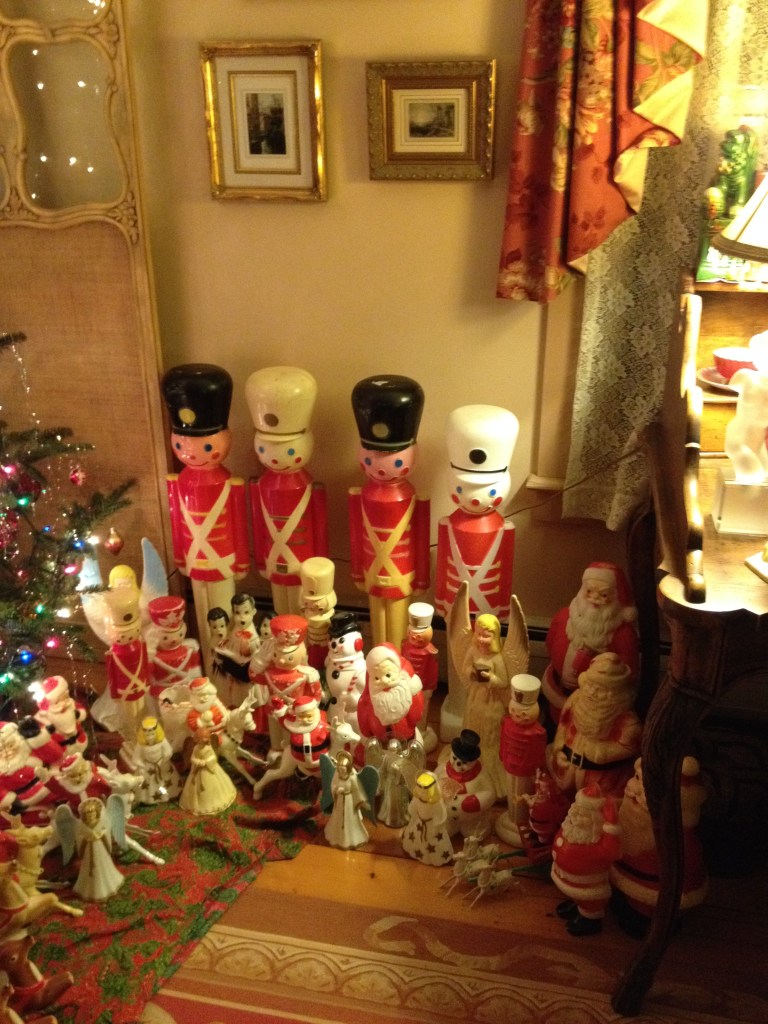
I have a few collections that I admit to.  Some others that I don’t.  I love large wooden or metal folk art toys- homemade trains, trucks, planes.  The kind a grandfather would make for his grandkids.  They are all over my living room.  And I am always on the lookout for more.  Then there is my plastic Santa collection.  Santa’s from the 50’s and 60’s, some from Occupied Japan. I no longer go out in search of them but there is one piece if I should ever find I would grab at any price!    They of course are stored safely away ‘til a week or two after Thanksgiving when they come out for air for about a month only to be packed away again for the remaining months ‘til next year.  But my prize collections are close to my heart. I have been a model railroader since I was a kid.  My dad bought my brother a 1938, prewar, Lionel train when he was a little kid and I got mine many years later, a 1954 Lionel train, no longer made of metal.  It is the only thing my dad, brother and I ever did together.  My dad made a platform for our living room that took up almost half the room. It would take the better part of a week to set up our Christmas layout.  Every December my brother and I would head off to F.W. Woolworth’s to see what new Lionel cars were available and to see what new Plasticville structures came out that year.  Those trains and then, years later, my HO and N gauge trains are all packed safely away and stored in my basement.  They haven’t been set up in over 20 years!  But,  DON’T TOUCH MY TRAINS!  And finally, for my college graduation, my brother bought me an original water color painting by a Long Island painter named Alan Ullmer.  From that day on, anytime I saw an original painting that I liked, I bought it.  I would go to art shows and check out the paintings. If I saw one I was interested in I would squint at it, like I do with the Christmas lights, and If I could imagine myself in the painting, I would buy it! Now that is not to say that I don’t collect new things.  Sometimes something catches my eye and I have to have it.  You know, that useless piece of junk that you can’t live without!  You have a problem with that?

In Defense of ‘Less is More’

“Where’s all your stuff?” a friend once exclaimed when he visited my home for the first time.  I have plenty of “stuff” mind you.  Some is tucked away in boxes in the basement – my children’s school records, birthday cards, artwork, and a stuffed animal or two.  Nearby are outdated cameras, boxes of Kodachrome slides, old pictures in older frames; the list goes on.  And I do have a few decorations on my walls, books that mostly fit on my shelves, and a knick-knack and picture or two here and there.  But I don’t have stuff that fills my counters or floor space or the horizontal space that Wal describes.  This friend, perhaps like Wal, also loves his stuff and he and his wife abundantly fill their home spaces with those things they hold dear. 

I do know that my children are less interested in those things of their youth and likely will have little use for my “stuff” when I’m gone.  Both of them, each in their own family setting, seem to cycle out stuff to make room for the new.  I wonder how that kind of balance may change for them and each of us as we age.

Wally’s piece speaks to me about acquiring and holding on to what we value, what matters.  And things that represent connections to cherished memories are often valued. 

I grew up with little, now have much, and hope to leave my children with little worry to wonder about what to do with all my stuff. 

Wally referenced Marie Kondo who asks us to part with anything that didn’t spark joy when we touched it.  Margareta Magnusson, is the author of a book that speaks to the art of Swedish Death Cleaning.  The idea is for middle- to older-aged people to rid their homes of things they/we don’t need.  This not only is a huge favor for those we leave behind, who must decide what to do with our things, but often allows our lives to run more smoothly with less stuff. It also affords us a trip down memory lane as we go through these belongings, adding value along the way.

I’ll be looking at my stuff from now on, with purpose and more intention.  I’ll begin to let go of many things I no longer need or use.  And along the way, as an item raises a fond memory, I’ll be sure to share that with the appropriate person, if I can.

I wonder if, in one year, I can wander about my own house and exclaim, “Where’s all my stuff?”

Taking Life for Granted

“Awareness requires a rupture with the world we take for granted; then old categories of experience are called into question and revised.”  Shoshana Zuboff

I love the first part of this quote.  It reminds me that I have everything I need: and more.  And I’m not just talking about my home and its contents or my bank account, or the freedoms I enjoy as an American.  I’m also referring to my most basic abilities: to see every time I open my eyes, to hear, every time I pay attention, to walk when and where I choose.  Daily, I take for granted all of these abilities and more because I presently can do them or have access to technology that enables me to exercise these behaviors with little to no effort.  And in the process of doing these things with little cause for reflection or appreciation, I take them for granted.  I’m more likely to allow myself to “suffer” the slightest imposition or hindrance of such actions than to recognize how blessed I am to have these capabilities.

When we experience a significant loss or decrease to one of our physical or mental faculties, we become aware of how inconvenient or difficult life becomes.  For the moment, maybe even the next few measured moments of time, not only are we more mindful of what we had but we find new appreciation for what we still can do or, if we’re fortunate enough to recover what we lost, a re-appreciation for what we can do again.  But in time, it fades back into the habituation of being “taken for granted.”  Some say, that’s just life.  It’s human nature to do so.  There’s not much we can do about it.  But every once in a while, we meet someone who has remained changed by the experience.  Changed in a way that they become regularly aware of such simple and basic abilities and who seems more often to be in a joyful and content state of being.

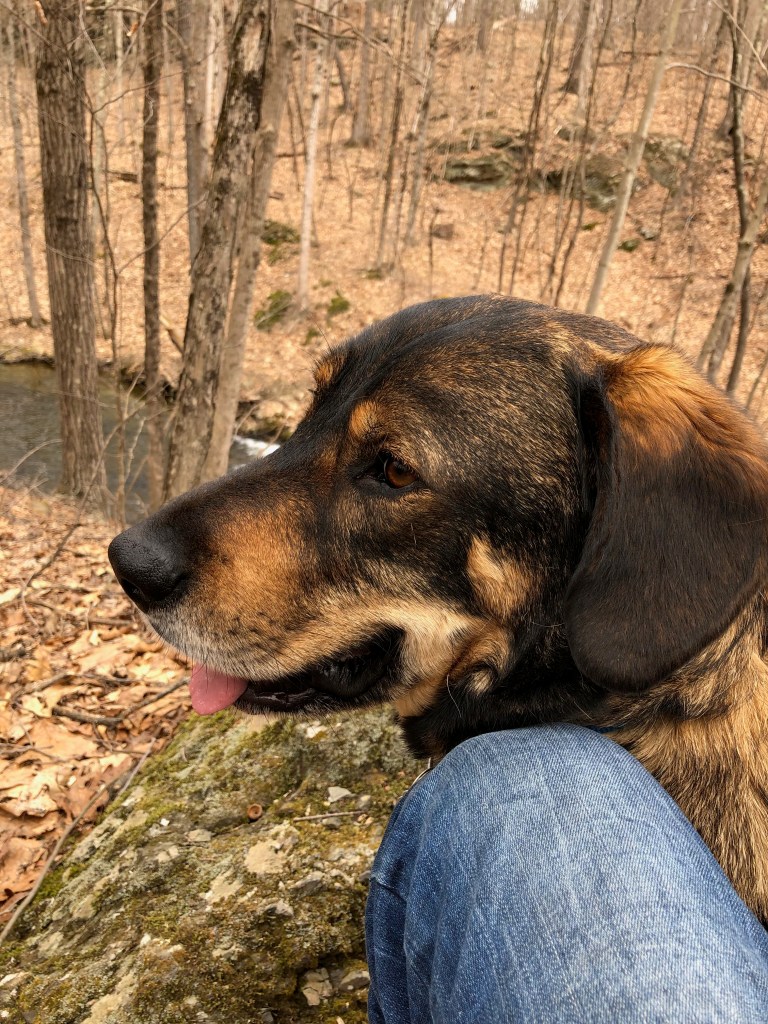
I want to be that someone.  I want to continue to be mindfully appreciative of everything I am still able to do.  I’ve built it into my daily walking meditation to be aware of what I’m doing and to say aloud, “Thank You!” often, and to no one in particular. Thank you for the shadows I can see on my daily walk in the woods, for the sounds of my footsteps snapping a twig, for the feel of the wind on my face and the smell of the damp leaves after a rain.  Today I remembered to tell Duke what a great day it was for us as we mucked though the mud, soaked by the wind-driven rain on a 33 degree morning.  Of course, Duke already knew that; dogs seem to do that naturally.

As Joni Mitchell says in her song:

“Don’t it always seem to go … That you don’t know what you’ve got …Till it’s gone”

Make time to appreciate what you can do and what you do have.

Each time you can’t seem to catch a break, recognize that there are often more times that you do and you just don’t recognize it.  When you do, say it aloud.

A Peek Behind the Curtain

The Zuboff quote makes sense, because there is awareness and AWARENESS. AWARENESS is ‘Aha’! Normal sensory anticipation of the world’s flow operates on one level, but Shosona Zuboff is talking about epiphanies. Such glimpses are typically sudden, surprising, and compelling. David Brooks calls these “annunciation moments” — and they are powerful enough to change your life.

A rupture lets you take a peek at the underlying structure of an experience. It changes your yardstick for measuring the world and your own perception. Henry is talking about increasing the likelihood of celebrating epiphanies by practicing mindfulness – washing the filters that color perception. It’s said that the human brain can process eleven million bits of information per second, but the conscious mind is aware of only forty. The goal of being mindful is not just to increase the number of bits you consciously process, but to apply better quality standards to your focus. I am in total agreement with Henry — the first step is to say ‘thank you’ out loud for each ‘small miracle’ in your life.

I’m rereading a book called Centering, which likens a person’s creative consciousness to the art of pottery. The author talks about centering the clay on the potter’s wheel, pressing down and inward, then drawing upward to lift the walls of the vessel. Most importantly, she focuses on the shape of the inner space within the vessel – but, she also writes about the artist’s use of destruction in the creative process.  Her advice is to occasionally damage a clay-shape that is looking good and reassess how you would re-build. This ‘rupture’ of the material forces the artist to jump the groove of constantly repeating the same design. In the same manner, we sometimes have to rupture – or break with – our typical path in order to see where we have been and where we are headed in a new light.

Assume, Alas to Dream

Interesting- I can’t relate much to the quote but the concept is very real.  Maybe it is the time of year.  I shop for my kids, I stop for the groups collecting change in the road and try to generously contribute to the particular cause.   I feel fortunate that I have the monetary ability to donate above what I need to get by.  Last week my daughter and I were decorating the Christmas tree and ran out to get something to eat.  On the way home she wanted to stop at Starbucks and get a coffee-  well not just a coffee, some kind of latte with multiple creams and other items I have no understanding of.    She knows all the people who work there cause she tips big.  When we got to the window to pay, the girl said we didn’t owe anything cause the car before us paid for her coffee.  Wow- I was kind of overwhelmed and gave her a big tip and paid for the coffee for the guy behind us.  I took it for granted that I would pay for our order and became emotional at the simple gesture of a total stranger. It made me feel good and I wanted to make someone else feel that way. 

I wake up each morning and assume I’ll be able to get around, find something in the fridge to eat, and go on with my day like I planned.  I take the day for granted.  In the past, I took my relationships for granted and did nothing to insure their well-being.  Since I am in a new relationship now I do not take it for granted and daily work at making it better than yesterday and make sure I acknowledge it and listen to the cues I am receiving from him.  That is not quite as easy as taking it for granted but it also pays a premium.  

The dog kisses my face in the morning when he is ready to wake up.  He protects me, keeps me company, watches me in a way humans never do, but I have started trying to do that.  Being attentive to others’ needs, anticipating others’ concerns and trying to address those things instead of assuming everything is a-ok.  We all know that to assume makes an ass out of u and me!
I take for granted that the requirements of life will be there- there will be food to eat and water to drink, air to breathe and curiosity to satisfy…until the day when the body can no longer maintain its mobility and the mind no longer has clarity.  Things I never had to contemplate before!  Aging has the benefit of reflecting — something we never do in youth but something necessary if we don’t want to take things for granted.

I Hear Music… Let Me In!

As the years mount up I find myself becoming more and more like my parents.  They would wax poetic about what it was like to be growing up in the teens and twenties of the last century.  My brother and I would roll our eyes and prepare ourselves for what was to come.  How the kids of “today”(which was 60 or so years ago) have no respect and don’t accept responsibility, yada yada yada.  I now find myself with those words on my lips and must bite my tongue because the torch has been passed to a new generation of nostalgic old men!

Looking at an old album of black and white photos of my family back in the 50’s and 60’s stirs great memories in my mind but it doesn’t stimulate feelings for me other than remembering the people and the event.  Nothing brings those memories to life the way music does.  I don’t need the pictures when a particular song comes on the radio.  The music makes me feel, hear and see the people and brings me back in time to significant places in my life.  And for me the music was always associated with significant memories and special places or events.  One of my earliest family memories was of everyone sitting around the living room on some holiday with my dad playing the ukulele and my uncle, on the guitar and everybody singing, “I’m Looking Over a Four Leaf Clover.”  Dinner would be over and my Aunt Eleanor would be dancing around the living room with the remnants of her last Manhattan sloshing  around in her glass after a few too many, designed to make her unable to wash the dishes.  Everybody was singing and as I write about this I can actually hear the voices, the clapping and laughing and the teasing of Aunt Eleanor about how she always managed to get tipsy as soon as the dishes had to be done.  This went on every year and every holiday for the first 2 decades of my life.

Aunt Eleanor and Jennie

In junior high school, we would spend summers in my mom’s home town, Mahanoy City, PA.  My cousin, Linda and I learned to do the double lindy together watching American Bandstand and The Steel Peer and then practicing the dance at the Teen Canteen every Saturday night.  The song we learned to dance to was Twinkle Twinkle Little Star.  To this day when I hear it on 50’s on 5 on Sirius radio, I can’t help but be back in Mahanoy City in my uncle’s living room practicing the steps.

In my senior year in high school, my friends Anne and Norman and I would get in Norman’s little Nash Metropolitan every Friday night.  We’d drive on the Van Wyck Expressway to LaGuardia Airport.  You used to be able to go on the observation deck, meet your friends and watch the planes take off and land.  We whizzed along the highway with the top down and the radio blasting, listening to Cousin Brucie.  It seemed he played “If I Fell” every Friday night. To this day when I hear it, I stop whatever I am doing, sing along and remember Anne’s clear voice, Norman’s tuneless voice and mine, trying to harmonize as we shared this carefree moment.  I felt free and I feel that way whenever I hear it. Anne and I were dance partners too, and loved to dance together at the high school sock hops.  We couldn’t wear our shoes on the gym floor so to dance we had to take our shoes off.  I was popular with the girls in high school, ‘cause I could dance so I always had a dance partner, but Anne and I were special partners.  I am still in touch with Anne though she lives half way across the country.  We still want to meet once more before…….to share a few lindies together again.  I am sure we could pick up right where our feet left off.  She and I even invented a new dance we called the penguin to “Be My Baby.”  When I hear either of those songs it brings me close to tears and a feeling of warmth and longing for youth fills my mind.  I loved her parents so it even allows me a moment to remember them fondly, even though her dad always called me Stupid Bastard.  I haven’t thought about that in years!  And I was never sure why he called me that but it was said with affection so it was important to me.

Though musically inept myself, it was so important throughout my life.  I could run up to my room, put my hi-fi on and get lost just thinking.  I carried my transistor radio around everywhere to the chagrin of my parents, my generation’s version of the i-phone.  I guess it isn’t surprising music is so important in our lives- it is everywhere- elevators, the doctor’s office, the barbers, in fact I can hardly think of a place where there isn’t music.  Music was always playing in my inn, all day, every day, even when no one was there. One of my fondest memories from the inn was one weekend an elderly, excuse me, mature, couple from Great Britain came and registered.  They were all excited about being in Vermont.  Unfortunately the weather was not cooperating and for the three days they stayed with us, it rained.  The last night they returned from dinner and were sitting out in their car for a long time.  I always checked the parking lot so I could greet our guests to see how their dinners went.  I was in the dining room when they came in the door and she came over to me and explained to me that 50 years ago that night her husband asked her to marry him.  They were at a night club in London and her husband asked the band leader to play her favorite song, “Moonlight in Vermont.”  They came to Vermont 50 years later to celebrate and to see the Vermont moon in person, but the weather did not cooperate UNTIL they pulled into our parking lot after dinner. As they sat in their car, the clouds separated. The moon came shining through. So they did get to see moonlight in Vermont after all.  She returned to her husband in the living room and I knew I had several versions of the song in my collection.  I picked the one by Billy Butterfield and his Orchestra sung by Margaret Whiting.  No sooner did 2 notes play than she came running into the dining room in tears saying that was the exact version that was played that night.  I told her that dancing was permitted in the living room, started the song again and disappeared.  The next morning at breakfast she and her husband told us that this was the most special holiday they had ever had.  What a special feeling that gave me to think I had been able to provide them with such a memory, but it was more about the music! I get teary eyed a lot more than I ever used to.  Nostalgia is something hard to avoid. Each generation has its own memories and its own music.  The two are tightly intertwined, but the tears they provoke in me aren’t of sadness, but are tears of relived memories, renewed friendships, and recycled emotions.  I can’t imagine living without them or without my music!

Getting in Tune

George, that’s a beautiful story about finding the Moonlight in Vermont tune! Your words underline the shared enjoyment of music and how it acts as a transit to past experience.

I wonder whether musical preferences change for a person as they age — or perhaps become more eclectic? Sure, I tend to gravitate to music of my youth. And I like some soft jazz, bosa nova, and reggae – background music. However, lately, I find a pull to more classically composed scores, be it methodical Mozart or romantic Rimsky-Korsakov.

My father played such music all through our childhood – he favored the romantics. I still love some of those pieces and think of him whenever they are performed (ah, Clare de Lune!). And of course, a tip of the hat to Walt Disney Studios for bringing classical music to animation. There’s more, though: the deeper, longer rhythms and lied motifs of these works call out to me – differently than a popular song that gathers you in with a catchy refrain and jaunty jingle (though I enjoy those as well).

I don’t pretend to know much about music, despite the best efforts of our college’s listening lab. However, in tennis jargon, if someone hits a ball that strikes your racquet with greater force than you would expect, it’s called a ‘heavy’ ball. Symphonic music seems like that to me – it has momentum, it builds; it carries the force of a full orchestra. Its weight is required to ping a chord buried deep within that may not be associated with memory, but simply a fundamental aspect of our nature

Now, some music has become decidedly less evocative – plaintive lamentations (“I’ve got tears in my ears as I lay on my back in my bed as I cry over you’) or pieces simply devoted to anger or calls to action. I don’t tend to seek that reinforcement of social consciousness these days. On the other hand, I am amazed to hear myself whistling hymns from time-to-time. What’s happening here? I’m curious how you would score your life in musical terms? My oldest grandson is resuscitating Pink Floyd, so maybe the Dark Side of the Moon would be his theme. I’d probably go for a tablespoon of Take Five with a dollop of Scheherazade. You?

Marching to a Different Beat

As I think about the role of music in George’s heartfelt story and I ponder the influence of music in my life, a curious notion is evolving that suggests I have a fragmented and disjointed relationship with music.  Like George and Wally, it seems to me that most people regularly seek out music to bring them into a particular mood or frame of mind.  I, however, despite coming from a family of talented musicians, don’t relate in the same way; at least not in any predictable or consistent manner.

My mother was an extraordinary, pianist; her brother was a natural on the violin and her father played the bass in the orchestra of the Waldorf Astoria for a living.  And, while I dabbled with piano, violin, and viola in my early school years, I found it to be a foreign language I just couldn’t decode.

When music became an important part of the high school social scene, I again found myself struggling to understand it, figuratively and literally.  And while I like certain popular tunes, and was caught up in the feeling of freedom and lightness during a college concert or from swelling voices extending a song on the jukebox at a local bar, it was short-lived and fleeting.

Even today, I can go days without playing any music in the house.  When I do activate my Sonos speakers, I enjoy the oldies, classical pieces, and meditative arrangements.  I feel them.  They move me.  But I don’t look for them.  I don’t miss them when it’s quiet.  They are, for me, just one of many nice options to lighten my day.

And, while I also don’t consciously seek it out, I enjoy immensely the music of nature.  As I walk through acres of wooded trails with my rescue mutt Duke every day, I am calmed and moved by her sounds, the wind through leaves or as it whistles around barren trunks, bird songs, the hollow reverberation of the woodpeckers as they seek their food beyond the layers of tree bark, the many sounds of the stream as it flows, trickles, or rushes at different levels after a rain.   As I write this piece on my porch with Duke by my side, the rain is falling steadily and plays a tune as it echoes off the metal roof of my nearby woodshed.  I love the changes in volume as the rain falls more heavily for a while and then subsides.  It calms and soothes me.  It’s my kind of music.  I’m not sure why I don’t think to seek it out but I do enjoy it when I find myself in its presence.

A Moment’s Sunlight

We are but a moment’s sunlight fading in the grass – Youngbloods

You know it – I know it: the mortal coil has a limited warranty. The tides lap at our sand castles, until finally, they are indistinguishable from the rest of the beach.

When I was six, my brother and I shared a bunkbed in a space that used to be a foyer. Times were tight and the room was our bedroom while the upstairs of our house was repurposed into a rental apartment.

One door off the room connected to the kitchen which once contained a deadbolt lock. Because the lock had been removed, a beam of light broadcast into our bedroom from the hole where the lock had been. After my brother and I were tucked into our beds, we would hear our parents talking at the end of the day, while they sat at the kitchen table — and look at that knothole with its pure circle of light.

One night, I got to thinking that my Mom and Dad might die someday. It was a disturbing thought that got more intense as I listened to their happy voices. Finally, I leapt out of bed and went into the kitchen, eyes full of tears and asked if they truly were going to die.

Of course, they hugged me and reassured me that this was an event in the far future. It probably was also a real buzz-kill for whatever happy conversation they had been having, but they were young and no doubt did not dwell long on the premise.

Years later, my father sat me down at his hospital bedside and told me that it had been a privilege to raise my brother and me, but that he needed to say goodbye. I could barely concentrate on his words through my sobs. In retrospect, I recognized that in both cases, the immediacy of MY feelings had taken front and center. While understandable for a child, something more was required as an adult – that is, the poise needed to listen and properly thank my Dad for his life.

So I pass this on: Honor the efforts of the dying to consolidate their life. My father essentially offered me his death-poem.  It is important to have this moment belong to the teller of the tale. My role was to listen, provide reinforcement and comfort. Perhaps even retell some tales. My Dad desired to die in dignity – don’t we all?

An old psychological truism used to be that all learning experiences are painful. If that is true, then Death is a great teacher. Although it sounds oxymoronic, Death allows you to take the long view. That is, you can evaluate your life up to present against the expectation of a finite end. Death shows you what is important — Death keeps you honest.

In The Teachings of Don Juan, A Yaqui Way of Knowledge, Carlos Castenada’s Yaqui shaman, Juan Matus, suggested that he keep Death on his right shoulder – a constant arbiter of decisions and attitude. I believe that is a useful remedy for the world weariness that can sometimes plague old age. When confronted with the inevitable end of days, even the most routine acts can seem exquisite.

Let’s face it, the process of dissembling and decay is elemental and ever present.  Even the sounds our words make begin to degrade as they leave our mouths. Entropy happens. Our task is to strive to re-create in the face of continual destruction: evoke memories, build new stories — make myths together. And honor the living who are proceeding toward their farewell.

In a discussion, Henry brought up a term that resonates: a living eulogy. Why wait until a person has passed in order to let them know how they have been instrumental in this world? Express how they have helped others to navigate through difficult paths. In addition, make your own eulogy: what made your life worth living – and what is your unfinished business? Cherish our imperfect performance called life.

——

It was difficult reading Wally’s piece, even painful in places.  I guess because of the topic of death and of our own mortality. Throughout my life, death has always been present- beloved dogs and cats, elderly relatives who in many cases scared the living Bejesus out of me(pardon the pun), but death still seemed far off and impersonal for a long time growing up.  I had a goldfish for 12 years in a little bowl that hung on with minimal care or attention but when I found it one morning  floating on its side I was devastated. At that point I was old enough to understand, and then began wondering if it was something I had done or didn’t do.  My parents tried to ease my conscience and told me that 12 years was way longer than the average goldfish’s life span.  And for a while I can remember asking them what was the average life span of my dog, or my parakeet, or the mosquito in my room at night.  I think at one point I was so angry at a teacher I asked them what the average life span of a teacher was.  That was the last time I asked them about lifespans for some reason.
And as you mature, you deal with the deaths of aunts and uncles and  other significant people in your life and begin to accept the idea that it happens to all of us.  But we naturally assume that is far in the distance. All kinds of life things happen, school, career, families, all things that for some reason allow the years to pile up without realizing it til all of a sudden your own kids are asking you about lifespans and accumulating their own experiences.  For me, that time was a real danger zone because  significant people in my life then were in the declining years and I watched as my parents couldn’t do what they used to be able to. 
I never had the fortune to say good bye to my parents like Wally did. My dad died suddenly while on the toilet one morning. My mom, all hooked up to ventilators and tubes in Winthrop Hospital, passed after my brother and I left for the night.  The hardest death was that of my brother because we had become very close after our parents died and after I had come out to him.  He and I would talk regularly, laughing at things my dad did or bitching about things my dad did.  After his death, the loneliness was incredible.  A void that no one other than a sibling could fill.  My kids were great but it just didn’t feel the same and there was and still is an emptiness that only he could fill.
Now I am the oldest living member of my family.  The only living member of my generation or above. Death doesn’t scare me so much anymore cause I have seen how death can be a relief of pain or loneliness.  I had 3 elderly aunts who lived into their late 90’s and they were ready to pass when their time came.  I saw such strength in them, and faith that truly comforted them until they passed.  They were ready, and I want to be at that point when I am called also.  Their eulogy, all of my family members’ eulogies would include love and tried the best they could to be good people.  That is what I want to be remembered for as well and I hope I will be remembered for doing good things for people, making people laugh and hope that when my name comes up in conversation it will put smiles on their faces and tears in their eyes, cause I was pretty special after all, but tears of joy and pleasant memories.

——

Understanding the Last Sunset

Wally’s story resurrects many memories and stimulates many thoughts as I find myself in the winter season of my life. 

My dad was an absent father.  When I turned 40, I tracked him down, asked him questions, and got some ambiguous answers. But I did receive closure to the question I asked of myself – Was I my father?  Six months later he died without any of us at his side.  I said what I needed in that solo encounter.  I expressed my disappointment in him and my desire to remain detached but I said it without anger and with quiet resolve.  I don’t know how he felt or what he may have thought about in the hospital in his final hours after failed heart surgery.  Perhaps his other family provided the final dignity and farewell that he would have wanted.  Since we never met and have no contact, I’ll never know.

I do know that Wally’s call, to honor the efforts of the dying reminds me to ask more of what others need and offer less of what I think they need.   A noble model for all relationships at all stages of life!

Wally mentioned my idea for a living eulogy. What if we made time to celebrate people’s lives while they can still hear it?  In a sense, create a service for them not about them.  I suspect many of us underestimate our worth and value to those who know us.  Might hearing those words now, influence the rest of our lives for the better?  I’d like to think so.

What Matters…

IMG_2451-002

What Matters

“As long as you have your health…” These words were often uttered by my grandmother and later as an aphorism from my mother every time I faced disappointment.
As a child who was healthy, these words offered little solace to whatever ailed me. Health? Everyone around me seemed healthy, most of the time. Why would that matter when issues of fear, loneliness, heartbreak, or ridicule loomed bigger than life?
Now, at 72, with all those years of experiences, readings, and self-reflections under my belt, health, in the scheme of things, really is important. Health is up there on the list of what many people of my vintage would argue, really matters. But is that what matters most?
Another consideration I gleaned has to do with relationships. As I read and reread endless profiles of women registered with online dating sites, a large majority firmly declare that strong relationships with family and friends are something of which they are most proud and something they seek in a potential mate. How can I disagree with the notion that positive relationships are what really matters. I’ve often remarked that even sunsets seem more beautiful when viewed with someone you love. And the last entry in Chris McCandless’ journal (Into the Wild) read: “Happiness is only real when shared.”
There are other really important things that I could list here that would answer this query about what is important. After all, isn’t life replete with complex shades of gray, varying in hue based on individual perceptions? Yet, pushed to hone it all down to one core belief, I would say that having a healthy and reflective relationship with myself is what really matters. If I truly know myself and am truthful with myself, when all else falls away, I remain grounded. That is to say, if I’m content with my own companionship I have a solid foundation from which to face all desirable and undesirable experiences. I can recover from the blinding joys or crippling tribulations that come my way and remain focused on living purposefully. My dependence is on myself.


We often add up what we’ve accomplished and accrued and use the total as evidence of having a life well lived. Perhaps those of us who do so should make a conscious effort to be certain that’s what really matters and to consider the words of Einstein who wrote, “Not everything that counts can be counted, and not everything that can be counted counts.”
Having written all of this after much thought and deliberate reflection I am clearer about what matters less and what matters more. Naturally, I don’t know what future challenges loom. But I do know that for the rest of my life I want to concentrate on living in alignment with how I want to be remembered and how I conduct myself on a daily basis.

Have you given thought to what really matters to you?
And, are you mindful to act accordingly?

3 old guys George

Recipe for What Matters

I agree with everything Henry wrote…health, relationships, knowing yourself and being comfortable in that knowledge of course. But that seems like a baseline for what matters. There is a lot more…. and those things are like ingredients in a favorite recipe. They are what made me…. ME! A cup of memories that I shared with my brother growing up matters. Memories of my kids when they were little…all kinds of memories! They can’t be left out or substituted because then the final dish won’t taste like it’s supposed to.

Add a tablespoon of the touch of others. Caresses, massages, tickles, and pats matter. Also shaking hands with people you meet or hugs with friends matter. You can always tell when that ingredient is missing. Beauty matters! Mix in a cup of beauty- audio and visual, natural or manmade- a sunset, an autumn leaf, a beautiful painting, the sound of a babbling brook or a thunderstorm——a favorite tune that transports you back to your youth to a special person and a specific place, not to mention a teaspoon of the aroma of my dad’s tomato sauce or a crackling fire in the winter. And don’t forget to sprinkle in those deep belly laughs shared with people, the kind where you can’t catch your breath and fill your eyes with tears of happiness. Cook all these ingredients for a lifetime and it adds up to someone special—YOU! And that matters!

IMG_2451-001

Too Big for My Brain

Well written, George! You make a good case to add a celebration of the senses to ‘What Matters’: straight-up epicurean. But isn’t ‘what matters’ simply what you decide should matter – a personal choice.
Some might say that what matters is what you lack/what you need. In certain circumstances, what matters most is living one more day, hanging on to your identity, or being self-sufficient. Remember Abraham Maslow’s need hierarchy: from safety concerns to self-actualization? Different areas of focus follow need fulfillment. Does ‘what matters’ change over time – or is it eternal? Maybe what matters is not even our choice after all. Isn’t this question the very essence of philosophy? This subject is too big for my brain – and this page!
However, at its heart, I’d argue that what really matters is the purpose you bring to life and the elegance with which that purpose is applied. I guess I’m adding a moral compass to Henry’s conclusion (‘know thyself and be comfortable’). After all, intention guides action. When your actions are consistent with your purpose, you have achieved that “impeccability of word” that we have discussed – or what Jordan Peterson describes as minding your patch. Okay, that’s good enough for me!

Takeaway:
Be aware of your intentions. If you cannot express a purpose for your being in the world, embark on a journey to find one. Refine that statement of purpose as you learn more.