What Matters

It’s Time

We have been trying hard to turn the page of the calendar to a new year, but the bad karma of 2020 wants to linger. The unimaginable events of Dec 37 makes you wish we could skip ahead in time – or go back and change decisions. Usually, when I think about time, it’s from the vantage point of examining time as a commodity, as in, ‘wish there was more time for this or that’. Time usually seems in such short supply. Don’t you wish it could be mined and saved in a repository like a bitcoin?

What really is the nature of time? Can we suspend time, reverse it, or experience an alternate timeline? I don’t have the chops to figure this out — we need a quick trip to wiki! George is going to hate this, but I‘m going to need citations.

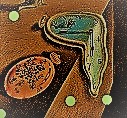
Reworked detail from the Persistence of Memory by Salvador Dali

There are a number of definitions that can be found on the web. Some take the easy way out: time is what is measured by a clock, and so forth. Others approach time as a fundamental quantity, experienced as a sequence of events. Hen sent George and me an article which defined life as change. Is change also the essence of time as well: Time = Change? Simon and Garfunkel sang about the “leaves that are green turn to brown” – is that a function of a life cycle – or simply time? Does life depend on the action of time? Some philosophers, including Anne Conway believe that. In the 17th century, she put forward a view that life cannot exist without time… and that time is change.

Stephen Hawking* wrote a book, A Brief History of Time. He concluded that the arrow of time only moves in one direction: forward. In fact, he identified three arrows of time:

  1. Psychological arrow: the inexorable flow of existence – a sequence of events
  2. Thermodynamic arrow: the sense that in a closed thermodynamic system, time is represented by things losing coherence or degrading; the entropy of green leaves turning to brown
  3. Cosmological arrow: time was only introduced at the big bang and is measured by the continued expansion of the universe. If that’s true, then time may not be infinite.

If time is not infinite, what happens when time ends? Could it be that there is an eternal ‘Now’? If life is change, can life exist in an eternal Now? A great deal of meditative discipline is devoted to the goal of being ‘present’ and attuned to the NOW. Where does Now exist? The 6th President of the US, John Quincy Adams, wrote in The Hour Glass:

“…Time was – Time shall be – drain the glass –

But where in Time is now?”

Heidegger used the term “Dasein”, meaning that while we are all in the present, we are simultaneously anticipating and planning for the future. And if you consider that technically, our nervous system has a built-in delay in reacting to stimuli, our ‘present’ is already an artifact of history. The Now balances on a knife-edge.

Not only is time a finite quality, according to physicists, time is also relative. Einstein described it as follows:

“When a man sits with a pretty girl for an hour, it seems like a minute. But let him sit on a hot stove for a minute, and it’s longer than any hour. That’s relativity.”

Dr. E continued that time is affected by gravity, which can bend space-time and slow it down. That is why time proceeds faster at the top of the Eiffel tower, than at its base. Experiments are in process to physically slow time, as well as to measure its speed across quantum particles. These experiments are closely connected to properties of light. One such experiment recently measured the speed of light in zeptoseconds — one millionth of a second. This approach may change our lexicon:  “In a New York Zepto”, or ‘just a zepto, Honey, I’ll be right there’. This could put “one Mississippi” in a bad spot.

However, I’m more interested in the experience of time – Hawking’s psychological arrow. Mainly, I view it as island hopping – from memory to memory. There are no objective time distances among these memories: some old memories seem vivid and close by, while other more recent memories have faded. Research suggests reasons: heightened emotional states can alter a person’s perception of time passages. George wrote about this in an earlier post, As Time Goes By; that for him time is measured in events – not necessarily in a linear progression. He’s in the same line of thought as Heidegger, who felt that time can only be understood as events in the past and only from the perspective of a fixed lifespan. I’d agree that time is only experienced in the rear view mirror of memory. Because so many moments are simply repetitions of daily tasks, they are completed with little ‘present’ attention. So when we talk about ‘being present’, what does this mean to you?

*Funny anecdote about Hawking. He decided to prove time travel was impossible by hosting a time travel party, but sending invitations after the event. Since no one showed up, he jokingly “proved” that the arrow of time cannot be reversed.

Time, Time, Time is on my Side

I’m trying to think of a way to define time without using the word “time.”  I’m not smart enough.  It is a measurement of the passage of WHAT? I can tell what it is measured in-  seconds, minutes, hours, days, weeks, months, seasons, years, decades, centuries, eras, ions…..but that doesn’t help with the definition.


My perception of time is more based on experiences in my life. Time doesn’t appear to be a standard measurement.  An hour today is much shorter than it was in my youth.  A day used to be an eternity when I was in grade school but now it goes by so quickly that sometimes I feel I get up in the morning and the next thing I know I’m climbing back into bed.  I find it is variable from day to day.  Some days I can’t find enough time, or there’s all the time in the world and I can take time or I have time to give. Sometimes I’m ahead of time or it’s about time.  Time is very flexible and isn’t consistently the same unit.


Time can be evaluative.  I had a good time last night or I had a great time or even I had the time of my life!  OR, I wasted my time, I had a bad time , or I had the worst time ever!  When I evaluate my time I divide it into sections: childhood, college,  marriage, post marriage, retirement, future. I can evaluate each section. College and retirement are in the time of my life category.  Where other sections were good to great, and fluctuated therein. Fortunately, my bad times faded as good times replaced them. 


That’s another aspect of time-you can do things with it.  You can waste time, spend time, share time, you can even take time and even do things in timely fashion.  Time has a mind of its own.  It can lapse, drag, fly or be sensitive or even stand still, and sometimes it is even on my side, yes it is!  And time is even different from one species to another.  At the end of a year I am a year older but my dog is seven years older, whew!


I guess the point is we can’t live without time.  Try to count the number of times in a day you say the word TIME.  Sometimes you are referring to the scientific definition of time but more often used in different contexts: on time, in time, overtime, time and a half, once upon a time, time capsules, times up, yada, yada. OMG, I’ve had too much time on my hands!  It’s bedtime anyway…

On Time…

Wal has given me so much to think about in his presentation of time.  It seems, as we grow older that its passage gives us pause to reflect upon it more and more.

For me, it is no longer the commodity it once was.  Working full time took, well, lots of time.  As Wal mentions in his piece, there never seemed to be enough time.  Never enough time to get all the work done; to be an attentive parent/partner, or to adequately care for my emotional and physical health.  As I got older I slowly moved from wanting to “find” more time, to realizing I needed to “make” more time for the things that mattered most.  But still, there never was enough time.  But now, mostly retired, single, and easily enjoying my completely independent children, I have all the time I need.  Upon my retirement, I remember being asked by a colleague, what I’m doing differently with more time on my hands.  “I can now change a light-bulb as soon as it goes out!” I replied.  The hurried world I created in which every waking moment was accounted for, was no longer.

I like Wal’s comment regarding living in the now;  “Our present is already an artifact of history.”  I agree.  Now is only here for that Zeptosecond before it’s behind us.  However, can we not flow with the now?  Isn’t our quest for mindfulness and awareness staying with where we are for as long and often as we can?  The present always becomes the past but, not falling prey to thinking of what just past, can keep us one step ahead, in the present.

I had another thought about the notion Wal brings up from Heidegger’s explanation that time can only be understood as events in the past.  Does this preclude the impact anticipated time (imagined time in the future) can have on us in the present?  According to a 2010 study published in the journal Applied Research in Quality of Life, just planning or anticipating your trip can make you happier than actually taking it.  Perhaps the perception of time that hasn’t yet occurred but has had a measurable impact on one’s present life, can expand its understanding beyond past events.

As to the speed of time passing more rapidly for us when we’re older, some research suggests that over time the rate at which we process visual information slows down.  Thus, we end up interpreting less information than we did when we were kids.  As a result it feels like we get to the end of the day faster than we used to.  The March 2019 blog from Harvard University entitled:  No, Its Not Just You:  Why time “speeds up” as we get older, explains this in more detail.  I also remember reading that the more we remain habituated to our daily routines the more quickly we get to the end of our day.  But, if we seek to insert new and creative challenges into our lives, the more the brain has to consciously process and our days seem longer, time seems to slow down.

On a related note, I want to recommend a wonderful four-minute movie created by artist and musician, Prince Ea.  He puts time in perspective by overlapping the 4.5 billion years the Earth has been in existence with the approximately 140,000 years of mankind.  If we were to consolidate that into a 24-hour period, we will have been around for 3 seconds!  The video is entitled, “3 Seconds.”

Finally, I would be remiss if I didn’t include my relationship with being on time.  I never was.  I would usually leave for an appointment at the latest possible moment and then hope against hope that nothing would hinder or slow me down.  Life almost always does!  I was late for meetings and late picking up my children, and when I did arrive, I was usually stressed. One day, someone who also kept a calendar with a very busy schedule told me to write down the time to leave, so that I would arrive fifteen minutes early.  Problem solved!  I’m almost always where I need to be with time to spare and in a much more relaxed frame of mind.   

Questions for Reflection

One year ends, another begins.  

According to Wikipedia a New Year’s resolution:  “is a tradition, most common in the Western Hemisphere, but also found in the Eastern Hemisphere, in which a person resolves to continue good practices, change an undesired trait or behavior, to accomplish a personal goal, or otherwise improve their life.”

While the intentions are sincere, more often than not, people find they are unable to sustain the quest to change and the resolution is dropped, reduced, or entirely forgotten.  As a result, it appears that people of my vintage no longer make promises to themselves. One T-shirt I recently saw captured this notion:  2021 – Eat, Sleep, Fail my New Year’s Resolution, Repeat! Another stated their goal simply and clearly:  First Rule of 2021 – Don’t Talk about 2020!  (Yeah, Good Luck!)

However, I like the idea of looking back over the year to consider what worked and what didn’t and then making a plan for moving forward.  Perhaps asking myself some questions might give me the foundation from which to be more successful in my commitment to change.

Question:  What do I want to get rid of?

I’m tired of feeling defeated, deflated, angry, and surprised when I expect life to be fair!  I’m tossing that out and replacing it with fairness as a preference but not an expectation.  If I can remember to chuckle or say, “Isn’t that interesting!” when something turns out unfairly, I might have a chance!

I’m concerned that my children will be forced to sort through all of my “stuff” when I’m gone.  I’m going through file drawers and basement shelves each week and am throwing out, recycling, and donating.  A secondary benefit of less clutter and more room is also appealing.

Question:  What do I want to do more of, less of, and keep the same?

I want to spend more time laughing.  I need to spend more time with people who are uplifting, sincere, energizing, and enjoy a sense of humor!  Applications are now being taken!  Grumps need not apply.

I want to feel more of the creative energy and sense of purpose I used to get from my work.  Recently, I had a conversation with my granddaughter about creating a video collection of daily, interesting experiences.  She is interested in working remotely with me on the artistic and editing end of it.  What a wonderful opportunity to kick off the New Year in a joint venture with Kylie!  Delicious!

I want to spend less time agreeing to situations that drain my energy.  Warning!  If I say no to you for something you may request, I’m really saying YES to me.  

I want to maintain the time I now spend communicating with my children.  (Due to COVID, we talk and FaceTime more than ever before!)  Amen!

Do you have an “end of year” question to suggest?

Nevermind!

Before addressing Henry’s questions let me preface this by saying that I always approached New Year’s Resolutions in the same way I gave up stuff for Lent.  As a kid I thought I was so clever giving up homework, peanut butter (which always made me gag), Brussel Sprouts, and the like as sacrifices for Lent.   If you are going to give something up, give up something you were supposed to do but hated doing!  Makes sense, right?  My resolutions were similar.  Mostly they were things I promised I wouldn’t do anymore in the new year.  And I would pick things I hated to do.  In the new year I am not going to make my bed cause I can use the time much more pleasantly, or I’m not going to clean the garage cause I have too much stuff to store in the house and it has go somewhere.  In general, I never thought of these things as ways to improve myself but rather ways to get out of doing stuff I hated.  That served me well as a young adult but alas I, too, had to grow up and with growing up comes the nagging nuisance thought of improving yourself, being responsible and mature. Acting like an adult can be very draining.  One last thought before answering these adult, mature, personal improvement questions is that Henry may not want me for a friend anymore because on my application form it will admit grumpiness is part of my make up!  Ggrrrrrr!

There’s a lot of stuff I want to rid my life of.  Definitely clutter.  For years I’ve collected things. Things that mean something to me but not to those near me.  What will happen to that all?  And that is stressful to think it will all wind up in the dump.  Stress!  The question is for a person who is a habitual stresser, what things could I do to reduce it.  I would prefer if it would just go away rather than my having to do something to cause it’s exit.  Drama, I have two kids so it is hard to eliminate drama which just leads to more stress!  Covid, I’m doing my part but not sure it is working to eliminate the disease which causes me more stress yet again.

There are things I’d like to do more of in 2021.  For years I was an avid model railroader.  It was the only thing my dad, brother and I ever did together.  I have collected mounds of paraphernalia- trains, structures, everything all neatly stored in my basement but the hobby has progressed technologically well beyond my capabilities.   I would love to set up a layout again and play with my trains.  I’d like to write more and make my voice heard.  I’d like to be the perfect dad ( wait, that takes real effort).  And I’d like to get some things accomplished at my house which requires organization, money, and planning, 3 more things I’m not very good at which just causes me more STRESS!

I am truly grateful for the relationship I have with my kids, I have friends who sustain me and actually tolerate my quirks and sense of humor, and I have a constant canine and 2 feline companions that have been with me throughout this entire Covid journey.  I am truly thankful for these things.  

So what do I resolve to do to improve ME in this coming year?  Wait a minute…..last  year I resolved not to make anymore New Year’s Resolutions this year!   Nevermind……

Best Foot Forward

I admire Hen – if he says it, he will do it. His goals for 2021 are bound to be achieved! On a less reliable note, here goes a shot at his very good questions:

Question:  What do I want to get rid of?

First, I share Hen’s desire to prefer life to be fair, but on the other hand I believe that we should continue to press for fairness as an expectation. If we all can imagine it and believe it, I suspect we can tip the scales to get closer to that end result. Sure, we will be disappointed now and again. However, keep in mind that fairness does not mean that there is always a happy ending – or even an ending, for that matter. I think of it as a never-ending thread in the warp and weft.

So what do I want to get rid of? Well, off to Hen’s second point: clutter. Now, if you have ever visited Hen, you realize that clutter is a relative concept. He is so neat and organized that I have a hard time picturing what he is sorting through. You want clutter – I’ll show you clutter!

Among other things, I hoard wood. Slabs, crotches, burls, spindles, blocks or all kinds. All air-drying for potential projects. Beautiful specimens of huge black cherry butt logs, walnut, flame box elder, osage orange, buckeye, kingwood, coyote wood — A to Zed: afzelia to ziracote. I am a wood ho’(arder). My aim is to clear out the excess wood under tarp and under roof and send it to Hen, so he really has something to sort through! Truly, I will reduce the dragon’s treasure of wood in 2021.

Question:  What do I want to do more of, less of, and keep the same?

More: 

  • Stay in touch: If 2020 has taught me anything, it’s not to take anything for granted. I’m not alone in losing – or almost losing – friends and dear ones. Strangely, only one loss was to COVID, but this season makes every loss more tangible. So, my desire is to stay in contact with those I care about and be more present and engaged. Left to my own devices, I would normally just stay busy and let the world pass by.
  • Continuing that thought: I tend to believe that while we all are the main characters in our own screenplay, sometimes we forget that at best, we are simply character actors in other people’s movies. In 2021, I’d like to do a better job of performing a supporting role in some wonderful stories.  
  • Creating: Linda and I find we are happiest when we are making things. I think for both of us, it’s a calling vs. a preference. Collaborating with my wife is a win-win! A must-do for 2021.
  • Last, I will work hard to attain an “attitude of gratitude” each day. Starting each morning, I will focus on three things for which to be grateful – and not the same three each morning. I won’t get out of bed until these are visualized.

Less:  (correspondingly, less elaboration)

  • Less time imagining every worst outcome. Boy, does that sap energy. 
  • As above, less time overly planning and constructing narrow definitions of success. Less time building mental labyrinths.
  • Less sedentary activity. Humans are meant to move.

Same:

  • See the humor in this existence. I can be intense at times, but the saving grace is always humor. Who could invent some of the situations in which we find ourselves enmeshed? Regarding many of today’s items of obsessive focus, I continue to ask myself, “Who will remember this in 50 years?” If the answer is ‘no one’, well then, ease up.
  • Stay in balance: life IS change – no two ways about it. We experience new terrain every day. When we walk on uneven ground, we shift our weight, juke left or right – but maintain our balance. There’s no telling what new contingencies will be introduced in 2021, but maintaining balance is the key.

Merry Griping

When Christmas and Covid intersect it brings out some strange feelings and reactions. Reflection usually is nostalgic for me.  Pleasant memories waft through my mind.   Smells carry me back to the warmth of grandparents and holidays and the intersection of both those things!  Favorite past times rush back and desire wells up inside me wondering why I stopped doing them. 

But the intersection of Christmas Blvd. and Covid Ave. bring up less reassuring feelings and I want to get things off my chest. Odd even for me at Christmas. Things are annoying me.  They crop up every year around this time and for probably 50 or so years I have stuffed them away but now I want to say them, get them off my chest.  Let me dive into my point….”Keep Christ in Christmas.”  We have all heard this or read it assuming that the X is a way of eliminating Christ from the most revered of Christian holidays and cheapening it.   Somewhere along the way I heard the derivation of Xmas and asked my friend Siri to tell me again.  She confirmed my belief that it does not remove Christ from his own birth!  It seems it was first used in the year 1021 by a scribe.  Back then, parchment was scarce and expensive and because the name Christ was written frequently he came up with a way to abbreviate it.  Greek was the language of the New Testament and X was the Greek letter “chi” which was the first letter in the Greek word for Christ.   The scribe used  X to stand for Christ.  So for a thousand plus years the X has been misunderstood and therefore Christ is in Xmas and in our hearts if we believe.

What about this so called war on Christmas?  Are you afraid to say, “Merry Christmas” or is it politically incorrect?  Hardly!  If I know someone celebrates Christmas I always say, “Merry Christmas.”  If I know they are Jewish I wish them a Happy Hanukkah.  If I don’t know their religious history I will say,  “Happy Holidays,” out of respect.  I remember years ago my parents would send out Christmas cards but to their non-Christian friends the term back then was, “Seasons Greetings.”  It was an acknowledgment of the fact that other people celebrate holidays different from our own.  Nothing political about it!  Respectful, thoughtful, all inclusive!

One last gripe.  For years as a school teacher I would hear how the public schools took prayer out of school and it had dire effects on education.  That, too, is a falsehood.  Prayer was not prohibited in school.  Just the open recitation of a prayer from one specific religion was done away with.  When I student taught my cooperating teacher made the class stand for the Pledge of Allegiance and the Lord’s Prayer. That was years after that practice had been abolished.  I wonder how the Jewish or Islamic kids in those classes felt reciting such a prayer.  Probably no different from the class standing and  reciting a Jewish or Islamic prayer would feel  to a Christian child.  I was never very religious but spiritual and prayed all the time in school.  I have to admit sometimes it was to please make the day be over quickly or even pray that tomorrow would be a snowday. I know that kids prayed at their seats when they were taking a test or as in my case in gym class that I wouldn’t get picked to be on a basketball team or something!  No one was ever told they couldn’t pray in school! EVER!  Ok, I’m praying now that I will regain my more positive feelings for Christmas now that I verbally regurgitated these long standing complaints.  

Incidentally I read somewhere that there are about 14 religious holidays between Thanksgiving and Christmas, and so Happy Holidays doesn’t sound so bad!

Whatever holidays you celebrate this time of year may they be peaceful and enjoyable, happy or merry, but may they lead to a hell of a better new year!

War with the Newts

The first thought I had after reading George’s piece was: Here we go – War with the Newts. This is a dark satire written by Karel Capek just prior to WWII. In a nutshell, humans discover a breed of intelligent salamanders and the book highlights how our unique ability for quarrel and aggravation turns an opportunity into disaster.

There are whole industries based on whipping up contention. Aren’t you tired of the talking heads braying about real or manufactured issues, with less an eye toward solution, than toward retweets or ratings increase? I am. It’s time to give the drumbeat a rest. Let’s heal.

I view this time of year as an opportunity to celebrate the wonder of an existence that depends on faith, because we don’t have all the answers. In fact, I celebrate the faith journeys of any point of view that focuses on achieving harmony. If you focus on the joy, there’s less room for the gripe, Grinch — no Rant-a-Santa. 

It’s a question of balance. As a person following the Christian path, I embrace all the non-religious aspects of Christmastide. After all, it’s a great social occasion – and has had its ups and downs (check out History Channel’s Christmas Unwrapped: the History of Christmas).  Christmas, the holiday, fosters goodwill and generosity of spirit. Good things! Since Christmas has secular and commercial acceptance, some states have even pushed for resolutions renaming their Christmas trees ‘Holiday trees’.

However, since parchment is not an issue, I will still write out ‘Christmas’ and refer to our tree as a Christmas tree. It has nothing to do with Chi-Rho, or Constantine’s dream of military victory (i.e., “in hoc signo vinces”). Rather, it helps me focus on the fact that Christmas is a holy day, as well as a holiday. Shorthand ‘Xmas’ is what I associate with ‘XmasSale!!!’  It’s a preference to avoid a commercial connotation, nothing more.

In addition, I will share the joy of Christmas with my friends, who are diverse enough and nuanced enough to appreciate this is a special time and accept the greeting as it is meant.

Merry Christmas to All! 

Happy Holidays!

While I personally don’t find the challenges George raises as significant concerns, I do agree with his approach to greeting others during the holiday season.  Essentially, if you know what they celebrate, name it, if you don’t, wish them a happy holiday.  It feels respectful, inclusive, and thoughtful.  

As a child, I celebrated Chanukah.  And, while I lived in a neighborhood where fifty-seven of the sixty families celebrated Christmas, salutations of “Merry Christmas didn’t offend me.  However, when kids who knew I celebrated Chanukah, said Merry Christmas to me, I felt more ignored or dismissed than included.  And those who made a point of saying Happy Chanukah or Seasons Greetings gave me a recognition and a visibility that felt like it was okay to be different.  It was never a huge issue to me.  It was just learning how to cope when you are in the minority.

I appreciate the good will that abounds around this time of year.  Gifting lifts the spirits of both the giver and the receiver.  Greetings and smiles (although masked this year) and holiday music wrap me in a warm and joyful feeling.  I am thankful for all those who make an effort to bring a bit more joy and connection to their daily interactions and hope they feel the same from me.

I wish you all a most Joyful and Healthy Holiday and a very Happy New Year!

Words: A Prolegomenal Disquisition

English — you have to love it!  The title comes by way of WordGenius, a daily feed of words you never knew existed — and may never have a chance to use.

My high school English teacher used to encourage us to use “thousand dollar words” in order to expand our vocabulary. I still love to collect such words — they are fun!. Considering inflation, thousand dollar words in the 60’s are probably ‘hundred thousand dollar words’ today. Are they worth knowing — or using? Like rare stamps, some words are treasures, but not meant for the daily mail.

In fact, words can be temporal: usage waxing and waning — or in fact changing. For example, within 100 years the term ‘tory’ morphed from describing an Irish ‘bandit’ to describing a conservative member of parliament!  The popular use of slang, like carbon dating, can place a word squarely in a timeframe. Today’s lol was yesterday’s belly laugh. BTW, isn’t it time for lol to FITS (fade into the sunset)?

It’s no coincidence that groups of words are called passages — a conveyance for understanding. However, choice of words can create distance and draw more attention to the author than to the subject. A learned pastor — and excellent speaker — I know used to rail on about people who ‘bloviate’ and inserted the word frequently in sermons.  Whether you find this ironic or irenic will say a lot about your communication philosophy!

Yet at times, arcane words do fit the need. ‘Mellifluous’ sounds like what it is — and it’s easy off the tongue. Unfortunately ‘ratiocinate’ sounds like the starter is failing in your car. So, I must confess a bias: a preference for words with lots of vowels vs. the chitinous sound of consonants clicking together.

Words can speed progress or slow you down to a crawl — try again to read the fine print and boilerplate in legal documents. After reading hundreds of scholarly articles in professional life, I grew a bit tired of third person passive, densely packed language. It’s not that written discourse needs to be pointed to the lowest common denominator, it’s just that reading — and then rereading — passages seems inefficient. Lately, if I invest time in reading (or listening), I’d like to get to the point, particularly if the information appears useful. So, accessibility is key.

Accessibility is important, but so is precision. No one benefits by vague descriptions that declare people or efforts are “fantastic”, “beautiful”, or “nice” (or nasty). Some politicians prefer that type of 50,000 ft. explanation, but other than providing a blue or pink litmus test, what do you really learn? Descriptions long to be clothed elegantly!  Why are results ‘fantastic’, the person ‘nice’, the program “beautiful”?

If I were to give my grandchildren advice, it would be: choose your words to suit the subject, the audience, and the medium. Mutual understanding is the aim. Realize that words have their moment. Don’t be afraid to show off a special word, if it is a precise modifier — but a little goes a long way. Conversely, verbal shortcuts or initialisms may be a long-term trend, but consider the depth of information conveyed. Verbal shortcuts are your acquaintances, but your real friends are words that make your thoughts come alive.

Parting Words. Food for thought: what is the word you would most like to hear initially — and the last word you would like to hear? (Mine — for both — might be “welcome”). What’s yours?

The Spanish Disquisition

I must admit I had to reread Wally’s piece a second time with my dictionary just to figure out the title.  True confession…my title has nothing to do with what I am writing.  Just a play on words.  Words have always been a favorite of mine.  I’m generally good with words, hmm…. does that mean I know a lot of them or perhaps I’m just kind to them when they are struggling?  Interesting conundrum!  Well at least to me it is.  To you it may be neither interesting nor a conundrum, if you catch my drift.  Drift being used in the slang sense,  not being pushed around by the wind. OMG I am very confused.  I have to clear my head- what the heck does that mean?  If I clear my head what happens to my nose and eyes?  Where do these expressions come from?


Words develop over time as Wally said.  Can you imagine George Washington telling Martha that Mt Vernon needs WiFi or tech support for their computers? So new words have to be invented as society progresses.  “Martha, you are interfering with my digital networking!  I’ll burn the garbage later!” 
Each day in my classroom for many years I would write a new word on the blackboard with its definition  before the kids arrived.   The kids knew they would get extra points if they used that word in their speech or writing that day.  “The Word of the Day” became popular and sometimes kids would bring in words for me to use.  


My brother and I growing up in Flushing  invented words for specific situations.  Goodhumerical, an adjective used to describe a hot summer day when a nice ice cream bar from the Good Humor truck was in order started our private word development.  He and I developed quite a few adjectives to describe many of our relatives.  “Nissengnat” was how we would refer to our uncle from the Bronx because he would always finish his sentences with the expression, “ and this and that….” but with his heavy Bronx accent it came out as, “And nis an nat.”  My brother used to tell me I was being cataclusional, when I would come to a cataclysmic conclusion as I usually did about most things.
So I too always thought of words as being fun.  And the combination of words into phrases even more enjoyable.  I’m feeling very scatter brained as I write this rejoinder today.  Does that mean parts of my brain have been scattered around my house? Maybe, like Maria, who the nuns couldn’t even deal with, I’m just a flibbertigibbet!  I have no idea where that word came from derivatively speaking!   Not sure how you speak derivatively but it just rolls off your tongue, actually made me giggle inside.  Sometimes I giggle outside but it was too cold this morning! 


Oh, I almost forgot.  Probably the first word I heard in my family was, “d’yu eat?” And that probably will be the last thing I hear as well!

On Words

I was immediately taken with the word knowledge and wit of my blogging partners.  They keep me on my toes and always in learning mode as I read their posts and listen to their stories.  This is yet another reason why I appreciate them and what they bring to my moments of thought and reflection.

For a period of time, words served me well.  Fortunate to have intelligent colleagues and family, critical friends, and a love of my work, I readily found the words I needed at the right time and delivered in the right tone.  Clearly I’m not, nor ever was a grammar maven.  I was adequate, at best.  Yet, as well as I can recollect, I was usually able to find just the right word or phrase to help express what I meant or to affirm what I heard.  It was critical to my sense of value and good work.  However, that capacity is now diminished and continues to decline as the years advance.  I feel the loss of words I can’t retrieve, shorter moments of clear focus, memory confusion, the list goes on.  I appreciate what I can do but am inexorably aware of what I do, less well.

Early in my career a student came to me at lunchtime and asked if I could help her.  She wanted to know why she didn’t have any friends and wanted to know what she could do about it.  She was bright, as cute as any of the girls in her class, and mostly upbeat.  And, she loved to talk.  She spoke of her vacations, her adventures after school, and about the books she read.  Together, we came to the understanding that perhaps one of the most important things people want is to be heard.  She agreed to practice spending less time talking about herself and more time listening, really listening, to the words of others in the hopes of making friends.  Later on, we formed a small group of students with similar needs and focused on using “words of connection” to help them address their needs.

I often think about what word to use to capture, with absolute precision, my feelings at a particular moment.  And while I know the feeling, I cannot find the words to do it justice.  You know, the feeling that is a bit more than one descriptor but a bit less of another.  Sometimes we find words in other languages that aren’t directly translatable and that seem to better convey what we mean.  They can be described in English but the native speaker will tell you there is no way to explain it accurately.  The Yiddish word Kvell, is defined as a state of being extremely proud.  Yet to me it’s more than that.  It is a feeling that comes from within that goes beyond pride.  It is like an act, a feeling, and a thought, intensely combined. 

Wal challenges us to identify a first and/or last word we find meaningful.  I choose delicious!  I often use that word beyond the context of how food tastes.  It’s how I sometimes feel about a morning walk, a loving friend, or a perfect moment.  Delicious!  I would also use Thank You!  Some days, I find myself so appreciative of what I have, where I am, and what I’m doing that I shout out, “Thank You!”  Most often only Duke hears it as it’s usually when I’m with him in nature but sometimes I do so with a trusted friend.  It’s an expression of gratitude to whomever or whatever in the universe might be listening.

Where Do We Go From Here?

Most of us desire to be in community – a place where people feel valued, accepted, and connected.  And, while communities are often founded around common goals and interests, they vary greatly in regards to their openness and collaboration with other communities and with society as a whole.  It appears that we are currently experiencing more entrenched attitudes and behaviors within and among these groups and fewer opportunities for open dialog toward the common good.

The “ends justify the means” seems like the present mode of operation by many groups.  And, while it may lead one collective or another to a temporary victory, is the long-term cost worth it?  In our righteous indignation and justification for winning at all costs, is the angst, corruption of our principles, and the constant attention we give to defensiveness and negativity how we want to live?

Even when we feel we have no other options, we are often avoiding the hard work of finding or creating alternatives.  Sometimes, rather than picking one side/approach or another, we can merge the two into an even more effective one.  Martin Luther King spoke at the 10th annual meeting of the Southern Christian Leadership Conference in 1967 about two approaches that often provoked one choice, the path of love or the path of power.  His stance was that we couldn’t be effective without both.  Perhaps it’s time for us to reconsider where we stand and whether the communities we align with have the best interests of long-term goals and those of our children.

Is our community behaving in ways that illicit trust?  Do we act in ways the make it difficult for the other side to challenge our civility, dignity, and authenticity?  If we don’t because they don’t, how will we ever get there?

Where do we go from here?  Isn’t it up to each of us to decide how we act to bring about the future we want for our children and ourselves? And isn’t that future dependent on how we respond and embrace other communities?

Thoughts?

Dear Santa

Dear Santa,

After reading my friend Henry’s blog post I have to confess I have been naughty this year, well these past 4 years.   You see I have had very strong political views that often crossed the “being appropriate” limits.  I was often angry, outraged even and vociferous in my expression of that outrage.  I said mean things on Facebook and listened to only one tv station news coverage- the one that I agreed with.

I always considered myself a reasonable, intelligent person.  But I just couldn’t accept imitating a handicapped journalist or calling people names based on their appearance or physical features.  In my heart I knew that was wrong but our leader was displaying this behavior publicly, snd I saw our interaction between people becoming caustic and aggressive.  Santa, I gave into those feelings I had and expressed them instead of trying to find common ground. 

We now have an elected leader who is trying to model appropriate behavior and I promise to follow his lead.  I will do things to try to bring our country together again.  I won’t say mean things or cause disagreement to intensify.  I promise to try to reconnect with people I may have upset.    That way my letter to you next year can tell you that I have been a good boy and have everything I need so give my stuff to kids who are more needy. This pandemic will certainly cause people to need things that they normally would have.  Hopefully by next December this Covid thing will be gone but if not I will ask for enough masks for everybody in our country and the general acceptance that masks help!  Please forgive me Santa.  I tried but just couldn’t live up to my wish to be a good boy.  My friends Henry and Wally were gooder than I was this year so you should give them what they ask for.  Well, maybe they were a little naughty too!
Your friend,
Georgie

Permeability

I suspect that we each have an urge to assimilate and an urge to be distinct. We try to solve that tension by finding a reference group (or several) that allows us to do both. In a healthy society, just as in a healthy individual, affiliation in various ‘communities’ is fluid enough to help us practice seeing different points of view. I tend to think about this condition as one which features permeable boundaries – like a biologic cell wall — allowing traffic of ideas (like RNA) through the walls. This allows analysis and accommodation among varying points of reference.

 When ideologic boundaries harden, it’s no wonder that commerce between particular communities tends to stop.  So for me, it’s about permeability – allowing flow. Carrying the analogy a bit further: if we each act as a unit in a living entity, our function is to pass nutrients throughout the system and keep it thriving. It’s also our job to defend against threats to our ability to do so. 

If the body encounters a destructive virus, it tends to attack anything which looks like a threat. Sometimes it overreaches. Hen describes a situation where our communities seem to be ill – and some functions are not working well. A healthy community, like a healthy body – should rebound from most infection. However, that rebound depends upon various organs working in concert, not shutting down. The individual’s essential job is to continue to pass nutrients through the system. Now I know that I’ve set the stage for some to liken our current state of affairs to a cancerous growth. Okay, maybe we need chemotherapy – maybe our living entity will die. Or maybe our society is suffering from a malady that can be treated with an injection of common sense and affection. Either way, I believe that our boundaries need to be permeable enough to receive both familiar ideas and new ideas and pass along the useful bits of both which allow the whole body to thrive. 

Go Back Where You Came From

I did!  One of the most incredible experiences I ever had was going back to where I came from.  My entire life I was surrounded by the crazy Italian Family that I came from- or at least half of me!  Holidays consisted of people yelling at each other, all at the same time.  Half in English,  half in a bastardized Italian that was spoken in southern Italy.  I should refer to it as a dialect but if you speak ITALIAN you might agree that the dialects were bastardized.  The area I came from in Italy is Basilicata.  The arch of the boot.  Calabria was to the west (the toe of the boot)and Puglia to the east(the heel).  The minute you drive south of Naples you begin to feel the difference!

Planning the trip was a trip in itself.  My partner called the only hotel in the area but they spoke no English.  So he called an Italian friend of his to call for us.  She arranged a conference call and within moments we realized they were speaking 2 different languages.   A subsequent call with someone on their end who spoke “English” resolved the issue and we were all set to go. 

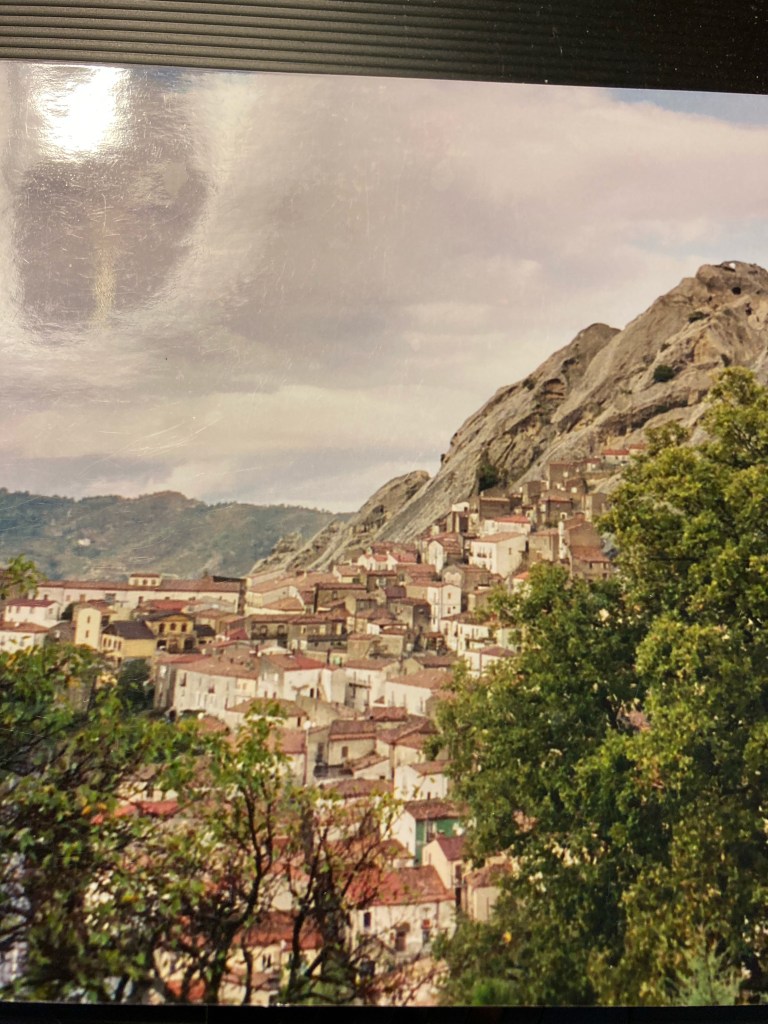
The trip was phenomenal. As we flew into Rome I became very emotional. We drove from Rome south to the little town of Pietrapertosa, a little mountain town in the Dolomities(Little Dolomites).  The drive was incredible.  Dirt roads through the mountains, pigs blocking the roads, rock slides to drive around and then miraculously the town was right in front of us.  As we drove up the cobblestone street the emotion overwhelmed me.  Here I was on streets that my grandfather played on. 


We pulled into the only hotel  in town and parked.  It was 2 pm in the afternoon and judging by the lack of anyone around it was the traditional siesta time.  But the smell was unmistakable . From the kitchen wafted the smell of my dad’s sauce. I broke down!  The owner came out and introduced herself. When she heard my name it was as if the world erupted. Moments later we were in a car driving through the village to “commune” which we learned meant town hall.  Once there the mayor introduced himself snd obviously knew who I was as he went to a closet and from an old waterlogged shoe box took out my grandfather’s birth certificate from 1881.  From that point on the trip was out of our hands.  We went to every household in the town where my family lived, had grappa everywhere, then to the mausoleums.  In that part of Italy the dead are not buried but placed in mausoleums and I met many of my dead relatives.

To make a long story short, all of the living relatives in the village are teachers, and  our guide whose great great  grandfather was my great grandfather’s brother, had been a teacher but left teaching and like me became an innkeeper- Coincidence????

This does not do justice to the incredible feelings and emotions that I experienced, about the story of my Aunt Eleanor as a young girl, walking with Bartolo Longo who has become a saint since my visit, about having to eat at every relative’s house still there.  This is a case of not really being able to express the depth of emotion and love that overwhelmed me in this little mountain town from which I had originated.  We all came from somewhere else.  Ellis Island has all our names engraved there.  If you EVER get the chance to go back where you came from, GO!

NoWhere To Go

I envy George’s sense of place. But what do you do when there’s no specific place in which to return? Like George, my grandparents came to the United States in the early 1900’s. However, where they came from is not clear. Technically, my grandfather and his brother left a farming village somewhere near Rome and struck out for a new life in America with the idea of sending for their wives and family. Two years later they both returned to Italy and only my grandfather returned with his bride via Ellis Island in 1904. 

On my father’s side, my grandparents emigrated from Walthamstow, UK in 1924. The area in Walthamstow where they lived was devastated by Nazi bombing during WWII and was significantly redeveloped. Unlike George’s story, there are no memories and close family to investigate. I did recently learn that my grandmother was one of twelve children; it appears that this cohort was involved in railway occupations and distributed themselves far and wide. One granduncle left for South Africa, got into some trouble as a result of a railway accident and hightailed it to Argentina, then Uruguay to work in the railroad industry. A cousin now living in Mexico City has filled me in on their exploits.

Now, my grandfather (who served in the RAF) may have come from Edinburgh, Scotland, but since he sort of disappeared shortly after arrival in the US, there’s no way to confirm. My father’s older brother Alfred went with my grandfather when he left – soon after, it seems like Alfred may have stolen a car and was deported to Australia. He later died during WWII serving in the Australian Airforce. I do sense that the English side of my family tree had a strong sense of adventure and were not afraid to strike out boldly. My father used to say “scratch an Englishman and find a pirate”… seems like this could sum up our family tradition. 

Honestly, I don’t have any desire to search out places near London, Rome, or Edinburgh – I sense that these are places my forebears really wanted to leave behind. I did not grow up with fond retellings of life in the old country — I don’t feel a connection. That is not to say that I don’t appreciate and honor the effort it took to transplant a family in an entirely new country. It’s simply that my good non-piratical memories sit in this little corner of the world.

Going Back – Moving Forward

George’s piece likely triggers different memories and emotions for each of us.  His desire to go back to his family roots and the feelings that were evoked for him, brought up another kind of “going back to where you came from” for me.

My father rarely lived at home due to the nature of his business.  One day, when I was in my teenage years, he stopped coming home altogether.  For a short while there was some correspondence and financial support, but then that ceased as well.  Except for one ambiguous letter from him while I was in college, I knew nothing more about the man, his history, his intentions, his beliefs, or his rationale for abandonment.

When I turned forty, I felt the urge and found the courage to seek him out.  All I knew was that he had left the New York area due to legal issues and was absorbed into some other part of the country with no address that was made available to me or my mom and sisters.  I knew someone who knew someone who could, for a price, get me my father’s location.  The source turned out to be sound and one summer’s day, I found myself on a plane bound for Houston, Texas, with an address, a phone number, and a load of questions.

Good fortune was on my side.  After settling into my hotel room, I called the number and told the woman on the other end of the line that I was looking to talk to Joe and that I was an old acquaintance who would like to surprise him without giving him my name.  He was indeed surprised, and after a few awkward minutes where I could hear my heart beat louder than his voice, he agreed to meet me at a diner I had noticed on the way to my hotel and not far from his home.

I remembered my father as an imposing figure.  He was six feet tall, always confident and self-assured, and always in control.  Now, as I watched through the diner window, I saw an old man struggle to get out of his weather beaten sedan and lumber up to the door.  He was in his late seventies, just a few years older than I am now.  His gait was slow, his posture slouched, and he was clearly not in control as he walked in the door and I went up to introduce myself.  Uncharacteristically, he went for a hug but I offered my hand.  We shook and I took him to where I had been sitting.  I asked my questions and received vague responses, deceptions, and mostly evasive language.  In truth, he had no answers for me, nothing of substance that could help me understand how he could leave the four of us without explanation or support.  I felt little to no empathy from him when I told him how the man he had sold our mortgage to, foreclosed on our house and how we lost all of our possessions and had to live in a motel until we could reclaim my grandmother’s 800 square foot cottage from a reluctant tenant.  For whatever reason, I don’t believe he was capable of truly feeling another’s emotional condition and, time, it seemed, hadn’t changed that part of him.  As he spoke of his hardships I recalled he had always told us stories of his heroic efforts to ward off injuries and illnesses, injustices done to him, and fantastic tales of survival.  Most, we later learned, were fabrications and exaggerations.  It’s just who he was.

Since he had shown no interest in contacting my sisters or me over our adult years, I chose to answer none of his questions about my mom, or us other than mom was still alive despite what he claimed he had heard.  In less than an hour I confirmed what I had suspected about this man.  I had given him a chance to prove me wrong, to hear the other side of the story but, for me, there was none.  I shook his hand and wished him well as he ended our meeting with another one of his woe-is-me stories about an upcoming surgery that was critical for his survival.

On the flight home I reflected on my journey.  Meeting my dad as an adult I realized that despite our shared DNA and many similar characteristics, I was not, nor would I become, my father.  

It was also fortuitous that I chose to “go back to where I came from” when I did.  As it turns out, his last story was indeed true and his surgery, six months later, was not successful.

I’m glad I got to see him and was able to address the issues that were on my mind.  And while I would have preferred a different kind of reckoning, it provided the closure I sought.  

Afterthoughts: Today my reflections of that time include more questions than answers. Was I really interested in listening and understanding or did the anger and fever of the moment keep me from hearing? If we had established any kind of relationship, would he have been able to be more honest? Can I ever truly understand the intentions and choices made by another, having had only my experiences and not theirs?

Falling Down

George hurt himself. He was simply trying to put out the garbage one evening when his dog, Devin, body- checked him and proved once again that stone is harder than face. George wound up with a boot on his foot and luckily did not need one for his face. Devin was apologetic, but Devin was a hockey defenseman in a past life, so he was doing just what came naturally.

George and His New Boot

George felt bad about this accident, but it was dark and wet – and hey! – unplanned. George’s incident was on my mind when I took a wrong pivot during a tennis serve return and heard about it from my hip. It was the final point in our doubles match and I was still talking to myself about being a clumsy idiot as we all gathered our stuff to dress and leave the court. In the process of limping back to my chair, I managed to spill my water bottle into the tennis bag and knock the open can of balls back onto the court. Naturally, bending down was not on my bucket list at the moment, so I expressed some displeasure. (Well, that might be a euphemism for my actual words).

Rich, one of our foursome, said: “You know, Wally, we are old enough to forgive ourselves for these kinds of things”. That brought me up short. He is absolutely right! We talked in the last post about asking for and accepting, help. Forgiveness – particularly self-forgiveness – is a necessity as one ages. (Of course, you could make the argument that it is essential at any age — but you might also figure that younger folks at least have a longer runway left to learn this lesson). If you can’t achieve a reckoning in later life, what a tortured soul you will have been. Don’t ask me how I know this.

I confess to storing a long list of my gaffes that remain unforgiven – well, at least by me. Most are not blockbusters, but rather insensitive sins of commission and omission over the years. These items, like the Ghost of Christmas Past, often impinge on my consciousness at pretty inopportune times – you can tell by the sudden scowl on my face while involved in some otherwise pleasant conversation. My wife calls me out on this (rightly) and suggests that I have on my ‘Isabelle-face’ (my good-hearted mother was also similarly afflicted). Rich’s comment brought home that we ourselves have the tools and ability to come to terms with these silly aggravations. Items that no one will remember in 5 or 50 years. He was giving me permission to forgive myself for not being always at my best. It felt good!  I’m going to start giving myself some mulligans… why not?

Feeling Forgiveness

The Ho’oponopono Prayer is an ancient Hawaiian practice of forgiveness.  It goes like this:

I’m Sorry

Please Forgive Me

Thank You

I Love You

I remember reciting this once at a large Thanksgiving gathering at my home. 

I said I was sorry for anything I had said or done to offend any of the guests seated at the table.

I asked for their forgiveness for those shortcomings.  (I also added that I forgave them for anything they may have done to offend me.)

I thanked them in advance for forgiving me and for being significant in my life.

I told them all that I loved them.

One person came up to me afterwards and shared her appreciation of the sentiment.  However, it mostly made the rest of the family uncomfortable, if not bewildered.  Several wondered if I was referring specifically to them, some became defensive, and others had no idea why I chose to share this piece on a day of giving thanks.  It was one of my greatest miscommunications in a group setting.  This time, I was able to smile and quickly forgive myself for causing more disconnect and confusion than the sense of closeness and clarity I had sought to create.

Wal reminds me that I haven’t always forgiven myself so readily and even when I did, the occasional flashbacks and corresponding emotion – – feeling like I was just punched in the gut, still lingered.  I wonder if there will always be a consequence of a wrongdoing that while forgiven, is permanently linked to guilt.  Or, if I am able to truly forgive myself, is the connection broken and I am free from ongoing remorse. 

Of all the words I value, acceptance is number one.  Indeed, if I accept things (people, incidents, actions) as they are then I would have no reason for forgiveness.  If I never judged something or someone to be lacking or wrong, or a mistake, it was just as it was supposed to be.  Thus, there is nothing to forgive.  And while I subscribe to this concept and practice it when I harken to do so, it is not yet (and likely never will be) a consistent habit.  So, for now, I’ll use Wal’s story and my age to remind me to allow myself more forgiveness and perhaps find it easier to forgive others along the way.

Reflections on a Brittle Body

I’ve said before that during this pandemic isolation a lot of reflection happens.  Thinking occurs when there isn’t a lot of activity to distract and I have had some very pleasurable moments reflecting.  I took time to look around and see things I never noticed before.  However, sometimes reflection can go south and stir up concerns that may never have surfaced otherwise.  Such is the case when I  collided with my pup. The night was dark, the ground was cold and wet.  I had taken out the garbage and recycling bins and was headed inside to chill. Just at the moment  as I was headed up the path to my back door, my devoted companion came charging around the back of the garage and at top speed came 60 lbs of muscle .  It happened too quickly for either of us to dodge and in an instant there I lie on the cold wet stones on the path to my house.   I fell forward and was worried I had hurt my face so just for a moment, stunned, I stayed put and took inventory.  


It’s incredible what you think of when your head is under an evergreen bush and you feel the wetness of the ground soaking into your body.  Immediately feeling foolish, I took stock of any pain that would need attending to and all felt good til I tried to stand.  I realized my left foot was most likely broken. Carefully I climbed up the brick steps on my knees and crawled all the way into bed.  There was little doubt in my mind that indeed a bone had snapped . The dog, feeling guilty and repentant, kept licking my foot saying he was sorry. 


I began thinking how in a moment things can drastically change.  My body, which years ago would have sprung back with a little bruise,  had become brittle and rigid with time.  While lying in bed looking up at the ceiling all kinds of fears came rushing in.  Will I need surgery, will this be another part of my body forever aching and causing pain?  Is this the moment where I am no longer able to care for myself and live alone?  Will I no longer be mobile, able to get upstairs to the bathroom, drive my car?  All these thoughts came rushing in during this forced reflection,  things people my age have to consider.  Did I do something stupid to cause it? If I am more careful in the future can I prevent accidents from happening.   My imagination was running away with me and not in a good way.  I remember saying out loud, “All right!  Knock it off”. Tomorrow I’ll have it checked out and do whatever has to be done!


But the feeling still lingered that as we age we become more susceptible to silly little accidents that could cause a drastic change in our lives.  So, do I spend the rest of my life carefully studying the landscape for mine fields or just dismiss the whole thing with the …whatever is going to happen will happen… attitude?    Hopefully, somewhere in between is middle ground that doesn’t inhibit my lifestyle or cause it to come crashing down.

 
I guess I will have to think on it!

Help!

Asking for help has never been easy.  As a child I believed that working hard, persevering, and striving for independence was the way to be. And since my mindset has always been to do it myself, asking others to lend a hand, especially with something I could somehow figure out on my own, is not easy for me.  Even though I could save time, attempt challenging tasks more safely, and end up with a more refined end result, I almost always chose the solo route.  My belief has always been that if I could accomplish a task by myself, I would be seen as successful, capable, maybe even better than those who needed assistance.  I’m not sure how I developed that belief but it’s been part of my thinking for a very long time.  Whatever the psychological underpinnings, I’m not very good at asking others to help me. 

I am a fan of Stephen Covey. In his work on defining the behaviors of highly effective people, he talks of an evolution from dependence to independence and finally to interdependence.  It is not enough for us to be independent and expect to live well in society, especially in this global society.  He contends that we must collaborate and recognize how we need each other to grow into our best selves and accomplish our best work.  From personal experience the beginning of a most successful business partnership began when a friend asked me to co-present a topic with which he was less familiar.  This collaboration led to almost a decade of some of my best work and I’m convinced, could only have happened through the interdependent relationship we had developed.  It all happened because of a request for help.

I actually enjoy helping others and appreciate when friends and family ask.  It enhances my sense of connection, I feel good being there for others, and it sends a message that I have value.  If I receive these benefits from helping others, it is likely that others will feel similarly if I ask them for help.  My hesitation though, comes from a rationalization that everyone appears to be so busy dealing with the challenges of their own daily lives, that even if they gain something from helping, they are still being inconvenienced and I’m still adding more to their list of things to do.  As I think about it though, perhaps this is a way of justifying my old habits and beliefs.  Perhaps I can have faith that if they are too busy, they will simply say so.

I truly value the idea and practice of interdependence.  I love the idea of Amish barn raising.  In an article in the Family Handyman, Alexa Erickson writes, “Barn raising combines socializing with a practical goal of building or rebuilding a barn, and allows for everyone involved to feel helpful. With all hands on deck, no one has to work too hard, while also getting an opportunity to catch up with friends and family.”

In fact, for a period of time, many years ago, my family joined with two others to cut and split enough wood to feed our wood stoves for the winter season.  Each of us ordered about eight cords of uncut tree trunks delivered in sixteen-foot sections.  We would spend entire weekends together at each home cutting, splitting, and stacking. The children played with each other, we ate meals together, and we were able to get more work done than any one of us could have accomplished alone.  And, we had fun in the process.  I’ve tried to replicate that over the years.  More recently,  I asked a group of friends over to help me with the spring tasks of weeding, pruning, and mulching my gardens.  I provided the meals and the after party!  Once again, we got a tremendous amount of work done and had a great time doing it. A few weeks later, one friend asked us to help her start a garden.  In one day about a dozen of us turned over the soil, built a fence, and planted her garden.  

I cherish those times.  For me they were brief but powerful experiences of being in community.  And each one began with a request for help.  Perhaps this is as good a time as any to begin to think of ways we can help each other.  

Help Me if You Can

“When I was younger, so much younger than today…
I never needed anybody’s help
In any way…..” so go the lyrics of the famous Beatles’ song and they are so not true according to my experience.    I have always needed help from infancy to old age.   Asking for it?  Well that’s another issue!  In my early years I discovered if I played coy around the right people someone would say, “Do you need a hand with that?”  Of course I did so once it was offered I jumped at the chance.  Funny expression about needing a hand.  I guess it is derived from the concept that most situations require lifting or carrying things hence additional hands are always welcome. 

My situations were usually more involved.  As the years progressed that coy technique became a little counter productive as I was supposed to feel a bit more self assured (borrowing another lyric from Help).  I think that is the root of difficulty for me to ask for help.  It would show my weakness, my insecurities at a time when I was maturing into adolescence and supposed to be coming independent.  HAH!  So I struggled.  I had great ideas but many went unfulfilled because I just couldn’t get the words out, “could you help me out here?”

I wonder if it is a guy thing?  Or I just know many insecure guys. When I have asked for help I have always been rewarded not just by the actual project but by the camaraderie and friendship that it enhances.  But why is it so difficult to get those few words out?  Other things are easy to say like, “I’m sorry,” “I Love you,” “Could you please leave me alone?”  et al.  But those “I need help” words just won’t come out easily.

Funny thing is, I love being asked to help somebody.  Oftentimes just offer help before being asked.  Love being asked for advice because that means somebody thinks enough of my intellect or opinions to seek it out.  Makes me feel important and smart.  Much more important to me than physical help as I carry the remains of a scrawny little kid around with me who couldn’t do much physically or mechanically, or technologically as Hen and Wal will attest to.  Anyway, you get my drift!  Let me know if I can be of any help!

Codgers United

Well George, the rest of that stanza goes: 

But now these days are gone, I’m not so self assured 
Now I find I’ve changed my mind and opened up the doors 

That hones in on an interesting point. As we get older, what’s our greatest fear? A survey of seniors indicates that it is the fear of being marginalized – because we are no longer instrumental. Here’s the dilemma: we’ve reached a point where we realized that it’s not a crime to ask for help, but worry about the consequences of being seen as incapable or ‘past it’. Those consequences for older individuals can result in real life changes (such as how much independent living you may be allowed to engage in).  

So when do you ask for help? Laurne Sanderson nailed it: 

I need help 
It’s so hard to admit when I ask myself 
If I need help 
I need help 

The question is HOW to ask for help. Now I had an elderly friend who sort set the right tone. He looked at asking for help as not “doing for me”, but rather “doing with me”. The focus is participation – helping one another. He would invite folks to work with him. Another friend adopted a “home and home” approach where one visit is devoted to a project of his choosing – and the next visit is the partner’s project choice. These are effective ‘guy-solutions’, due to the reciprocity inherent in the activity. No one feels indebted or inadequate. (Actually, most of the time, we are inadequate together, but in a good way)! In fact, struggling through projects with someone else — or several ‘someone elses’ — is a terrific opportunity for learning and laughing. At the least, it establishes a basis for later legends.  

George mentions that he feels good when asked for his opinion. Of course! That just underlines the fact that he is still instrumental… the problem is when you are never asked for your opinion.  That’s why I think it is important to build a social network of friends who can be asked for their opinions. It’s as important for them to be asked as it is for you to get the feedback. 

It takes a village to raise a codger, so start early! 

Take Time to Smell the Roses

During this time of sadness and concern due to the intersection of this horrid election season and COVID-19, a time when little is happening to be positive about I actually became surprised.  In fact, when I think of these last 7 or so months, where days pass by almost unnoticed, one sliding into the other without much distinction, it is hard to list anything good to take note of.  We’ve been living more in our own minds and inside our homes oftentimes cause a kind of negative reflection and poor me-ism!  I have been stuck in that space for a longtime until just recently. 

I think it started about midweek last week.  I was staring out my bedroom window as the sun was rising and I noticed something on my neighbor’s lawn that I never noticed before. It was always there I just never noticed it.   There is a clump of white chrysanthemums in full bloom but the shape of it looks just like his white SUV parked next to it in the driveway.  It hit me like a brick and I began to scan the whole neighborhood that I can see from my bedroom.  It was amazing what I saw for the first time.  Door decorations, a broken window, a package on Gail’s stoop that I realized has been there for at least a week.  I was always too busy to look closely at things right in front of me.  And that began some soul searching about what else I may have overlooked.


Last night, Sunday night, as is our ritual, my daughter and I had dinner at a favorite restaurant, sitting on the side deck, lit up by white lights and heated with towering propane heaters.  It is our “check in” time and we share feelings and events of the week.  We have been doing this since restaurants reopened.  But this time I realized that as a result of these Sunday night meals together we had become really close.  There it was in front of my eyes but I just never saw it til now.  In this case it wasn’t just seeing something that was there but there was an incredibly warm realization of our connection and how important it was to both of us.  We laughed and cried.  We relived events that went on in the family over the years. We talked about my relatives and things she remembered about my parents and her uncle.  She reminded me of times I embarrassed her as a teenager and chided me that she’s almost 50 and how I shouldn’t treat her like a teenager still….point well taken!
When I drove her home and said good bye last night it was different.   We hugged and kissed good night, but held on longer and looked into each other’s eyes and we were both tearing up!  We both acknowledged who we are today, how life is different but how our bond grew a little tighter and closer because of what we are currently experiencing.  Guess I have a lot of things to be thankful for that I wasn’t even aware of and may have never seen without the current situation we are all experiencing. That old expression, “take time to smell the roses” may apply.  Glad I did!

Surprised by Joy (Apologies to CS Lewis)

My wife and I have vastly different modes of experience. Linda can sit on our deck and enjoy the birds, flowers, and outside awareness, becoming refreshed and renewed. Me – I usually see this as an impediment to finishing one of those tasks that I’m woefully behind on completing. So, when we sit together in an idle moment, my impatience usually trumps enjoyment.

Except last week. 

On an enforced hiatus after returning home from my colonoscopy, I helped Linda disentangle a wild grapevine from a forsythia bush. We pulled out the invasive plant and in the process noticed the tendrils that wrap around host branches in order to support the climbing vine. The tendrils are tough, forming spirals and curling shapes. Hmmm, perhaps they could be used in a woodturning project that I’ve had on the back burner? 

Well, I started unraveling the tendrils and cutting them off the main vine. After a small space of time, I realized a real peace of mind and enjoyment in harvesting these little guys – hence, the title of this piece: the feeling of joy sort of snuck up on me. Of course, the title of CS Lewis’ autobiography dealt with something far more significant, but I hope he would not mind me stealing his turn of words.

I kept at it for the good part of an hour, resulting in a box full of curlicues. I was having such a good time that I hardly noticed that it was raining. It resulted in a bit of an epiphany: ‘you don’t need much to be happy’. Even in this time of isolation and tension, happiness is literally right at our feet.

Part of my joy had to do with the anticipation of how the grapevine could be used in my project. I felt in the creative flow — and that is where I find my best self. Linda achieves that state much more frequently; I admire her capacity for joy. 

Perhaps, I’ll try sitting on the deck for a while each day…

The Positive Side

 “The bad things in life open your eyes to the good things you weren’t paying attention to before.”― N.M. Facile, Across The Hall

It looks like George and this author have much in common.  And what I like most about George’s piece is that he uncovered this understanding naturally.  It wasn’t like he read the quote and then told himself to pay more attention.  He fell into it on his own, perhaps without even looking for it.  I find it rare to “wake up” to those experiences without prompting, searching, or following the guidance of others.  But when it does occur, it becomes something one owns and feels rather than something one learns and understands.  Here’s wishing us all, such awakenings!

It is not easy to see joy and beauty and normalcy lately.  If we’re fortunate to have friends and family who spend more time being and less time focused on the heavy and threatening issues before us, we can be uplifted when we spend time with them.  

Thanks to George, I’m even more aware that looking deeper at what I see and do each day can be a powerful antidote to the toxicity of the negativism that surrounds me.  And, like George, I’ve found my relationships with family have gotten stronger.  Even the close connection I already enjoy with my daughter has changed.  We have more honest and open conversations, I feel more accepted and appreciated (a term that carries much meaning to both of us), and I’ve gained a new-found respect for the way she juggles the additional pandemic challenges of a working wife and mom with humility, perseverance and love.  My son and I have more contact than ever before. Our conversations are deeper and more thoughtful as we talk face to face via FaceTime on a regular basis.  His care and understanding were always there but I’m more aware of the feeling behind his words and we smile and laugh together more than ever.  And while they both live too far to enjoy an in-person weekly meal together, I recognize how much I have to be thankful for as they fold me into their busy and often overwhelming lives, with sincerity and love.

Recently, the Three Old Guys discussed what we thought would become the new normal following the pandemic.  Many thoughts were offered and analyzed.  But if those new normals include an increased sense and appreciation of the present moment and the maintenance of those meaningful relationships we’ve grown to further appreciate and nurture over these many months, perhaps the post pandemic future will be even better.

One Sigma

Once upon a time I won an award for achieving outstanding quality in an organizational context. I also taught six sigma concepts to managers in the company for which I worked. If you missed the six sigma effort, it had to do with reaching 99.99966% accuracy in deliverables or products by engineering efficient and repeatable processes. Sigma, of course, represents one standard deviation from the mean in a normal distribution (bell curve). Six sigma exudes absolute confidence in (close to) perfect achievement, all of the time.

Now you might suspect that the discipline of six sigma would also seep into the personal life of its practitioners, but sadly, that is not always the case. My workshop motto is “Oops!” and my crooked headstone will read “This Will Have to Do”.

How could a person sink so low?

Well, as I age, the goal of perfection seems further away. It’s like the Big Bang: the universe is expanding faster than my ability to keep up.  Certainly there is a red shift in my ability-to-aspiration ratio. Pursuit of excellence has been replaced by pursuit of ‘okay-ness’.

Social psychologist Gordon Allport used to say that individuals generally adjust their goals, based on a recent track record of successes and failures. This concept was strongly brought home in a recent project I attempted – installing a planked ceiling and crown moulding in my second floor stairwell. Naturally, I researched different methods of cutting compound angles and I built a stair box to support my ladder. However, try as I might, I could not envision the correct method of cut… and due to a long standing reversal problem, one third of my stock was wasted. However, despite uneven walls, ladder balancing, and (what is the opposite of ambidexterity? – well, that), it got done.

In retrospect, I wonder if pursuit of excellence is at times hijacked by a simple desire for personal control – a goal that is usually self-defeating. In that regard, it’s easier to understand the artists who intentionally mar their work as a recognition of impossible standards. Clearly, my work embraces this wabi-sabi approach.

So these days, I’ve attuned my goals to pursuit of small successes… anything more falls into the category of ‘minor miracle’. But you know what – that’s okay. Maybe one sigma is enough…

Pursuit of Perfection

As Wally suggested, I’m one of those people who missed the Six Sigma program.  But after admitting my lack of knowledge in this area I  think in my field of work,  perfection is rarely achieved and we settle for doing our best, at least the conscientious ones do!  I can’t imagine what perfection even looks like in education, or in my second career of innkeeping, for the simple reason that our final product is people and I don’t think there is anyone perfect (to the chagrin of those who think they are!)  How is perfection measured when you don’t know the results of your input for years to come? 
But loving what you do makes the striving for excellence easier.  And when success is reached the pleasure and pride is shared with those who are benefiting from your hard work!  That is a feeling that is unlike any hallucinogenic drug can deliver.  And it propelled me to do it again tomorrow, maybe with modification or maybe not. I did that for 35 years and it never got old.  Don’t get the wrong idea.  As much as I would like to think that level of excellence was reached everyday in my classrooms, I know there were low days and bad days interspersed with the good ones but there was always tomorrow to win my respect back!


Innkeeping is similar.  The end product is a happy tourist.  I was good at that too.  We always went out of our way to please and delight our guests.  If they mentioned something they were looking for, kind of off the cuff, we arranged it for them to their delight.  Cleanliness and good food are requirements in hospitality so that was a given.  Excellence came in the trimmings.  One of us met them at the door after dinner every night just to see how they enjoyed it.  The fire was always going in the living room for late evening schmoozing with a glass of wine, and a willing ear to listen to their stories.  But once again we were doing what we loved so striving for excellence was an achievable goal not an obligation to merely get through the day!


Now, however, with advancing age and social distancing the trouble is I have lost my purpose, my definition. I was a teacher, then an innkeeper, but now I’m a lonely old man with inertia.  I do believe I’m probably pretty good at inertia, too.  After all my entire life I strove for perfection.  I know I’m good at it cause when I try to get out of my chair, there is this weird groaning noise and I realize there is no reason to get out of my chair.  Looking for purpose is hard, and I’m not really good at it now,  but hopefully as the world opens up new purposes may provide themselves to me and I will find another one I love and strive for perfection once again!

The Stigma of Perfection

I am a firm believer in personal growth and self-improvement.  I have a dear friend who displayed a quote on the wall in her office that said, “If you’re not working on yourself, you’re not working.”  But even the six sigma model allows for a small degree of error affirming that perfection is not the goal.  And if the quest is for improvement in efficiency and effectiveness then doing the best we can under the circumstances can be pretty darn good.

I’m also a firm believer in “good enough isn’t.”  Let me explain.  I once worked for a boss who would often challenge my idea and requests, especially if they exceeded standard norms and resource distribution.  Her response would usually boil down to, “Can you live with what you have?”  Even now, I feel a visceral reaction to those words.  Of course I could “live” with it.  We don’t need even what we already have to “live.”  But to excel, to improve, to energize, and to engage my staff and colleagues to provide excellence, good enough just wouldn’t do it.  So when I talk about doing the best we can, I mean, doing the best we can which is definitely more than okay or good enough or even the infamous – “I’ll try” which, of course, allows for failure.

But none of this implies perfection.  Early in my career, I would hear the wise words of my senior colleagues who would remind me that I’d never get it all done because no one is perfect.  And while I understood them, I secretly strove to prove them wrong.  Even when, at times, I may have reached a six sigma level, it not only didn’t last, but it took its toll from other parts of my life.  Later on I would learn that balance and working to be my best self were necessary companions in living a good life.

Today my best isn’t what it once was.  And while it’s better in one or two areas that have unfolded from the wisdom of many years of experience and self-reflection, it cannot, nor should it be, compared to days of yore.  “Oops!” and “This will have to do” accompanied by an understanding and accepting smile may also be a sign that not everything that used to matter, still does and what didn’t appear to carry much significance, now holds more of our attention at doing the best we can.