What Matters

Where Do We Go From Here?

Most of us desire to be in community – a place where people feel valued, accepted, and connected.  And, while communities are often founded around common goals and interests, they vary greatly in regards to their openness and collaboration with other communities and with society as a whole.  It appears that we are currently experiencing more entrenched attitudes and behaviors within and among these groups and fewer opportunities for open dialog toward the common good.

The “ends justify the means” seems like the present mode of operation by many groups.  And, while it may lead one collective or another to a temporary victory, is the long-term cost worth it?  In our righteous indignation and justification for winning at all costs, is the angst, corruption of our principles, and the constant attention we give to defensiveness and negativity how we want to live?

Even when we feel we have no other options, we are often avoiding the hard work of finding or creating alternatives.  Sometimes, rather than picking one side/approach or another, we can merge the two into an even more effective one.  Martin Luther King spoke at the 10th annual meeting of the Southern Christian Leadership Conference in 1967 about two approaches that often provoked one choice, the path of love or the path of power.  His stance was that we couldn’t be effective without both.  Perhaps it’s time for us to reconsider where we stand and whether the communities we align with have the best interests of long-term goals and those of our children.

Is our community behaving in ways that illicit trust?  Do we act in ways the make it difficult for the other side to challenge our civility, dignity, and authenticity?  If we don’t because they don’t, how will we ever get there?

Where do we go from here?  Isn’t it up to each of us to decide how we act to bring about the future we want for our children and ourselves? And isn’t that future dependent on how we respond and embrace other communities?

Thoughts?

Dear Santa

Dear Santa,

After reading my friend Henry’s blog post I have to confess I have been naughty this year, well these past 4 years.   You see I have had very strong political views that often crossed the “being appropriate” limits.  I was often angry, outraged even and vociferous in my expression of that outrage.  I said mean things on Facebook and listened to only one tv station news coverage- the one that I agreed with.

I always considered myself a reasonable, intelligent person.  But I just couldn’t accept imitating a handicapped journalist or calling people names based on their appearance or physical features.  In my heart I knew that was wrong but our leader was displaying this behavior publicly, snd I saw our interaction between people becoming caustic and aggressive.  Santa, I gave into those feelings I had and expressed them instead of trying to find common ground. 

We now have an elected leader who is trying to model appropriate behavior and I promise to follow his lead.  I will do things to try to bring our country together again.  I won’t say mean things or cause disagreement to intensify.  I promise to try to reconnect with people I may have upset.    That way my letter to you next year can tell you that I have been a good boy and have everything I need so give my stuff to kids who are more needy. This pandemic will certainly cause people to need things that they normally would have.  Hopefully by next December this Covid thing will be gone but if not I will ask for enough masks for everybody in our country and the general acceptance that masks help!  Please forgive me Santa.  I tried but just couldn’t live up to my wish to be a good boy.  My friends Henry and Wally were gooder than I was this year so you should give them what they ask for.  Well, maybe they were a little naughty too!
Your friend,
Georgie

Permeability

I suspect that we each have an urge to assimilate and an urge to be distinct. We try to solve that tension by finding a reference group (or several) that allows us to do both. In a healthy society, just as in a healthy individual, affiliation in various ‘communities’ is fluid enough to help us practice seeing different points of view. I tend to think about this condition as one which features permeable boundaries – like a biologic cell wall — allowing traffic of ideas (like RNA) through the walls. This allows analysis and accommodation among varying points of reference.

 When ideologic boundaries harden, it’s no wonder that commerce between particular communities tends to stop.  So for me, it’s about permeability – allowing flow. Carrying the analogy a bit further: if we each act as a unit in a living entity, our function is to pass nutrients throughout the system and keep it thriving. It’s also our job to defend against threats to our ability to do so. 

If the body encounters a destructive virus, it tends to attack anything which looks like a threat. Sometimes it overreaches. Hen describes a situation where our communities seem to be ill – and some functions are not working well. A healthy community, like a healthy body – should rebound from most infection. However, that rebound depends upon various organs working in concert, not shutting down. The individual’s essential job is to continue to pass nutrients through the system. Now I know that I’ve set the stage for some to liken our current state of affairs to a cancerous growth. Okay, maybe we need chemotherapy – maybe our living entity will die. Or maybe our society is suffering from a malady that can be treated with an injection of common sense and affection. Either way, I believe that our boundaries need to be permeable enough to receive both familiar ideas and new ideas and pass along the useful bits of both which allow the whole body to thrive. 

Go Back Where You Came From

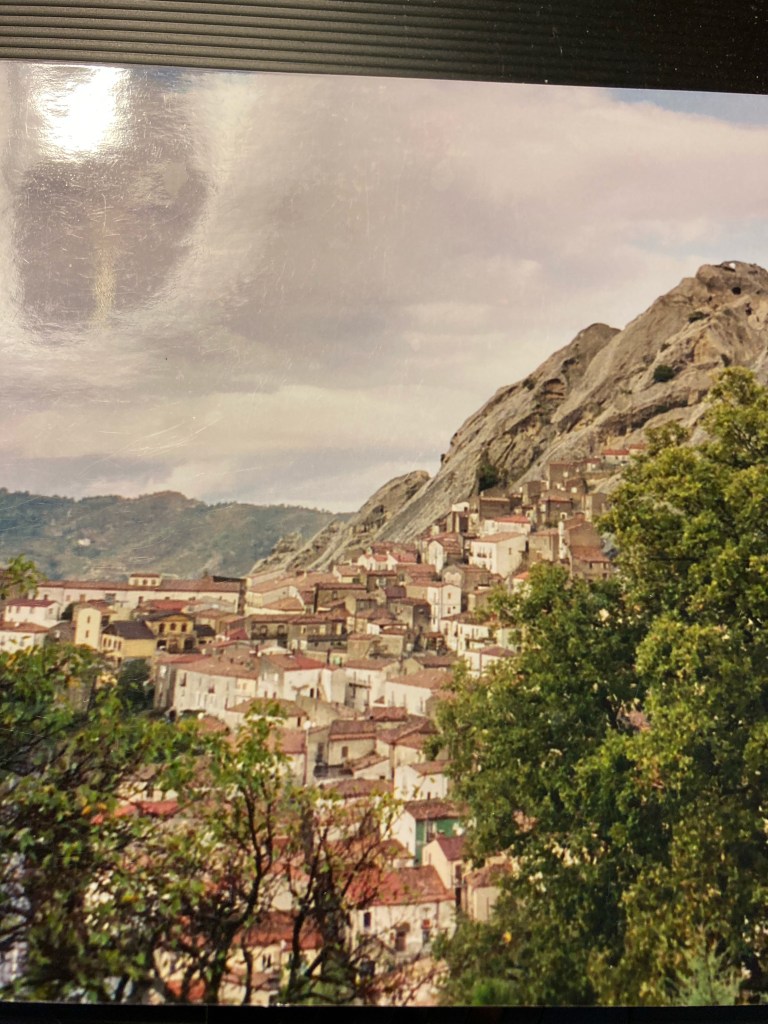
I did!  One of the most incredible experiences I ever had was going back to where I came from.  My entire life I was surrounded by the crazy Italian Family that I came from- or at least half of me!  Holidays consisted of people yelling at each other, all at the same time.  Half in English,  half in a bastardized Italian that was spoken in southern Italy.  I should refer to it as a dialect but if you speak ITALIAN you might agree that the dialects were bastardized.  The area I came from in Italy is Basilicata.  The arch of the boot.  Calabria was to the west (the toe of the boot)and Puglia to the east(the heel).  The minute you drive south of Naples you begin to feel the difference!

Planning the trip was a trip in itself.  My partner called the only hotel in the area but they spoke no English.  So he called an Italian friend of his to call for us.  She arranged a conference call and within moments we realized they were speaking 2 different languages.   A subsequent call with someone on their end who spoke “English” resolved the issue and we were all set to go. 

The trip was phenomenal. As we flew into Rome I became very emotional. We drove from Rome south to the little town of Pietrapertosa, a little mountain town in the Dolomities(Little Dolomites).  The drive was incredible.  Dirt roads through the mountains, pigs blocking the roads, rock slides to drive around and then miraculously the town was right in front of us.  As we drove up the cobblestone street the emotion overwhelmed me.  Here I was on streets that my grandfather played on. 


We pulled into the only hotel  in town and parked.  It was 2 pm in the afternoon and judging by the lack of anyone around it was the traditional siesta time.  But the smell was unmistakable . From the kitchen wafted the smell of my dad’s sauce. I broke down!  The owner came out and introduced herself. When she heard my name it was as if the world erupted. Moments later we were in a car driving through the village to “commune” which we learned meant town hall.  Once there the mayor introduced himself snd obviously knew who I was as he went to a closet and from an old waterlogged shoe box took out my grandfather’s birth certificate from 1881.  From that point on the trip was out of our hands.  We went to every household in the town where my family lived, had grappa everywhere, then to the mausoleums.  In that part of Italy the dead are not buried but placed in mausoleums and I met many of my dead relatives.

To make a long story short, all of the living relatives in the village are teachers, and  our guide whose great great  grandfather was my great grandfather’s brother, had been a teacher but left teaching and like me became an innkeeper- Coincidence????

This does not do justice to the incredible feelings and emotions that I experienced, about the story of my Aunt Eleanor as a young girl, walking with Bartolo Longo who has become a saint since my visit, about having to eat at every relative’s house still there.  This is a case of not really being able to express the depth of emotion and love that overwhelmed me in this little mountain town from which I had originated.  We all came from somewhere else.  Ellis Island has all our names engraved there.  If you EVER get the chance to go back where you came from, GO!

NoWhere To Go

I envy George’s sense of place. But what do you do when there’s no specific place in which to return? Like George, my grandparents came to the United States in the early 1900’s. However, where they came from is not clear. Technically, my grandfather and his brother left a farming village somewhere near Rome and struck out for a new life in America with the idea of sending for their wives and family. Two years later they both returned to Italy and only my grandfather returned with his bride via Ellis Island in 1904. 

On my father’s side, my grandparents emigrated from Walthamstow, UK in 1924. The area in Walthamstow where they lived was devastated by Nazi bombing during WWII and was significantly redeveloped. Unlike George’s story, there are no memories and close family to investigate. I did recently learn that my grandmother was one of twelve children; it appears that this cohort was involved in railway occupations and distributed themselves far and wide. One granduncle left for South Africa, got into some trouble as a result of a railway accident and hightailed it to Argentina, then Uruguay to work in the railroad industry. A cousin now living in Mexico City has filled me in on their exploits.

Now, my grandfather (who served in the RAF) may have come from Edinburgh, Scotland, but since he sort of disappeared shortly after arrival in the US, there’s no way to confirm. My father’s older brother Alfred went with my grandfather when he left – soon after, it seems like Alfred may have stolen a car and was deported to Australia. He later died during WWII serving in the Australian Airforce. I do sense that the English side of my family tree had a strong sense of adventure and were not afraid to strike out boldly. My father used to say “scratch an Englishman and find a pirate”… seems like this could sum up our family tradition. 

Honestly, I don’t have any desire to search out places near London, Rome, or Edinburgh – I sense that these are places my forebears really wanted to leave behind. I did not grow up with fond retellings of life in the old country — I don’t feel a connection. That is not to say that I don’t appreciate and honor the effort it took to transplant a family in an entirely new country. It’s simply that my good non-piratical memories sit in this little corner of the world.

Going Back – Moving Forward

George’s piece likely triggers different memories and emotions for each of us.  His desire to go back to his family roots and the feelings that were evoked for him, brought up another kind of “going back to where you came from” for me.

My father rarely lived at home due to the nature of his business.  One day, when I was in my teenage years, he stopped coming home altogether.  For a short while there was some correspondence and financial support, but then that ceased as well.  Except for one ambiguous letter from him while I was in college, I knew nothing more about the man, his history, his intentions, his beliefs, or his rationale for abandonment.

When I turned forty, I felt the urge and found the courage to seek him out.  All I knew was that he had left the New York area due to legal issues and was absorbed into some other part of the country with no address that was made available to me or my mom and sisters.  I knew someone who knew someone who could, for a price, get me my father’s location.  The source turned out to be sound and one summer’s day, I found myself on a plane bound for Houston, Texas, with an address, a phone number, and a load of questions.

Good fortune was on my side.  After settling into my hotel room, I called the number and told the woman on the other end of the line that I was looking to talk to Joe and that I was an old acquaintance who would like to surprise him without giving him my name.  He was indeed surprised, and after a few awkward minutes where I could hear my heart beat louder than his voice, he agreed to meet me at a diner I had noticed on the way to my hotel and not far from his home.

I remembered my father as an imposing figure.  He was six feet tall, always confident and self-assured, and always in control.  Now, as I watched through the diner window, I saw an old man struggle to get out of his weather beaten sedan and lumber up to the door.  He was in his late seventies, just a few years older than I am now.  His gait was slow, his posture slouched, and he was clearly not in control as he walked in the door and I went up to introduce myself.  Uncharacteristically, he went for a hug but I offered my hand.  We shook and I took him to where I had been sitting.  I asked my questions and received vague responses, deceptions, and mostly evasive language.  In truth, he had no answers for me, nothing of substance that could help me understand how he could leave the four of us without explanation or support.  I felt little to no empathy from him when I told him how the man he had sold our mortgage to, foreclosed on our house and how we lost all of our possessions and had to live in a motel until we could reclaim my grandmother’s 800 square foot cottage from a reluctant tenant.  For whatever reason, I don’t believe he was capable of truly feeling another’s emotional condition and, time, it seemed, hadn’t changed that part of him.  As he spoke of his hardships I recalled he had always told us stories of his heroic efforts to ward off injuries and illnesses, injustices done to him, and fantastic tales of survival.  Most, we later learned, were fabrications and exaggerations.  It’s just who he was.

Since he had shown no interest in contacting my sisters or me over our adult years, I chose to answer none of his questions about my mom, or us other than mom was still alive despite what he claimed he had heard.  In less than an hour I confirmed what I had suspected about this man.  I had given him a chance to prove me wrong, to hear the other side of the story but, for me, there was none.  I shook his hand and wished him well as he ended our meeting with another one of his woe-is-me stories about an upcoming surgery that was critical for his survival.

On the flight home I reflected on my journey.  Meeting my dad as an adult I realized that despite our shared DNA and many similar characteristics, I was not, nor would I become, my father.  

It was also fortuitous that I chose to “go back to where I came from” when I did.  As it turns out, his last story was indeed true and his surgery, six months later, was not successful.

I’m glad I got to see him and was able to address the issues that were on my mind.  And while I would have preferred a different kind of reckoning, it provided the closure I sought.  

Afterthoughts: Today my reflections of that time include more questions than answers. Was I really interested in listening and understanding or did the anger and fever of the moment keep me from hearing? If we had established any kind of relationship, would he have been able to be more honest? Can I ever truly understand the intentions and choices made by another, having had only my experiences and not theirs?

Falling Down

George hurt himself. He was simply trying to put out the garbage one evening when his dog, Devin, body- checked him and proved once again that stone is harder than face. George wound up with a boot on his foot and luckily did not need one for his face. Devin was apologetic, but Devin was a hockey defenseman in a past life, so he was doing just what came naturally.

George and His New Boot

George felt bad about this accident, but it was dark and wet – and hey! – unplanned. George’s incident was on my mind when I took a wrong pivot during a tennis serve return and heard about it from my hip. It was the final point in our doubles match and I was still talking to myself about being a clumsy idiot as we all gathered our stuff to dress and leave the court. In the process of limping back to my chair, I managed to spill my water bottle into the tennis bag and knock the open can of balls back onto the court. Naturally, bending down was not on my bucket list at the moment, so I expressed some displeasure. (Well, that might be a euphemism for my actual words).

Rich, one of our foursome, said: “You know, Wally, we are old enough to forgive ourselves for these kinds of things”. That brought me up short. He is absolutely right! We talked in the last post about asking for and accepting, help. Forgiveness – particularly self-forgiveness – is a necessity as one ages. (Of course, you could make the argument that it is essential at any age — but you might also figure that younger folks at least have a longer runway left to learn this lesson). If you can’t achieve a reckoning in later life, what a tortured soul you will have been. Don’t ask me how I know this.

I confess to storing a long list of my gaffes that remain unforgiven – well, at least by me. Most are not blockbusters, but rather insensitive sins of commission and omission over the years. These items, like the Ghost of Christmas Past, often impinge on my consciousness at pretty inopportune times – you can tell by the sudden scowl on my face while involved in some otherwise pleasant conversation. My wife calls me out on this (rightly) and suggests that I have on my ‘Isabelle-face’ (my good-hearted mother was also similarly afflicted). Rich’s comment brought home that we ourselves have the tools and ability to come to terms with these silly aggravations. Items that no one will remember in 5 or 50 years. He was giving me permission to forgive myself for not being always at my best. It felt good!  I’m going to start giving myself some mulligans… why not?

Feeling Forgiveness

The Ho’oponopono Prayer is an ancient Hawaiian practice of forgiveness.  It goes like this:

I’m Sorry

Please Forgive Me

Thank You

I Love You

I remember reciting this once at a large Thanksgiving gathering at my home. 

I said I was sorry for anything I had said or done to offend any of the guests seated at the table.

I asked for their forgiveness for those shortcomings.  (I also added that I forgave them for anything they may have done to offend me.)

I thanked them in advance for forgiving me and for being significant in my life.

I told them all that I loved them.

One person came up to me afterwards and shared her appreciation of the sentiment.  However, it mostly made the rest of the family uncomfortable, if not bewildered.  Several wondered if I was referring specifically to them, some became defensive, and others had no idea why I chose to share this piece on a day of giving thanks.  It was one of my greatest miscommunications in a group setting.  This time, I was able to smile and quickly forgive myself for causing more disconnect and confusion than the sense of closeness and clarity I had sought to create.

Wal reminds me that I haven’t always forgiven myself so readily and even when I did, the occasional flashbacks and corresponding emotion – – feeling like I was just punched in the gut, still lingered.  I wonder if there will always be a consequence of a wrongdoing that while forgiven, is permanently linked to guilt.  Or, if I am able to truly forgive myself, is the connection broken and I am free from ongoing remorse. 

Of all the words I value, acceptance is number one.  Indeed, if I accept things (people, incidents, actions) as they are then I would have no reason for forgiveness.  If I never judged something or someone to be lacking or wrong, or a mistake, it was just as it was supposed to be.  Thus, there is nothing to forgive.  And while I subscribe to this concept and practice it when I harken to do so, it is not yet (and likely never will be) a consistent habit.  So, for now, I’ll use Wal’s story and my age to remind me to allow myself more forgiveness and perhaps find it easier to forgive others along the way.

Reflections on a Brittle Body

I’ve said before that during this pandemic isolation a lot of reflection happens.  Thinking occurs when there isn’t a lot of activity to distract and I have had some very pleasurable moments reflecting.  I took time to look around and see things I never noticed before.  However, sometimes reflection can go south and stir up concerns that may never have surfaced otherwise.  Such is the case when I  collided with my pup. The night was dark, the ground was cold and wet.  I had taken out the garbage and recycling bins and was headed inside to chill. Just at the moment  as I was headed up the path to my back door, my devoted companion came charging around the back of the garage and at top speed came 60 lbs of muscle .  It happened too quickly for either of us to dodge and in an instant there I lie on the cold wet stones on the path to my house.   I fell forward and was worried I had hurt my face so just for a moment, stunned, I stayed put and took inventory.  


It’s incredible what you think of when your head is under an evergreen bush and you feel the wetness of the ground soaking into your body.  Immediately feeling foolish, I took stock of any pain that would need attending to and all felt good til I tried to stand.  I realized my left foot was most likely broken. Carefully I climbed up the brick steps on my knees and crawled all the way into bed.  There was little doubt in my mind that indeed a bone had snapped . The dog, feeling guilty and repentant, kept licking my foot saying he was sorry. 


I began thinking how in a moment things can drastically change.  My body, which years ago would have sprung back with a little bruise,  had become brittle and rigid with time.  While lying in bed looking up at the ceiling all kinds of fears came rushing in.  Will I need surgery, will this be another part of my body forever aching and causing pain?  Is this the moment where I am no longer able to care for myself and live alone?  Will I no longer be mobile, able to get upstairs to the bathroom, drive my car?  All these thoughts came rushing in during this forced reflection,  things people my age have to consider.  Did I do something stupid to cause it? If I am more careful in the future can I prevent accidents from happening.   My imagination was running away with me and not in a good way.  I remember saying out loud, “All right!  Knock it off”. Tomorrow I’ll have it checked out and do whatever has to be done!


But the feeling still lingered that as we age we become more susceptible to silly little accidents that could cause a drastic change in our lives.  So, do I spend the rest of my life carefully studying the landscape for mine fields or just dismiss the whole thing with the …whatever is going to happen will happen… attitude?    Hopefully, somewhere in between is middle ground that doesn’t inhibit my lifestyle or cause it to come crashing down.

 
I guess I will have to think on it!

Help!

Asking for help has never been easy.  As a child I believed that working hard, persevering, and striving for independence was the way to be. And since my mindset has always been to do it myself, asking others to lend a hand, especially with something I could somehow figure out on my own, is not easy for me.  Even though I could save time, attempt challenging tasks more safely, and end up with a more refined end result, I almost always chose the solo route.  My belief has always been that if I could accomplish a task by myself, I would be seen as successful, capable, maybe even better than those who needed assistance.  I’m not sure how I developed that belief but it’s been part of my thinking for a very long time.  Whatever the psychological underpinnings, I’m not very good at asking others to help me. 

I am a fan of Stephen Covey. In his work on defining the behaviors of highly effective people, he talks of an evolution from dependence to independence and finally to interdependence.  It is not enough for us to be independent and expect to live well in society, especially in this global society.  He contends that we must collaborate and recognize how we need each other to grow into our best selves and accomplish our best work.  From personal experience the beginning of a most successful business partnership began when a friend asked me to co-present a topic with which he was less familiar.  This collaboration led to almost a decade of some of my best work and I’m convinced, could only have happened through the interdependent relationship we had developed.  It all happened because of a request for help.

I actually enjoy helping others and appreciate when friends and family ask.  It enhances my sense of connection, I feel good being there for others, and it sends a message that I have value.  If I receive these benefits from helping others, it is likely that others will feel similarly if I ask them for help.  My hesitation though, comes from a rationalization that everyone appears to be so busy dealing with the challenges of their own daily lives, that even if they gain something from helping, they are still being inconvenienced and I’m still adding more to their list of things to do.  As I think about it though, perhaps this is a way of justifying my old habits and beliefs.  Perhaps I can have faith that if they are too busy, they will simply say so.

I truly value the idea and practice of interdependence.  I love the idea of Amish barn raising.  In an article in the Family Handyman, Alexa Erickson writes, “Barn raising combines socializing with a practical goal of building or rebuilding a barn, and allows for everyone involved to feel helpful. With all hands on deck, no one has to work too hard, while also getting an opportunity to catch up with friends and family.”

In fact, for a period of time, many years ago, my family joined with two others to cut and split enough wood to feed our wood stoves for the winter season.  Each of us ordered about eight cords of uncut tree trunks delivered in sixteen-foot sections.  We would spend entire weekends together at each home cutting, splitting, and stacking. The children played with each other, we ate meals together, and we were able to get more work done than any one of us could have accomplished alone.  And, we had fun in the process.  I’ve tried to replicate that over the years.  More recently,  I asked a group of friends over to help me with the spring tasks of weeding, pruning, and mulching my gardens.  I provided the meals and the after party!  Once again, we got a tremendous amount of work done and had a great time doing it. A few weeks later, one friend asked us to help her start a garden.  In one day about a dozen of us turned over the soil, built a fence, and planted her garden.  

I cherish those times.  For me they were brief but powerful experiences of being in community.  And each one began with a request for help.  Perhaps this is as good a time as any to begin to think of ways we can help each other.  

Help Me if You Can

“When I was younger, so much younger than today…
I never needed anybody’s help
In any way…..” so go the lyrics of the famous Beatles’ song and they are so not true according to my experience.    I have always needed help from infancy to old age.   Asking for it?  Well that’s another issue!  In my early years I discovered if I played coy around the right people someone would say, “Do you need a hand with that?”  Of course I did so once it was offered I jumped at the chance.  Funny expression about needing a hand.  I guess it is derived from the concept that most situations require lifting or carrying things hence additional hands are always welcome. 

My situations were usually more involved.  As the years progressed that coy technique became a little counter productive as I was supposed to feel a bit more self assured (borrowing another lyric from Help).  I think that is the root of difficulty for me to ask for help.  It would show my weakness, my insecurities at a time when I was maturing into adolescence and supposed to be coming independent.  HAH!  So I struggled.  I had great ideas but many went unfulfilled because I just couldn’t get the words out, “could you help me out here?”

I wonder if it is a guy thing?  Or I just know many insecure guys. When I have asked for help I have always been rewarded not just by the actual project but by the camaraderie and friendship that it enhances.  But why is it so difficult to get those few words out?  Other things are easy to say like, “I’m sorry,” “I Love you,” “Could you please leave me alone?”  et al.  But those “I need help” words just won’t come out easily.

Funny thing is, I love being asked to help somebody.  Oftentimes just offer help before being asked.  Love being asked for advice because that means somebody thinks enough of my intellect or opinions to seek it out.  Makes me feel important and smart.  Much more important to me than physical help as I carry the remains of a scrawny little kid around with me who couldn’t do much physically or mechanically, or technologically as Hen and Wal will attest to.  Anyway, you get my drift!  Let me know if I can be of any help!

Codgers United

Well George, the rest of that stanza goes: 

But now these days are gone, I’m not so self assured 
Now I find I’ve changed my mind and opened up the doors 

That hones in on an interesting point. As we get older, what’s our greatest fear? A survey of seniors indicates that it is the fear of being marginalized – because we are no longer instrumental. Here’s the dilemma: we’ve reached a point where we realized that it’s not a crime to ask for help, but worry about the consequences of being seen as incapable or ‘past it’. Those consequences for older individuals can result in real life changes (such as how much independent living you may be allowed to engage in).  

So when do you ask for help? Laurne Sanderson nailed it: 

I need help 
It’s so hard to admit when I ask myself 
If I need help 
I need help 

The question is HOW to ask for help. Now I had an elderly friend who sort set the right tone. He looked at asking for help as not “doing for me”, but rather “doing with me”. The focus is participation – helping one another. He would invite folks to work with him. Another friend adopted a “home and home” approach where one visit is devoted to a project of his choosing – and the next visit is the partner’s project choice. These are effective ‘guy-solutions’, due to the reciprocity inherent in the activity. No one feels indebted or inadequate. (Actually, most of the time, we are inadequate together, but in a good way)! In fact, struggling through projects with someone else — or several ‘someone elses’ — is a terrific opportunity for learning and laughing. At the least, it establishes a basis for later legends.  

George mentions that he feels good when asked for his opinion. Of course! That just underlines the fact that he is still instrumental… the problem is when you are never asked for your opinion.  That’s why I think it is important to build a social network of friends who can be asked for their opinions. It’s as important for them to be asked as it is for you to get the feedback. 

It takes a village to raise a codger, so start early! 

Take Time to Smell the Roses

During this time of sadness and concern due to the intersection of this horrid election season and COVID-19, a time when little is happening to be positive about I actually became surprised.  In fact, when I think of these last 7 or so months, where days pass by almost unnoticed, one sliding into the other without much distinction, it is hard to list anything good to take note of.  We’ve been living more in our own minds and inside our homes oftentimes cause a kind of negative reflection and poor me-ism!  I have been stuck in that space for a longtime until just recently. 

I think it started about midweek last week.  I was staring out my bedroom window as the sun was rising and I noticed something on my neighbor’s lawn that I never noticed before. It was always there I just never noticed it.   There is a clump of white chrysanthemums in full bloom but the shape of it looks just like his white SUV parked next to it in the driveway.  It hit me like a brick and I began to scan the whole neighborhood that I can see from my bedroom.  It was amazing what I saw for the first time.  Door decorations, a broken window, a package on Gail’s stoop that I realized has been there for at least a week.  I was always too busy to look closely at things right in front of me.  And that began some soul searching about what else I may have overlooked.


Last night, Sunday night, as is our ritual, my daughter and I had dinner at a favorite restaurant, sitting on the side deck, lit up by white lights and heated with towering propane heaters.  It is our “check in” time and we share feelings and events of the week.  We have been doing this since restaurants reopened.  But this time I realized that as a result of these Sunday night meals together we had become really close.  There it was in front of my eyes but I just never saw it til now.  In this case it wasn’t just seeing something that was there but there was an incredibly warm realization of our connection and how important it was to both of us.  We laughed and cried.  We relived events that went on in the family over the years. We talked about my relatives and things she remembered about my parents and her uncle.  She reminded me of times I embarrassed her as a teenager and chided me that she’s almost 50 and how I shouldn’t treat her like a teenager still….point well taken!
When I drove her home and said good bye last night it was different.   We hugged and kissed good night, but held on longer and looked into each other’s eyes and we were both tearing up!  We both acknowledged who we are today, how life is different but how our bond grew a little tighter and closer because of what we are currently experiencing.  Guess I have a lot of things to be thankful for that I wasn’t even aware of and may have never seen without the current situation we are all experiencing. That old expression, “take time to smell the roses” may apply.  Glad I did!

Surprised by Joy (Apologies to CS Lewis)

My wife and I have vastly different modes of experience. Linda can sit on our deck and enjoy the birds, flowers, and outside awareness, becoming refreshed and renewed. Me – I usually see this as an impediment to finishing one of those tasks that I’m woefully behind on completing. So, when we sit together in an idle moment, my impatience usually trumps enjoyment.

Except last week. 

On an enforced hiatus after returning home from my colonoscopy, I helped Linda disentangle a wild grapevine from a forsythia bush. We pulled out the invasive plant and in the process noticed the tendrils that wrap around host branches in order to support the climbing vine. The tendrils are tough, forming spirals and curling shapes. Hmmm, perhaps they could be used in a woodturning project that I’ve had on the back burner? 

Well, I started unraveling the tendrils and cutting them off the main vine. After a small space of time, I realized a real peace of mind and enjoyment in harvesting these little guys – hence, the title of this piece: the feeling of joy sort of snuck up on me. Of course, the title of CS Lewis’ autobiography dealt with something far more significant, but I hope he would not mind me stealing his turn of words.

I kept at it for the good part of an hour, resulting in a box full of curlicues. I was having such a good time that I hardly noticed that it was raining. It resulted in a bit of an epiphany: ‘you don’t need much to be happy’. Even in this time of isolation and tension, happiness is literally right at our feet.

Part of my joy had to do with the anticipation of how the grapevine could be used in my project. I felt in the creative flow — and that is where I find my best self. Linda achieves that state much more frequently; I admire her capacity for joy. 

Perhaps, I’ll try sitting on the deck for a while each day…

The Positive Side

 “The bad things in life open your eyes to the good things you weren’t paying attention to before.”― N.M. Facile, Across The Hall

It looks like George and this author have much in common.  And what I like most about George’s piece is that he uncovered this understanding naturally.  It wasn’t like he read the quote and then told himself to pay more attention.  He fell into it on his own, perhaps without even looking for it.  I find it rare to “wake up” to those experiences without prompting, searching, or following the guidance of others.  But when it does occur, it becomes something one owns and feels rather than something one learns and understands.  Here’s wishing us all, such awakenings!

It is not easy to see joy and beauty and normalcy lately.  If we’re fortunate to have friends and family who spend more time being and less time focused on the heavy and threatening issues before us, we can be uplifted when we spend time with them.  

Thanks to George, I’m even more aware that looking deeper at what I see and do each day can be a powerful antidote to the toxicity of the negativism that surrounds me.  And, like George, I’ve found my relationships with family have gotten stronger.  Even the close connection I already enjoy with my daughter has changed.  We have more honest and open conversations, I feel more accepted and appreciated (a term that carries much meaning to both of us), and I’ve gained a new-found respect for the way she juggles the additional pandemic challenges of a working wife and mom with humility, perseverance and love.  My son and I have more contact than ever before. Our conversations are deeper and more thoughtful as we talk face to face via FaceTime on a regular basis.  His care and understanding were always there but I’m more aware of the feeling behind his words and we smile and laugh together more than ever.  And while they both live too far to enjoy an in-person weekly meal together, I recognize how much I have to be thankful for as they fold me into their busy and often overwhelming lives, with sincerity and love.

Recently, the Three Old Guys discussed what we thought would become the new normal following the pandemic.  Many thoughts were offered and analyzed.  But if those new normals include an increased sense and appreciation of the present moment and the maintenance of those meaningful relationships we’ve grown to further appreciate and nurture over these many months, perhaps the post pandemic future will be even better.

One Sigma

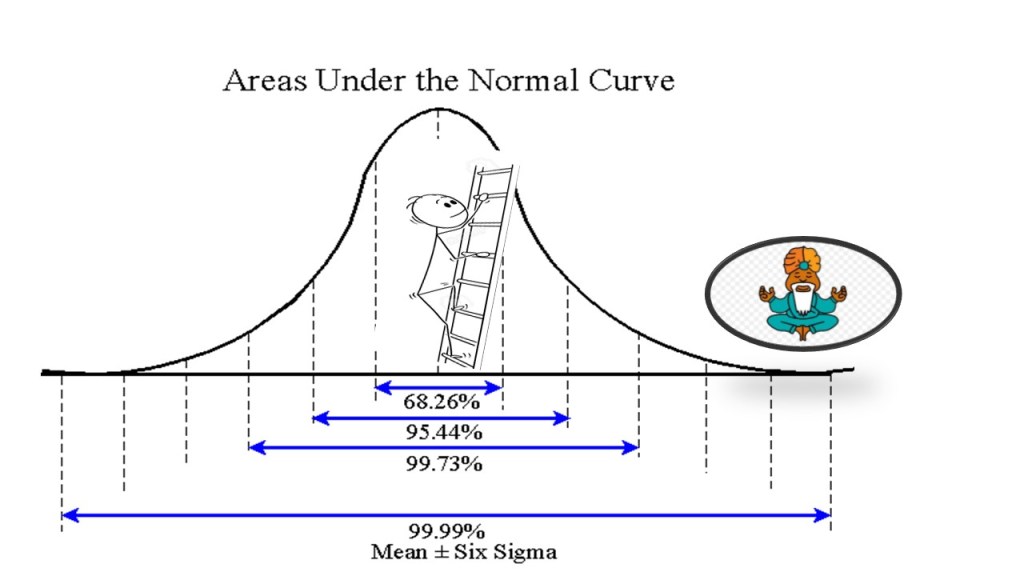
Once upon a time I won an award for achieving outstanding quality in an organizational context. I also taught six sigma concepts to managers in the company for which I worked. If you missed the six sigma effort, it had to do with reaching 99.99966% accuracy in deliverables or products by engineering efficient and repeatable processes. Sigma, of course, represents one standard deviation from the mean in a normal distribution (bell curve). Six sigma exudes absolute confidence in (close to) perfect achievement, all of the time.

Now you might suspect that the discipline of six sigma would also seep into the personal life of its practitioners, but sadly, that is not always the case. My workshop motto is “Oops!” and my crooked headstone will read “This Will Have to Do”.

How could a person sink so low?

Well, as I age, the goal of perfection seems further away. It’s like the Big Bang: the universe is expanding faster than my ability to keep up.  Certainly there is a red shift in my ability-to-aspiration ratio. Pursuit of excellence has been replaced by pursuit of ‘okay-ness’.

Social psychologist Gordon Allport used to say that individuals generally adjust their goals, based on a recent track record of successes and failures. This concept was strongly brought home in a recent project I attempted – installing a planked ceiling and crown moulding in my second floor stairwell. Naturally, I researched different methods of cutting compound angles and I built a stair box to support my ladder. However, try as I might, I could not envision the correct method of cut… and due to a long standing reversal problem, one third of my stock was wasted. However, despite uneven walls, ladder balancing, and (what is the opposite of ambidexterity? – well, that), it got done.

In retrospect, I wonder if pursuit of excellence is at times hijacked by a simple desire for personal control – a goal that is usually self-defeating. In that regard, it’s easier to understand the artists who intentionally mar their work as a recognition of impossible standards. Clearly, my work embraces this wabi-sabi approach.

So these days, I’ve attuned my goals to pursuit of small successes… anything more falls into the category of ‘minor miracle’. But you know what – that’s okay. Maybe one sigma is enough…

Pursuit of Perfection

As Wally suggested, I’m one of those people who missed the Six Sigma program.  But after admitting my lack of knowledge in this area I  think in my field of work,  perfection is rarely achieved and we settle for doing our best, at least the conscientious ones do!  I can’t imagine what perfection even looks like in education, or in my second career of innkeeping, for the simple reason that our final product is people and I don’t think there is anyone perfect (to the chagrin of those who think they are!)  How is perfection measured when you don’t know the results of your input for years to come? 
But loving what you do makes the striving for excellence easier.  And when success is reached the pleasure and pride is shared with those who are benefiting from your hard work!  That is a feeling that is unlike any hallucinogenic drug can deliver.  And it propelled me to do it again tomorrow, maybe with modification or maybe not. I did that for 35 years and it never got old.  Don’t get the wrong idea.  As much as I would like to think that level of excellence was reached everyday in my classrooms, I know there were low days and bad days interspersed with the good ones but there was always tomorrow to win my respect back!


Innkeeping is similar.  The end product is a happy tourist.  I was good at that too.  We always went out of our way to please and delight our guests.  If they mentioned something they were looking for, kind of off the cuff, we arranged it for them to their delight.  Cleanliness and good food are requirements in hospitality so that was a given.  Excellence came in the trimmings.  One of us met them at the door after dinner every night just to see how they enjoyed it.  The fire was always going in the living room for late evening schmoozing with a glass of wine, and a willing ear to listen to their stories.  But once again we were doing what we loved so striving for excellence was an achievable goal not an obligation to merely get through the day!


Now, however, with advancing age and social distancing the trouble is I have lost my purpose, my definition. I was a teacher, then an innkeeper, but now I’m a lonely old man with inertia.  I do believe I’m probably pretty good at inertia, too.  After all my entire life I strove for perfection.  I know I’m good at it cause when I try to get out of my chair, there is this weird groaning noise and I realize there is no reason to get out of my chair.  Looking for purpose is hard, and I’m not really good at it now,  but hopefully as the world opens up new purposes may provide themselves to me and I will find another one I love and strive for perfection once again!

The Stigma of Perfection

I am a firm believer in personal growth and self-improvement.  I have a dear friend who displayed a quote on the wall in her office that said, “If you’re not working on yourself, you’re not working.”  But even the six sigma model allows for a small degree of error affirming that perfection is not the goal.  And if the quest is for improvement in efficiency and effectiveness then doing the best we can under the circumstances can be pretty darn good.

I’m also a firm believer in “good enough isn’t.”  Let me explain.  I once worked for a boss who would often challenge my idea and requests, especially if they exceeded standard norms and resource distribution.  Her response would usually boil down to, “Can you live with what you have?”  Even now, I feel a visceral reaction to those words.  Of course I could “live” with it.  We don’t need even what we already have to “live.”  But to excel, to improve, to energize, and to engage my staff and colleagues to provide excellence, good enough just wouldn’t do it.  So when I talk about doing the best we can, I mean, doing the best we can which is definitely more than okay or good enough or even the infamous – “I’ll try” which, of course, allows for failure.

But none of this implies perfection.  Early in my career, I would hear the wise words of my senior colleagues who would remind me that I’d never get it all done because no one is perfect.  And while I understood them, I secretly strove to prove them wrong.  Even when, at times, I may have reached a six sigma level, it not only didn’t last, but it took its toll from other parts of my life.  Later on I would learn that balance and working to be my best self were necessary companions in living a good life.

Today my best isn’t what it once was.  And while it’s better in one or two areas that have unfolded from the wisdom of many years of experience and self-reflection, it cannot, nor should it be, compared to days of yore.  “Oops!” and “This will have to do” accompanied by an understanding and accepting smile may also be a sign that not everything that used to matter, still does and what didn’t appear to carry much significance, now holds more of our attention at doing the best we can.

Simplicity

My red-tinged maple 
Duke by my side 
The sharp line of shadow and sunlight on my garden

My own schedule 
Freedom of choice to do as I may 
Time to wonder while I wander

The gentlest of breezes 
Perfect coolness 
Endless blue sky

Learning to be in stillness as an end in itself 
Accepting the rush of others without judgment 
Trading later for now as well as I can

I am 
We are 
This is – enough.

Simplicity/Serenity

Simplicity is a word I have not been familiar with for most of my life.  Simple does not exist in my vocabulary, well at least my pre Covid Vocabulary.  My life has always been complicated and I have succeeded in surrounding myself with other “complicated-lifed” people.  I know there is no such term but the condition exists.  See, maybe this is why my life has been complicated. Plus my progeny also learned to be complicated and so the cycle continued!  

Then slowly at my increasing age several goal posts were reached. 35 years in education and then WHAM- retired.  And immediately 25 or so lives were out of my jurisdiction but no, I opened an inn in Vermont and suddenly groups of people regularly entered and left my life.  I loved both occupations but , come on-  simple?  Huh uh! 

And then……Covid 19 came to

my house!  At first there was the scramble to figure out how to socially distance and self isolate.  Do I barricade my front door and move heavy objects in front of it?  Worry and confusion muddled my life until I found a routine to follow and the realization that I would be spending most of my time alone, which immediately eliminated a huge portion of anti simplicity in my life.  

I first was uncomfortable with the quiet.  Initially people stayed off the streets. There was very little traffic noise in my area. Even the dog stopped barking because there was nothing for him to bark at!  Simplicity was seeping into my life a little bit at a time.  And I didn’t like it!  But like a numbing gas seeping under my door I was getting used to the quiet and the simplicity of life.  The biggest complication was what to have for dinner.  Hell, I can always have pasta!  Simple!

Then at night I began sitting in the dark on the back porch.  My neighborhood is quiet at night and dark.  I can feel the gentle breeze and the cool air and I have learned how to sigh. It sounds like this, “Aaahhhh!”  My dog and I are pretty much in sink and often our sighs are synchronized!  He gives me a lick on the face and then goes and cuddles in a pile with the two cats.  I watch, feeling a little left out and wonder why we as people can’t get along as well.  My wine glass is getting a little empty so I refill and sit back in my rocker and just as I close my eyes to chill and listen to the silence.  I hear the train whistle as it comes over the trestle across the creek and I smile.  I imagine hoboes hitching rides in the boxcars taking them to new adventures and I let my imagination go wild.  Simplicity has its advantages!

Simple is a Reprieve

Simplicity is a reprieve. It is a respite from the daily ‘busy-ness’ and complications of daily life – I sincerely doubt it is a steady state. But, hey, I’m no expert – so a quick survey of the internet was in order. I checked out a paper from the Journal of the History of Ideas, called Simplicity, a Changing Concept. Unfortunately, it turned out to be too complicated to easily apprehend.

Next steps: poems, quotes, and sound bites – my go-to’s (now there’s simplicity in action)! Usually, poetry expresses larger concepts in fewer words… however, I found no real affinity in the poems that I looked up. Again, they were not delivered in the shape of simplicity. In fact, one poet wrote about morning: “Whether it’s sunny or not, it’s sure to be enormously complex—“(William Meredith, Poem About Morning). He goes on to suggest, why take it on again (i.e., the complexity), when you were duped yesterday. Yikes!

The philosophers have more succinct quotes. Lao Tzu wrote that he had only three things to teach: simplicity, patience, and compassion. I’m pretty sure that Lao Tzu did not write the pictograph instructions that came with the ‘shed-in-a-box’ that I just constructed to store my woodturning logs!

Even Thoreau, the prophet of the Walden Pond, may have been seeking refuge from more than life’s usual complications (although working in a pencil factory wouldn’t appear to be like a telenovela at first glance). Apparently, two years before he moved to the Concord woods, Mr. T almost burned it all down by starting a forest fire (the consequence of trying to barbeque a fish in a hollow stump). Perhaps he relocated because he was tired of being called ‘Hank the Skank’ by the angry townspeople. It sort of gives new context to his quote: “We are happy in the proportion of things we can do without”.

Even Albert Einstein weighed in with his three rules: a) out of clutter, find simplicity, b) out of discord, find harmony, c) in the middle of difficulty lies opportunity. To test this out, I reposed to my messy office, but after two days – dehydrated and weak from hunger – my wife showed me the path out of the room. Strangely, I did find some measure of harmony in the disorder, as though that was meant to be my steady state. However, in regard to Einstein’s third rule, I found that in the middle of difficulty lies more difficulties. (Try filling out a grant application for COVID Personal Protective Equipment).

In sum, I learned that my state of harmony lies smack in the middle of chaos — not apart from it. In homage to Hen, however, I found a quote I think he would like from author Sharon Salzberg:

“We can travel a long way and do many things, but our deepest happiness is not born from accumulating new experiences. It is born from letting go of what is unnecessary, and knowing ourselves to be always at home.”

Sharon Salzberg

As the World Turns

This past winter slowly, almost imperceptibly melted into spring. Winter temps were very mild and snowfalls almost negligible.  But as spring arrived so did Covid 19 and the accompanying isolation. Spring, usually accompanied with people spilling out of their houses, going to yard sales, nurseries, flea markets with their friends were stifled by the need to socially distance ourselves from one another.  Spring temperatures revved quickly up to the 80’s and days became indistinguishable from summer. 

The Spring months were lonely, solitary, fearful months as we began to learn more about Covid.  Instead of spring clothes we adorned masks and carried hand sanitizer whenever we dared venture out of our domiciles.  Days flowed one into the next unnoticeably, I lost track of the day and the date and it really didn’t matter.  Because of the heat of this past spring I hardly noticed when the solstice arrived and the season changed.  The brightest day and longest day of the year was hardly discernible because sequestered inside the house, little seemed different.  Perhaps the only recognition of the change of season was the sound of mowers more frequently resonating around the neighborhood.  Little social interaction between neighbors occurred cause we were all trying to feel our way safely through this pandemic.

Now with Labor Day over we are about to slide into the next season.  As a kid, autumn was always exciting.  In NYC we used to rake all the fallen leaves into huge piles on the edge of the road and jump in them.  Running, leaping, screaming into the piles. Then our dads would light the pile of leaves at the curb and we would all stand around and watch them burn.  That’s something you can’t do today but on any fall day, on any block in the suburbs of NYC,  you could find a pile of burning leaves to warm your hands with. The smell of the burning leaves is emblazoned in my nasal cavity for life and the thought of it, not it’s presence, still warms the cockles of my heart!  Autumn was for kids, for artists who tried to capture the incredible colors of the leaves, for bakers, with apple and pumpkin pies in the oven and their aromas wafting through the neighborhoods.    

During my teaching years, fall brought the first day of school.  I loved the excitement of setting up my classroom, loved decorating it for fall and meeting all the new students.  During my innkeeping years in Vermont it was the start of “leaf peeping” season and dealing with a month straight of full houses and   welcoming new people from all over the world.  It was exciting, special, I was surrounded by people in both experiences and loved it.  At the inn in the evenings it would mean schmoozing with guests in front of the raging fire and bottles of red wine.  There was joy and laughter and incredible conversation with people from all over the country and around the world.

So how am I going to distinguish the arrival of fall this year?  Of course, it comes with the 19th anniversary of 9/11,  an event emblazoned in my mind  and heart.  We are at the beginning stages of socializing and I have noticed a red tinge on some maple trees.   The light in my house has shifted slightly- the light from outside entering with a slight yellowing tinge.  I am grateful for that.  My dog and I wake up to a dark sky now which I can deal with because it is the natural progression of the world and it comforts me.  But little else is different from summer.  I suspect soon I will smell the wood burning stoves and fireplaces as they come into action and rubber gloves and masks will be replaced with knitted gloves and scarves, or at least I hope so!  I’m too old to do flips into piles of raked leaves and you can’t burn them anymore at the curb.  I’m ok with

those traditions passing but I would like to find a way to celebrate the autumn and would appreciate any suggestions as to how we can acknowledge the world turning during a smothering pandemic and once again discover some joy and youthful excitement.   Suggestions greatly appreciated!

Time Passages

The lead in to autumn is my favorite time of year and September my favorite month. George is right — this has been a time devoid of social landmarks that help keep track of the seasons. It is a shame, because we like to celebrate the seasonal transitions: winter into spring, spring into summer, and the coming of fall. The sameness of limited activity through the pandemic has dampened our collective activity. Unless you are a potential super-spreader, you have likely narrowed your social outreach. Schooling, zooming, or working from home has you staring at a screen of one sort or another for a good portion of the day. Is it possible to get a “blue tan”?

Yet, there is something about the fall which you feel in your bones. The high pressure weather systems and cooler temperatures encourage me to move, finish projects, and prepare for winter. Autumn is large muscle time – outdoor projects and sports take center stage. Growing up, the Fall Classic was the World Series which was played out in September. It was football weather in October, marked by homemade confetti and the smell of oak leaves. These days it’s the start of the indoor tennis season. I don’t see this time of year as the end of summer so much as the beginning of a new round of events. 

If summer is the celebration of flowers, the fall is celebration of leaves – and the harvest. Vegetable gardens are bountiful. Nothing better than fresh tomato sandwiches! Farmers markets share the bounty. It’s time to plant mums! 

This year has dulled the social aspects of the seasonal celebrations and looking back, it seems as though we have been robbed of our preparatory rhythm. Rhythm is important. Many of my friends are having difficulty remembering the day of the week, so it’s no wonder the weeks have passed in homogenous similarity. George asked for suggestions… I’d offer these:

  • The nights are cooler. Take advantage open windows and regular sleep patterns
  • Buy new shoes. Go for a walk in your new shoes… be aware of the new bounce in your step
  • Pretend you are starting school – get up at a regular time; dress for the day
  • Prepare your garden for winter rest – spend an hour a day outdoors
  • Start an indoor project
  • Take vitamin D – less light, more Seasonal Affective Disorder
  • Less TV, more book
  • Celebrate the bounty of the season with fresh foods, a new coffee, a different tea

We can make our own seasonal markers. Make your kitchen table the center of the celebration. As Joy Harjo writes:

The world begins at a kitchen table. No matter what, we must eat to live.

The gifts of earth are brought and prepared, set on the table. So it has been since creation, and it will go on.”

Moving Through the Seasons

My blogging partners raise the question of how the pandemic influences our movement through the seasons. Certainly the transition of summer to fall is most noticeable to those of us who have connections to schools. Whether we have children or family and friends who are school employees, the summer vacation typically comes to an abrupt halt after Labor Day and marks a shift from more leisurely living to more rigorous schedules

The pandemic has certainly impacted this tradition.  While children and staff are back to school, they are returning in new and untested ways.  Hybrid models of in-person to full time virtual learning have unfolded with uncertainty as each district and state interprets the data and readies their school communities for potential shifts and adjustments over the coming months.  Add to that the challenge for working parents, who may or may not be working from home, to supervise their children when they are not in school, and we have a fall season like no other.

Yet autumn still signals us with diminishing daylight, cooler temperatures, changing leaves, and flowering grasses.  The days no longer sit heavy with heat and moisture and the cooler temps and falling dew points encourage us to get up and out, to breathe deeply and to enjoy our natural surroundings.  Duke and I have more energy and a quicker step during this time of year.  In this pandemic fall season I am still able to hike, garden, split wood, and sit on the porch with my laptop.  What’s changed is the lack of group gatherings around the fire pit and visits to see my grandchildren and to help out with their online learning while their parents are at work.  Not being able to help is my biggest challenge and not knowing when this will change, adds yet another layer.

However, fall only lasts so long.  Right now I am still able to have a friend or two over to sit on the porch for a meal or for a walk in the woods and to play outdoor pickle ball in the local park.  When winter arrives, these options will no longer be available and I must ready myself for a season of solitude (SOS). While the last few ideas Wal offered can apply, like George asked in his opening post, I welcome suggestions for those indoor days.

I-dentity

I’m sitting at the dining room table with my grandsons. We’re discussing the use of semi-colons. Yikes, why? Well I read a squib in The Week, indicating that young people find it hostile when older people, such as myself, use a period in a text message. I wondered why and asked my two young consultants. My youngest grand said that periods are called for at the end of a thought and are not a signal of hostility; my older agreed with the The Week, feeling that the period expressed a position of stark finality – in the vein of a proclamation from an adult — and possibly too strong for a short informal text. He felt that lack of a period leaves a sense of open-endedness in the exchange.  That led to a discussion about other punctuation, including the misunderstood semi-colon. I mined Wikipedia for its guidance on the “;” and we had a lively conversation on punctuation. Who’d a’thought?

Let’s segue to the well-used pronoun “I”. It is used four times in the paragraph above – four times in nine sentences. If we add the use of ‘my’ or ‘myself’, that is nine times in nine sentences. Sounds like it’s all about me, doesn’t it? Sometimes this is called ‘self-reference’ writing. Does it seem to you that self-reference is an over-used trope in both writing and speaking? Perhaps it is a sign of the times that one’s point of view overshadows all forms of communication. When was the last time you heard a reporter simply read the news, versus opine about it? Maybe it’s time to consider a different approach.

A book (Wake Up and Live) written in 1936 explores the idea that self-reference discourse freezes a person in their own opinions and hardens his/her/they/one’s point of view. Sure, describing a personal experience requires the use of personal reference, but perhaps that need not be dominant form of daily communication. The author, Dorothea Brande, suggests avoiding the use of “I” or “my” as an exercise in damping down the subjective or egocentric nature of our thinking. Her thesis is that substituting “we” in our conversation nudges a person to find common ground with others – and may in fact make a person a more interesting communication partner.

Since common ground seems like a diminishing resource these days, it might be worth a try. As a homework assignment, she asks her readers to write an essay or report without using any self-reference – no “I” or “my” or “me”. Sounds like a tough task for us who are members of the “Me-generation”. But there’s help. Check out ‘Avoiding the “I” Trap’ https://www.livewritethrive.com/2015/12/09/writing-mechanics-avoiding-the-i-trap-and-other-irritants/ and ‘3 Methods for Avoiding Personal Pronouns’ https://www.wikihow.com/Avoid-Using-Personal-Language-in-Writing.

But enough about me….

Beyond the _I_

Walther Conkite was the trusted voice of reason.  In an article written by Scott Simon for NPR, Simon says:

“Cronkite was a great broadcaster. He spoke to masses, not niches. He grasped that when the news was urgent, people would turn to the broadcaster not only for information, but for sincerity and calm.  Millions of people felt better to hear from this man who seemed experienced, but not jaded. He had a visible sense of grief in tragedies, and a little boy’s delight in the glory of space shots. He had gray hair and hound-dog bags under his eyes, but ageless sincerity.

Wal (another Walter) nudges us past what is, to what might be, and in the case of Walter Conkite, what was)

The notion of speaking and writing from “I” is something well practiced, especially in the United States.  Emily Landon, the chief infectious disease epidemiologist at University of Chicago Medicine writes:

“In all honesty, if we say, ‘This is like the flu, we’ll be all right,’ that attitude is going to harm other people,” Landon told The Post. “And it’s really hard to wrap your head around that, especially in American culture: We’re individualistic and we pull ourselves up by our bootstraps and find a way to make it through. And that’s not going to work right now.”

On April 1, 2020 Jane Hyun wrote an article for Fast Company about the impact of culture on how we approach the current pandemic.

“Geert Hofstede, renowned social psychologist, measured the differences in individualism vs. collectivism across nations. The “hugger” approach is a prime example of American individualistic culture. It is expected that each individual act for him or herself, make their own choices, and that individual needs take precedence over the group’s. In South Korea, Singapore, Taiwan, and China, where the collectivist orientation is prevalent, preferences are given to the rights of the community, team, or organization and standing out is not encouraged; therefore decisions are made that take into account the best interests of the group. Employers (and institutions) take responsibility for their employees and recognition is given to groups and teams as a whole. In times of crisis where we need to move quickly to contain a pandemic, the collectivist orientation perspective has its benefits.”

We are a country that fiercely celebrates independence, so it is not surprising to find the “I” influence in our communications.  Earlier in our culture, it was more common to find families living in closer proximity and each member accepting responsibilities that contributed to the greater good.  It could also be argued that family elders were looked upon for their life experiences as well as the stories that bound the kinfolk.  This interdependence was often necessary for the survival and success of the family. Perhaps this is a seminal time for us to consider a shift in our way of thinking that goes beyond the “I.”  Perhaps, in addition to the benefits of independence, there are significant consequences we wish to avoid and the bygone benefits of interdependence are worthy of renewal.

Me, Myself, and I

I am the oldest member of this blog group.  Henry won’t be my age for another 2 or 3 months and Wally, well he’s much younger!  So, I’ll just say that if wisdom comes with years,  I should receive respectful deference for my opinions!  I’m glad Wally didn’t talk to his grandchildren about the use of exclamation points cause I use them all the time!  Not that everything I say requires emphasis because of it’s value but I’m old and need humoring!   I will,  however, adhere to the concept: one sentence, one period at the end.
I am not very cerebral.  I think with my gut.  I often use wrong parts of my body to do different functions than were intended.  But I digress!  After several readings of  both Wally’s and Henry’s pieces I began to understand the concept of I-dentity.  I slept on it…I contemplated over late night snacks on it,  I mused over how to write without using it.  And(never start a sentence with “and” nor end one with a preposition) I questioned what the heck was I going to write about!  After several failed attempts I realized my writing was about my personal feelings and experiences.  I always value hearing other people’s personal experiences and feelings about those experiences.  In a political time when social discourse is mainly “them” vs. “us” I would rather hear about you personally. I am comfortable reading an entire story about someone in the first person. I don’t feel that the decline of western civilization is based on our ending I-dentity in our literary genre.
I commiserate with 3 important people in my life I this time of pandemics,  Me, Myself, and I.  Therefore,  I will write in the first person. For me my ideas, experiences, and struggles are valuable to be shared. If something I write gives someone an idea how to deal with something, I have done a good thing.  If you are experiencing something that I may have already gone through, it may make you feel good to know you aren’t alone!  I know that has happened to me. If just for a moment something I said put your mind at ease, I have succeeded!  If something I said gave you an idea of how to deal with something, I have succeeded.  If you chuckled, I have succeeded.  It has to do with authenticity.  This IS who I am.  But now, one must stop and get one’s butt into bed!

When We Struggle

We all have different thresholds for what moves an inconvenience into the struggle category.  And, because words have different meanings for each of us, to acknowledge struggle doesn’t mean the same thing for everyone – anyone for that matter.  

Some define struggle as  “work hard to deal with or overcome a difficulty or challenge.”  Notice this is written in the singular, which implies that we perhaps “struggle” with one thing at a time.  But wait!  It has been my experience that when one thing stands apart from the many, I am more easily able to marshal my energies to focus on a solution or best choice scenario.  In fact, I am often energized in this case because most everything else is in synchrony, relative harmony, and in alignment.  I have the luxury of allowing an unrelenting focus on my issue.  Yum!  Nope, that doesn’t define struggle for me.

For the purpose of this post, I need to pluralize the definition to include the feeling of being bombarded by multiple difficulties and challenges for a significant period of time.  Add yet another factor of not always being able to clearly identify all of the assailing projectiles, and you might better understand where I’m coming from when I say, I’m struggling.  And now add the component that there is no convincing evidence to support an end-date by which most of these trials will resolve.  Ugh!

I recently went for my physical exam.  Prior to and throughout the process, I was asked as a matter of a new standard protocol, if I was feeling depressed.  Is this not a sign of that many of us are struggling during these times?

It’s one thing to know about struggle and how to address it.  It’s another thing to be able to step back to see yourself more objectively as others may see you.  But it’s an entirely different thing to be able to apply what you know and what you’ve learned to move forward toward improvement and out of that almost seductive black hole that spirals downward into an emotional abyss of despair.

Throughout my life I’ve ridden the roller coaster of good and bad, happy and sad, fulfillment and desire, success and failure.  When I look back though, I realize how thrilling it has been, how much joy I’ve felt, and how many people I’ve interacted with and with whom I’ve influenced and been influenced by.  The bumps and bruises of the wildest part of the ride have left scars, yes.  But they also taught me when to pull the seat belt tighter and when to loosen it, when to hang on tight and when to weave and bob and be more flexible.   Each incident gave me more reason to keep at it.  It always, always, got better.

One of my secret weapons against struggle!

If you asked me last week, I would have told you the current events in my life during these extraordinary times have given me good cause to say I’m struggling.  Today I would say I’m not!  Not so much has changed since last week.  But the few simple things that did, allowed me to remember to have faith, that life is good, it all works out, and the struggle makes me stronger.

Some things that help me with struggle:

  • Reach out to friends, especially those who know how to listen.
  • Nature heals, even when it’s too damn hot to feel it.
  • Exercise, keep moving, motion is lotion (for my old achy joints)
  • Laugh
  • Hug – thank goodness for my dog Duke.  (He’s much softer than the trees.)
  • Get back up – every time
  • Keep an attitude of gratitude, even when you’re not feeling it.
  • Drink chocolate ice-cream sodas with whipped cream.  (My two secret ingredients are a splash of heavy cream and a squirt of raspberry syrup.)
  • Be helpful to someone other than yourself.
  • Life is uncertain so eat dessert first. (Did that last week with George and Wal!)
  • Let go
  • Accept

A Struggle Snuggle

I’m glad Henry raised this topic.  I’ve struggled my entire life for all kinds of things, mostly trying to hide who I really was.  That was a struggle that took somewhere upwards of 40 years to resolve.   It was a struggle I had to manage all alone and without help, advice, or encouragement from anyone.  That’s probably why it took so long!

Historically, I have always had trouble asking for help from anyone.  For most of my life there have been unresolved issues that were easier to let sit and fester than to resolve by asking for help.   Simple kinds of things, decisions about career and family, daily life stuff.  Just let time pass, they will work themselves out.  Of course my internal worry system would have time to kick in and often built the struggle way out of proportion from what could have easily been resolved yesterday. 

But I notice now we all seem to be struggling.  Not just from the virus and the quarantine but the news cycle as well. The struggle is an internal struggle.  How do I deal with the loneliness, the isolation, the news of hardship and pain, the inertia that months of separation have allowed to set in?  Things are easing a little and I find it becoming an effort to get out of my chair and do things.  I miss people and touch. Reaching out isn’t easy.  Each evening as I climb into bed I have an overwhelming feeling of sadness oftentimes driving me to tears. The sadness is sometimes brought on by something I saw or read about someone else’s misfortune but sometimes it is just a heavy dark sheet that covers me in self pity! The cause undetermined other than these crazy times in which we live and the lack of knowing if letting time pass will bring back NORMAL!

Things are so strange.  The other day my neighbor introduced me to someone who was working on his house.  I reached out automatically and we shook hands.  Immediately we both apologized but it was automatic, sincere and comforting to do it. Something so natural has become another struggle. Common daily practices become part of the problem.  

Living alone now has intensified my struggles.   Not because I would have asked for advice or help but because my struggling is always easier with a snuggle when someone just understands you are going through something that a hug, cuddle, or pat on the back could help.  I, like Henry, have a dog to hug who isn’t a bad snuggler and seems to have a sixth sense about when the dark sheet starts to cover me.  We are all dealing with our own demons, and I’m afraid each of us has to find our own way to slay them!

Inertia

Struggle — whether you oppose, contest, fight, endeavor or find yourself in a conflict, encounter, or skirmish – means you are rubbing against the grain. 

I admire Hen’s ability to profit from a struggle involving multiple and/or serial difficulties, but I can’t seem to embrace a positive position on this subject. Mandy Kloppers writes: ”With struggle there is no joy and rarely any reward. In fact, for some people struggle is the reward. They are a little lost without it. There is comfort in what you know.”(mentalhealthnet). 

Perhaps that better describes my position – I expect to struggle, so I do. I expect to contest, churn, and endeavor – but not to enjoy it. When it seems like a flight of arrows forces you to tuck and roll – my primary focus is simply to survive. Generally, I put my head down and grind through it. When it’s over, the overwhelming feeling I have is relief – and the satisfaction of remaining somewhat intact. And perhaps a little lingering adrenaline high.

Hen says what doesn’t kill you makes you stronger. The Jamaican version goes ‘what doesn’t kill you, just gives you gas’. Struggle is a case of indigestion with a heartburn topping. Struggle is roadwork on your metaphysical highway. Struggle of any kind looks just fine in the rearview mirror, but there are plenty more visible in the road ahead. What’s to like?

I suppose I’m a big fan of inertia in the sense of moving in a straight line at a constant speed, unimpeded. Inertia isn’t laziness – it’s the need to channel energy to stay on track to reach a targeted goal. George is right: most of our struggles are internal. My guess is that many internal struggles are manufactured distractions. Perhaps that’s why Matthew Wilder’s anthem sings:

Ain’t nothin’ gonna break-a my stride
Nobody gonna slow me down, oh no
I got to keep on movin’
Ain’t nothin’ gonna break-a my stride
I’m running and I won’t touch ground
Oh no, I got to keep on movin’

Granted that presumes a limited amount of self-reflection. But I can identify with the aspect of powering through some internal doubts or struggles in order to face the basic conditions of life: we do our best in the moment, understanding that we have limited control of all the variables and we may not make all the right choices, but we move on and hopefully live to fight another day. In the end, it is not clear that ‘struggling’ improves the choices that we do make. And yet, I’ll likely continue to struggle with this concept.