
Early this summer I decided to give back about 1/4 acre of my back lawn (It’s about half of my existing back yard) to nature by no longer mowing the grass or clearing encroaching branches from neighboring trees and shrubs . Currently, this section has longer blades of grass interspersed with the beginning of several shrubs and a very small tree. The Japanese honeysuckle, the Multiflora Rose, and the Bradford Pear tree are, according to my Picture This app, all hardy and healthy plants and I have every reason to believe they will continue to flourish and multiply. So far my bordering neighbor who is out back as I write, hasn’t said a word. Either the difference is still negligible, she and her husband don’t care, or I’ll hear from them soon. I’ve also stopped trimming the side of my lawn that borders the length of the woods along the side of my house which also allows tree and shrub branches to grow into the lawn area and for the undergrowth to develop unabated.

I didn’t make this commitment lightly. In fact, when I moved in a little over a year ago, I vowed to clear portions of the forest. These portions interrupted my line of sight and bumped out into the lawn. But I’ve come to realize that in addition to giving me more lawn to mow it continues to further diminish the local ecosystem which sparsely supports the shade we need or the natural elements that ultimately provide the food we depend on. I hope to make a difference by giving back space for regenerating this habitat.
Years ago I watched a webinar in which Doug Tallamy – entomologist, professor, and author – talked about how the non-native plants we nurture or simply accept and the manicured lawns we dote over have greatly diminished insect life – particularly caterpillars – to the detriment of birds and their survival. He reported that in the last 50 years we have lost 3 billion birds in North America alone and 1 million species face extinction over the next 20 years worldwide. Birds are actually responsible for pollinating about 5% of our food and medicine and for rebuilding damaged ecosystems by dispersing seeds through their droppings. And insects he explains, drive the production of essential seeds, fruits, and vegetables via pollination which are essential for our survival. They are at the heart of the food web, the main way nature converts plant protoplasm into animal life. And, insects and birds are often plant specific for their food. Many of the beautiful trees and plants that surround our homes are invasive. The three I mentioned earlier that have taken root on my dedicated back lawn are among them. The owners before me left my property beautifully decorated with flowering trees: mulberry, crepe myrtle, eastern redbud, and southern magnolia. The first two are also invasive. And while they all eventually will provide more shade as well as a habitat for animals, they are not likely to enrich the local ecosystem with the necessary insects and bird populations that are in serious decline here.
As I walk in the evening I notice a marked temperature difference when I leave our cul-de-sac which is surrounded by forest and move towards the center of the neighborhood which is beyond the cooling effects of the woods. For years our town has been clearing forests and farmland and building homes and retail centers. Homes with lawns and few trees and retail stores with huge heat-holding parking lots. I’m not telling you anything you don’t already know. Shade lowers temperature. Large shady areas cool larger areas of air which helps cool the surrounding environment. According to recent data from NASA and NOAA, the last 10 years have all been recorded as the warmest 10 years on record. 2024 is expected to continue this streak and break last year’s record high temperature globally. Every little bit we give back has to help.
“The sparrow heard that the sky was falling, and while all the other creatures fled, she asked herself, ‘What can I do? I’m just a sparrow.’ But then, in a flash of brilliance, she lay on her back, pointing her tiny feet towards the sky. ‘What are you doing, Little Sparrow?’ the others asked. ‘Well, I’ve heard the sky is falling, and so I’m doing my bit to hold it up.’,” Nipun Mehta recounts a story told to him by a young teenager from a village in India. In an address at last month’s annual Eurpoean Forum Alpach, Mehta palpably builds on the profound parable: “From the lens of impact, the sparrow’s actions may seem insignificant. Yet, where critical mass and ‘critical yeast’ converge is not in quantity, but in the organizing principle of the field in which they operate. The sparrow’s intention to serve without condition sustains the very platform of consciousness that allows a thousand flowers to bloom. She doesn’t just add a drop to the ocean; she sees the ocean in that drop. Her act, because it is given freely, without expectation, becomes the yeast of the heart, drawing a delicate line from the fleeting to the eternal, carried forward by the unseen currents of nature. And in that way, even the smallest act becomes a seed of transformation, a spark that ignites the unimaginable…” From the Daily Good – by Nipun Mehta
Reduce, Reuse, Recycle

I admire Hen – he not only stands on principle, he acts upon it. His experiment with the naturalization of his property will be interesting to watch. I can see many benefits for the habitat, as well as for addressing an important aspect of climate: absorption of carbon dioxide. I also like his fable, but more on that later on.
The problem is where to begin to comment on this huge topic. It’s easy to get lost. Just perusing the vernacular of climate improvement is confusing, because the terms have been co-opted by various entities: recyclable, biodegradable, non-toxic, sustainability, circular economy, advanced recycling, greenwashing. Think about it — are you certain that you know what they mean?
I thought I did, until doing a swift read of the internet. Biodegradable means it will melt away on its own, right? Well sure, but if it takes 450 years to do so (like a plastic bottle), is it really practical to name it biodegradable? How about ‘recyclable’? It turns out that many items labeled as such, can’t or won’t be recycled. Why? It seems that if any part of a recyclable product is contaminated, it can either impurify the rendered product or worse, gum up the industrial process used to do the recycling. The plastic windows in envelopes, the sealing membrane on yogurt cups, and other hybrid packaging prevent the recycling of the entire item. In addition, some products named as recyclable need specialized apparatus not widely available. Did you know that ‘compostable’ items should not be recycled (compostable means the same as biodegradable, except needing human intervention)? At the end of the day, only 5% of American plastics are recycled.
The good news is that these terms are being standardized by the Federal Trade Commission as we speak – the first revision since 2012. The European Union has formalized some of these terms as well. For example, “biodegradable” can only be used when greater than 90% of the original material must be converted into CO2, water and minerals by biological processes within 6 months.
All of that still leaves the world in a position of too much stuff! We have presided over the creation of a disposable culture. Tons of used clothing is buried under the sand in the Sahara as chronicled by a recent National Geographic article. Flip-flops will live forever, apparently. And let’s not even discuss the space junk flying around up there…
Well, I have a solution. My goal is to store 3% of the world’s cast-offs in my garage. I’m almost there. In 450 years, at least some of it will go back to its natural components: green timber drying in the shade, screws, fasteners of all types, old machinery, new machinery, forgotten decorations, rescued items with hopeful futures – it’s all there (at least in one garage bay). I’ll keep checking the progress!
Actually, I have another small goal: to upcycle waste items into some artistic result. It’s a movement: check out Sashiko (the craft of mending and swatch stitchery) and Recycl’Art. Linda’s friend Helene (no relation to the Hurricane) has been weaving plastic bags into usable items for years. I’m starting with making cupcake shaped boxes from detergent caps. However, check out the serious art installation in the picture attached – I wonder if this installation used any of the fashion detritus buried in the desert?
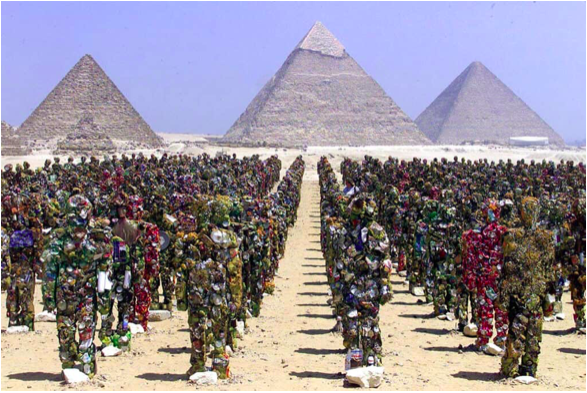
Lastly, I want to say that I loved Hen’s fable. It can seem sometimes that a lone person can’t make a difference. But if we all align with the sparrow, nothing can stop us!
My Frog Recycles All His Trash: Kenn Nesbit (from Poetry for Kids.com)
My frog recycles all his trash.
He eats organic food.
He cares for the environment.
He’s quite the hipster dude.
Reduce, reuse, recycle
is the motto of my frog.
He drives a solar-powered car
to cut back on the smog.
He helps endangered species and
opposes climate change.
He knows that, since he’s just a frog,
this might seem kind of strange.
But still he does his very best
to keep our planet clean.
He thinks it’s only natural.
He’s proud of being green.
Recycling

This is a tough one for me. I am not sure what to write because after our zoom discussion this week I learned that I was doing it all wrong. I had no idea you are supposed to remove the clear plastic that protects the tissues on your tissue box before it can be recycled or else they can’t recycle it. That was a real blow to my recycling activity. I have been recycling cans with the paper labels on them, not to mention all of the stuff I have been recycling that isn’t recyclable! Live and learn! At 78 I am learning new things all the time! My system is pretty straight forward. As I use stuff up and I don’t need their containers anymore, and if it is messy I rinse the inside to rid it of excess dog food, ketchup, mustard and whatever other condiments I use. I have a neat system. Right outside my kitchen door in the back room I have a large black, swinging lidded, multi use container, larger than a waste basket and smaller than the garbage and recycling barrels that get rolled out to the street every week. As I finish using a container or whatever, I rinse, shuffle over to the door and with the lid partially open I can throw most of my recyclables right into that container and save me a trip out there. Then once every week I drag my little container full of used merchandise out to the Waste Management rolling bin and take it all to the curb. That pattern is comforting, The routine done weekly every Sunday evening for early Monday morning pickup is strangely reassuring. But now since Henry and Wally brought this to my attention, that pattern is broken for fear I may have put an unrecyclable thing in my bin that doesn’t belong. That comfortable, reassuring routine will never be the same!
Recycling used to be simple. Growing up there were all kinds of recycling, we just didn’t call it that. I know I have mentioned this in other pieces but we had a metal box on the porch labeled, “MILK”. Each week mom would put the old used milk bottles in the metal box and there was always a curled up note in one of the bottles’ necks telling the guy what we needed for the next delivery. They would deliver regular milk, skimmed milk, cream, and some other milky like products. Easy…….no hassle. We as kids would collect soda bottles, I am not sure the soda can was invented yet, and we would go up and down the block collecting other soda bottles to return to the A&P or Bohacks, Waldaum”s or King Kullens, and for every bottle we would get 2 cents in return. It may have gone up to 5 cents a bottle by the time it was undignified for a high school student to be collecting and returning soda bottles. Of course the other major source of recycling or repurposing was the dependable paper bag. I had to give the cashiers at grocery stores real credit because they could fill every inch of that bag neatly and balanced so that it wouldn’t tip over if you had to put it down on the way home. I think the boxes of stuff back then were designed to fit neatly in the bottom of these bags so that you could get the most efficient amount of groceries into the bag. When we got home, Dad would empty the bags, taking each item out and putting it away before getting the next item. This procedure took a few minutes but it too was comforting to watch the system at work. Then when each bag was empty my dad would fold each bag making sure it would lie flat when he stored them away, until their next job came around. The best time for recycling paper bags was in September when school started. We would bring our school books home and we were instructed to get them covered ASAP. Out came the paper bags. They were cut into one long sheet of bag that would be folded top to bottom to fit the exact height of the book. Then you would fold the ends in so that it would cover the entire length of the book . You had to make sure that the open folded end top and bottom on each side would slide over the front and back cover of the book and fit snugly when the book was closed. The remaining bags were used for various and sundry things, linings for the kitchen garbage cans, etc.
Families recycled all kinds of things, we just didn’t think of it that way. Luckily I was 8 years younger than my brother, and half his size so my cousin got stuck with the hand me downs from him. But lots of other things residing in the attic were taken down out of the box marked Jerry and given to me like baseball gloves, hockey sticks, ice skates. and of course the old metal roller skates with the ears to attach to your shoes and the skate keys to tighten them. It was rare that I would get anything new until my brother went away to college and then I started getting new stuff. when I think back there were a lot of things that we repurposed or recycled but it wasn’t a big deal. Everybody did it! I even remember my mom would carefully remove a stamp from a letter that was in the mail box that wasn’t post marked and then she would glue it on to something she was sending out. She would also sew curtains for our bedrooms using old tablecloths or bed covers. That is the other thing people did back then that would fall into the category of recycling perhaps. She would darn socks, sometimes I had socks with two or three scars on them. People were just more resourceful perhaps back then and just did things because it made sense and saved money.
In my adult life I think we started becoming aware of the recycling phenomenon perhaps sometime in the mid 70’s. I remember when we lived in Woodstock, we would have to separate our recyclables. Glass in one container, cans in another and cardboard and such in a third. There was no curb side collection back then so we had to take everything to the recycling center ourselves and make sure we were dumping our recycling in the right areas. So I have been blindly recycling this way for probably 40 years plus. I thought I was being a good citizen by doing this. Conservation goes along with recycling and for many years as an innkeeper I drove two little Fiats, which I loved and also a Smart car which was really cool. And I did it to be conscious of the environment. Recently, the last few years I have been conscious of the fact that honey bees needed dandelions to be able to produce their honey so I made sure not to cut my grass until the first dandelion crop was in full bloom. I also purchased a battery operated lawn mower which I love even though it sometimes shuts down in the middle of the lawn . I equipped my house with mini splits for heat and air conditioning to save energy and money and it was the best thing I ever did, Now I have to sit and contemplate what can I
do now to meet the new demands on recycling. I will have to talk to Wally and Henry about this.

 Three Old Guys Walked Into A Bar
I too try to recycle. Hopefully, I get it right more than not. But I try. But what irks me are those who don’t even try. One of my pet peeves are those who toss a carbon box into the dumpster labeled “trash” instead of the one labeled “recycle.” The dumpsters literally sit next to each other. Sorry for venting. Good post.
LikeLike
Thanks for doing your part, Diana! Hopefully, each of us making our contribution will eventually reach a tipping point after which it will become a common and effective practice for everyone.
LikeLiked by 1 person