What Matters

From Samara to Burning Leaf Piles

Society depends on symbols. Symbols are used to keep us safe on the road where they direct us which way to go, where people might be crossing, or deer or where road crews might be working. They tell us where it is safe to park and where handicapped people can park to make it easier for them to navigate on our streets.  Symbols are used by professions to indicate their purposes. We know there is a pharmacy when we see the mortar and pestle, a restaurant when we see a fork and spoon,  the caduceus to indicate a doctor’s office.  Even in athletics, symbols are used to identify the different teams.  We use symbols on our clothing to indicate different organizations  we belong to or different causes we support.  We even use symbols to locate rest rooms or to tell us when it is safe to cross a street.  The upright red hand means don’t cross and the green silhouette of a person tells us it is safe. Most major organizations use symbols for their advertising.  Symbols are easier to understand than words and even people who don’t speak the language can identify the meaning of such symbols.

I have a few symbols, one in particular that is meaningful to me and that I have carried around with me my entire life.  My family left New York City when I was 5 years old.  They didn’t want me to start school there and have to pay 25 cents a week to the local gang on the lower East Side to guarantee my safety back and forth from school.  My folks decided to move to the country, which back then was Flushing, Queens.We moved into a big old house with 4 bedrooms and a backyard that had trees and grass and bushes.  From the very beginning before I developed any friendships with the neighborhood kids I found a huge old maple tree in the corner of our yard.  The roots stuck out of the ground in a circular pattern and I found l could sit with my back against the trunk and color in my coloring books or draw, even draw patterns in the earth with an old broken off twig.  I loved it there, I felt safe and comfortable.  I didn’t know it at the time but our street was lined with maple trees.  Coming from the Lower East Side of NYC, trees were few and far between and I didn’t know there were different kinds of trees.  That maple in my backyard became my friend.  There was something about the shape of the leaf that I thought was beautiful.  I can remember plucking a leaf off a low branch and twirling it in my fingers, studying each side, following each vein and tracing the shape of the leaf with my finger.  For a  little kid, I was enamored with that tree in my yard,  As I got older I would go there to escape arguments inside the house or times of sadness,  The tree never failed me.

Entertainment wise, maples always afforded us kids on the block with a lot of fun.  In the Fall, you could look up and down the block and see kids with their dads raking the dead leaves into piles on the curb.  Then the kids would go from house to house and take running leaps into the heaping piles of dried crunchy leaves.  I can feel the crunchy scratching of the leaves that wound up going down the back of my shirts, but the fun wasn’t over yet.  Around late afternoon, just before it would get dark, the dads did the unthinkable thing that dads of today can no longer do.  They would strike matches and those leaf piles became alive with orange and yellow flames and the incredible smell of autumn leaves burning could be smelled throughout the block. and the kids would stand around with the flames reflecting off their faces while their outstretched hands could feel the comforting warmth of the fire.  We always stayed til the last of the embers had cooled and the fire was just a puddle of ashes until the next raking session in a few days,

But the Fall wasn’t the only time we were entertained by the many talents of maple trees.’ When they went to seed the trees would shed their seed pods and we would catch them as they  twirled their way to the ground like tiny helicopters  They looked like old men’s mustaches and by puckering your top lip you could hold one between your nose and lip and talk like we thought old men used to talk.  And better yet, if you broke the seed pod in half, and separated the actual covering of the seed, there was a sticky substance that allowed you to stick it to the tip of your nose and walk around like that until the stickiness wore off and it fell to the ground.  The seed pod of the maple I came to discover was called a samara.  

As I got older, I began to appreciate the beauty of the maple leaf and discovered the many varieties of maples that exist.  I loved the shape of the leaf, the points and valleys between them.  I loved how the veins brought nourishment to the foliage.  They would branch out toward each of those points assuring me that life can be fulfilling and sustaining.  And then the added bonus of the changes in colors as the seasons changed and they could produce brilliant reds and yellows depending on the variety of the maple.  Sometime in my teens I saw a copy of Vermont Life magazine and it was all about maple syrup and I actually bought a subscription to the magazine.  Vermont seemed like a wonderland of nature, and I wanted at some time to live there with all the maples and syrup I could stand.  The maple leaf became my symbol!  I would draw a maple leaf on my schoolbooks that we all covered with brown paper bags from the supermarket.  To this day I still enjoy the beauty of that simple pattern of nature. I always imagined getting a tattoo of a maple leaf on my arm but never was brave enough to actually do it.  The closest I came to it is putting a maple leaf decal on both sides of my Jeep hood to keep the memory alive.  I did fulfill my dream of living in Vermont after I retired from teaching.  I owned and operated a Bed and Breakfast in a beautiful Vermont town and Vermont proved to be that amazing place where maple trees thrived, and life just seemed simpler!

Reverence for Trees

Don’t get me started on trees! The Ents were my favorite characters in JRR Tolkien stories.  To me, those large, slow moving, ancient tree creatures represent the power of stewardship. It’s no wonder that people have such strong attachment to the mighty entities we call trees. Once I was called to evaluate the fallen carcass of a beloved tree, in order to judge whether the wood was viable for a sculpture. The owners grew up with that tree (as George did with his maple); had named it; climbed it as kids; and wanted the memory of their tree-friend to be showcased in a sculpture.  They felt so strongly that they engaged a wood artist from Ireland to create life-size ballerina figures from their maple.

Actually, I’m doing something similar: making a series of twenty ‘steeple’ pens from pine used in an 1853 construction (as a result of some remodeling of our church’s steeple). When you consider that the 16” boards that came out of the steeple were likely from a 200 year-old pine, this tree was a youngster in 1650!

If you’ve kept up with current events, no doubt you’re aware of the recent outrage over the felling of the Sycamore Gap tree which stood by Hadrian’s wall in Britain. The logger initially (falsely) accused of the illegal cutting said, “If I’d have done a murder, I’d be getting less hassle, you know that?” – and now wears a wig to disguise himself. People have a connection with trees!

The connection is so strong that many animistic religions claim a self-aware life force – a consciousness — in trees. From the sacred ash tree in Norse cosmology (Yggdrasil) to the shinboku trees of the Shinto belief, trees have been used since early times as a means of approaching the divine, particularly through specimens which have lived for many human generations. Some tree populations – especially clonal forests – are estimated to be among the world’s oldest living entities (The Pando Aspen Grove in Utah is said to be between 14,000 and 83,000 years old, connected by a common root system). Some communities respect their elder-trees by taking their name, e.g., Elmsford, named after the 300-year-old Elm used as a landmark by George Washington. George’s maple tree may have been over 100 years old.

And trees communicate. Some call the interconnectivity of the root system the “wood-wide web”, due to the ability of trees to send chemical messages to other trees through mycorrhizal network – an interaction of root and fungi. German author and forest steward Peter Wohlleben described tree interactions in his book, The Hidden Life of Trees (a great book btw).  

All that said, I’m totally on the same wavelength as George! And while I love the many varieties of acer, my strongest association with a tree symbol is quercus, the strong and enduring oak. In fact, I use the oak leaf symbol – a sigil, really – for my woodturning venture: Lost Leaf Turning.

The use of the oak leaf comes from a very intense dream that I had as an adolescent. No doubt it was influenced by the 1954 movie, Prince Valiant. I used to read the comic strip as well, but the movie made an impression. Specifically, Valiant wore a sigil of a horse on his attire, including his over-tunic. In my dream, I was fighting evil-doers and had the pointy red oak leaf on my chest. Very specifically, my over-tunic was white, with a cutout in the shape of the leaf – and the under tunic was forest green, showing through the negative space – producing a green leaf on white background. In a way, it’s kind of reminiscent of George’s green maple leaf on his white jeep.

Of course, I was fascinated with knights and at the right age for such fantasies. However, the image in the dream persists, even sixty-plus years later. The symbolism of the oak for me represents the ability to hold strong to purpose and to live with honor, participating in the mysteries that the ancient celts used to call ‘oak-knowledge’.

This sense of endurance and resilience is found in the poem The Oak Tree, by Johnny Ray Rider Jr.


A mighty wind blew night and day
It stole the oak tree’s leaves away
Then snapped its boughs and pulled its bark
Until the oak was tired and stark

But still the oak tree held its ground
While other trees fell all around
The weary wind gave up and spoke,
“How can you still be standing Oak?”

The oak tree said, “I know that you
Can break each branch of mine in two
Carry every leaf away
Shake my limbs, and make me sway.

But I have roots stretched in the earth
Growing stronger since my birth
You’ll never touch them, for you see
They are the deepest part of me.

Until today, I wasn’t sure
Of just how much I could endure
But now I’ve found, with thanks to you
I’m stronger than I ever knew.”

I Am Phoenix!

The legendary Phoenix is my symbol!  I didn’t meet this noble creature until I was in my early forties.  It began in the best darn elementary school east of the Mississippi! (Actually west too but I love the phrase so why not?) I don’t remember how I came upon the book but loved reading it aloud on Friday afternoons to all the fifth graders.  Each of the many mythical characters who came in contact with the Phoenix was unique and I was able to formulate a different voice for each.  For years I took these ten and eleven year olds on one adventure after another as the Phoenix attempted to teach David the “important and meaningful” lessons of life.  At the time, it was a great way for me to connect to the students while being appropriately childlike along the way.

Years later, I found myself drawn to the symbol of the Phoenix as well as the traits (admittedly they were embellished in the story) affixed to this creature.  In time, it became somewhat of a representation of both who I am and who I aspired to be — rebirth, passion, tenacity, courage, flight, wisdom, common sense, kindness, competitive, love of sweets, friendship, mentor/coach, love of outdoors, and a playful sense of humor.

The book, written by Edward Ormondroyd, follows the adventures of a young boy named David, who stumbles upon a mythical creature, the Phoenix, in the woods near his home. The Phoenix is a majestic bird with brilliant plumage and the ability to be reborn from its ashes. The two of them quickly become friends, and the Phoenix takes David on a series of magical journeys.Throughout their adventures, David and the Phoenix encounter a variety of mythical creatures and engage in various challenges. The Phoenix imparts wisdom to David and teaches him about courage, friendship, and the importance of kindness. The story is not only a tale of magical adventures but also a coming-of-age narrative, as David learns important life lessons from his extraordinary friend.

At various times in my life I considered getting a tattoo.  The Phoenix, of course, would have been displayed on my forearm. The tattoo will likely never happen, but if it does there is no other symbol I would choose.

My experiences in Temagami, in the Canadian wilderness created lasting changes in how I saw myself and who I was.  And while I didn’t have to enter a funeral pyre and arise from the ashes as did the Phoenix, my fire walk and related encounters provided the ingredients necessary for me to significantly change the course of my life — a rebirth if you will.

At times I am an idealist, a dreamer, and a believer in mind over matter.  And while I am also realistic and relatively grounded in a scientific belief system, I know there is more than meets the eye, more than we can prove, and there are things that defy logic and human understanding.  And in that space between reality and fantasy lies possibilities…maybe even a Phoenix!

“I have been sent to you to see that you get into some trouble. People who never get into any trouble are usually very sad and lonely people.”

 – The Phoenix

No Sub-2-Toots

The other day I was congratulating myself on coming to grips with the preferences in my life. Usually, I take things as they come without a lot of examination. But, I thought, after being on this earth for over 75 years, I should have defined a certain set of clear likes and dislikes based on experience.

For instance, I’ve had some trouble with my feet due to an injured Achilles tendon – and there is one brand of shoe that seems to correct the problem. So, in a swift preemptive strike, I ordered two more pairs of Keen Brixen low-cuts. Because, who knows when they will stop being manufactured? Now it’s true that George calls them ‘clown shoes’ and he’s not completely wrong. Nevertheless, I was patting myself on the back for not only finding my shoe groove, but also for investing in another 4-5 years of hobble-prevention (anti-hobblement, non-hobblemento?).

Armed with that success, I also ordered an extra pair of K-Swiss tennis sneakers – pretty much for the same reason. The shoe bank is prospering and the future looks bright! I felt myself rising, freed up to make other choices based on my newly curated tastes. Maybe it’s time to ‘flex my brand’?

I mean, I have standards –right? I’m not crazy about gel toothpaste. I prefer spinach over green beans; angel hair as opposed to bucatini; peach jam instead of grape jelly; gestalt vs. cognitive; hard sci-fi more than fantasy; Rimsky-Korsakov over Phillip Glass. So why not declare that this is ‘my thing’ – it’s how I define myself?

My 97-year-old friend Dap demonstrated why I should not do that.

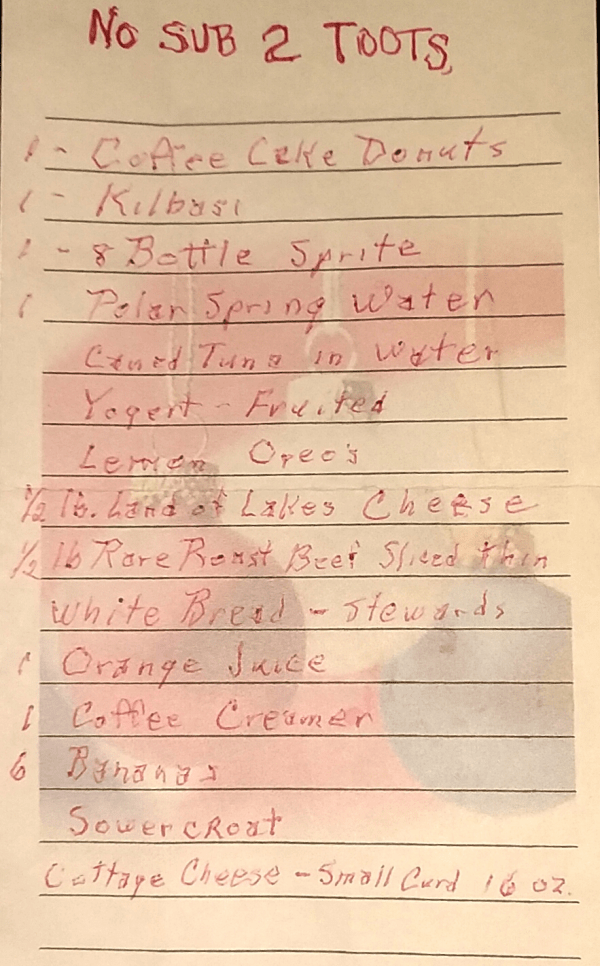
I shop for him, as he gave up his driver’s license. His tastes are very well defined – and have caused some disagreeable interactions between us (I think that Dap would characterize these interactions as ‘teachable moments’). After all, his shopping preferences specify Dole sliced peaches, Stewart’s brand white bread (lasts for two weeks), Hood non-dairy creamer, Florida Natural Most Pulp orange juice, General Mills Wheat Chex, Freihofer mini-cakes, Oreo thin cookies (chocolate and lemon), razor thin-sliced Angus roast beef, Land O Lakes white deli cheese, Stouffers frozen turkey dinners, Sam’s Club rotisserie chicken, Twining’s Irish Breakfast tea (square, not the round bags) … and Poland Spring water. I know this list by heart, because it rarely varies – and exceptions are not well received.

For instance, he requested another order of Poland Springs water: has to be 12oz bottles, has to be an 8-pack. But the grocery store featured only the small bottles, or the 12 oz bottles with sippy tops. I picked up the latter. Other than that, every item was as noted.

It turns out that sippy tops are not acceptable. When I brought in the groceries, my friend grew red in the face, slowly stood up and literally bellowed: “NO SUBSTITUTIONS! I have told you over and over that if you can’t get what I want, I don’t want anything!” He was in such a state that he actually became short of breath. To make sure I got the message, he wrote “NO SUB-2-TOOTS” on the next shopping list. (At least we could both laugh about that).

Let’s skip over the fact that he already has an industrial strength water dispensing machine for hot, cold, and room temperature options which holds a 5-gallon water tank; let’s also skip over the several cases of Poland Spring water sitting in his kitchen; let’s skip over the efficacy of Poland Spring water vs. other brands. The issue is entirely due to the cap on the bottle. I’d venture that this is an example of exquisite preference.

So, the question is: when do preferences become requirements; requirements become rules; and rules become commandments? I’m watching a 97-year-old individual paint himself into a corner, isolated by his preferences. After a lifetime of choices, it seems a shame to be defined by a shrinking set of options.

Now I’m scared straight! I think that I’ll hang loose with my curated tastes for a while – gel toothpaste is okay, after all — but I’m keeping my Keens!

Perfectionism by Blue Winged Poet — allpoetry.com

She poured a rainbow
down the toilet; its colors
wouldn’t stop touching.

My Relationship with Preferences

When I was younger, in my late 30’s, I began learning that what I knew to be truth could change with new information.  Scary stuff!  Around that time I began reading Buddhist type material.  One such reading yielded a phrase that remains with me, “…change expectations to preferences…”  The intention here, was in order to become happier, one needed to free oneself from becoming needlessly disappointed when something didn’t occur as expected.  However, if I preferred something to be a certain way, it carried less weight and thus became more acceptable if it didn’t quite turn out the way I had hoped.  This was a guiding principal for me over the better part of my life. 

More recently, I read Michael Singer’s book, “Living Untethered” which challenged me to leave behind my preferences.  He argued that if I simply took things as they are without even caring if they turned out a certain way, the angst, disappointment, and upset I still might feel when having a preference, one way or the other would cease to exist!  While a worthy challenge it is one that requires great diligence and discipline.

However, Wal reminds me that while I might aspire to total acceptance and freedom from want, I am and will always be a passionate, feeling, and responsive being.  I enthusiastically embrace the joy I experience when I meet a goal, accomplish an objective, or it’s a cool sunny day when I hoped it would be.  Knowing that and integrating Wal’s query about our relationship with preferences, especially as we age, I now wonder how it will go from here, for me.  Mind you, Wal has much to learn as the young whippersnapper of our group.  In those 431 days until he’s my age (and even longer to reach George’s longevity 😉 he’ll likely pick up a thing or two about preferences and the acceptance of substitutions and how to avoid falling into the “exquisite preferences” category.  But I thank him for his bringing my attention to this part of our senior lives.  What if we never thought about it?  What if we fell into the mindless behavior of seeking that which we know and brings us contentment without seeing the trap before it springs shut and is so tightly shut that we can no longer see a way out?  His story about Dap is a perfect reminder that staying aware that our choices and our reactions to those things that bring us joy or frustration are the products of our own doing.  Whether we seek to recognize this or ignore the warnings and fall prey to our shrinking perceptions, is the story of our lives yet to be told.

Inflexibility is the worst human failing. You can learn to check impetuosity, overcome fear with confidence and laziness with discipline. But for rigidity of mind, there is no antidote. It carries the seeds of its own destruction.

Anton Myrer – (Marine Corps vet and author)

Life Repeats Itself

Wally’s topic was tough for me.  I didn’t know where to go with my thoughts.  When I read Hen’s piece it gave me an idea.  I was always a little(size) kid, the littlest kid on the block, so I never got picked for teams or games even though I was fast!  Sometimes I got to fetch the ball when it went out of bounds.  Anyway, I am not “poor me-ing” my childhood.  There are many of us who experienced being left out or ignored. Every time I went out to play on the block this is what I learned to expect.  I accepted the role I was assigned and either went along with it or played alone in my room.  I am not sure where I learned to cope. I don’t think my parents ever sat me down and said that I was the little kid on the block and should just accept that as the  way it is. I don’t remember them telling me anything that helped me develop the attitude I eventually did.  I had to survive……period!

Without going into too much detail or hand wringing, my dad was a heavy drinker and not the nicest guy on the block when he had a few.  Everyday, I would worry what he was going to be like when he came home.  More than likely he had stopped at McAuliffe’s at the bus stop on the corner of BowneSt and Northern Blvd for a quicky which became 2 and by the time he walked around the block to our house I could tell he was a few sheets to the wind, as the expression goes.  If I had expected him to come in the door like Father Knows Best, I would have been incredibly disappointed and once again confirmed that I had little power to make things nice.  This went on for years.  And I adjusted my life accordingly, being careful to orchestrate such things as when my friends came over my house, or we were playing in my backyard, it was my job to hide all that from my friends, so that my house seemed just like theirs!  My philosophy developed over time.  I never realized it was buddhist like til I read Hen’s response.  All on my own I decided that expectations or predictions, whatever you call them, cause problems and I had two choices, either never expect anything in which case you never will experience any feeling or expect the worst and when it turned out by chance to be much better than anticipated(childhood logic) I could revel in the positive feelings I was unfamiliar with.  I adopted the latter philosophy and it worked well for me.  In stead of worrying about the outcome of something, just anticipate the worst so that if that is how it turns out I wouldn’t be all upset, BUT if it worked out better than my mind had it managed, I could be over joyed.  That works well for me, even today.  All through my life I worked hard to do my best but that didn’t necessarily change the outcome. BUT when the outcome was what I really hoped and prayed for the feeling of accomplishment and gratitude was terrific.  I did this through college, through my working years and it served me well.  Life got easier as I aged, goals became more easily attainable and I actually learned to love the life I had created.

Fast forward to the present, and I am starting to see the past repeat itself.  There are too many unexpected roadblocks thrown in the way of seniors. Personal health issues, loss of friends and relatives, disappointment at your own body that it can’t do what you want it to, anymore. So, I am finding that old, adopted philosophy that I thought I came up with on my own is seeping into my life again.  I’m not as good at not anticipating things as I was way back but perhaps it is like riding a bike.  The biggest unknown at this point in my life is the loneliness.  My expectations at 77 are very low, that way I can’t be disappointed but if something should develop then I have all this room to celebrate.  I guess you could say I’m a half empty kind of guy who is ok with that because if it should be filled imagine the joy I will experience!

Walking the Senior Balance Beam

Somewhere between the acceptance of my diminishing capacity due to aging and the notion that I am capable of maintaining my current level of physical and mental activity lies a balance. And living in this balance, is, for me, the best way to enter the winter of my life.  In other words, while I won’t deny that my abilities and reaction time are diminishing, it is counterproductive to add to those limitations by reducing my activities and mental mindset.  I believe, it only accelerates the aging process whereby continuing to participate at the present level of activity along with the mindset that “I can” prolongs my current status until I naturally succumb to less.

Sometimes I hear senior-speak accelerate acceptance of their age.  In anticipation that they will no longer be able to play singles pickle ball or hike 5 miles, or stay out past 9:00 pm, they will only play doubles, only go on hikes that are 3 miles or less, or turn down evening events that are scheduled to end at 10:30.  The more we tell ourselves that we are no longer capable, the more we become no longer capable.  

On the flip side,  I hear seniors overstate their abilities in spite of their age.  In denial of the fact that they tire more quickly or cover a singles court at a slower pace, they tell themselves they are as fit as ever and either use excuses to cover their less than youthful performance or convince themselves they must work harder.  While this feels like a more positive approach to aging, it may lead to more frustration and stress as they seek to stay fixed in a state that is no longer able to be sustained.

Somewhere within all of the thinking and beliefs and expectations seniors have for themselves, there is a balance.  A place where we continue to challenge ourselves to do our best without comparison or expectation or need.  In The Four Agreements, by Don Miquel Ruiz, the fourth agreement (Always Do You Best) is defined as, “Your best is going to change from moment to moment; it will be different when you are healthy as opposed to sick.  Under any circumstance, simply do your best, and you will avoid self-judgment, self-abuse, and regret.”  And, of course, in doing our best, we simply (this is hardly simple!) accept whatever the outcome.

And so, it is easier for me to accept whatever my best looks like, if I change my old concept of balance in which everything is in a perfect state of stasis. In this case the image is both people on the see saw are of the exact same weight and sit on a horizontal plane across from one another.  This is how I used to interpret balance.  Now, I see balance as more fluid, as moving gently from the middle to 5 or 10 degrees either way.  I now accept that I’m in balance if I’m a bit lopsided in the up position one day or perhaps off center in the down position on another.  I am only concerned when I’m closer to the extremes.  Formerly a rather rigid thinker, I’m allowing myself to become a bit more flexible.  This permission gives me the comfort to accept my less than perfect attempts at whatever I do, to fall within the “okay” realm as I continue to live my senior life walking along my redesigned balance beam.

“If you think you can do a thing or you think you can’t do a thing, you’re right!”

-Henry Ford

On Balance

Hen raises an important subject – maintaining balance, particularly within the aging process. Reevaluating the boundaries of reasonable expectation is a constant exercise. When we were younger, we might count on improving physical skills with practice and experience. On the down side of seventy, there’s a bit more internal negotiation that needs to take place. I guess this is the dynamic balance that Hen talks about: don’t sell yourself short, but don’t set unrealistic goals. Someone’s advice to me was, “whatever you did yesterday, continue to do it tomorrow – right up until the point where you can’t; then adjust”.  

In order to achieve balance, It’s been said that we have three abilities to draw from: the power to stand; to withstand; and to understand. The power to stand is action-oriented – to stand up and take a step, move forward, even though it may be hard to do. It draws on energy and courage. It’s our positive motive.

The power to withstand relates to endurance and adjustment. This strength flows from our ability to adapt to changing circumstances, while keeping core values in sight.

Power to understand portrays our skill in discernment. Analyzing our environment and developing a course of action derives from our ability to understand.

If you were a pilot, the power to stand would be the horsepower of your jet engine and the amount of fuel available for your journey. The power to withstand represents the integrity and agility of the aircraft, which allows you to trim the ailerons to change altitude or direction. It helps you to deal with heavy weather and navigation. Your ability to understand, aids in setting a safe, but efficient and interesting flight plan. These three abilities work together to maintain balance, in my opinion.

Now, in our discussion, George raised the point that sometimes, overwhelming circumstances obliterate any hope of balance: no fuel for the aircraft, hurricanes on the horizon, or broken navigational aids. In our life, we’ve seen people laid low with serious illness and devastating personal setbacks. Yet, I’ve found that even when facing terminal illness, friends that I know have found some sense of balance and adjustment to a ‘new normal’ of diminished options. In fact, it’s really amazing that we can alter our range of expectations so readily. Perhaps that’s why Hen warns of limiting ourselves too early… we get what we expect.

An interesting take on expectations comes from a post in letslearnslang.com:

The Symphony of Unforeseen Wishes

In the silence of our solitude, expectations hum a melody,
Painting pictures of tomorrow, shaping our destiny.
They dance like playful shadows, by the moon’s silvery glow,
Weaving patterns of hope and fear, in the ebb and flow.

These silent whispers of the heart, these sparks in the mind’s night,
Illuminate the path ahead, a beacon of spectral light.
They are the architects of dreams, the cartographers of desire,
In the forge of their promise, we stoke our inner fire.

But expectations, like all gifts, possess a double edge,
They can lead us to the mountaintop or to the precipice ledge.
For when reality bites, and dreams start to fade,
The echoes of unmet wishes can cast a long, dark shade.

Yet, in the grand tapestry of life, they play a crucial part,
Pulsating like a steady rhythm in the symphony of the heart.
They are our north star in the abyss, our compass in the unknown,
Guiding us through the labyrinth of life, to a future yet unshown.

So, navigate with caution, in the sea of these silent pleas,
Where the waves of expectations can drown with subtle ease.
Balance your dreams, your ambitions, your quest for the sublime,
With the understanding that every dream may not shine in time.

Savor the voyage, the adventure, not just the final goal,
Find joy in the making, in the growing of your soul.
For expectations are but whispers, not our absolute decree,
In the chaotic, beautiful symphony of our life’s spree.

Understand that life’s true treasures often lie in the unseen,
In the resilience forged, the wisdom gleaned from where we’ve been.
Even when expectations crumble, or seem to steer astray,
The spirit of perseverance, of hope, will light the way.

So, let your soul echo with expectations, let them take flight,
But ground them with understanding, with gentle, loving insight.
For the symphony of unforeseen wishes can play a bitter-sweet tune,
In the silent hours of longing, under the watchful moon.

And know, dear voyager, in your pursuit of the ideal,
That success is not always about how you make the world feel,
But about the heart that persists, that loves, that dares,
Despite unmet expectations, and the burdens it bears.

For the worth of our journey, when all is said and done,
Is not in the fulfilled expectations, nor in battles won,
But in the heart that, despite the trials, the hardship, the strife,
Stands resilient and hopeful, singing the symphony of life.

A Balancing Act

My life has always been a balancing act.  Not to suggest that there weren’t large amounts of time when things seemed to be in perhaps not perfect balance but at least close to it.  When I was a  little kid it was my job to keep an eye on my dad to make sure he wasn’t drinking too much while he was preparing dinner.  He wouldn’t get mad at me the way he did my mom or older brother so I was the bourbon police.  What a responsibility that was for me.  I would be responsible if he drank too much and got sloppy.  I hated to be the house spy and the weight of the responsibility I had as a little kid was overwhelming.  When I started school I was the little kid, shortest in my class, bullied by the bigger kids all the way up through junior high.   I used to have to either get out of school quickly and run home or wait inside the school doors til the other  kids got a head start and then maybe I could make it all the way home without getting picked on or beaten on. I only wish Robert Gross, my nemesis in 7th grade is reading this. Just the weight of knowing what the options were threw my whole  life at that point out of balance.  It wasn’t til I began high school that I began to feel more secure and accepted.  I was still small  and skinny but for some reason, the hoods were too busy smoking in the bathrooms to be picking on us small kids and I began to find my niche which truly brought some balance to my life.  The world seemed at that point to get easier.  No more looking around corners or planning my escape routes.  Life became simpler, more naturally easy and I found my place in the world  that surrounded me.  Fortunately that was just the beginning of the period of balance in my life as I became even a little popular in high school. That gave me the expectation of it continuing through college, a reasonable expectation.  As my world grew bigger the balance seemed to even out.

College was a hoot, and expanding my world allowed me to interact with all kinds of people including more people like myself.  Balance wasn’t a concern, it was just naturally occurring.  Of course campus life and independence overpowered any concerns about anything else and fun became the focus of the new society I was part of.  It wasn’t til senior year was ebbing when the next wave of imbalance struck. Will I get a job?  Will I even like the job I had been preparing myself for for the last 4 years?  Where will I live?  Marriage, family, home, all started tilting the balance to where I almost fell off the tight rope.  That was a tricky period but one by one things began to fall into place.  The job I was worried about I, fell in love with.  I got married and we bought a house, that long rod that tight rope walkers use to balance their bodies high in the air was getting easier to manipulate and more experiences piled up in the good balance column.  I was feeling at ease with myself, confident of my job and this continued for a good decade and only started to get off kilter when the kids entered those difficult teen years where every parent is tested for capabilities beyond their control.  Those factors of balance were beyond the control of us all and were foisted on us to deal with as aptly as possible, usually clumsy and feeble attempts guiding us through those unbalanced times.

Unbeknownst to me a huge hurdle was about to be thrown at me that I assumed would wreck my balance for good but turned out quite the opposite.  Having hidden my being gay all my life I thought I could simply go on hiding it.  But circumstances developed that required me to make one of the most major decisions of my life.  I decided to come out at 46—-everywhere!  In for a penny, in for a pound as the expression goes.  To obtain any kind of balance that I had recently lost, I had to be truthful in all aspects of my life.  Of  course work was the hardest.  I came out to my principal and colleagues, then friends and family.  To my great surprise it wasn’t a big deal- well to them it wasn’t, and many expressed their knowledge of it for a long time.  In the moment of truth, my life fell into balance like it had never done before.  The panic attacks I had been experiencing for a decade mysteriously disappeared, my gastro -intestinal attacks from colitis and an ulcer eased and my life actually became calmer and more relaxed.  I was once again more balanced.  The truth set me free!  It opened up a whole new realm of exciting possibilities and gave me the confidence to face retirement from teaching head on and opened up a second career for me in the hospitality industry.  A second career I came to absolutely love.  How many people can say they had two full time careers they truly loved?  Balance at work!

Which brings us to today…….Truth requires me to admit this is the last quarter of life for me, and as of now I am still on the right side of the grass, which is something in itself.  However, balance has taken a new form at this point in life, a harder one to deal with.  Before the world had always been expanding, more opportunities, new friendships, experiences.  Now I find the world shrinking, opportunities not being offered unless you consider 10% Senior discounts as opportunities, and of course the most vicious of all, the loss of friends and family.  It is no longer a distant threat with the loss of colleagues, old school buddies, new diagnoses around every bend.  When two old friends meet and begin to converse, the topic of conversation invariable goes to where does it hurt,  how long have you had it,  what meds do you take?  Henry calls these conversations “organ recitals.”   That is a perfect description of these talks and we all have them.  Now I didn’t want to get morbid but the simple truth is balance is much harder at this point in our lives.  Hen and Wal are already gritting their teeth with my “Glass half empty” view of life so let me finish by saying, there is something to be said for years of experience and knowledge gained from all our years of living.  We know how to navigate through a lot of rough water, and have built  in defenses that support us and quell our fears.  We do a damn good job of that but it just has to be said that balance  is harder now adays!  Try putting on your briefs standing up!  Try balancing on one foot for 15 seconds at a time.  Try staying calm after the fifth day in the row of finding the newspaper in the flower bed instead of in the newspaper box by the walkway.  Try remembering what day of the week it is if you forgot to take your pills this morning!  And I might add, a half empty glass allows me to fill it up again with wine!  Wine does wonderful things for balance….you just “forget about it,” as Archie Bunker used to say!

All Alone Am I

I never liked being alone.  Even as a little kid I didn’t enjoy my own company.  My dad worked in Manhattan at a 9 to 5 job and my mom worked at our local hospital from midnight til 8 in the morning,  So when I came home from school I was alone from 3 til 5 cause Dad hadn’t come home yet and mom was sleeping til dinner time. I would do  my homework and then run out and join the other kids playing in the street.  I was never very good at entertaining myself.  That may be one of the few traits of mine that has followed me everywhere up to the present.  A lot of it has to do with low self esteem I am sure.

For most of my adult life I have been partnered, but with the onset of Covid and some other unfortunate circumstances, I have been cast out to fend for myself.  Actually it wasn’t that dramatic!  However, for the first time in my life I bought a house by myself and moved back to the community where my kids grew up and where I had close friendships and connections.  Sometimes circumstances just dictate what you have to do.  I thought I could handle this all on my own.  And,,,,I proved to myself that I could handle it but there was no guarantee that I was going to enjoy it.  Old ghosts rather quickly came to haunt me.  Before, I always had someone to encourage me and calm me down when circumstances required it.  At 70 years of age the old body began to break down and I had no one to tell me things would be all right or we will go through it together.  Not only did I have to go through things alone, I had to deal with an over active imagination about what the pain in my lower stomach meant.  The glass was definitely half empty at those times. I am not very good at soothing myself or developing alternative possibilities to what could be causing the pain!  That is just one area I have trouble dealing with alone!  I’d be remiss if I didn’t add making major decisions alone about life or the house. NO one to run it by…..to clarify……to annoy…or all of the above.. all necessary when making major decisions.

Another area I have trouble with is doing things for enjoyment.  Most of the things I did for fun always included another person.  Sheer beauty or happiness or even sorrow is so much better when you can share it with someone you care about.  A beautiful sunset is a work of art but watching it alone makes it seem empty and ten minutes later I have to ask myself if it really happened.  I love to laugh but find it uncomfortable to laugh alone.  It just isn’t as funny.  This past Friday, Wally and I went back to our old college haunts and met with 4 fraternity brothers (a gaggle of old farts)to plan an upcoming reunion at the college.  In the course of the conversation, we started laughing and griping about all sorts of things and we cackled for a good hour straight.  Not just that polite chuckle, but guffaws from the belly, the kind of uncontrollable laugh that comes from the pit of the stomach and is probably much better blood pressure medication than anything you can get at the pharmacy.  I continued laughing all the way home in the car and later that night when something would pop back into my mind.  One of the guys in the group said, as we were saying good bye in the bar/restaurant, “If you need proof of true affection, we just experienced it!”  He was right on the money!  But for me that kind of thing can only happen in the company of others.

So now at 77, I live alone!  I don’t know what to do with myself cause I don’t enjoy doing things alone.  I love my little house and I tend to the gardens as best I can, and have the place decorated with all the art work and antiques I have collected over the years.  I am proud of it, but it still feels like something is missing- another person. Someone to cuddle on the couch with, to snuggle by the fire with, to stand holding each other watching an incredible thunder storm sweep through the area, and squeezing each other tight as a loud surprise burst of thunder strikes and scares us.  But, that isn’t to be….. at least for now.

OK, OK, I know I have to quit whining.  So what am I going to do  about it?  A  thought came to me to try and think about times when I actually enjoy being and doing things alone.  So the list isn’t too long right now…..This isn’t a complete list but it is what I can identify as things I truly don’t need other people to enjoy, in fact they would probably interfere with my enjoyment of them.  The first thing that came to mind is my jeep.  I LOVE my jeep and I love driving it.  I have used it to move three times, to load antiques to take to my shop when I owned it.  Just to rub things in, as I am typing this old Mother Nature is beating my street with a beauty of a thunderstorm.  All I can think about is standing in front of my huge window in the arms of another and watching the lightning and counting the seconds til the thunder claps to figure out how far away the lightning struck….but I digress!  I like to drive somewhere I have never been before, crank up the radio, sing at the top of my lungs, and enjoy the scenery as it passes by.  I can speed up or slow down to study something that interests me.  I especially enjoy doing that at night cause I like to take sneak peeks into people’s homes and imagine what the family is like that lives there.  My imagination takes over and the story develops- what does dad do for a living?  Mom’s sister lives with the family and she watches the kids most of the time and so it goes.  I can’t do that when other people are in the car with me!  I also like mowing the lawn.  Something is soothing seeing the rows of mowed grass develop a pattern on the lawn.  It is immediate satisfaction     and when complete I feel accomplished, an achievement that adds to the coziness of my house.  The same thing is true of tidying up the garden, making sure the flowers are plush and the beds are weed free.  Digging in the dirt kind of reminds me of being a kid and daring the girl next door to eat dirt!  I like sitting at my dad’s desk and writing out bills, filing them away, straightening up the cubbies and the drawers and making sure that when I pull the drop down desk back up that it is as neat and organized as it was when I started.  The other thing I enjoy by myself is meandering through the aisles of a big antique shop where I can take as much time as I want looking through things.  I love searching through piles of stuff for that one piece I have to have. I can spend hours doing that. The trouble is, how do I incorporate these things into my life so that I can actually begin to enjoy myself alone for most of the time.  Of course, the worst time is around 10 pm when the street becomes quiet and the effect of being alone really sets in.  Maybe someday I will discover the secret.  I am tired like Brenda Lee was of being  alone with just the beat of my heart!

Better Alone?

Better Alone?

I look at George and see a person who is energized by social interaction. When we talk, it’s pretty apparent that he reaches out to engage in many interactions with friends, former students, and past colleagues. George is outgoing and comfortable – except apparently, when he is by himself. I certainly wish that the intimacy and easy connection he seeks becomes a reality. 

When George posed the topic of ‘Activities I like to do solo’, I would have guessed wrong as to his top items: driving in his jeep, doing bills, weeding the garden, searching for antiques. Antiques aside, I might have expected writing, drawing, and model railroading to be on the list. And certainly, after 50 years, I know George well enough to tease him about driving around at night peering into people’s homes. In fact, I have already reported him to the local constabulary (“yeah, he’s a jeep guy singing in his car looking in folks’ windows – can’t miss him; has rubber duckies on the dashboard”). At least that may result in new relationships with uniformed individuals. After all, what are friends for, George?

Okay, so now it’s my turn to ‘fess up: I sort of like to be alone – at least for portions of the day. When I’m alone, I can obtain focus free from distraction. Perhaps there are two broad categories of things I can do better by myself: tasks that I “ought” to do and tasks that I’m “called” to do. There’s a big difference between the two.

Usually, I put off obligatory demands… But when alone, there seem to be less excuse for ignoring all those projects which lay half done or unstarted. These items may vary, but currently range from fitting baseboard in an extra room, reseating the tail light cover on the truck, or maintenance of the brick walk at the museum. Obligations where I’m lacking skills, but also have no desire to improve those skills. 

Unfortunately, I’m haunted by unfinished business. Solo, I will at least mentally break the activity down into manageable pieces and force myself to take baby-steps to complete elements of the work. I’d be safe in guessing that we all have these lurking “to-dos”, where any distraction is a ready-made avoidance reason. But when I’m by myself, these to-dos seem to stand tall and stare at me.

The second broad area of solo tasks is actually not so broad at all, because it’s really about achieving focus. Hen and I have had some discussion about “flow”, that state where all activity seems to effortlessly stream from the unconscious, or barely self-analytic, aspect of our make-up. It’s when you’re ‘in the flow’ and totally riveted in doing what is at hand.

You know how this goes: you follow your curiosity to a new place, find the joy of discovery, as well as the desire to try something new — something new just beyond your reach – but achievable! It takes all your concentration, like riding a bike for the first time. There’s no time to think: just do

For me, it can be conceptual: reading a book that opens a door to another worldview, leading to more research. Or it can be hands-on, like trying a technique that improves your ability to achieve a goal. It is purpose-driven. I find this often while attempting to make something from a slab of wood. It is addictive, but – at least for me – easier to achieve while by myself.

I think George was on this path when he mentioned his pleasure in driving alone – following his curiosity, trying a new route; finding the joy of discovery. George related an experience where he came upon some historic stone houses nestled in the middle of undeveloped land on a back country road… and wondering about the origin stories of these dwellings, while trying not to lose his way. Sounds like fun!

Perhaps some things are better when you explore your own time and space.  So, drink in the light! (No, Geo, that’s not “drink in the night”: read it again).

Here’s a poem by Lizella Prescott:

Singularity
She is alone.A loner.On her own.A single singularitydrinking in the light.

Alone and Together

While I would describe myself as a social person, I often enjoy being alone.  Not by choice, I spent many childhood hours alone or with my dog.  Due to a variety of reasons, I wasn’t well liked by the general population of neighborhood children and as a result, spent lots of time in the nearby woods exploring nature with my shepherd collie.  Likely because I never knew what it was like to be part of a larger group of friends, playing alone in the natural environment was what I knew.  You can’t miss what you never had so this was enough for me. In high school, I became part of a small group of accepting friends and enjoyed the benefits of socializing as well as having alone time.  Fast forward to the present and I find myself in a similar state.  I have a wonderful partner and a small circle of friends but also find myself spending weeks or longer by my(human)self but in the company of my four footed companion, Duke.  And, about 90% of the time, it works very well.

To mitigate the downside of his loneliness, George closes “All Alone am I” by identifying the things he does that are enjoyable because of his single status.  He reminds me of the things I prefer to do alone as well as the joy I get from certain activities with or without my partner.  For example, I love taking care of the outside of my property.  Cutting the lawn, making and maintaining hiking and off road trails, vegetable and flower gardening, and wood cutting are deeply satisfying physical chores.  I get to exercise my muscles, spend time thinking while doing repetitive tasks, and often get into the flow that Wal describes in his rejoinder.  When alone, I also feel good about what I am still able to accomplish, by myself, with my own two hands.  But when I’m doing some of these with Teresa (I say some because we haven’t yet tried riding the lawn tractor together – after all, we’re still new to the neighborhood!) I not only appreciate the help but feel the closeness of shared and often playful time spent together.  This dual enjoyment – working alone or with another (sometimes with my grandchildren) also includes creating the morning on the porch, watching a movie, or being in nature.

In some of those cases I have a preference to be alone.  As I’m easily distracted when someone speaks to me, I’d rather drive alone, cut the grass alone (until I get a bigger seat), and read and write alone.  As soon as someone speaks to me while I’m doing any of these things, I might easily pass my turnoff or lose my place since my brain literally can only do one thing at a time and, lately, very slowly!

Currently, I’m updating all of the light switches and outlets in my house as well as door knobs and light fixtures.  Since I’m not a trained carpenter or electrician, I often find obstacles that are unique to me that require lots of research, trial and error, and plain think-time.  My brain functions in a very specific order that allows me to stay focused and eventually get to an acceptable solution.  However, if someone offers a suggestion or asks a question that isn’t in the order in which my mind is processing, it throws me off, gets me confused, and sometimes upset (dare I admit, angry?)  Then, if the suggestion or question happens to lead me to a quicker or better solution, it takes me a lot of zen practice and time to get to the point of accepting and appreciating it.  So, while I’m not proud of this behavior, I do know that my preference is to do it alone…for all concerned!

I am a most fortunate man to have the time to do things alone as well as time to share with another.

“When nobody wakes you up in the morning, and when nobody waits for you at night, and when you can do whatever you want. what do you call it, freedom or loneliness?” ~Charles Bukowski (German-American poet, novelist, and short story writer.)

Good Will Hunting

Our last post focused on endings and farewells. I’d like to take a turn to highlight beginnings. Even at our advanced age, we three old guys engage in new starts – and don’t we all? Beginnings hold hope — and sometimes we need to be reminded that life is sweet. There is a cartoon from the New Yorker that shows two individuals looking at the display in a bakery shop. One says to the other: “Mini cupcakes never solved anything”.

I’m here to disagree.

A couple of months ago we got a call from our friends Gail and Bruce. They asked us to join them in sampling cupcakes to determine which flavors to order for their son’s wedding reception. Well, Bruce and Gail are… thoroughscientific. They share a quality I’ve observed in the characters from the Big Bang Theory; that is, the ability to step out of the frame, hold something up to the light for dispassionate examination, and then step back into the frame to enjoy the moment.

So, we visited their home and met a half dozen folks assembled for the sampling. I knew none of the people who were present, but it turns out that many of us had previously worked for IBM and stories were shared about that particular technical universe. Bruce regaled us about installing a miniature video camera (years before Go-Pro) in his model railroad engine and casting the image to a screen in real time, captivating IBM engineers at a party – and the major new product demonstration that almost failed, due to fingernail clippings in a keyboard. Each person had a story. In short, we bonded over cupcakes.

Fast forward to the actual reception. It was planned as a backyard outdoor event: “meadow chic”. It rained most of the day but cleared up just before we drove to their house. The tents, food truck, port-a-potties, parking spaces were all carefully planned, the result of months of active analysis. People found their own affinity groups under the tent – we sat with the ‘cupcake crew’ from the tasting. This was the east coast reception, which followed a west coast wedding. However, people came from as far away as Australia.

And then something extraordinary happened.

The tagline for the reception was “W-squared”, which derived from the fact that both the bride and groom family names began with “W”. Over champagne and hours d’oeuvres, friends and family members each took the mic to express their joy at this marriage. Brother, sister, mothers, fathers — all spoke, then hugged. The groom’s uncle acted as the emcee and questioned whether the earlier rain was a good or bad wedding omen – he concluded that it was a good omen, washing everything clean for their new life, symbolizing tears which have no further need to be shed.

Bruce talked about his great joy to be present. He was diagnosed with stage 4 pancreatic cancer almost two years ago and given only months to live. You need to know that Bruce and Gail set goals and immerse themselves in the execution of the tasks. (For instance, Bruce has also published a book during this period and authors a weekly blog, but that is a tale for another time). While still in treatment, he described how the goal of witnessing at this event has helped to carry him through. Bruce expressed his love for his son Andrew and in particular, Andrew’s dedication to principle. He said that his son has made the father a better man.

In turn, each person presented a clear, transparent, and genuine sentiment for Emily and Andrew.  It was a testament to selfless good will. Each person, when in the spotlight, had to recover from heartfelt tears in order to continue. (It was pointed out that less tears have been shed at funerals). But these were tears of joy – the message clear that this was a marriage between two families, not simply between two individuals. Isn’t that way it ought to be?

However, the words that struck home were from Andrew’s twin brother, Bradley. He said kindness is underrated and that it is misunderstood as a personality trait. He made the case that kindness is a skill; the ability to consider others’ needs and respond to those needs. It is a learned behavior which can be improved. He pointed out that both Emily and his brother have that the skill of kindness and it remains strongest basis for a fulfilling life.

No sweeter words have been said. If you are looking for a reason for existence, look no further. Here’s some lines from I Don’t Believe by Paul Simon

"Acts of kindness
Like rain in a drought
Release the spirit with a whoop and a shout..."

Starting Over

Wal reminds us of new beginnings.  As I think back on my life, I recognize that experiences and relationships cycle through beginnings, middle, and endings.  In my career, I often felt the most enthusiasm and energy from beginnings.  I was also good at the early parts of the middle of a project or experience as I learned to watch it evolve and adapt to what needed more of my attention or replacing something that wasn’t working as effectively as I or we would have liked.  Once I got to the latter part of the middle where maintenance became the focus, I was less enthused and consequently less of a support to the process.  Endings were also not my forte unless the demise of one experience meant the beginning of another.

Today I am in the throes of new beginnings.  Setting up a new home in a new location has set the stage for making daily decisions about how I want to live my life.  Old routines established by space, distance, color, landscape, and such are now completely changed.  Adjusting and adapting are necessary factors as I re-establish my daily functions.  Where I make my coffee, how I navigate the landscaping as I cut the lawn, and where all of my “stuff” is located, is new.  And while some of it takes a bit of effort, most of it energizes me. 

Whereas in my apartment, my physical activity was limited to taking walks and preparing meals, presently, there is an endless checklist of things to do that require being up and about with little to no down time.  And not only am I fixing, replacing, and restoring with my newly rediscovered tools but my mind is also incredibly more active and “on” while I sort through decisions on each of these projects.  I feel fully engaged in my life throughout the day and totally exhausted at nightfall.  For me, a perfect way to be!

As if all of that isn’t enough, I am also adjusting through the newness of no longer living alone.  With the exception of a brief visit to her grandchildren in Florida or a work related trip to the Hudson Valley, Teresa is now here until late fall when she migrates south for the winter to where I will follow shortly after.  Sharing decisions on where and what on a regular basis is most certainly new and taps into all areas of my being (and Teresa’s as well).

There is a saying, “You don’t stop playing because you grow old, you grow old because you stop playing!”  Well, perhaps buying a house and starting a “move in” relationship in my mid 70’s and beginning all the new ways of living that go along with each will also help me keep my sense of youthfulness.  What if the body and mind adapt to what we choose to do and if they are fully engaged in new beginnings, they will assume we’re still able and capable?  I guess I’m going to find out.

“Take the first step in faith.  You don’t have to see the whole staircase, just take the first step.”

Martin Luther King Jr.

 “And suddenly you know: It’s time to start something new and trust the magic of beginnings.”

Meister Eckhart (A 13th century German Theologian)

The Sun Will Come Out Tomorrow

As the sun rises, so another day begins.  We have beginnings all the time many of which pass through our lives without our realization or recognition.  Endings are often more memorable and more often acknowledged.  Each day, by its very nature, is a new beginning, but it is the events that occur within those days that are acknowledged, celebrated or mourned. By my calculation I have already experienced 28,105 beginnings.  Many of those early beginnings I wasn’t much aware of.  They were significant beginnings for  me but I hardly had awareness however they were certainly substantial beginnings for my parents, brother and family.  Perhaps my brother viewed it differently as he had been in the limelight for 8 years till I came along.  “New beginnings” is redundant as all beginnings by definition are new.

As kids we have numerous beginnings, some excite us and some we look upon with trepidation or even fear- starting school, going to high school, off to college.  All these beginnings bring excitement with new friends and new places. Some I actually just gritted my teeth and pushed forward and found to my excitement they led to wonderful middles and even endings!  Next came careers, and relationships, and kids.  There is no shortage of beginnings…….then retirement, which included an uncertainty I wasn’t sure how to deal with at first.  But an opportunity arose to move to Vermont and open a Bed and Breakfast.  Plunged into that beginning with little knowledge of what I was doing I discovered I was good at it just as I was in my 35 year long teaching career.  But the characteristics of all these beginnings were similar.  New people to deal with, new scenery, new friends, new responsibilities, new tasks never before approached.  Actually in the  inn business, every weekend is a new beginning, a challenge and an opportunity to meet new friends and new rewards and the days and years fly by with regular daily beginnings we don’t even recognize or acknowledge!  Then that too, after 15 years comes to an end and we are forced to find our next beginning.  This particular retirement was harder than the first because nothing loomed in its place.  I moved back to where my kids grew up, and having just come out of a relationship there were definite scary challenges I had to deal with. Then up popped another beginning.  The chance to open an antique shop with a friend and so another leap of faith.  New scenery, new faces, new challenges.  For a guy in his early 70’s it was working out pretty well.  I got into a groove, enjoying myself being a shop keeper and then abruptly, without warning a new ending- Covid struck.  Now what?  After 52 years of working, I put my working days to rest and decided this new beginning would be a life of leisure………….or so I thought!

Perhaps because with Covid, not only did my store close down but social interaction came to an abrupt halt.  For the first time in my life I now had to learn how to be alone which included the difficult task of learning to like myself.  Like everyone else, two years passed by with little personal interaction.  My floor boards got worn down from my constant walking from my bedroom to my kitchen to my living room and back.  The scenery didn’t change,  no new friends to meet, and no opportunity to get together with the old friends.  Time passed, Covid eased, life slipped back into normal mode pretty much, however certain things I started noticing–subtle changes, ones that scared me. Now the early 70’s silently slipped to the latter 70’s and I noticed more endings occurring.  My new social life consisted of doctor appointments, lunching with former students and friends and, unfortunately funerals, the ultimate endings.

That’s why right now I am having trouble seeing the next beginning.  Even the prospect of a beginning is hard to visualize but I have been fooled before and hopefully an opportunity of some sort will be presented to me.  Unlike Wally and Henry, my glass historically tends to be half empty most of the time.  With the passing of my close friend just recently I am having difficulty visualizing my next beginning, but as the sun rises so a new day is born and with fingers, toes and eyes crossed and with nightly prayer perhaps around the corner is my next beginning!

The Drawer is Open!

I have been struggling for a few weeks now.  A very close friend was diagnosed with Stage 4 esophageal cancer that had metastasized in his liver, lungs and lymph nodes.   It was a very bleak diagnosis without much hope of any curative procedures addressing it.  One night around 9pm he called me and said he just got a call from his doctor with the results of his blood work and the doctor told him he was severely anemic and he should get to an ER immediately.  He said he was going to wait til the next day to go and I said, “Like Hell” and ran over, picked him up and off we went to Northern Dutchess Hospital ER.  They admitted him right away and gave him the first of 2 blood transfusions.  The first one didn’t work but the second one took hold.  With his symptoms and concerns they decided he couldn’t leave until they performed a colonoscopy and an endoscopy.  The endoscopy procedure identified the cancer and set all this into motion. From the very diagnosis he pretty much decided this was his death notice and began getting his affairs in order, accepting the truth, and trying to decide how to protect himself from the pain that more than likely would be associated with the end of his life.  His friends, myself included, weren’t quite as ready to accept his impending demise as he was.  With the help of his doctors and his loyal friends we encouraged him to begin chemo treatments and immunotherapy  treatments in the hope of slowing the process down and giving him some hope of survival.  There are new wonder drugs out  now and hope springs eternal….but not in Sal’s case.  I took him down to Sloan Kettering in Westchester County for one of his first chemo treatments.  Things went well, the treatment was relatively easy and painless, giving us both hope.  I was shown how to remove the chemo needle from the port two days after treatment and with great trepidation I agreed to be the official needle remover from the port in his chest.  He went through 4 chemo treatments before his next scan only to  discover the chemo did absolutely nothing to shrink any of the tumors or lesions,  In fact the number of lesions in his liver increased considerably. After much conversation, debate, and disbelief Sal and his doctors decided to end treatment and allow it to take its course.  That was in mid January…..By the second week in May he had passed

I have lost a lot of people in my life.  Both parents, my brother, aunts, uncles and friends have all passed in previous years as well as another dear friend also with esophageal cancer.  I miss them all terribly and there are empty spots all through me where their life forces once filled the holes.  But they all died at times and places where I was not present.  Sal is the first human I actually watched deteriorate, decompose and die in front of my very eyes.  Stepping back a moment, Sal and I met 8 years ago when I returned to NY after selling my inn.  We were both freshly out of relationships, had 2 adult children each, living alone for the first time in a long time, we were around the same age and similar in a lot of other ways as well.  The friendship developed quickly and mutually.  We shared many of the same friends and traveled in the same circles.  So our friendship grew very strong.  10pm calls were common to complain about our kids, the crazy state of American politics, ask advice, give advice and plan things to do.  It was very comforting especially because we both were newly out of relationships where all of that was build in. Now, once again we had someone to commiserate with, to complain to, to be encouraged by or made fun of for stupid remarks.  We each filled a need in the other’s life and things were good.

Sal’s disease struck suddenly, and the progression of it was so swift none of us was prepared for it with the exception of Sal, thank goodness.  But Sal had a group of loyal friends who in combination with his two sons, came together and started providing all the services and care he needed.  Grocery shopping, witnessing wills, driving him to appointments and the most important of all, visiting and talking with him during this terrible time. That was the most difficult part for me was just trying to be with him and comfort him.  What could I possibly say, what do we talk about, how do I make him feel better.  One day in a meager attempt at humor myself and another friend were sitting on his bed while he was laying down, and he pointed to his dresser and asked me if I would close the bottom drawer which was open about a half an inch.  Sal always was a little compulsive, but something just came over me and in a loud incredulous voice I said, “That’s what you are upset over?  The drawer is open a quarter of an inch while you can’t even get up out of bed?”  We laughed but driving home that night I felt terrible that I was that insensitive.  That Sunday, Sal threw his own 74th birthday party to give him the opportunity to say good bye to all his friends.  That was the last good day he had.  It was a great party and many of his friends came from all around the area.  It was truly joyous. That week things went down hill suddenly.  He called me to come over midweek cause his lawyer was coming and he needed a witness to update his will and trust. He had trouble sitting up that day but got through all the legal stuff and he was obviously relieved to have all that taken care of.  This was after he arranged for a priest to come to give him last rites, which actually never occurred.   That Friday his son called and asked if I could come over and sit with Dad while they went to temple on Saturday.  I got there around 10, he was still in bed and I came in the room and we chatted.  He slept for a little while and then asked if I could help him into the living room.  He was lying on his side and I lifted him upright which he couldn’t do for himself.  I helped him stand and put his wheeled walker in front of him and he asked me to walk in front cause the wheels sometimes went too fast for him.  We crept into the living room and got him set up on the couch.  He was a little hungry so i got him some fruit and yogurt and he ate a tiny bit of it only to regurgitate moments after.  We were talking and he fell asleep, moaning from the pain in his stomach. This went on and off for about 2 hours and I realized he probably didn’t even know I was there.  He was a shell of his former self having lost about 40 lbs in 2 months.  I realized he was dying right before my eyes.  When his son got home I made it to the car just before I broke down.  Sal passed two days later.

Since then I have been having a lot of difficulty.  That hole that is left that Sal filled hurts.  Politically we were in synch so when something happens that I know he would like I want to call and talk to him about it.  When 10 pm comes I expect the phone to ring but it doesn’t.  I was telling my doctor about it this week and he said that being privileged to witness the death of a loved one is one of the most intimate moments two people can share, probably the most painful but also the most intimate.  Something a person never gets over but works through.  It exaggerates my loneliness, the issues I was dealing with (or not) since my relationship ended and am alone.  He and I were simpatico, in synch, shared much in common and now that person is gone.  Knowing you are in the last chapter of life makes all of this more poignant.  I want to go out laughing and living life regularly, not morphined up and counting the seconds til relief finally comes.

Connections

George is grieving his friend: it is difficult and exhausting. It’s said that grief is a process, but I wonder if we emerge whole at the far end of that process. As individuals, we make sense of the world by establishing a sense of continuity. Death exposes the vulnerability of that proposition. 

George’s piece evoked a number of feelings and it’s hard to know how to respond. He was given the most substantial gift a dying person can bequeath: a seat on the last train leaving the station – the opportunity to be a companion on the final journey. This speaks to the connection between George and Sal. Knowing George, he brought compassion, concern and humor to the situation; an ideal traveling companion.

But now that Sal has gone on to parts unknown, the lost connection has become tangible. When the brain loses connections between synapses, we call it Alzheimer’s disease. Currently, there is no cure. How do we treat the loss of connections in the heart? Many of us have lost numbers of connections in our social fabric – and the losses mount as we age. We rely on this network of loved ones as opportunities to transmit our feelings and affections, as well as to receive love and feedback. Loss of these connections can shrink our world.

It is easy to say that the obvious solution is to simply make new connections. And that certainly is good advice. After all, the brain repairs itself: new experiences establish new connections. If the analogy holds, so can the heart establish new emotional bonds. But perhaps, we are not ready to leave behind the strong ties we have just lost.

So, George has taken a first step: that is, to honor his friend in his writing – to keep the connection alive. Highlighting those experiences, he shared with Sal reinforces the significance of that person in your own life as well.  Our friends shape us. 

At times like this, I think it is important to celebrate those connections with other friends. It reinforces the connections that remain and acknowledges the temporary condition we all face together. 

A stanza from When We Two Parted, by Lord George Gordon Byron

They name thee before me,

A knell in mine ear;

A shudder come o’er me –

Why wert thou so dear?

They know not I knew thee,

Who knew thee too well –

Long, long shall I rue thee,

Too deeply to tell.

Celebration and Acceptance

George shared his grief and sense of loss and found solace in doing so.  What he feels, what it triggers, and how it impacts his emotional well being, is only known to him.  Despite his openness, his conscious vulnerability, and his choice of words, we can never really understand what he is going through.  It is indeed a solo and lonely experience, whether we live alone or with a large family.  In the final analysis, when we move into our thoughts all that follows is ours alone to endure.

One of the many gifts I receive from speaking with these two other “old guys” every week is the ability to openly express my feelings and ask direct questions about death, dying, and living in our waning years.  An otherwise, taboo topic or at least one that is more often avoided rather than encouraged, the mystery and power of knowing I will eventually die is gratefully diminished as a result of this ongoing banter.  The more we dig deep to respond to each other’s thoughtful questions the more comfortable I become with the inevitable.  The more I recognize our overlapping fears and thoughts and hopes, the more I realize that I am part of a common and universal journey which affects all of humanity.  I feel less afraid, more prepared, and clearly motivated to make the most of what time I have left.  I wonder what it would be like if these kinds of conversations became more commonplace, especially among families.  Would we not fear less?  Might we make more time to forgive, accept, and live with more compassion and love?

Funerals, memorials, and wakes loom larger, for men of our vintage, than weddings, births, and other light-hearted gatherings.  Yet all are celebrations of life.  All bring friends and families together.  The passing of a loved one brings us in touch with others who not only share the loss but with the possibility of reconnection.  And doesn’t reconnecting with distant family and friends provide the potential for establishing deeper relationships than was possible before?

Each age has its benefits and its challenges.  The secret, I believe, is to create a mindset that recognizes and celebrates the benefits and accepts the challenges regardless of the decade in which we reside.

“It is not death that a man should fear, but he should fear never beginning to live.”

Marcus Aureliu

Beyond a Doubt!

We make decisions, sometimes with certainty, but almost always followed by doubts.  And so it is with my decision to finally buy a house and property that feels perfect for me, for now but not what I spent more than two years in search of.

As one of the three “Old Guys” who walked into a bar some four years ago, I think like a kid but measure behaviors by my age.  Living with Duke in my apartment has been a new and challenging experience.  Living with the daily (and nightly!) noise and odors from the nearby trucking company, numerous construction sites, and 24-hour commercial businesses (A humongous Amazon warehouse is one of them) coupled with the limitations of a 3rdfloor apartment has been for me, difficult.  As an outdoor kid who relishes the peace and quiet and enchantment of nature the expiration date for doing without was past due.  

This house didn’t match my requirements for the style, the size, the required updated features, or the accessibility to a first floor bedroom but was filled with light and open spaces and a screened in porch.  A stretch for sure, especially considering the out of reach additional costs required to convert it to my dream home.  But it does sit on a very nice piece of property.  Enough land to provide room to roam and to garden and enough privacy to feel like the retreat I once had.  And the views!  Out of each window of this cul-de-sac house I can see woods and open space and the marshlands of Silver Run Creek, a preserve that is protected from any development.  My decision was clear and swift.  I made the offer and told the seller’s agent I wanted a response by noon the next day.  In this crazy market, it usually works the other way around where I would have to meet the listing agent’s timeline, often competing with numerous buyers offering outrageous above-list prices.  This time it was different.  They said yes within my parameters.  Clearly this was meant to be!  This was yet another factor that affirmed my decision.  

Tomorrow morning I will attend the closing and will begin the process of taking ownership and making more decisions about what to update and how much to spend and whether or not it will be worth the cost for me as well as the return value on the home.  Last night, as I considered taking out yet more money from my investment savings to meet my project ideas, I experienced “the doubts.”  Should I have waited longer for a smaller more updated home?  Am I too demanding in my requirements for the property?  Should I have spent less?  Do I really need to update to make me happy?  Am I leaving myself enough investments to carry me through potential elder care issues?

Perhaps.  But, if not now, at the ripe young age of 76 ½, then when?  What if the work I look forward to doing around the house provides the exercise, inspiration, and energy needed to live healthier and longer?  What if I had waited longer and fell into such despair that I would be unable to enjoy a better-suited purchase?  For me, for now, I am ready to cast aside the doubts and move forward.  Peace and quiet and new adventures, here I come!

“I Go to Seek a Great Perhaps!” (Again!) – Francois Rabelais

Heart vs Mind

I had trouble deciding how I would respond to Henry’s piece about decision making.  Buying a house is a huge decision that has to be made and one that is not easily rectified if you screw it up!.  I understand the frustration, worry and second guessing that goes into such decisions and that is why I wasn’t sure what I could add to the discussion. I would come up with an idea and then talk myself out of it, realizing that my idea didn’t contribute anything significant.  I fretted and postponed, argued internally with myself for days.

And that is when the realization came to me and the clarity was unmistakable!  I was doing the same thing  I always do when I have to decide, except that factors come to play in the process.  Never having put much thought into my decision making until now at almost 77, it became crystal clear how I go about it!

I have had to make major decisions many times. I purchased 5 houses in my life.  When I was married I pretty much deferred to my partner because that was easy, and then I had someone else to blame if things went south.  But there were certain things that I took the lead on because they were things that I held the strong belief that I was doing the right thing.  Adopting my children, and dealing with the county social services required many decisions and a constant but not aggressive pressure.  I was determined to make it happen and I knew in my heart it was the right thing to do.  And therein lies the rub!  The major decision making was easy once I knew in my heart it was right for me.  Every house I ever purchased I knew as soon as I walked into it, it was the right fit. I just knew!  I felt it, it fit me.  It was the emotional connection that is within my heart that made those big decisions easy for me.  And once those kinds of decisions are made there is no second guessing because I just “feel” they are right. I just felt in my heart it was time to retire- a huge decision.  My partner wanted us to buy an inn, and I was ok with that but knew in my heart I wanted it to be in the northeast to be near my kids.  So the next chapter of my life was running an inn in Vermont and it was definitely the right choice.

The minute my intellect gets involved is when the trouble starts.  If the decision isn’t important enough to be heart capturing, then my mind takes over and hence…. agita! The intellect starts whispering to me.  What ifs and second guesses creep in and the decision all of a sudden becomes much more complicated than it really is.  Fretting becomes my middle name as I run through multiple scenarios that muddy the decision further.  Lists of pros and cons, seeking advice from others who have difficulty deciding things themselves, and then endless second guessing results.  And for me the sad thing is the decisions that I make this way are usually not worth the time and worry I put into deciding.  They just aren’t that important to me.

So, yesterday it just came to me.  Heart vs Mind/ Emotion vs intellect.  When faced with a significant decision, my emotion takes over and I basically trust that it will lead me to the right course of action.  The minute my intellect gets involved is when all the what if’s and how about’s start eating away at my brain and causing little pockets of doubt that tend to spread and grow.  I am not suggesting everybody’s decision making process works the same way, but for me, the more important the decision that has to be made, the heart is the organ I use and can depend upon for successful actualization.  I am just not as comfortable in the intellectual realm.  That’s just the way I am wired.  I have to end this now cause I am starving.  I think I’ll go for pasta, but I had pasta yesterday, and I want some wine but I hate to pay 10-12 bucks for a glass when I could get a bottle for that price and stay home.  Maybe I’ll call a friend and see what he wants to do, then I don’t have to make the decision at all!

Between Two Pines

I am happy for Hen! It has been pretty clear that he has been making a good face in a poor situation for two years. He and Duke are at home in the open spaces, not holed up in a concrete bunker by the Amazon warehouse.

And yet, even though Hen says this house was not quite perfect right out of the box, it reminds me of his previous happy home: connected to expansive woods and water feature. It’s ripe for exploration and I can see a good fit!

But he raises the issue of decision making and the ‘yips’ that sometimes accompany a path you’re not quite sure is the most suitable.  Generally speaking, I think those doubts usually subside once the decision is made. Most folks are a little shaky pre-decision, but more positive once they have made a choice. After all, we’re at least moving forward and usually too busy attending to the follow-up activity resulting from our decision.

John Muir famously said that “Between every two pine trees there is a door, leading to a new life”. Decisions are like that – they open a door displaying a new vista, with lots more choices to make. Of course, my grandson edited Mr. Muir’s comment to read ‘Between every two pine trees, there are two more pine trees’. And yes, decisions are like that as well. Always more vistas and more choices…

A friend of mine is of the opinion that people make decisions emotionally and then rationalize why they came to their conclusions. In other words, decisions come from the subconscious and only later made logical in the conscious mind.  There’s some truth to that. Despite our best efforts to categorize and analyze the wants and needs underlying our choices, we don’t really have a grip on all of our motives. Malcolm Gladwell agrees. In books like The Tipping Point and Blink he documents the readiness we all have to very quickly make judgements, even without a lot of data.

George told Hen, ‘You’ll know when a house is right for you – you will just feel it’ – or words to that effect. George felt comfortable letting his unconscious help make a connection – and a decision. Haven’t you ever felt that something just “felt right”, even if you couldn’t exactly pin down what that was. Honestly, I believe that my best choices were made simply by relying on that subconscious litmus test. 

And yet, I still research, write exhaustive lists of pros and cons, and perseverate, before coming to conclusion. I guess this is my typical ‘due diligence’ mode.  However, if I’m in a group when a decision needs to be made – and no one wants to make it – I’ll be the person to press forward. My nature can’t stand a vacuum. 

Isn’t it great that life can be so contradictory? How do you approach a decision?

Hard Choices By Jojoba Mansell from greatexpectations.org

A path is laid out ahead,
It forks before your feet.
A decision filled with dread,
Uncertain of what you’ll meet.

A game full of chance,
Of many hidden pit falls.
To find true romance,
Dare you risk losing all?

Choices never easy to make,
Fog seems to cloud your way.
You fear making a mistake,
Of gambling and losing the day.

But life is full of Hard Choices,
And risk is part of the game.
Be brave, ignore doubting voices,
Make the choice, life won’t be the same.

Thoughts and Prayers

“Thoughts and prayers” – it’s become a meme; words which have suffered from ‘semantic satiation’ (as reported by CNN). That is, a phrase repeated so often as to lose any significance.

But I have some thoughts about prayers.

I believe it is justifiable to view the ‘thoughts and prayers’ incantation in a cynical way, when the sentiment is simply a substitute for action. However, when we gloss over the power of communal prayer, I think we lose a vital medium for change.

It is documented that we humans have come together in prayer for over five thousand years. At its root, prayer is a quest for connection to the ineffable, an act of supplication. All faiths practice a form of this connection – no one religion ‘owns’ prayer. People pray as individuals or in groups. Whether it is the ‘two or more gathered in my name’, the minyan of ten, or formal call to worship, communal prayer strikes a cosmic chord. Deepak Chopra calls prayer ‘applied consciousness’.

While prayer itself may not immediately change outcomes, it does change us. We—being changed – can affect outcomes. An author I admire, C.S. Lewis, has said: “I pray because I can’t help myself. … I pray because the need flows out of me all the time, waking and sleeping. It doesn’t change God. It changes me.”

Action is a necessary concomitant of prayer. To offer thoughts and prayers without commitment to deeds is ineffectual – it’s only half the process. This is not just my opinion:  Pope Francis has said that prayer without action is useless. However, my favorite quote is from Houston Police Chief Art Acevedo:

“This isn’t a time for prayers, and study and inaction, it’s a time for prayers, action and the asking of God’s forgiveness for our inaction (especially the elected officials that ran to the cameras today, acted in a solemn manner, called for prayers, and will once again do absolutely nothing).”

Think about a prayer vigil asking supplication and forgiveness for our inaction to effect change to quell violence. Think about the power a citizen group – with many points of view and diversity of faith – can accomplish by gathering for communal prayer about our inaction in living out our ideals in a way that helps our shared community. Would our elected officials join or disown such activity?

What if every citizen meeting started by reciting something like the following:

I pray that harmony may prevail in my community. Help me to be an instrument of peace. Help us in this community to come together to resolve the issues that affect us all. Help us cooperate in overcoming violence, health issues and prejudice. May we each bring our experiences and our expertise to the table and work out solutions together. Help us to listen well, to empathize, and resolve the best path for our community. Amen.

Some may say this would violate the separation of church and state, because the word ‘pray’ is included, yet there is no mention of a deity – and of course, ‘amen’ simply means “so be it”. In the spirit of discussion, would you see this as just a naïve wish or essential pledge to any meaningful change?

What follows is reported to be the Dalai Lama’s favorite prayer – attributed to Shantideva:

“May all beings everywhere
Plagued by sufferings of body and mind
Obtain an ocean of happiness and joy
By virtue of my merits.

May no living creature suffer,
Commit evil, or ever fall ill.
May no one be afraid or belittled,
With a mind weighed down by depression.

May the blind see forms
And the deaf hear sounds,
May those whose bodies are worn with toil
Be restored on finding repose.

May the naked find clothing,
The hungry find food;
May the thirsty find water
And delicious drinks.

May the poor find wealth,
Those weak with sorrow find joy;
May the forlorn find hope,
Constant happiness, and prosperity.

May there be timely rains
And bountiful harvests;
May all medicines be effective
And wholesome prayers bear fruit.

May all who are sick and ill
Quickly be freed from their ailments.
Whatever diseases there are in the world,
May they never occur again.

May the frightened cease to be afraid
And those bound be freed;
May the powerless find power,
And may people think of benefiting each other.

For as long as space remains,
For as long as sentient beings remain,
Until then may I too remain
To dispel the miseries of the world.”

What If…?

Once again, Wal presents us with a well thought out and carefully articulated discourse on a timely issue.  Even more, he offers up a suggestion and asks each of us to consider what might happen if we, collectively, took it seriously.

I am moved by this question and Wal’s insightful views.  Would I see this, as he puts it, “… as a naïve wish or essential pledge to meaningful change?”  I suggest that it doesn’t have to be one or the other.  For me, naïve wishes, in the minds of action-oriented thinkers, become essential pledges to meaning change.  Yes, if we are caught up in the meme of “thoughts and prayers” and generally feel hopeless about how things are, this suggestion could become just another “naïve wish.”  But what if we bring ourselves to these things with hope and enthusiasm about what could be?  Even if it begins as another innocent and as yet unsophisticated idea, could it not spiral into an unexpected but highly effective action?  Absolutely, I say!

Wal plants this seed for all of us to witness.  We can pass by it and notice it’s beauty and smile or shake our heads and see it’s futility, we can stop and hold it in our hand for a while and consider it’s potential, or we can pick it up, feel it’s possibilities and decide to adopt it, plant it and nurture it.

Why not advance Wal’s question from query to an outright challenge?  What if we accept the premise that simply feeling badly and once again thinking about and praying for the victims of violence is no longer enough and worse, is eroding my capacity for honest empathy?  What would happen if each of us took the recitation* Wal assembled and brought it to the organizations to which we belong and asked them to consider using it to begin each gathering?  Or, what if you brought it as a working construct to be modified and adapted so that it engendered more ownership?  Can you feel the energy that could bring? 

“I Go to Seek a Great Perhaps”

Francois Rabelais * I pray that harmony may prevail in my community. Help me to be an instrument of peace. Help us in this community to come together to resolve the issues that affect us all. Help us cooperate in overcoming violence, health issues and prejudice. May we each bring our experiences and our expertise to the table and work out solutions together. Help us to listen well, to empathize, and resolve the best path for our community. Amen.

Time to Put on My Old Man Pants

I believe in the power of prayer; I must believe in it because I do it all the time.  Sometimes I pray out loud, sometimes I pray silently.  As a kid growing up Catholic, I knew all of the usual prayers by heart…. The Our Father, Hail Mary, Act of Contrition, Now I Lay Me Down to Sleep…To this day, when I begin to pray I go through the entire litany of memorized prayers before I get to the real substance of what I am praying about, just out of habit!  I remember as a kid  when my parents were arguing loudly, I used prayer as a way of blocking out their anger and the length of my praying was in direct correlation to the length of the argument and saved me from hearing what was being said.  I used prayer as a way of drowning out anything I didn’t want to hear.  As I aged, I often would pray as a way of allaying my fears.  The physical act of praying blocked out my fear and apprehension and allowed the time to pass with as little worry and anxiety as possible.  It still works for me.  The saying of the prayer in my mind distracts me, barricades outside noise, and allows the time to pass by without having to replay the reality that initiated the prayer in the first place.  It doesn’t bring me the peace and comfort I would see on my Aunt’s face when she would say her rosary but i was always envious of how successfully that worked for her.

I came to realize that my mind is never quiet.  Maybe if I practiced yoga I would be able to shut it down for periods of time but honestly there is never a moment when I am not talking to myself in my head.  I don’t hear my voice in my head but I perceive every word as clearly as if I were speaking it out loud.  I also came to realize that more often than not those head conversations present themselves as prayers,  asking for help  or hoping for a solution to some kind of problem.  Sometimes I am not even aware I am doing it but my mind is never silent.  I have incredible internal conversations when I am driving, or eating alone, or anywhere and in any activity where directed thinking is not required. Sometimes I may be asking for help, imagining a dream I would love to see come true, sometimes a hope that I could win the next argument with someone.  But it always includes a wish, a hope, a different outcome, all of which I perceive as prayer.

There are times when my prayers are less than questioning and more out right angry. Can there be an angry prayer?   If there is an “All Mighty,” omniscient being why are innocent children dying in schools, why are there tornadoes and earthquakes to add to our suffering? Why are there bad people shooting up schools snd malls and churches.  Why can’t the omniscient one prevent this pain and evil.  At those times my thoughts get quite agitated and angry and yes, even challenging! What does the Almighty one get from our pain and suffering.  And if nothing, why not stop it.  Teach us how to live harmoniously and get along, after all the Almighty Omniscient one has the power to stop it and the knowledge that it is going to happen.  Those thoughts usually enter my head after a school shooting, having been a grade school teacher for 35 years!

I believe that prayer benefits the pray-er more than the object of the prayer because it can drive that individual to action.  And action is often what is needed to answer prayer. I guess it is time for me to put on my old man pants with the suspenders and step up to the plate.  Who knows,  if enough of us take action, change might just occur! I sure hope so!

Unsafe and Insecure

I remember growing up and well into my adult years when someone rang my doorbell or knocked on my door, a kind of rush would go through me in anticipation of guests arriving. Often it was the Jehovah Witnesses, but hey, it was unexpected, it was a change in routine, and offered an unexpected surprise- usually a positive or pleasant unexpected surprise.  I don’t know when the change in me occurred but recently, if someone knocks on my door, it sets a tension filled, fearful reaction even if in the middle of the day.  If it happens in the night hours, I tend to be really hesitant and concerned for safety.  After living in my house for almost a year I had a suspicious experience that sat like a rock in my shoe ever since.  I had been away for the weekend and returned on a Tuesday.  There were four days of newspapers scattered across my lawn.  A neighbor had already warned me about that and advised me to get someone to pick up the paper for me but I didn’t heed his advice.  A surprise knock on the door occurred in the middle of the day.  Apparently the knocker was expecting no answer and was surprised when I opened the door.  A middle aged woman was standing at the door and said with surprise ‘OH!”  I asked if I could help her and she stammered and asked if a judge lived here.  “A judge never lived in this house, I responded and as I looked past her there was a stopped car with three men in it waiting for her.  She apologized for bothering me and returned to the car.  I didn’t think much about it until a few days later when the neighborhood was buzzing about a break in just several blocks from here.  The “looking for the judge” excuse was used all over and when no one was home, the house was broken into.  That is when I first began to get that foul taste in my mouth of distrust.  Now if there is a knock, my first instinct is to go to the front window, pull the drape back a little and peer out to help me decide if I should open the door.  My dog goes to the window now automatically and waits for me to pull back the drape all the while growling and barking.  If this knock happens after dark, I get a little chill up my spine.  The front door is the only protection I have and being a senior citizen living alone it can be a little threatening.

This feeling of insecurity has been building over the last few years.  I remember the day of the Sandy Hook shooting.  I was driving back to my Inn from having been with my kids that weekend and literally had to pull off the road because the tears were affecting my vision.  I could not conceive of anyone doing that to little kids and their teachers. Columbine already happened while I was still teaching but that seemed long ago and far away.  I tried to imagine if I would have been as brave as those teachers –some of them using their own bodies as shields for their students.   That scared me to my soul and still has me in disbelief every time a group shooting happens.  The school ones are especially difficult for me.  Then in 2019 Covid came along and we all became isolated, living in the safety of our own cocoons, praying to be spared the inevitable infection that being among other members of our tribe would cause.  For over 2 years we lived in fear of Covid, adjusting to talking to the few people in our households and yes, our pets!  As the virus began to wane, we had to learn how to be among people once again.  Our masks separated us from others but once again we were facing personal fears we all shared.  My life of being safe and secure had changed.  Before Covid I was dealing with the fear of personal safety and the safety of people I love against physical harm.  Covid brought on the fear of sickness, pain and discomfort.  My personal comfort quotient continued to slip.  With society opening up after two long years, mass shootings began to spring up again in grocery stores, concerts, schools and more schools, universities, Sweet Sixteen parties.  I wasn’t aware of the effect this has had on me til last week. I was going to meet teacher friends for dinner at one of our old familiar haunts.  I pulled out of my driveway and about two blocks away from home I realized I didn’t have my phone. I   turned around thinking what if there is a shooting I would have no way of letting anyone know if I was safe.  Very matter of factly, I acknowledged that and returned home, got my phone, and headed to the restaurant.  On the way there I began to realize that my thinking had changed and I was concerned about my safety.  When I got there I was telling that to my friend and she said she always carries her phone wherever she goes for that very reason, so I guess I am not alone.

This whole thing saddens me, and I worry about my kids’ safety, friends, everybody!  So last night I am sitting alone at home watching TV and my son calls from South Carolina.  Up until that phone call I had an obviously false sense of safety and security driving around in my dependable Jeep Wrangler, I feel very safe in it.  Perhaps the last bastion of safety for me was my car.  My son proceeds to tell me that down there there has been a rash of car thefts.  No break ins and jump starts but new technology that can use your key fob remotely from where you keep it in your house, as most of us keep our keys near the back door.  With this new technology, a thief can aim this device at your fob and open the doors and start the car and off they go.  No fuss no mess!  So now they have a device that you can get to cover your fob, like a coat or armor, to protect your fob from falling predator to this new car theft device.  Call me old fashioned but I miss the days of feeling safe in my house, at school, grocery shopping, eating in restaurants, going to the movies and just living life the way we used to.  Some of the solutions are easy but we just can’t seem to have the desire to bring safety back into our lives. What aspect of our lives is next to be violated?  We won’t even protect our kids!

Fear Itself

Last week, Linda and I went to our local grocery store. Because I am oblivious to details, she pointed out that the fellow who entered in front of us had a machete strapped to his back. Certainly, a cool fashion accessory, but — unless he was shopping for coconuts– I’m guessing that here was a guy who believed himself to be under constant threat. 

According to Bureau of Justice, we in the US are at the lowest rate of violent crime since 1993. Indices of crimes including assault, rape, and robbery are all downward trending. However, perception doesn’t always follow data, does it? Why is that the case?

Is it the media, which relentlessly brings every report of violence to your doorstep via radio, tv, phone, internet, and the newspapers strewn across George’s front lawn? No wonder these topics are always in our conversations. According to Randall Munroe in his book, Thing Explainer, “gun”, “kill”, “attack”, and “shoot” are in the top 1,000 words that people most frequently use.

Or is it the aging process that leads us to focus on our safety? Do we feel more vulnerable as we age? Perhaps, this is the reason that the largest percent of gun owners are the age group 65 or older (36% of our cohort owns a gun)? A girl enters the wrong driveway and is killed by a 64-year-old. A young man knocks on the wrong door and gets shot twice by an 85-year-old? No wonder the lady knocking on your door seemed nervous, George – she was probably afraid of you! Old folks are dangerous!

Do we fear for our safety because we don’t understand our constantly changing society? Neuroscientist Daniel J. Levitin reports that as we age, our dopamine receptors and hippocampus shrink. The consequence of this age-related deficit is that we are chemically less motivated to look for new experiences. In addition, our accumulated memories act in opposition to the acquisition of new points of view. Such a condition leads a person to back away from initiating change in their personal circumstances and can promote social isolation and “hypersensitivity to threatening stimuli.” 

Yikes, is that us? Is brain chemistry leading us to focus more on threats and safety?

I subscribe to the theory that what you focus upon is more likely what you will bring into your life. Rumination reinforces the aspects of life you ruminate about. Whether you choose to call this selective perception, self-fulfilling prophesy, or the law of attraction, it works the same way. Therefore, the key is to focus on what moves you ahead. But how?

Professor Levitin encourages older folks to learn new skills both for brain health and to maintain a feeling of well-being. He argues that embracing a mindset of curiosity and openness not only empowers us to feel more in charge of our lives, but is actually good for the brain’s neuroplasticity. In other words: ‘Keep Up’. Hmm, sounds right. Maybe there’s room in that macramé class, so I can learn how to weave a sheath for my machete… what do you think, Geo?

Freedom from Fear from NikkiGsPoetry – poet at allpoetry.com

Fear

The twisted truth
hidden inside every human,
chemically charged,
hypothetical noose,
effects booming,
Like steel it’s forged,

From the deepest parts,
of the heart,
of the subconscious mind,
created to blind,
created to distract from reality,
to drag you towards fatality.

Paralyzing,
irreparable damage,
brain analyzing,
deciphering the disadvantages.


The path,
overcome damnation.
The truth,
swallowed by isolation.
The remedy,
chase your aspirations.

Fear.

Fueled by fire,
diminished by desire,
overcome the obstacles
keep faith in your arsenal.

Fight your fears,
take the cotton out of your ears,
lift the veil so you can see,

Set yourself free.

My Freedom to Choose

George openly shares his feelings about how he sees life today with regards to safety and security.  He remembers his earlier life as far less worrisome and his present existence as great cause for concern about his (and his property’s) safety and the safety of others.  He presents examples as well as conversations he has had with others that validate his feelings.  None of us can understand the depth of another’s emotions, especially those evoked by fear.  Nor, can any of us tell a person not to feel that way and expect that to happen.  I believe I understand how George arrived at his current perspective and accept that this heavily influences his present reality. 

While I sometimes share similar feelings when faced with the issues George mentions, they don’t influence me in quite the same way.  As a result, I arrive at different point of view.  My rejoinder is not intended as a rebuttal or an attempt to foster “my view of life” as better.  It is simply my perception of how I feel about present day life and how I choose to allow it to influence me.

Any time I hear of another mass shooting, violence affecting children, and crime in general and the inability of policy makers to come together to address these issues collaboratively, I feel a host of emotions.  I experience frustration, anger, sadness, disappointment, and sometimes helplessness.  I wish these things were different. Never the less, at this time, that’s not the case. 

My impulse and past practice has been to immediately replace the negative thoughts these events invoke with the positives in my life.  I have much to be grateful for and so why would I want to dwell on things that aren’t going well in the world, especially if I unable or unwilling to do anything directly about them?  I’ve acted similarly with personal loss and hurt.  And while this seemed to help keep me from sinking into despair it has had its drawbacks.  Recently, I’ve adopted a hybrid practice that is not yet measurable but is appealing enough to me to continue on in this fashion.  Rather than brush aside or replace the anguish caused by terrible news, I’m learning to sit with it and accept it for what it is.  While I don’t much like how it feels, I now believe it’s necessary to let it in and experience the resulting emotions.  Then, I ask myself what I can do or what I’m already doing, directly or indirectly, to counter whatever anger or hatred or negligence is behind this news and act accordingly.  Finally, I remind myself that, on a day-to-day basis, I regularly meet kind, thoughtful, peaceful people despite the fact that they struggle with the challenges of life.  I remember that in this day and age where the communication of horrifying news is instantly and directly transmitted to our phones I believe they are outliers of what over 8 billion people experience on a daily basis and not representative of our daily lives.  On a regular basis, I feel relatively safe and secure as I go about my daily routines.  Yes, I exercise caution and avoid certain areas and conditions that might compromise those feelings.  But they are few compared to how and where I spend my time. 

 I usually start my day with a journal/planner.  The first prompt asks me to list the things that I’m grateful for.  Along with my family and my health I always acknowledge my freedom to choose.  For now, I choose to spend more time with what’s working than with what’s not.

Life is good!   

“Watch your thoughts; they become words. Watch your words; they become actions. Watch your actions; they become habits. Watch your habits; they become character. Watch your character; it becomes your destiny.”— Lao-Tze

“Life is what we make it, always has been, always will be.” — Grandma Moses

“You must not lose faith in humanity. Humanity is an ocean; if a few drops of the ocean are dirty, the ocean does not become dirty.” —Mahatma Gandhi 

Moving Forward!

I love spending time moving through nature.  Before I relocated to Delaware I had the advantage of hiking daily from the front door of my house as well as driving to known hiking trails to join several area Meetup groups whose leaders and regular members were familiar to me.  In November of last year, I decided it was not enough to walk around my apartment complex or at the nearby park alone with Duke.  First, Duke has his own pace.  Duke is part Shepard and part Elkhound.   The latter breed is known for their instinct to track and hunt.  And so it is with Duke to sniff out the scent of every animal that has gone before us.  Thus, with this walk and stop and sniff and pee and repeat pace, I was getting fresh air but not much aerobic exercise.  Second, while Duke is friendly and handsome and is, at first-look, a people magnet, while on a leash he feels obligated to bark and act more protective than welcoming.  As a result, the odds of meeting potential friends during these outings are greatly diminished.

Last November, I decided it was time to join a local Meetup group.  It was a bit of a challenge at first to show up to new locations and without knowing any of the people with whom I would be spending three hours over a six or seven mile course.  However, as I quickly remembered, being with others who share a common interest and having the opportunity to chat with multiple folks throughout the experience, feeling comfortable and at ease comes quickly.  Six months later, I now hike with a group every Saturday and Sunday (and sometimes on Tuesday), take advantage of social gatherings during the week, and find I form new friendships along the way.  Of course, even though I show Duke the mileage I’ve already covered on my health app, he still expects me to join him for our regular outings.  Needless to say, I’m doing well in the suggested daily steps category.

In addition to making the commitment to increase my physical activity and to improve my socialization interactions, I’ve been focused on letting go of a lifelong mindset that no longer serves me.  Replacing the belief that life (people, weather, pets, etc.) should be fair, with the nonjudgmental acceptance of life as it is, removes (for now, reduces) the triggers for upset, disappointment, and anger.  Inspired by Living Untethered, by Michael Singer, I have been making a daily effort to transform my old way of thinking to an approach that not only makes me feel better but also, when I stop to think about it, makes more sense.  

A couple of weeks ago, I took Duke to Lums Pond State Park, a nearly 1800-acre site brimming with activities and adventures to be had.  The focal point is Lums Pond, which I had been to before.  During those times I had kayaked briefly with my family, hiked short distances along either side of the boat dock, and explored each end of the pond. On this day, I decided I would take advantage of the warm temperatures and walk with Duke around the full perimeter.  I had an hour before I would need to leave to meet my grandson as he arrived from school and even then, there would be time to spare.  As I began the trek, I took note of what parts of the pond I should be able to see from the other side and when.  I didn’t bother to look at any maps as this looked rather straightforward and relatively easy compared to the many hiking adventures I had experienced during much larger and more challenging excursions in NY.  I also took time to remind myself that we’d be traveling at a “Duke Pace” and I was there to simply relax and enjoy, come what may.

Little did I know that this would be a test day.  My one-hour walk turned into a three-hour struggle.  Unable to see the full shape of the pond, it turned out that I had underestimated the size and even though I tried some shortcuts (that weren’t), we had exceeded Duke’s capacity to keep walking as his body absorbed the heat of the sun through his yet remaining winter coat.  I became confused and not sure of where I was and felt all of my former habits of thinking flooding my mind.  Fortunately, I had cell service and was able to let my grandson know that I wouldn’t be there to greet him; something I wasn’t happy about.  And while I went through each stage of this ordeal, slowly realizing that I was not in the kind of control I wanted, I began to blame not only myself but poor Duke.  At one point late into the afternoon, he ran out of steam. Panting and with no water nearby (we were now well out of sight of the lake-sized pond) he found a shady spot on the trail and lay down.  He would go no further without resting.  Duke weighs 70 pounds so picking him up and carrying him was clearly, only, a last resort.  So, I sat with him.  And, slowly, I realized that I was in the woods on a beautiful day with my dog and even if we had to inch our way forward, we’d eventually find our way out, whether I worried, or fretted, or got angry or not.  I also began to think more clearly and discovered that where there had been no access to Internet service previously, I could now see where we were on a map on my phone.  After about 10 minutes of rest, Duke was willing to push on.  Shortly we found a small stream into which he walked, cooling his feet and drinking its refreshing water.  Less than an hour later we were back at the car.

It will take me many more such experiences before I no longer default to my old and practiced habits of panic, anger, and blame.  And while I expect I’ll fair better and better, especially while doing what I love, which is to spend time walking in nature, I will also have an added advantage.  That night, I subscribed to the version of AllTrails, which allows me to download interactive maps!  Maybe, I’ll even invite a friend or two to travel along with us.

“All who wander are not lost.”  

 (the second line of J.R.R. Tolkien’s poem “The Riddle of Strider”)

I Wonder as I Wander

I have always wanted that adventurous spirit and a constitution to support that.  But unfortunately I never was afforded those traits.  As a kid I would watch adventure shows on TV and imagine myself as the main character. However, I couldn’t even sleep out in a tent in my backyard at night.  I was afraid of everything, especially darkness.  So nighttime adventures in the wild (or even in my dark basement) were totally out of the question.  I am not clear on why the woods seemed so frightening to me.  Perhaps as a city boy, growing up in the urban wilds of Manhattan and then the suburban forests of Flushing, Queens may have contributed to my fears.  Streetlights and sirens were more comforting to me than crickets, and far off coyote cries.  l had never even heard of peepers til I went upstate to college, which up until that point was the most adventurous step I ever took.   By 18 years of age I had to try and shun that part of me that was afraid of my own shadow.  Leaving the safety of home seemed like a good way to start shedding the old fears of youth.  I actually hid my acceptance letter to City College from my parents hoping that I would be accepted by one of my State School choices.  Going to City College was like transplanting my entire high school just in new buildings.  I was starving for adventure and had no idea if I was up for the task.

When I was a kid, I had a friend named Adele. She lived up the block from me and  was quite adventurous.  Her mother was a local realtor and she and Adele would go around the neighborhoods at night and enter into vacant old houses up for sale.  Adele always wanted to drag me along and as per usual I was scared but would swallow my fear cause i couldn’t let a little girl show me up.  I remember one house in particular just on the next block from my house.  It was dark out and probably around 8 pm.  Her mom had the keys and wanted to preview the house so in we went. It was dark and cold, empty and scary.  There is something eerie and spooky about a cold empty house.  My goose bumps were already preparing to pop as we went from room to room on the ground floor of this old Victorian 3 story house.  Adele challenged me to race her up the stairs so off we went.  I made it to the top step a few seconds before she did. We turned around to head to the front of the house and I let out a scream that made my own blood curdle, Adele also screamed and  we ran down as fast as possible.  Her mom came running to the stairs to see what was wrong.  Adele explained there were people upstairs.  Her mom said that was impossible so she headed up with us following carefully behind.  She reached the landing before we did and started laughing.  It seems the “people” were Adele’s and my reflection in an old mirror on the well.  That was the last time I went with them on their adventures.

When I met Hen back in ’65 I admired his adventurous nature, his easy way with trying new things and adjusting to whatever challenge he faced.  He was comfortable in the woods and with night animal sounds.  I was easy with people, but a cry in the night would make my skin crawl.  I enjoyed meeting new people and being in situations where I was forced to introduce myself and to make me and the other person comfortable in a short period of time.  Just as an aside, I think it was Henry who introduced me to peepers on the pond behind Capen Hall at New Paltz State. Add to my fear of the woods, I was blessed with the worst sense of direction ever so unlike Henry being lost that day but knowing he would make his way back, I would have been trembling in fear that the bears would find me before the search party would. Even now at almost 77!  But like Henry, over the years I have learned to love nature.  I love now the call of coyotes at night, peepers are my friends, I even get a thrill when I hear the scary screech of the fisher cat around midnight, but unlike Henry, I enjoy them from the safety of my screened in porch, somewhere where I can escape behind a closed door for safety.

But I digress, I do like to wander, but unlike Hen I enjoy wandering through flea markets, garage sales and antique shops.  I love looking at the old brown furniture ( the new term for furniture in a natural wood finish).  Brown furniture is no longer in demand as the younger generations are not into it anymore.  Slap a coat of milk paint on it and that makes it desirable today. But I like to look in the drawers, open the cabinet doors and imagine the room that it was located in.  I take in the smells from the open drawers, sometimes even finding a treasure left behind by the original owner allowing me to wonder who this person was and imagine the circumstances that led to this treasure winding up in an old yard sale. I love finding small personal trinkets that may have been carried around by the owner, a money clip,  a locket, something that would help define who this person was.  I found a handmade wooden toy train in an antique shop once and rolled up in the cabin of the engine was a short written note from the kid who once owned it saying it belonged to him in 1927-28.  I could picture this little kid playing with this beautiful toy made especially for him by his grampa!  There is so much history in these places but because it isn’t spelled out clearly, it allows my imagination to spin and invent the whole story of these artifacts. I can spend hours in such places and without the worry of darkness setting in or monsters coming out from behind a tree.  So I have grown up a little, not quite as afraid of the dark as I used to be, and open to new challenges, as long as they are safe!  As I wander from aisle to aisle, up one and down the next, lifting objects, studying them, imagining how they were used, who they belonged to, I always know my way home.  I do admit to one unpleasant feature of these places.  Wally and I have talked about this over the years.  I stumble upon a bowl or a box of old photographs- wedding pictures, babies, groups of people, their pets and I am saddened that this is where a family wound up, thrown carelessly into a pile to be looked at or ignored by total strangers.  That makes me very sad!  But though it doesn’t help me with any of my fears or personal struggles, It allows me to wonder as I wander through these museums of the common people.

Roads Go Ever On

Hen’s piece really strikes a chord – it not only got me thinking about the times when I was really tuned into hiking as a pastime, but also as a reminder that I need to rededicate myself to the walking culture. Well, hiking, trekking, walking, strolling — whatever – but moving mindfully through nature is the important feature. 

It’s been said that walking is the way we measure our bodies against the earth. That’s a great sound byte, but I think it misses the point. The point is that activity and exploration are the real benefits. Some studies indicate that the complex stimuli of being in the great outdoors are helpful for fostering neuroplasticity in the brain, especially for older individuals. Others simply say that it clears the mind for creative thinking. 

The grand European walking culture has benefitted people for generations. Making nature observations, collecting mushrooms, bird watching opportunities, and discussing ideas with walking mates are traditional. Two of my favorite authors, C.S. Lewis and J.R.R. Tolkien, were walking enthusiasts and their writings abound with references to being on the move in the woods. Here’s a quote from George Sayer (a friend and student of Lewis) that is descriptive of their different walking styles: 

 “You should have seen Jack (C.S. Lewis) trying to walk with J.R.R. Tolkien! Once Jack got started a bomb could not have stopped him and the more he walked, the more energy he had for a good argument. Now Tolkien was just the opposite. If he had something to say, he wanted you to stop so he could look you in the face. So on they would go, Jack charging ahead and Tolkien pulling at him, trying to get him to stop – back and forth, back and forth. What a scene!”

Many a philosopher and scientist worked out seminal thoughts while on the trail. However, I am really impressed by the walking badges affixed to canes and hiking staffs – and the stamps of kilometers walked in special ‘passport’ style books that are encouraged by the European walking culture.

I kept one of my own for years, logging hikes and reminisces for each walk. While I never engaged in long treks, my notes eventually filled up an entire journal. Occasionally, I will consult the pages, but sadly have not added any in quite some time.

An organization dedicated to the continuance of the walking culture is the Internationaler Volkssportverband (the International Federation of Popular Sport). The stated purpose of the group is

  • To encourage public health through non-competitive physical activities in a natural setting. 
  • To provide opportunities for social engagement, voluntarism, and community leadership. 
  • To contribute toward peace and understanding among people and nations by fostering international friendship.

Sounds like great goals! In order to reach those goals, the organization sponsors ‘volksmarches’ or group wanders – generally in the 10km (6.3 miles) range. Some are family traditions. Recognition is provided through points provided, as well as ribbons, pins and certificates. However, comradery and exercise are the main prizes. Hen’s meet-up group sounds like an entity on the same family tree.

Hen and George both reference the possibility of becoming lost while on a walk in the woods. But a little risk is part of the draw for exploring – it wouldn’t be fun if the route held no surprises. Being lost is not fun, but being resourceful is. Hen has already thought of methods to reduce the probability of issue. Preparation of course is the key – always.  

I’ll just say that the times I remember most from walks are 

  • The smell of pennyroyal on the Shawangunk ridges
  • The friendly chirp of a towhee that seems to follow along with you
  • Friendly banter along the walk, each friend picking up the other’s energy
  • A warm rock to sit on during nice weather or a dry rock during not-so-nice weather
  • The taste of mint tea after a tiring walk (interestingly, it’s the only time I like mint tea)

These aren’t spectacular moments – not even breath-taking views. They are just quiet features of a nice walk away from the hustle-bustle.

Hen ended with a quote from Tolkien… and I’ll end with a few selected stanzas from one of his longer poems:

Roads Go Ever On: JRR Tolkien

Roads go ever ever on,
Over rock and under tree,
By caves where never sun has shone,
By streams that never find the sea;
Over snow by winter sown,
And through the merry flowers of June,
Over grass and over stone,
And under mountains in the moon.

The Road goes ever on and on
Down from the door where it began.
Now far ahead the Road has gone,
And I must follow, if I can,
Pursuing it with eager feet,
Until it joins some larger way,
Where many paths and errands meet.

Still ’round the corner there may wait
A new road or secret gate;
And though I oft have passed them by,
A day will come at last when I
Shall take the hidden paths that run
West of the Moon, East of the Sun.