What Matters

Crazy or Therapeutic?

Talking to yourself out loud isn’t really crazy…right?  What about talking to people out loud who are no longer here?  Is that crazy or therapeutic? Anyway, I am getting ahead of myself. I am the last remaining member of my generation or the one ahead of me. There were 6 significant people in my life who helped mold me, who helped make me a hypochondriac, helped make me insecure,  and who led me to a confidence I didn’t experience until later in life.   I know what I am good at now, I feel secure when I attempt certain things and I think those  6 people are responsible.

For a lot of years I was angry at all of them.  I was angry at my dad cause I never knew if he would be sober or under the influence.  So many holidays were ruined as he was an unkind drunk and usually my mom, brother and I were the targets.  I hesitated bringing friends home for fear of embarrassment.  My friends thought he was great cause he would always make jokes of which I was the brunt.  They thought it was funny while I was dying inside.  Mom worked the midnight to 8 shift at the local hospital so she slept most days. And my brother was 8 years older so he was out of those house and we had little in common til I graduated college.  Then there are my three aunts, Eleanor, Edna and Dot.  They were my safety cushions-unconditional love, always and anywhere. 
They are all gone now.  The anger has been replaced by confusion and then understanding.  As I experienced parenthood I realized not everything is simple, black and white.  I had my daughter’s bedroom door slammed in my face more times than I care to admit to.  I began to realize what a hard job it is to parent. I also realized I wasn’t the easiest kid to deal with either.  
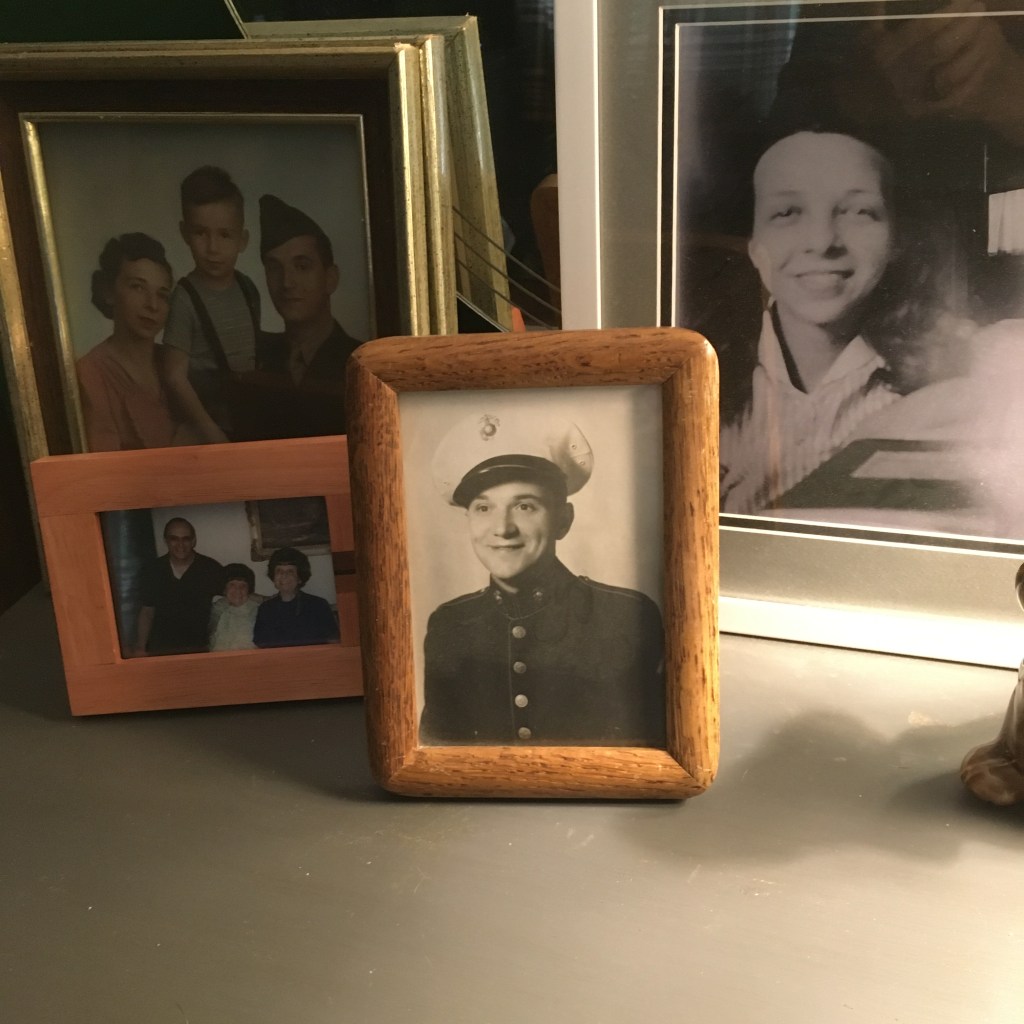
My dad enlisted in the Marine Corps in 1942 and served on Iwo Jima til his discharge in ‘45.  My brother, who knew him before the war said he was a different man when he came home.  I’m sure they had PTSD back then, probably called it shell shock. But the war obviously had an effect on him.  I couldn’t appreciate that cause I didn’t know him before, and he never talked about the war to us.  My anger lasted years after his death.
So what does all this have to do with talking out loud to dead people?  Every night I talk to all 6 of them out loud and in the dark.  The dog thinks I am talking to him!  But I finally know the questions I wanted to ask all of them. I finally  apologized for not appreciating the patience and guidance my mom gave to me. I told my brother how he guided me into a profession I was good at, and thanked my three aunts for their unwavering love of this skinny little kid.  And as a result of these one sided conversations I have a new understanding of how and why things happened and I began seeing some incredibly loving things my dad did for me- the corsages he made for all the girls at my party in 7th grade, the fight he had with my grade school principal when they wanted to retain me in 2nd grade.  My mom was a saint. She had to deal with me daily after working from midnight til 8 AM. I gained a new appreciation of my brother and an admiration for the kind of teacher he was.  i finally was able to verbalize to my aunts how much I appreciated their love and benefited from it.  I’ve asked all of them to give me a sign of some sort to let me know they are still watching over me and my kids.  i talk to them nightly. I love and miss all of them terribly.   Still haven’t heard back from any of them yet but I do believe they heard me and am open to any signs they can give!

Crazy or Therapeutic — Yes!

George raises some interesting questions for all of us.  Do we also speak to people or animals or even places/inanimate objects that were once an interactive part of our lives but are no longer so?

I do.  There are times when I’m alone and ask a question, put forth a gratitude, or declare a feeling to family members or friends who are no longer physically present in my life.  I don’t expect a response but often feel differently after I do.  It sounds therapeutic but, if I’m the only one (other than George) who does this in the world, perhaps it’s crazy.  So what is crazy?

When Wal, George, and I confer we recognize that we often have varying takes on the meaning of a word.  In order to establish that we’re talking about the same thing, Wal often refers us to Wikipedia.  Acting on that habit I found that one section of Wikipedia compares craziness to insanity and madness and describes it as “a spectrum of individual and group behaviors that are characterized by certain abnormal mental or behavioral patterns.”  It goes on to say, however, that a more informal use can refer to someone who is considered “highly unique, passionate or extreme, including in a positive sense.”  Therefore, who is to say whether the behavior George describes is good or bad, helpful or not?  Aren’t they just labels that are meaningful only to the labeler?  (Or does that sound crazy?)

George talks about how the nighttime conversations with his six departed family members have helped him reach new levels of understanding and peace with his past.  As I think about some of the “chats” I’ve had with my people, I realize that speaking aloud to an intentional person (even though they are not physically there) has a more direct effect on how I feel afterwards than just thinking it – silently – to myself.  Is it the physical sound of my own voice offered up to the person/universe that makes the difference?  I wonder.  (I just thought, “I wonder” and typed it but then I said it out loud and it felt different, more intentional.  Interesting.)  Try it!

There is an article in Psychology Today by Arthur Dobrin D.S.W. entitled Conversing with the Dead. “This isn’t talking to ghosts but a continuing source of comfort.”  In it he describes this for some, as a helpful, healing practice.

George closes his piece with him patiently waiting for a sign from each of the family members he spoke to.  I love this part.  My sisters and I would often contact each other when we were certain our mom sent a sign for one of us.  Once it was a sudden gust of wind on a perfectly calm day when a ceremony was taking place and we were all there together.  Other times it was a bird coming closer to us than it should when we were talking about her or a tug on my ear from out of nowhere when I was doing something that I was sure she would disapprove.  I/we have no evidence that it’s her.  But somehow, maybe because we want it to be true, we’re convinced it was mom. 

Crazy?  Therapeutic? What do you think?

Good Grief!

What could be wrong about talking to those people we loved who have transitioned on from this life? I think this is a means of keeping a person’s memory current – it’s instrumental bereavement; it’s good grief!

The psychologists tell us that complex bereavement can go on for years. Sometimes we are left with sentiments that have not been fully expressed, so we keep the conversations going. Having nightly conversations, as George does, is a sort of a role playing experience which keeps those stories alive. It is a way of keeping a connection with the departed, while still moving on with your life. Psychologist J. W. Worden describes these connection activities as the last stage of grieving. Another psychologist, Kenneth Doka might group this activity under ‘rituals of continuity’, which establishes that the departed are still a part of your life. Personally, I like the idea (Carl Jung’s idea) that building myths and stories about the departed is a positive and healthy activity.

The ability to talk out loud to individuals who have left for parts unknown can be therapeutic. Actually speaking the thoughts makes them more intense… after all, you have invested the energy and resolve to make a statement – an observable event (although most of us do this privately — we hope!) Some have termed this ‘directed imagery’ and it is a powerful technique in the healing process

Myself, I enjoy talking to my core family – I don’t expect an answer, but it helps to work out problems and just to say “thanks” (belatedly) for the care and kindness that was exhibited by these folks. And also to apologize for not understanding then, what you have come to understand now. It sure sounds like that is the gist of what Geo and Hen do as well.

Of course, as Hen points out, “crazy” is defined by the culture – it is outlier behavior. In a general sense, speaking to the dead may be crazy if it is obsessive; if it disables a person’s ability to effectively function in the living world. However, there are shades of gray here. I know spouses who refuse to erase the voicemail messages and telephone greeting recorded by departed spouses… and others who name pets after loved ones who have left life behind. Crazy? I don’t think so, but probably not therapeutic either.

On the other hand, you can go further down this road: digital reconstruction. All it takes is a zettabyte (yes, this is a thing) of information and Artificial Intelligence applications will – within the next decade — be able to create a digital ‘departed loved one’ that can respond to your emails and texts. This entity will use all the data known about the loved one and fashion thoughts and responses based on their experiences and predilections. See https://qz.com/896207/death-technology-will-allow-grieving-people-to-bring-back-their-loved-ones-from-the-dead-digitally/.

Or perhaps those desirous of keeping in touch real time may opt for the solutions offered through Guiding Echoes courses, such as Connect with Deceased Friends and Family, an online course advertised to “teach you to connect with loved ones who have passed away whenever and wherever you want”. You can ‘hang out’ or converse with those who have transitioned, according to the course’s author. Quirky, crazy? I don’t know – maybe it works. I guess each of us has a scale on which we rank these inclinations from healthy to quirky, along some continuum or another.

My Life in Space

Well, it’s my turn to write the lead post – and I have an idea that I’d like to develop. But it is the usual struggle to figure out what to exclude to keep to about 600-800 words (could you write an 600 word essay on Art, for instance – might have to narrow that down a little?). In fact, the title of this piece is a bit of a double entendre: how to manage the words in our blog space, as well as discussing living in outer space. Okay, let’s proceed with both goals:  I’m going to describe a passion and conclude with a question… after all, this blog is about sharpening different points of view and I’m interested in your thoughts – so read on!

Now you have probably heard that the United States has inaugurated a Space Force (USSF) this past December. The nucleus of the USSF is the Space Operations Command (SPOC) Yes, SPOC! Whoa…!  They will be staffed by military types initially, but the plan is to create civilian career paths within the force as well. Pretty soon there will be xenobiologists, astrophysicists, social scientists, geologists, project managers and insurance salespeople joining the center. (Hey, risk insurance is huge).

Sign me up! I have been submersed in space exploration since childhood. The Moody Blues declared in their tribute to Timothy Leary that “Thinking is the best way to travel…” I simply add “space” to the premise. Of course, much of my initial exposure was a passive reception of the subject. Analog Fact and Fiction magazine has had a place in our family home before I could walk, back when it was Astounding Stories. (Note: these stories were not just ‘pretty good’ – they were Astounding!) I joined a book club at nine and read among other titles, the Gray Lensman series by E.E. ‘Doc’ Smith. (The lensman were galactic police who were equipped with the Arisian lens, which augmented their powers of mental control in order to protect the universe). Clearly, the Space Force could use these tools! And don’t forget the powers of the telepathic Slans created by A.E. van Vogt… in fact, some sci-fi fans have adopted the rallying cry: “Fans are Slans!”

At ten years old, I still remember the warm summer night when I started to read Ray Bradbury. It was like someone opened a door in my mind. Not only were the stories fresh, but the writing was excellent. And that’s the point: Science Fiction opened up POSSIBILITIES.

My tastes grew into the type of content that focused on living arrangements and day-to-day life in space. The Alliance-Union universe created by C.J. Cherryh described space traders plying their routes between spaceports – each ship a self-contained tribe and business staffed by generations of one family; essentially long haul space peddlers.  Daily life on the ship is driven by main-day and alter-day shifts, since day and night have no meaning in space.

These “story universes” portray possibilities in human cultural change as we adapt to new environments. Larry Niven’s (and Jerry Pournelle’s) Ringworld series features a lot of the hard science that would be necessary for a stable life style in long orbit. I’m not sure if Niven invented the term ‘Belters’ – those miners and traders that made their homes in proximity to the asteroid belt in our solar system, but you may have seen the social system they formed in episodes of The Expanse. Niven described how their bodies would have changed during generations in weightless or low gravity conditions in space – growing taller, darker, and more slender – and developing their own patois and libertarian ethos: a loose affiliation of free thinking pioneers. Sure, some of you will say, ‘You haven’t mentioned Heinlein, Asimov, Philip K. Dick, trekkies, wookies, Firefly, or other favorite sci-fi themes – see, even more possibilities!

Possibilities!

Many science fiction authors have built themes over a large body of work, perhaps nine or ten books devoted to exploring societal change charged with new environmental challenges and interspecies contact.  A favorite is the “Humanx universe” created by Alan Dean Foster. In this reality, humans and the poetic thranx (large mantis type insectoids) partner to explore new worlds, while adapting to each other’s cultural and physical differences.  I’ve encountered literally hundreds of different alien species! The Space Force needs this type of expertise – I’m waiting for their call.

Possibilities!

Because life is not just about connecting dots – it’s about finding new dots! It’s about opening portals. Now don’t get me wrong, I love reading other material as well. I’ve gravitated (pardon the pun) to alternately reading three books at any one time: equal measures of non-fiction, literature, and escapist fiction like sci-fi. Non-fiction keeps me grounded; literature softens my heart, but sci-fi lets me fly! So tell me: What reading sparks your imagination?

My Life in the Woods

I can always count on Wal to fire up my thinking and to cause me to dig deeper as I respond to his thoughtful and measured queries. 

As a child, I was not a reader.  While I could read adequately and on grade level, I wasn’t drawn to books as much as I was to experiential activities and television (You know, that large heavy fat box with cathode tubes inside and a black and white screen on the outside that was activated by getting up and turning a knob and that, if you tilted the rabbit ears just so, enable you to view five or maybe 6 channels!)

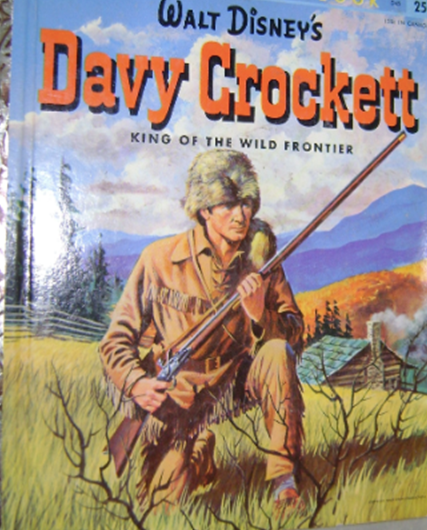
However, I do remember being enamored with two books that also each became a TV mini series: Davy Crockett and Daniel Boone. Both put me in awe of the adventures of woodsmen whose character and body were forged by rugged living in the natural environment.  However, having grown up in the Bronx it was unlikely I would be running down White Plains Road wearing a coonskin cap! But when I turned eight years we moved to an acre of property in the Hudson Valley that backed up to over one hundred acres of woods.  There I was convinced that emulating this folk hero would mould the man I would one day become.  As I often roamed the nearby forest most afternoons and weekends, I would imagine myself as a young Crockett or Boone, moving silently through the brush, leaving no footprints or evidence that neither man nor beast could detect.  I dreamed of easily eluding bad guys by escaping into the woods or perching in a tree, silently observing evil deed doers until I would stealthily swoop down to save the day!  These readings, further illustrated by Fess Parker, the actor who portrayed these clever, adaptive, adventurous, multi-talented backwoodsmen, tapped into something within that would remain a constant influence in my life.

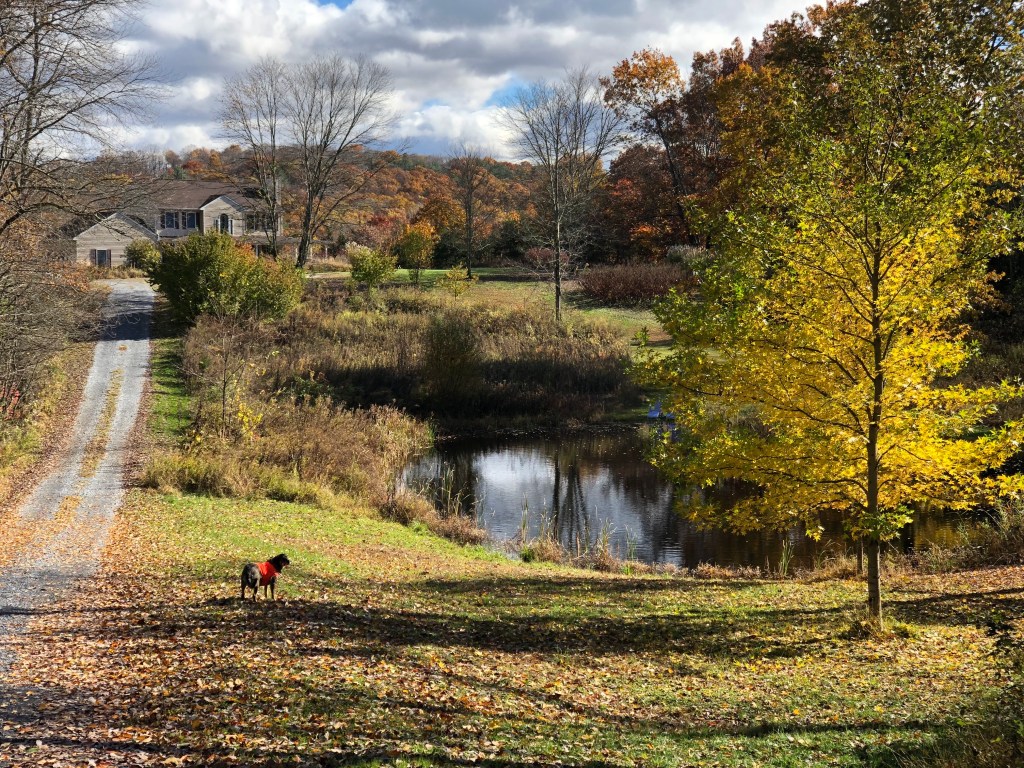
I still play in the woods and I still try to move silently as I walk daily with Duke.  And, occasionally I seek to camouflage myself near a log or behind a large rock to see if I can blend seamlessly enough to disappear from Duke’s senses.  What was once a childhood escape into imaginary storybook characters remains yet today, a source of comfort and connection.

Wal wondered about living in space; I dreamed of living in the woods.

Paws and Rails

Growing up in NYC I was usually out in the streets playing with all the kids from my block til the street lights came on.  I was and still am a very slow reader so it took me a while to get through a book.  But while Wal was lost in space and Hen was following animal tracks in the woods, I was in one of two fictional places.  I read every book by a man named Albert Payson Terhune.  My favorite was a book called A Dog Named Chips, but I read every one of his dog stories and I was lost in a world of saving helpless animals from horrible situations.  I would fantasize about saving a poor neglected dog, whose loyalty to me would wind up saving me at some point in the future.  I had quite a collection of pets growing up, cats and dogs but also birds, fish, and turtles.  My premier success was a goldfish that lived in a big bowl for over 8 years.  During those formative years I really believed I would grow up to be a veterinarian.

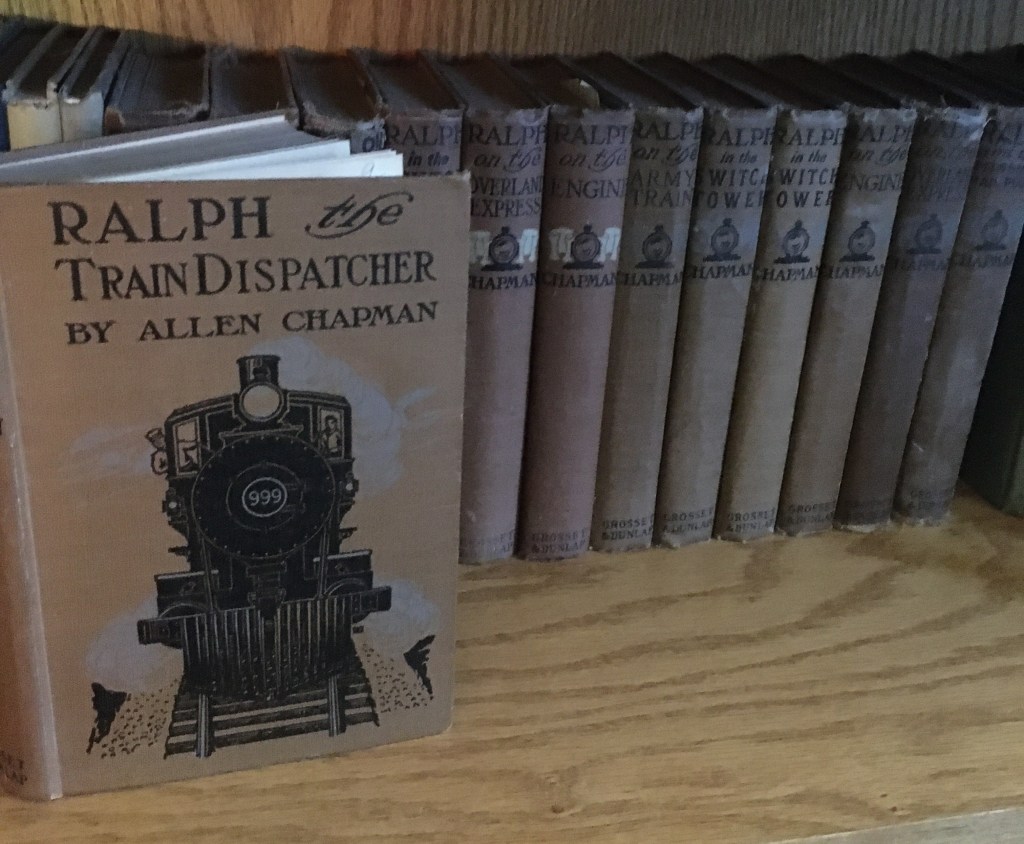
When I wasn’t rescuing fictional animals in my imagination I was riding the rails, a hobo in a boxcar traveling across the country, meeting other fictional hoboes and discovering life outside of NYC.  This interest came from the only activity my brother, father and I ever did together. My dad bought each of us our own Lionel train set.  My brother’s was a prewar metal set and mine was a 1954 plastic steam engine with all the colorful boxcars. Both of which I still have and still work!  My dad made a platform that took up half the living room floor and came out every Christmas when we would put up our Christmas village.  My imagination would run wild. That got me interested in a series of books called Ralph on the Rails written by a man named Allen Chapman.  Ralph’s adventures had me traveling the rails with him.  He experienced train wrecks, switch towers, riding with the engineer, riding the midnight express and many other incredible adventures.  And as a friend of Ralph I got to experience it too.   Perhaps it is funny how these childhood fantasies can carry over into our adult lives but in my case, I have been fortunate enough to have shared my life with all kinds of furry friends who have enriched my life and priceless memories of my brother, father and I creating this miniature and imaginary world.  The Ralph books just enhanced my love of trains and allowed my imagination to fly not into outer space but across this land on two rails.

When I Grow Up…

I never completely did…on purpose!

I often listened to friends talk about growing up.  Usually it meant being a little older so they could stay out later, drive a car, have a girlfriend, live alone, have their own money and their own rules.  Growing up represented freedoms with little thought given to the affiliated responsibilities.

When asked what I wanted to do when I grew up I would immediately remind myself to find something into which I could weave a sense of play.  (And my play would often occur in the woods near our development, with or without friends, but almost always with my dog.)  Play to me was the freedom that others found in more “mature” pursuits.

I always wanted to be superman or, if that position was already filled, Daredevil.

I really never had a calling.  I knew what I didn’t want to do when I grew up.  I didn’t want to have to wear a suit and tie to work each day and I didn’t want to do boring, routinized work.

When I reached college, I took liberal arts courses for as long as I could and then, when faced with a need to declare a major, I took a career survey offered to those of us who were undecided about a clear direction or purpose.  While I scored high in social careers, especially in helping people, the unquestionable recommendation for me was to become a forest ranger!  Imagine that!  Even though it was indicated that I would be successful working in groups and among people, my destiny also appeared to be in a solo connection with the woods, an isolated steward of the environment.   And, since my school didn’t offer that major I chose by default, elementary education.  Thus began my answer to the question, “What do you want to do when you grow up?”

As my family and friends and colleagues all know, I’ve loved every part of my career in education and in my subsequent work as a leadership trainer and coach.  But, today, despite my part-time coaching work with area school districts and social service organizations, I find myself living alone, playing in the woods (almost always with my dog), and caring for my twenty-two acres of forest.  And while I have grown older, since I’m still doing what I always loved as a child, perhaps I’ve redefined growing up!

What did you want to do as a child when you grew up?      

When I Grow Up…

I remember as a kid wondering what I would be when I grew up.  Today it’s a cowboy, yesterday I wanted to be a fireman(when I was a kid occupations were gender specific- there were no firefighters or flight attendants or female actors).  And tomorrow I might decide to be a doctor(one of the few professions where gender wasn’t specific, along with lawyer and teacher).  Maybe professions weren’t gender assigned but occupations were.  Interesting!  Anyway, as my childhood moved into my teen years I really hadn’t given much thought to my future, just whether I’d make it home from school in time to watch American Bandstand.  Or whether I would see the Beatles on The Ed Sullivan show for their premiere engagement in the US.  Those things were important , more so than plotting out my future.  

Then college came and I sort of fell into education because I had an aunt and a brother who became teachers.  Not a whole lot of forethought and planning went into it.  I just kind of followed suit and fortunately discovered that not only did I enjoy it but I was good at it!

So with the marching of time came new opportunities.  Now what?  Marriage, a family, a house- all new and exciting adventures and steadily they all were accomplished.  So now what?  Long years passed, slowly at first but more quickly as more years piled up.  What will I be when I grow up turned into did I grow up and now what?  Life got in the way, big changes occurred and now retirement was approaching.  What will I be was replaced by what will I do now?  

And suddenly a new career was in front of me with a whole new set of challenges and rewards.  But now in my 8th decade(how the hell did that happen?) the rewards are fewer and farther between when weighed on the scale of my youth and the challenges are more physically connected- like can I get out of the chair, or will my knee give out.  But weighed on a new scale smaller rewards have greater joys, like it being ok to take time to have a leisure lunch with a friend or smell the familiar and comforting fragrance when you open the door to your own house.  These are real pleasures even if the smell is of your dog or old laundry- it is yours! 

But I guess the question of what will I be when I grow up is still valid.  There is always more growing up to do but in a much more limited time frame.  Now,  I’ve lost friends and family members and my immediate family consists of three of us-  no more huge family gatherings that I used to love because they are all gone.  It puts into question how much more growing up is left. How much more quality time is left. How much more rewards are left as opposed to challenges and health concerns.  Well, we’ll know as it happens now, but the question of what will I be when I grow up is no longer something for the distant future anymore.  It is here and now.  Now I have to live in the here and now and take the challenges, pleasures and rewards as they come and with gratitude.  And that isn’t such a bad thing.  Too bad I couldn’t have learned that sooner but I was too worried about what I would be when I grew up!

When I Grow UP

How interesting it is that when you are a kid, the phrase ‘When I grow up…’ is usually followed by ‘I want to be a [insert occupational choice] ‘. Like Hen and Geo, my journey started with fantasy picks and developed through a series of realistic trade-offs. Seems like we followed a similar arc – and I’d guess that most people do. If you had asked, I would have stated that I’d be ‘grown-up’ by age 24. Little did I suspect that I’d be husband and father by 21. Lots of practical decisions had to be made. My evolution of job choices went something like this:

  1. Tribal elder and scout: No good: I didn’t have a tribe
  2. Aircraft designer: It’s what I thought my Dad did
  3. Artist: It’s what I thought my Mom did
  4. Anthropologist: Find out what the Etruscans did – but no, too much travel
  5. Psychologist:  Maybe I should help others figure out what to do
  6. Process analyst: How do things get done, anyway?
  7. Manager: Which things should get done?
  8. Consultant: Help others get things done (which turns out to be a key component of #7)

In college, I studied anthropology and psychology. When I concluded that studying other cultures might make for an irregular home life, I decided to focus on helping other people make up their minds on occupational goals. Hen talked about how a vocational work-up seemed to have captured some enduring interests. My Dad had the same experience doing an occupational profile at NJIT many years ago, and it sort of predicted his career as a liaison engineer. I figured, well, maybe I could be one of those folks who created those tests. Graduate school offered an opportunity to specialize in that area. Two graduate degrees and the first chapter of a PhD dissertation completed, I painted myself into a corner: too specialized for my employer’s needs and family life too compromised by constant commuting to Manhattan. So, additional adjustments were required over the years: positions in Human Resources, Management Training, Planning, and Operations. It was fine — I enjoyed the challenge of learning new jobs. My last assignment allowed me to work with other cultures to reshape business processes and applications – didn’t meet any Etruscans, though…

Through all that and the busy-ness of family life, the main focus for me was to be task oriented, sometimes to the detriment of relationships and good social judgment. Retirement has freed-up time to consider what type of person I can still BECOME. Hopefully, I’d like to think that I’ve grown up, grown old, but am still growing out

The Golden Years

After commiserating with my blog mates who felt my submission was a little down, I decided to review what I wrote.  What I realized is that this last week I was surrounded by some very sad news, sickness and accidents of three people very close to me.  When I wrote the following, I had awakened in the middle of the night and couldn’t get my friends off my mind.  Two of them suffering from disease and one from a terrible fall down a flight of cellar stairs.  Perhaps my mind was focused on the negative.  Lying in the dark room like that allows the demons to come to the forefront and I believe my piece, though admittedly a little down as a result, was actually a true reflection of where I was at that particular moment in the night.   Those thoughts tend to soften with the light of day and the need to look toward the future.    Wally reminded me that I don’t carry around that bleak of an attitude most of the time.  I did try to insert some comedic relief even at that hour of the night.  Thanks for your understanding.  I believe we probably all have our dark moments when our defenses are down and there is no one around to bring us up.

This may be a little rambling as my thoughts on this topic ramble from one day to the next. Maybe it is my mental state or my inability to focus on any one thing at a time.  I don’t claim that this is how all folks in their 70’s think or feel but perhaps some others can empathize with my plight.  There is a lot on my mind.  In fact my mind becomes incredibly active around 2 to 3 AM.  It is dark, scary, I know the boogie man is probably under the bed waiting for me to drop my arm over the side.  Funny how things I used to fear as a child come back to haunt in those glorious golden years.  It is in those dark hours that the demons that have been hiding through my 30’s, 40’s and 50’s come out  unleashed and unhindered to play with my mind.  Those are the times my worst fears seem most reasonable without the light of day to dismiss them.

I am soon to be 74.  My immediate family all passed by their 74th brthday, so naturally I have some trepidation about this upcoming birthday.  I feel as if my world is shrinking.  That doesn’t terrorize me or anything, it is just factual.  Raised in a large Italian /Welsh family our holidays consisted of 15 to 20 kids, cousins, aunts and uncles, grandparents yelling and laughing, singing and arguing at dinner.  That was the norm. It felt safe, comfortable, and predictable.  I liked that.  But now, being the last living member of my generation or above it seems lonely. Holidays with the 3 of us fall kind of short.   I can’t even call my brother and ask him if he remembers the time Aunt Eleanor dumped the pasta on my dad’s lap or was it Aunt Edna?  My family stories are fading and I have no one to run it by for verification.  So the size of my world is shrinking.

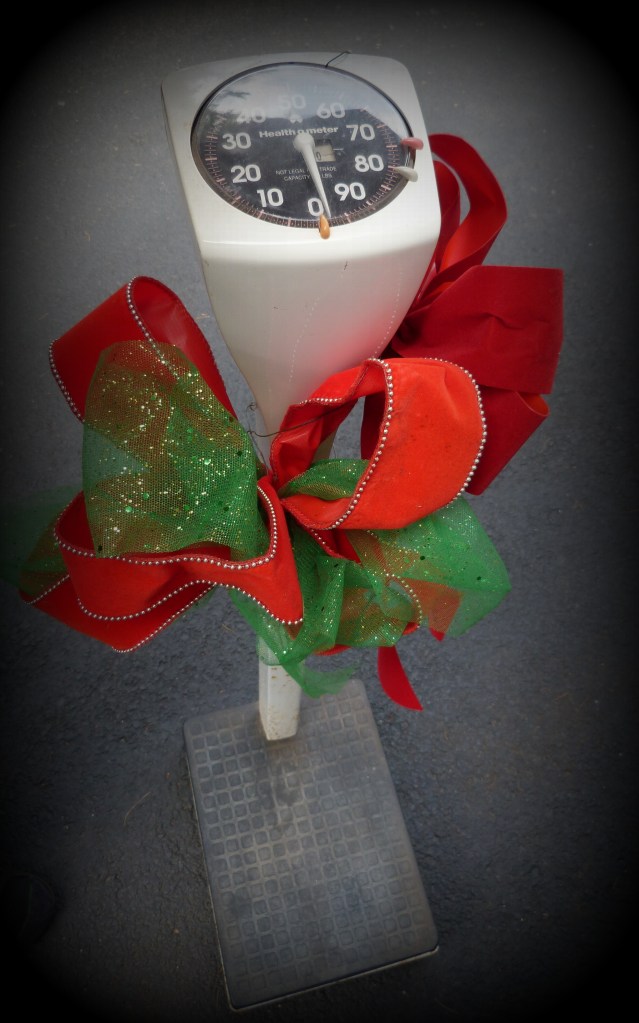
But it is more than that.  My body is unable to do things that I am sure I did just a year ago. That is unsettling cause it means my mobility or my stamina has shrunk as well.  As you grow through the decades of your life your body becomes better at things. Things you were incapable of performing in your 20’s somehow become easy in the 30’s.  Not true of things you did easily in your 50’s.  They suddenly become monumental in your 60’s. Or at least that is how it is in this body. I used to be 5’7″ tall but all of a sudden when I visited the doctor in my 70’s I have shrunk (I must admit my shoe size increased in all honesty).  Actually senior citizen maturity does have benefits, maybe because it is harder getting up out of a chair, we tend to be more reflective, more patient, less judgmental.  In the past, if my kids said something upsetting I would lunge out of my chair and go on a rampage- you know the  kind….I walked 9 miles to school in the snow, or we didn’t have phones to tell us how to get to places, we had to learn how to read maps.  You get the idea.  But now because I have to push up on the arms of the chair, make sure my legs are under me and then take a few moments longer to straighten up, the drama of “flying” out of the chair to make a point is replaced out of necessity to reflect on things before opening my mouth.  So perhaps patience and reflection are more features of immobility than wisdom!

I have no grandchildren.  I can see how they would certainly increase the size of your world. I don’t wish I had some, my kids just never married.  If I had grandkids I would probably be up at 2 AM this morning wondering what their lives would be like.  Would they have water to drink, clean air to breathe, flowers and wildlife to enjoy.  Better I don’t have any!  I guess I just have to get used to the world I am in now, shrunken as it is, it is all I’ve got.

I wrote this 2 years ago, just thought I would include it.

I’m already 71 years old

     the “Golden Years” so I’ve been told

But gold begins to lose its shine 

     somewhere around 59!

Hair’s the first that goes

     followed soon by achy toes.

Thumbs and wrists hurt next

     and other joints that used to flex.

Indigestion and heart burn pills 

     needed nightly to ease those ills.

Blood pressure and cholesterol rise

     despite my doctor’s endless sighs

Not to mention liver spots…

     who the Hell needs old age blots?

Now the memory starts getting weak,

     Check the  fridge for the keys I seek

Who knows what’s next to make me “blue”

     ’cause inside a year, I’m 72!

Work with What You’ve Got

I respect what Geo has written – and the place from which these feelings emanate. He and I share some of those demographics (losing our parents and brother prior to age 74 – and some physical challenges). These are areas that do narrow your perspective.

However, if folks will allow me a little faith space, I agree with Paul of Tarsus who said that adversity builds character and character leads to hope – and hope does not disappoint. So I’d suggest to Geo – stir a little bit of hope into his cup of worry.

I don’t know about ‘golden years’, but I think that we are lucky to have gotten to a point in life where we can sit back and reflect a little. It’s just a respite from some of the hard things in life we’ll go back to facing soon. Life is a struggle after all – but a glorious struggle! (And if you feel it is not, well, make it so!). Work with what you’ve got.

Everything has a season for sure. You might say that life is like a garden where different plants bloom at different times. Or you might say that when one skill starts to degrade that you find another modality of which you were not aware. I’m not as strong or fast or virile as I used to be – that makes me sad. But I’m switching gears to focus on creative tasks and finding ways to extend my tennis life: my goals are just more attenuated. And sure, there are times when it seems that my loved ones and I are just on a conveyor belt headed toward end of life. Unfortunately, that’s the way it is. But I’m still glad to be where I am in the cycle. And I don’t feel alone.  My faith helps me believe that there is a presence traveling with me – as near to me as my own breath. And I’m pleased with all the small miracles that occur each day, despite the headlines and negativity. It also makes me happy to say thanks for these items that go well, even when you did not expect it. So diminished I am – and more diminished will become… but I will work with what I’ve got.

It’s What We Feed Ourselves

George reminds us that all is not necessarily gold in the golden years.  And, there are times that try our patience, wisdom, and sense of being grounded despite our seven decades of life experience.  For even those of us who can live rather comfortably in retirement, the steady decline in our physical and mental functioning can be overwhelming. Our circle of friends and family grows smaller at an increasing rate and our sense of being valuable and important to those we love slowly transforms into a feeling of being a liability.  Ugh!  What’s so golden about that?

But here comes Wal to the rescue!  He gives us hope.  He suggests that we grab the bull by the horns and do what we can with what we still have to make the best of it.  He inspires me to find ways to be of value, to think smarter in pickle ball games to make up for my slower reflexes, and to find fun in whatever I can.  He reminds me that I can’t change those things outside of my sphere of influence but I can have a positive impact on those things I can influence.  And, as Wal taps into the realm of faith to assist him, I’m also reminded of the Serenity Prayer – written by American theologian Reinhold Niebuhr.

“God, grant me the serenity to accept the things I cannot change,

Courage to change the things I can,

And the wisdom to know the difference”

This topic also reinforces my belief in the notion that we can convince ourselves of most anything, often by spending time thinking about it and surrounding ourselves with people who reinforce what we think.  This works well if we’re happy and in a place of fulfillment.  If we’re not, I suggest we need to spend more time thinking differently and more time with people who are happy and content.  (A notion I gathered from the Law of Attraction?) And Henry Ford supports the idea of intention this way: “Whether you think you can, or you think you can’t –you’re right.”

In addition, I appreciate the opportunity to talk about the Golden Years as it pertains to not only the leisure years after retirement but also a kind of beginning of the end of life.  While this is likely another blog topic, I’m wondering if any of you have any conversations about the final years with family or friends.

Be Impeccable with Your Word

Hen featured The Four Agreements in his last post – one of which is to attain impeccability of one’s word. This chapter really resonated with me. However, I may rename this post to Be “Impeccabl” with Your Word, because it is a huge expectation. Not sure I can get all the way to Impeccable — honestly, I’ll be happy to just get close.

Being true to one’s word is a pervasive theme in ethics and philosophy. The focus is not just on veracity, but also taking care with what one says, avoiding gossip and snarky comments, etc. Word is bond. No trash talk. Loose lips sink ships.

In Greek philosophy and theology, “word” (logos) is an elemental concept: “the divine reason implicit in the cosmos, ordering it and giving it form and meaning”, according to the Britannica. ‘Word’ describes the essence of a thing. To know the essence of a thing and express its name is powerful. In some cultures there are ‘true’ names that are never revealed to others just for this reason. So impeccability is important. It drives home the tidiness of thinking and the economy of speaking that is the product of careful consideration. It presupposes an internal discipline and a firm foundation of guiding principles. It requires clear vision. It’s the sort of condition that one does not expect to be born with – rather it is the hard won product of survival, lessons learned, and dexterity of mind.

So, impeccability of word also implies impeccability of actions and choices.

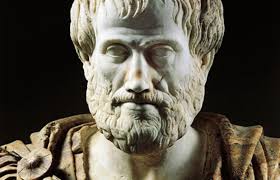
In this connection, I learned a new word: Eudaemonism. Apparently, Aristotle defined the state of eudaemonia as ‘living and doing well’ and felt that this condition was associated with achieving virtue or excellence, requiring virtuous activity. In the Greek sense, virtue is a bit broader than the moral context, but rather focuses on achieving perfection in one’s pursuits: impeccability. Aristotle set a high bar!

Aristotle set a high bar….

I like the definition in Wikipedia:

“Eudaimonia [sic] as a self-discovery, perceived development of one’s best potentials, a sense of purpose and meaning in life, intense involvement in activities, investment of significant effort, and enjoyment of activities as personally expressive, deep relationships”

To me, this sounds like a worthy goal and the work of a lifetime. When I think about all the words I wish were never said, my stock is going down: perhaps I can only hope to attain “Impecc” of Word after all.

The Power of Your Words

Thank you Wal for continuing this conversation.  Of all the issues, bumps, and causes for sleepless nights it’s often words said or unsaid that are at the root cause.  Ruiz gives us a comprehensive look at what is involved in being impeccable and, I agree, achieving a portion of impeccability is all I can hope for.  However, I believe that this is what the author intended.  By making an agreement with ourselves to maintain a level of awareness about how we use our word, is the goal.  Setting an expectation of mastering it to perfection is to set us up for yet another disappointment.

I have often thought about the concept Ruiz brings forth about gossip.  As I understand it, not only is it inappropriate to talk negatively about others with those who would listen, but to talk about others for any reason, without their presence is still gossip.  So, I find that although I choose to follow his intention about using my word only for positive intention, I have excused myself from the label of gossip, when I speak positively of someone who is not present.  And therein, lies my challenge.  That is, too often we modify definitions of words to suit our needs or present behaviors: an excuse to avoid the hard work of changing old habits.  While I don’t feel this excuse I’ve granted myself is an example of this, I am conscious of how easy it is to make my own rules.  Just a thought among many thoughts…

While the heart is arguably the most powerful part of the human body, a friend of mine would argue that it is the mouth. He contends that what comes out of our mouths can do enormous good or extreme damage to not only ourselves but to countless others.  I dare say he was right. 

I am being impeccable when I say how much I am appreciating each of you, George and Wal, for creating and sustaining this journey.

The Appeal of the Snark

Wal, as I was reading this a couple of thoughts came to mind and a couple of reactions came to heart. The first thing of course was what an admirable concept this is and how we should all strive to achieve it.  Then my heart sank– no “snarky” comments?  Damn– I didn’t even exist in teenage society ‘til my snarkiness matured. That was how I got noticed, laughed at and with by the rest of adolescent society.  It was the only way I could fit in, impress and have a personality.  To this day, snarky comments comfort me like a warm blanket as a bastion of protection, a wall paper to protect me, and make me prettier than I feel.

The impeccability of my word comes when I make a promise.  If I say I’ll meet you at 2, I’ll be there at 1:45, totally willing to wait ‘til 2.  I don’t think I have ever missed an appointment and was ever late.  But then what about the little white lies we tell when we know they aren’t true.  “You don’t look a day over 50,” if you could erase those crow’s feet around your eyes and grow a head of hair again.  Is that impeccability?  It makes the other person feel good, which is admirable but in reality you look like Hell.  Would that be impeccable to say that to him?  It wouldn’t seem very nice!  Here’s someone I can finally quote…..Thumper’s Mom said, “If you can’t say something nice, don’t say anything at all!”  Maybe even here I am being snarky, but impeccability of words requires the good with the bad……and to what end?  But I digress!  By the way, you and Hen looked like young stallions today!  

A Guide to Listening in a Time of Deafness

Many years ago I was part of a group called, The Caring Community.  Founded by a dear friend and colleague who was a facilitator and trainer in the area of human relations, the group was designed to bring diverse people together to spend time in community.  (He defined community as a place where people felt valued, accepted, and connected.)  This time in community was accomplished by way of our focus on personal growth and by regular participation in community service. Throughout our time together each of us contributed unique skill sets, experiences, and resources.  One of these resources was a book suggested by a participant who found it to be of great value.

The Four Agreements, by Don Miquel Ruiz offers a powerful code of conduct to recognize and free us from blindly following self-limiting beliefs and practices. Each agreement is more of a direction than a goal.  Followed conscientiously, they help diminish drama, reduce stress, and offer a personal context from which to make good decisions.  In other words, it helps us to better hear others and ourselves outside of our habitual practices.

I chose to write about this book as a means of offering a way to mitigate the divisive, angry, and polarizing language, we hear daily: the sounds of ideas, attitudes, and emotions we feed ourselves and that both justify what we believe to already be true and that cause us to dig in to protect our perceptions.  And while none of this is new in the history of mankind, it is more rampant and extreme than I have seen or felt in my lifetime.  And what I’m not hearing are alternatives to address these differences with civility, compassion, and understanding.

(There are many other models and authors which offer ideas for how to listen to self and to others.  I chose this one because it works best for me.)

To that end I offer the following taken from The Four Agreements:

Be Impeccable With Your Word

Speak with integrity.  Say only what you mean.  Avoid using the word to speak against yourself or to gossip about others.  Use the power of your word in the direction of truth and love.

Don’t Take Anything Personally

Nothing others do is because of you.  What others say and do is a projection of their own reality, their own dream.  When you are immune to the opinions and actions of others, you won’t be the victim of needless suffering.

Don’t Make Assumptions

Find the courage to ask questions and to express what you really want.  Communicate with others as clearly as you can to avoid misunderstandings, sadness, and drama.  With just this one agreement, you can completely transform your life.

Always Do Your Best

Your best is going to change from moment to moment; it will be different when you are healthy as opposed to sick.  Under any circumstance, simply do your best, and you will avoid self-judgment, self-abuse, and regret.

If we applied these agreements to our thinking and our practice, perhaps we might then hold the same conversations over the same issues with less anger and judgement and with the purpose of finding common ground rather than trying to convince others to abandon their perspective and see it our way.

I’d be interested to hear your viewpoints, any thoughts on The Four Agreements, or any books you may have read that you found to be a powerful influence in your life.

How Do You Heal a Country?

How do you heal a country?  How do you protect your own ideals while accepting those of others who are diametrically opposed to your way of thinking and how do you avoid contributing to the overwhelming lack of civil discourse that can often erupt through conflicting expressions of what is right and wrong, factual or fiction?  That seems to be where our country is stuck right now. 

We have to heal and in order to do that we have to find a path to help us heal.  Henry lays out a plan based on the integrity of our word and the desire to work things out.  Mr Kraftowitz , my 7th grade English teacher,  used to say that the mark of an intelligent person is not that he has a lot to say but that he listens!  Something I often struggle with.   I often find myself forming my next point In my head rather than listening to what the other person is saying.  As a result I haven’t learned anything.  I know I do this.  I assume many others do as well, and instead of hearing we are talking passed each other resulting in nothing being achieved.

Are the civil wounds  too great to heal?  Are there things we actually can agree on- facts that both sides can agree are valid and necessary to take into account? Maybe once we can agree to that perhaps we can begin a true meeting of the minds. Currently, this seems to be particular tricky.  We cling to the facts as we see them and can’t understand why everyone doesn’t see them the same.


I hate to admit that I tend to be a half empty glass kind of person.  My personal experience was that if I didn’t expect much I wouldn’t be disappointed.  And for a long time in my youth that served me well.


I guess that’s why I’m not sure Henry’s approach would work.  One has to assume for it to work, both/all parties have to want to mend the gap,  agree to be impeccable with their words and are both in search of common ground.  My half empty glass wonders if those factors can become aligned.  I sincerely hope it is possible because something has to happen for us to begin healing. Holding on to personal emotions, beliefs, and ideas in stubborn refusal to let go for fear of who knows what will only enlarge the wound and make civil discourse divide us more.

We Did Not Start the Fire

Before the introduction of the term, “Fake News”, I rode up in an elevator with my social psychology professor, who said: “There are no such things as facts”. He was making the point that all data are interpreted through the lens of the viewer. While there may not be ‘facts’, there’s no shortage of information. According to the Pew Research Institute in 2018, 68% of Americans suffer from news fatigue. Social media has exponentially added to this burst of ‘facts’.

In this time of tweeting, retweeting, and forwarding posts of like-minded opinions, I wonder whether anyone is interested in real discourse — lots of pots, lots of stirring. Hen has made a great point about active listening – and make no mistake, it requires discipline It seems rather that people are seeking confirmation of their own opinions. We’re becoming prisoners of our own ‘metadata’ defined by any one of a number of groups to which we identify.

Geo says that the passion invested in various opinions can prevent an understanding of another’s point of view. In order for rational discourse to occur, each of us needs to submerge our ‘need to persuade’ from the ‘need to repeat back’ someone else’s position so that they can feel understood. It is important to really listen rather than formulating a response while the other person is talking. Understanding does not equal agreement, but it may lead to new ideas and constructive action.  The Four Agreements is a very insightful book as Hen describes. I’d also recommend David Brooks’ The Second Mountain, in particular, his work with diverse groups to formulate community actions.

Conflict management is messy. As Billy Joel sang: “We didn’t start the fire, it’s been always burning since the world’s been turning”. We ought to be sure that we are not the ones stoking the fire.

Tears of Joy. Perhaps!

I wasn’t sure what I was going to write about this time.  Nothing seemed to grab me.  I have been in a kind of low place as I have a recurring pain in my neck that no one seems to be able to help alleviate.  The doctor, the massage therapist and the physical therapist seem to keep trying things that don’t touch the pain.  So with that on my mind and with the holidays approaching I have been at a loss.  Not being able to do much physically due to the pain, I have been sitting with heat pads and ice packs and have had a lot of time to be inside my head.  There are places I would rather be!  I noticed that my emotions have been very tender of late.  I hear a song and I start to tear up.  I read an article in the newspaper about a kitten that followed a man walking his dog back to his house and the man took the kitten in and I lost it.  A pattern was developing and I realized this has been happening more and more often in the last few months.

Everything seems to “touch” me more than it used to.  I watch a movie and I better have tissues nearby because I know somewhere in the movie something is going to bring me to tears.  I have always been a sensitive person and easy to express my feelings but this is something beyond that sensitivity. Maybe I am in a nostalgic period of my life where all these things take me back to positive memories from my childhood or from different events.  I was thinking back today when I was an innkeeper and reminiscing about the good times and fun I had in that position and sure enough I began to cry.  And it is a funny cry- I feel my face distort, the tears come and then disappear almost as quickly as they came.

Perhaps the approach of the holidays have brought me to this tender point.  My daughter and I are going to a local restaurant for Thanksgiving.  My son moved away recently and can’t make it back for the holiday.  I was fine with it all until I began to reminisce about holidays in the past.  They were filled with relatives, vast amounts of Italian food, noise, arguments, laughter- things I often dreaded at the time. But now I miss them terribly and sadness diminishes the memory.  I love spending time with my daughter but it just isn’t the same anymore. I think she feels the same way although when they were kids they used to hate opening their Christmas gifts and then having to rush off to get to NYC in time for dinner with the family.

I also think the time change and the change in the weather have affected my outlook as well.  The days have been gray and daylight is short and I can’t seem to muster up enthusiasm for much of anything.  I know some people are affected by the lessening of daylight but that had never bothered me before.  I suddenly understand why holidays can be very lonely times for people.  Coming from a family that would have 14 or so people for Christmas dinner every year to just the 2 or 3 of us has been very difficult to accept.  It is amplified by the holidays, I just wish I had a way to move passed it.  Now with Christmas music everywhere it becomes difficult to escape.  I am trapped in a world of happy holiday music and good cheer all around and I can’t appreciate it.

But in reality, the difficult realization is that I and my two kids are all that is left of my family and that leaves me with a very empty, and sometimes scared feeling in my heart. I guess I just have to accept the fact that my emotions are askew, and that I can be brought to tears in an instant, both wonderful things and sad things bring them on.  Along with old age maybe more than just the body gets arthritis.  Maybe I have arthritis of the emotions.  I will survive, I will adjust and accept and conquer.  But I probably will be brought to tears anytime I see something tender, hear or see something beautiful- yes, beauty does it to me as well!  The last time I was in Italy in my grandfather’s village I walked into the little hotel and they were making sauce.  The smell of that sauce brought me right back to my dad’s kitchen and, you guessed it, I began to cry!

A Rising Tide

They say a rising tide lifts all boats. It’s the same with emotion, which sort of wells up around the holidays and makes itself known in ways that George describes. No doubt most of us experience that bittersweet feeling of enjoying the present, while missing the past. Sometimes we are surprised by the strength of that feeling. The holiday season has so many strong associations that it is hard to simply remove yourself from cherished memories.

I confess to feeling blue around this time of year, missing my brother, mother, and father… and realizing that my kids are developing their own traditions independent from my wife and I. We are coming to grips with the fact that our time is passing and we are shifting into a less central role than we have played previously. In a way, this is welcome, because the ‘downshifting’ needs less energy. However, I don’t want the important people in my life — now gone — to be forgotten in the process of building those new traditions.

I’m moved by advice provided by a couple of smart individuals: Carl Jung and Erik Erikson. Jung talked about the importance of making myths and Erikson pointed to age-related challenges that must be addressed to remain psychologically healthy.

Jung has this mystic quality that is incorporated into his scheme of psychoanalytic thought. What I take from his writings is that it is important to stay in continuance with our past by reinforcing stories – or myths – that keep our history alive. My job is to retell – and maybe embellish – tales about my forebears to maintain the currency of those lost loved ones. Don’t we all do this? Friends get together and relive ‘war stories’ and old memories. We’re making myths – in a good way! I try to do that with my sons and grandsons. It honors those who have passed and gives me a role as a ‘creative historian’. Hopefully these myths provide significant life lessons as well as honoring people and times past. Erikson laid out a theory of developmental challenges as we grow. The generativity challenge has to do with a decision we make either to a) share our experiences and mentor others as we age or b) draw inward and focus on ourselves and our problems. Of course, we occasionally have a foot in both camps, but the latter choice tends to build a closed system over time. I’d rather acknowledge what I miss, take the best of it and reach out for new opportunities. Joni Mitchell sang “…something’s lost, but something’s gained in living every day”. Synthesize and celebrate, my friends!

Deep Waters — Surface Emotions

I love George’s newly coined medical disease – arthritis of the emotions!  Yup!  I too, contracted the same condition over the last few years.  However, my affliction is not necessarily triggered by only the holidays but seems to flare up on any given day, week, or season.  Sensitivity to joy, sadness, love, or loss, evokes a deep connection to a feeling that often results in tears.  Usually induced by a movie, I find my emotions, which have migrated to the surface over the years, release more readily and more frequently than before.  And, interestingly, they are more prevalent around stories of extreme joy or love, or transformation than those of sadness or loss.  I don’t know why.

The holidays for me have changed as both Wal and George have described.  My mother, who was the focal point for our gatherings, is no longer with us and my siblings and children have their own families and friends and traditions.  As a result, getting together for the holidays or birthdays is far less frequent.  And, as a single man, sometimes I spend a holiday or birthday alone—except for Duke of course.  At first I felt sorry for myself and drifted into places of sadness and questions of where I went wrong.  But over time, I’ve recognized that spending time alone, holiday or not, does not represent who I am or how my life turned out.  It’s simply a quiet time to rest, or read, or walk, or think, or watch one of those tear-producing movies.  Someone once said to me that it was better to be alone with yourself, than feeling alone with a partner.  I understand that difference and can now appreciate (most of the time) when I spend one of those days by myself without seeking to change it.  Being alone doesn’t have to mean I’m lonely.  However, when I do get to spend time with family and/or friends for a holiday, I truly enjoy the story telling that Wal referred to in his piece.  When my sisters and I would spend time together, my mother seemed to be with us as we told story after story of experiences and events that made us laugh so hard that tears came to our eyes.

Up and Atom

What animates us? We live; we experience awareness; we have consciousness of self. Where does the energy come from that acts as our driving force? According to physicist Jeremy England, it’s the entropy, stupid!

Simply unpacked, his theory maintains that atoms subjected to energy (say electromagnetic force) will tend to organize so that they will more efficiently dissipate that energy. This is entropy. Like the ‘arrow of time’ which only proceeds in one direction (according to current physics), entropy only leads to energy dispersion. It is the reason why my coffee will get colder – and not hotter – while it sits on the table as I write this piece. The coffee is dissipating energy to match the temperature in the room: entropy.

Over long periods of time, clusters of atoms develop structures – some complex — for dissipating energy, e.g., photosynthesis. England makes a case that complex structures gradually evolve to absorb and distribute increasing amounts of energy. Under certain conditions, life can develop. England says “You start with a random clump of atoms, and if you shine light on it for long enough, it should not be so surprising that you get a plant.”

Hmmm… why?

Well, apparently there are two reasons: a) increasing self-assembly allows clusters of atoms to absorb and rationalize greater amounts of field energy and b) self-replication is an efficient option for handling copious amounts of energy.

In sum, the resonance of energy in a field leads atoms to congregate in ways that allow more efficient systems for binding and disseminating energy. This process conforms to the law of physics in which an even distribution of energy is the final state. It is much like obtaining equilibrium in a solution – for instance, like stirring cream in your coffee. Rocks do it, trees do it, even the birds and the bees do it. Complex clusters can do it better – and they will over time replicate to form more clusters in order to handle all the field energy.

Wow! I applaud Dr. England. I also applaud all those who search after the ‘Big Why’. However, I’d hate to think we are just a special case of the second law of thermodynamics.  What is missing is any sense of intentionality – at what point does our purpose extend beyond energy dissipation?

Up, Up and a Way Out

Recently a friend asked me what I do to keep my brain sharp.  She has scrabble and crossword puzzles and I have Sudoku and Wally!

For me, it is likely that we are, in fact, evolved from randomly interacting atoms in chance encounters with other “stuff” under varying conditions that occurred in some primordial ooze. I also believe that all living and non-living things are in community with each other and don’t just survive independently, but in concert with all things of this world: interdependence if you will.  How we/they know what to do in order to fit into this whole-earth relationship, I don’t know.

Wally ends his piece with a question regarding the absence of intentionality and the notion that there must be more than physicist England suggests.  Another friend of mine refers to the idea of deliberate intervention as something he calls Source Energy; His name for what some call God, others call Nature, divine intervention, etc.  

Clearly there is no universal agreement as to what the source of our energy is.   Some of us are crystal clear about what is behind our existence and some of us have ideas with many captivating questions.  Perhaps the more important issue for all of us is to accept that the human world has always held differing beliefs to the questions of who we are and where we came from and to proceed with the notion of being the best versions of who we are for our universal community and ourselves.

What I do know is that there is some intangible thing that exists beyond our individual and collective consciousness.  And I know this because often, while walking in nature, I am struck with a overwhelming feeling of joy and gratitude and my usual reaction to shout out, “Thank You!”  And, since it’s usually only Duke and I during these moments, to whom am I offering thanks?

Inertia

This is a tough one for me.  Not sure about all the scientific stuff but I know MY energy is definitely influenced by life circumstance and emotional state of mind.  I know that when I feel purposeful and productive my energy intensifies and I become industrious and excited about getting things done.  My body seems to rise to the occasion and supplies the necessary energy needed to attack the tasks I have to  address.  My mind becomes sharp too and focused.  An object in motion tends to stay in motion!  It’s a great feeling.  I have a purpose and a path. 

When I first retired from teaching I had a difficult time reinventing myself and as a result my body was slow to pick up the new life required of me. Depression slows the process down as well, and saps the energy from my body making me want to go inward into my head and feel sorry for myself.   When I run into emotional roadblocks, which unfortunately still occur at my age, it slows me down. My approach to life’s daily activities seems to lag and my desire to “do” diminishes.  Inertia sets in.  I want to climb into bed and pull the covers over my head.   It becomes hard to break that cycle until I eventually have had enough of myself like that.   I then throw the covers off to try to find the next motivating thought to get me back on track-  not always that easy and as the years pass and the body continues to suffer aging,  that motivation gets harder to activate and the energy can become less and less.  The answer for me seems to be to keep the mind sharp to identify when my energy is being sapped and to use my mind to give a spiritual pep talk to my body to get back in the fight.

Who Am I?

Since 3 Old Guys began publishing our blog, some readers have suggested we offer a biography of who we are.  In response to that request, we present this blog entry:

I can use labels to identify me from others.  Hen, man, father, grandfather, son, brother, friend, dog companion, seventy-two, home owner, …

I can use experiences to describe what I’ve done.  Spent years being formally educated, played sports, lived with several long-term partners, sky-dived, taught, coached, befriended, laughed lots, wept, cut and stacked wood, rode sleds, swam, pondered, cleaned, cooked, hiked, biked, played, …

I can use words to describe what I desire.  A loving partner, deep friendships, more time outdoors, enlightenment, good health, good instincts from which to make good choices, discipline to improve my writing, …

But who am I?  I am aware of the question and aware that it is a question I continue to explore.  I am aware that when I step outside of my routine behaviors and observe myself doing an activity, I am a sort of consciousness:  an awareness of self separate from that self. 

Going back to a more conventional view of who I am and to a description that gives me a visceral connection between spirit and words, I would add the following:

My purpose is to bring my joyful nature, sense of humor, and accumulated wisdom to create opportunities for others to question and identify their (purpose) role in life.  I seek to forge intimate, meaningful relationships and to love and support this community of relationships unconditionally.

I am a happy man who wells up with extraordinary joy and excitement, often.

I live fully and with awareness.  I am on a journey to unshackle and reaffirm my spirit and soul and want those with whom I come in contact to benefit from my experiences.  I strive to increase my acceptance of others through empathetic listening.  I have let go of expectations and rather, live life with preferences.  I am slowly letting go of resistance, attachment, and judgment.

I am a man with a boy’s spirit and I weave play and adventure and fun in all that I do.

I am passionate about sharing my joy, knowledge, and love of nature and will bring those passions into my relationships with others.  As I engage others in areas of leadership and learning, I will remain truthful to my mission and to my authentic self.  I will model the importance of respect, truth, self-awareness, and giving my best through my training programs, my daily interactions with clients, friends, and family, and through writing.

Of course I am a work in progress with a known direction and a set of behaviors I subscribe to but have not yet mastered.  And I know I will not “master” them.  My intention is to remind myself to practice them with the goal of improvement.  That is all I can ask of myself.  And as long as I move in this direction and keep myself aware, I am content.  It is who I am.

Oak and Olive

Hen, your introduction starts from a challenge posed by Michael Singer in The Untethered Soul to really examine the premise of who you are. I read yours as a statement of purpose and it reminds me that it isn’t so much where you’ve been that is important, but how you are positioned to move forward.

Do you remember how Bilbo introduced himself in The Hobbit? Instead of a direct naming, he posed a riddle of ‘Who Am I’:

                  “I am Ringwinner and Luck wearer, and I am Barrel-rider” 

Perfect, because each person is a bit of a riddle… so here’s mine:

I am Quercus and Olea — English oak and Italian olivewood… a strange and contradictory graft. I’ve been nurtured in humus – Latin for ‘dirt’ and the stem for ‘humility’. Truly, I do grow best in humility. My oaken fruit sports a knurled helmet, which is appropriate, for my name means ‘Ruler of the Army’ (obviously, an army of nuts!). My tannic oak is obdurate and loyal, serviceable, but plain. If there is any beauty, it is from the quiet tone of the grain and the occasional medullary rays that streak across the straight fibers.

My DNA says that another wood has been grafted to the oak bones. Italian olivewood has bold contrast in its grain. It shouts of conflict, passion, and busy-ness: there are no straight lines here. Yet, it is warm in tone and supports a fine finish. Where oak may be tough to work with, olive is a pleasure. But the fruit … well, it is nourishing, but only after a great deal of processing.

So, this odd collaboration is who I am. My aim is to meld this mess: to cultivate tolerance of both acidic and alkali soil — to maximize the oak’s strength of purpose while learning to understand the intricate pattern of the olive. 

I Am What I Do

Too many metaphors for me.  Perhaps I’m still trying to figure out who I am.   For the longest time I defined myself by my work.  I was a teacher. I defined myself as such for 35 years and had a difficult time giving that up when I retired.  Then I was an innkeeper.  I was proud of both occupations.   But as I matured I realized I was much more.  I finally accepted what I knew since my teens, I am a gay man. Acknowledging that was probably the singular most honest thing I did in life.  I tried to do it with grace. 

Then if I mix all of this with my genetic makeup I am a mutt- half Italian and half Welsh.  Quite a mixture of emotionality and stoicism.  All of these things contributed to the makeup of who I turned out to be. I’m still a work in progress who tries to be the best that I can be. 

As the years progress I feel as if I am shedding more of the superficial characteristics and accepting who I am at the base level.  It kind of gives me permission to speak my mind and cut to the chase, to express my emotions openly and honestly and bedamn the consequences.  Age gives us that permission.  But honestly, ask me again next year and I might have an entirely different answer.

Pet Peeves

Christmas Decorations?……Really?

It was the last week in September and I ventured into Home Depot to get some chrysanthemums.  Upon entering I turned my head to the right and what to my wondering eyes should appear?  A miniature sleigh and 8 plastic reindeer!  And Christmas trees!  Christmas trees in September!   Two major holidays between now and then but Christmas trees- decorated Christmas trees! I remember the excitement and the suspense of waiting anxiously after Thanksgiving for all the decorations  to be out in the stores.  It was exciting, a little mysterious as to what new electric train pieces might be available or new lights for the outside of the house.  All that is gone now.  Any mystery or suspense or excitement —-G O N E!  It kind of spoils the season for me when it finally gets close.  Enough- one of my pet peeves.  I get annoyed, sometimes pissed off, but I get over it.

I go to fill up my tank with unleaded regular gas.  We all know that the 87 octane pump is the farthest pump on the left. I didn’t even check only to find out that….oooops, the station changed the octanes and put the 93 octane at a substantially higher price on the far left.  Accident?  I think not!  Purposely intended and deceitful, absolutely.  This more than pisses me off as my bill is  $.50 more a gallon than I had anticipated. I tell myself, “It is what it is, next time check before you pump!”

So those things frost my butt a little but there is one thing that blows my mind away, makes me scream, tear things up and kick furniture legs.  Before I say what it is, you have to understand I was an elementary school teacher for 35 years and before that I “lived” in stationery stores where I bought special fountain pens and mechanical pencils. You remember, the Scripto kind in pretty plastic colors that you would twist the eraser to get the lead to come forward.  I love the act of writing.  I love signing my name.  It gave me a feeling of who I am and that I was proud of it.

Now many school districts, my own included, in their infinite wisdom have decided cursive writing is no longer necessary and they have stopped teaching kids how to write in cursive.  Perhaps that explains why most younger folks have signatures that look like this-  —————————.   Now, I am not against progress.  Progress means moving forward and keeping up with the times and the future but do we have to throw away everything good from the past?  Not only are kids not learning to write cursive, they can’t read it either. They won’t be able to read my signature and know who I am.  I don’t like that!

When I discovered that my district no longer taught cursive several years ago, I called the superintendent of my school and gave her an earful.  Well, kids today do most of their work on the computer and that doesn’t use any script fonts.  #$%^ script fonts.  Please excuse my computer language. I said to the young woman, who seemed far too young to be a superintendent that there are many things written in cursive that kids will have no ability to read.  When she asked me for an example, my blood pressure cuff wasn’t available, but I was able to calm myself with a few ill verbalized yoga mantras, and  told her for example….The Declaration of Independence?  The Constitution?  Gramma’s diary?  Oh yeah, and my parents’ love letters from when my dad was on Iwo Jima and writing to find out how his son was…not me, I was born after the war.

I can remember being in high school and over the summer my friends and I would keep in touch through the mail.  Yes, personal letters. I could tell who each letter was from, not from the return address but from the handwriting.  It was so exciting to get a personal letter that wasn’t produced from a printer somewhere and had absolutely no personal touch to it at all.  I really miss those days.  

I recently found a little bible, pocket size so that soldiers could carry it with them into battle.  I found it in a box full of my dad’s stuff.  I opened the cover and inside it said in cursive, “With the earnest prayers and wishes for a safe return from the service with the armed forces.”  It was signed by the First Congregational Church of Mahanoy City, PA, August 1, 1943.  How sad if I was unable to read that.  There are still a lot of things written in cursive, historic documents, parents’ and grandparents’ memorabilia.  How sad that from this point on no one will be able to read these incredibly valuable inscriptions and notes in their own handwriting in Books given at Christmas or greeting cards, or absence notes we forged for our teachers (oops- forget that)!


Like so many things,  we cast these things aside and move on to the next shiny objects.  Any young folk drive standard transmission cars anymore? Very few!  Enough!  I am done ranting and raving.  There are other things that raise my blood pressure to the dangerous level but i will leave it here.  Next thing you know we will be teaching cursive as a second language but will have to really search to find people qualified to teach it.  Very sad!

The Mummy’s Cursive

Poor Austin Palmer! How quickly his star has faded. His method of cursive writing influenced a generation of teachers and students. The irony is that the Palmer Method was devised to speed the process of writing (and thereby retiring the slower Spencerian longhand). Since cursive is faster than printing, it makes you wonder what goal is being served by its elimination. At least we should demand the current crop of students learn shorthand.

Never fear, George – even if future folks lose the ability to read old notes and original documents, I’m sure they will be transcribed with the appropriate emoji’s. More to the point, how will folks sign contracts and legal agreements – with personalized chops, thumbprints, eye-scans? What will the Artist Formerly Known as Geo do in the new age? Likely leave a DNA specimen on his works…  

Pet peeves — It’s funny how the topic can elicit such a long laundry list of items. Once you start to enumerate them, it’s like the line of jets in the Atlanta Hartsfield-Jackson glide path. I used to watch those aircraft prepare their descent to Hartsfield as I traveled on Camp Creek parkway. You could see the lights of three jumbos, each appearing to hang right behind the other as they began their approach. Of course, these planes were at least a mile apart – but three would always be in view. One would land and three more sets of lights would stretch in the distance – a constant stream.

Pet peeves also seem to line up forever: so many! First, you struggle to search for just one, but after one is named, an endless procession of annoying items request permission to land. Where were they lurking prior to this thought process? Do they exist in a peeve universe, walled off from day-to-day happy thoughts? All of a sudden they are a nest full of baby birds competing to be fed.

Reviewing this litany of minor irritations does not end in any kind of catharsis – actually, It just sort of makes me sad. It puts in bold relief my tendency to blame others. My peeves almost totally involve someone else’s shortcoming: X is self-absorbed; Y goes out of turn at a stop sign; a form requires too much data.  On and on. At the end of the day, you begin to wonder ‘What do I like?’ or ‘How much do I contribute to someone else’s pet peeve?’

Making a game of it helps. Let’s laugh at each other’s pet peeves. Bring them out into the sunlight and examine how insignificant they are. Essentially, these intrusions are simply instances where the world does not conform to our desires. When measured against life-changing issues, pet peeves are mosquito bites: mostly harmless, unless you hang out in the swamp. 

So, Geo – your issues will be resolved by buying that Tesla (in September, for Christmas).

Not My Pet!

It is said that a pet peeve is something nurtured like a pet.  That is, it is something that easily irritates us that we can’t stop complaining about.  I’m not sure I see the connection as my pet Duke is a constant source of comfort and the few times a week he may bolt after a rabbit or woodchuck ignoring my efforts to call him back, are becoming less and less a trigger for my upset. 

It is also said that if we consider things that challenge us to distraction as opportunities for growth, they soon hold less power over us.  So far, Duke always returns and sooner rather than later.  And, perhaps because I’ve attached a GPS tracking device to his collar, I also know I can locate him should he exceed my parameters for being M.I.A.  So, this pet – pet peeve has lost it’s classification as such and is only a reminder of the times I became obsessed with how Duke was supposed to behave.

As for Geo’s cursive writing peeve, it’s not one of mine.  I understand and appreciate his stand on the subject of doing away with the mandated teaching of cursive writing.  For sure, it has served me well over the years and there is also something inviting about reading a poem or essay that has been written in clear and artistic penmanship.  For me it adds to the value of a well-written piece.  On the flip side, as my hand no longer holds a steady and smooth course as I write out a note or comment on paper, I appreciate the ability to type and print or type and send.  It’s fast, easy to decipher, and comes along with suggestions for edits!  What’s not to like?

Isn’t it interesting that some things become pet peeves only as we age?  As our parents before us, we like to hold on to things that we enjoyed, or were good at, or felt comfortable with.  And, change often challenges those securities we tend to hold fast to.  As for me, I often choose both when I can – a self-driving Tesla on one side of the garage and a stick shift pick up on the other!