Featured

Story Stick Continues

Some time ago, I wrote about the idea of a story stick – that is, the memorializing of a person’s life in a solid object. Since I have some interest in antiquity, the idea comes from a number of cultures that have celebrated achievements particularly through stele, large slabs of wood or stone.

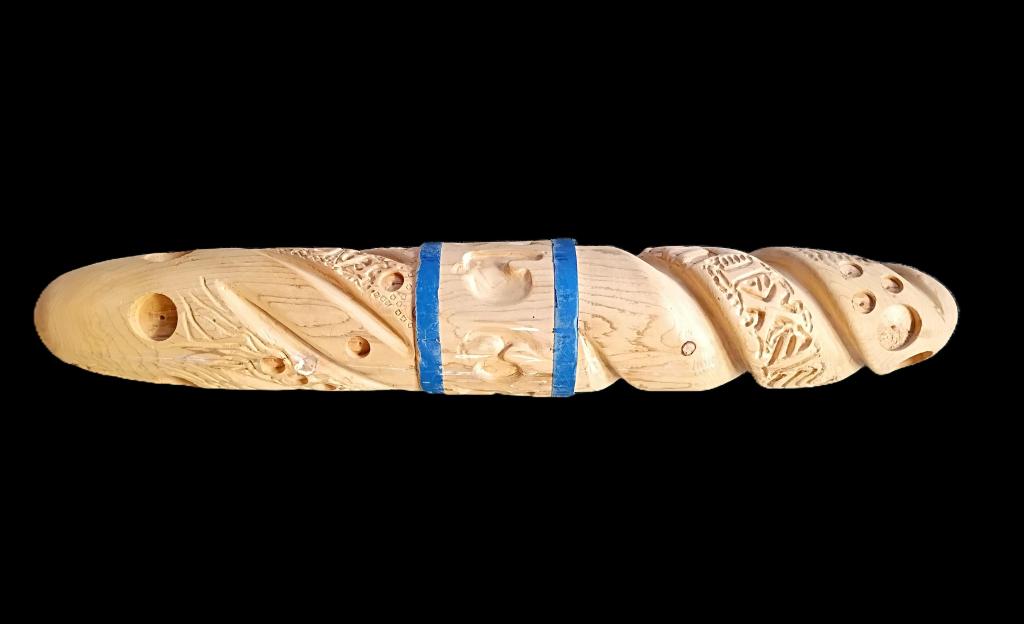
I decided to do an autobiographical story stick by shaping a cedar timber 30” long by 5” diameter. The work is still in progress. It looks like a cigar or capsule, fatter in the middle and tapered at each end. A carved ribbon winds around the piece, which is meant to be the feature which records significant items.

At first, I considered dividing my story stick using the life stages put forward by psychologist Erik Erikson. But then I changed direction… and I’d welcome some feedback as to whether it is a useful way of thinking about life experience.

Now, my sense is that during a lifecycle, recurring areas of focus are prevalent. I’m interested in gestalt psychology and field theory, where experience could be represented by a field, upon which items stand out from time to time: figure and ground. In thinking about my experience, five themes or areas of focus seem to come to mind:

  • Awe: a reaction to encountering something overwhelmingly new – or thinking about an important subject in a totally new way. Awe is a mighty wave, not a quiet ripple. In Old Norse, “AGI” is a related concept that mixes both wonder and fear. I believe that agi captures the meaning of awe in the context I see it. I use the runic symbols in my story stick.
  • Harmony: If awe is the wave, harmony is the ripple, the eddy in the stream, the gentle pattern on the sand left by the last receding wave. I’d like to think that harmony is the reservoir of creative and loving energy and leads us to crave beauty and association. There is a Navaho term I admire and would choose for this sense of holistic balance: “HOZHO” – walking in beauty.
  • Want: As infants, we are exposed to a world we do not understand (sometimes we may feel like that as we age!). However, once our basic necessities are met and we take inventory of our environment,  wants and desires assume center stage. It has been said that humankind is the only animal in a constant state of want. Want fills the senses. The Sanskrit word for desire is “KAMA” and is broader than sexual desire: it includes any type of want. I use the Sanskrit symbols for kama.
  • Reason and More: Here, my focus is about analyzing, synthesizing, and achieving. It is about our drive to be distinguished among many; to make a difference; to leave footprints; to be remembered. In my view, this ‘figure’ is guided by reason, skill, and data, but could also be seen as a series of campaigns in various arenas. Naturally, I thought of Roman exemplars and chose the Latin word “FACTVM” (no “u” in original Latin). It’s a heavy, ponderous word for observable items and conclusions.
  • Faith: At some point, the power of reason, data, and analysis are not enough to explain the moment. Philosophers such as Kirkegaard recognized the limitation.  Some would say that investing in unprovable concepts is simply magical thinking, but I find myself feeling that our data-reliant mode of life blinds us to other possible models of experience. For me, this a yin and yang, push-pull tension: scientific method vs. flow mode. I find myself reading treatises on religion and history of faith – and feeling there is a universal message – perhaps a yearning – that is beyond observable proof, but should not be discounted. I chose the Greek word, “PISTIS”, an admixture of faith and loyalty.

Okay, so that’s my lifecycle organization. Each of these figures can stand out from the ground throughout a person’s life, but I thought that awe is predominantly a childhood first-contact experience, it’s companion, harmony, is simply an underlying sine wave that periodically asks for attention, want is coming of age ( sure, and lots of other moments), ‘reason and more’ shows up steadily after training and applied during a career, and faith seems stronger to me as I age. What do you all think about that?

Thoughts on Marking Life’s Experiences

Wal’s piece asks us to share our perspectives on his approach to thinking about life experience. He initially considered using Erik Erikson’s life stages as a template for such a review; however, he now sees recurring stages or areas of focus throughout his life cycle as a more appropriate means of representing life experiences. My response is that, while I appreciate the challenge of looking back and identifying periods of my life that could be grouped to highlight transitions or movement from one state of being to another, I would offer a more integrated approach.

Each of the five stages Wal suggests—Awe, Harmony, Want, Reason and More, and Faith—holds significant relevance throughout my growth from birth to now. And although I have been comfortable throughout my life making sense of the world in a logical, organized, and rather linear way, I now understand it as more fluid, intertwined, and paradoxical. That is, I can no longer group experiences into the neat, ordered boxes I once saw and believed in.

For me, each category has the potential to influence life at any age, based on countless and often disparate circumstances. A moment of awe frequently experienced by a child exploring a new and ever-widening world might also be felt by a midlife professional at a deeper, more stirring level—one whose eyes are opened in a way a less-experienced soul could not yet understand. And while the want or desire of youth is often associated with things, people, and recognition, yearnings can also show up as we develop but with more of a focus on time, value, or self-improvement. Perhaps each of these five components is interwoven throughout our lives but appears in different forms depending on our maturity and the meaning we have attributed to our experiences.

So, my take on Wal’s approach is that while each of his areas of focus offers a strong foundation for exploring and better understanding our lives, they might also be considered in a braided rather than chronological fashion. That is, the stages might be seen as fluid, and surfacing and resurfacing at various times in our lives as we grow physically, intellectually, and emotionally.

I love Wal’s notion of crafting symbols of his life into a story stick. His use of elements of nature, tokens of ancient cultures, and skills preserved by only a diminishing number of people today is worthy of celebration—celebration of the man and the idea. The ancient Greek philosopher Socrates is credited with saying, “An unexamined life is not worth living.” A social pursuit through dialogue and debate to uncover ignorance and challenge beliefs is exactly what Wal inspires in me. I continue to appreciate the impact of his words and thought-provoking ideas on my life.

If I were to think about how I might memorialize my life an alternative approach comes to mind.  And while I don’t yet know how I would represent it other than writing it down, it shows up in a meaningful way.  My story tale lends itself to looking back and recognizing when I made an inner shift in my thinking about life and how it worked and how I needed to operate within it.  I don’t have labels for each area of focus as Wal did so I’ll describe it using myself as an example of how I would structure it.

For me, the first segment was childhood through about age 20.  I was insignificant (neither worthy nor unworthy), fun-loving but lonely, seen but not heard, and curious but without focus.  My first major shift came in my college years.  I made friends easily, I found a voice, and I felt significant and worthy.  The next inner movement came knocking when I entered the work world.  I was insufficiently prepared, insecure among my new and more experienced peers, and energized but not confident about the outcome.  Clearly many steps back from when I left college but from a more elevated platform. (The strength of previously having felt some security in school was offset by the gravity of my situation should I fall from this newly elevated height!) This next track switch morphed from experience and small but growing successes to full blown confidence and a sense of greater potential and competence.  My view of how things worked in my life lasted through my latter years as retirement gave way to part time work with plenty of opportunities for self examination via a number of close relationship losses and challenges.  Et voila!  Here I am, looking back at how I arrived, still changing into the me I am today…for now.

“This is my life…my story…my book.  I will no longer let anyone else write it; nor will I apologize for the edits I make.” – Steve Maraboli

Holy Crap!

This was a very hard post to respond to.  I certainly shared many of Wally and Henry’s experiences but I had trouble with the classification of those experiences.  Just like everyone else I experienced really cool things, some not so cool things, things that I leaned from and things that I wish I could forget.  Over the years, an event that might have made me go gaga when I was young may not have had the same effect on me as a teen or young adult.  Events that may have excited me as a teenager may have lost their luster as years passed and I naturally had other issues or events on my mind that would alter those experiences.  Wally and Henry are more intellectual than I am. I react more out of my gut than out of my mind which is not necessarily a good thing.  Reactions to events tend to hit my stomach before my mind and my reaction is more emotional than intellectual. I admire Wally’s ability to draw on scholars of the  past and Henry’s ability to debate Wally with other scholars who are equally intellectual.  That being said, my life experiences were diverse, some painful, some exhilarating, and the rest ran the entire gamut of feelings and experiences.  I unfortunately can quote my grandmother who through hand gestures and facial expressions let me know when I was full of it.

Wally created a story stick to memorialize events of his life.  He has a distinct artistic ability to carve things in wood to represent events and experiences in his life.  It is a way to memorialize his life for his kids and a way to express his own feelings about how his life has progressed.  His work is truly a work of art and clearly defines the events of his life for anyone interested in studying his story stick.  I unfortunately have no such artistic skill but I too have recorded events of my life, mostly as a therapeutic skill, for reflection and as reminders of what i went through as a younger man.  I also recorded my life events, many recorded daily before going to bed, for the purpose of reflection and study.  My journal entries were recorded during very exciting times of my wife and I going through the process of adopting our two children.  I have a collection of approximately 30 journals on my bookshelves which will eventually be handed over to the kids for them to see what their dad was going through during the procedures required to adopt them.  I was also struggling at the same time with trying to understand what difficult issues I had had to deal with as a young boy.  My dad came back from the war a different person than he was before the war. MY brother was born before WWII and I was born after and it seemed as if we had 2 different fathers. My dad was a Marine and fought on Iwo Jima and NEVER spoke about the war.   At least my brother would tell me that.  I struggled with that for most of my young adult years and one thing that helped me deal with this information was a sketch book that I kept where I sketched scenes from my childhood and later discussed with a therapist who helped me understand that my dad was probably suffering from shell shock which later became known as PTSD.  It opened up my heart  and allowed me to forgive my dad though I never doubted that he loved me.!  Both my journals and my sketch book will be handed over to my kids when the time comes.

OK- So what does this have to do with Wally’s Story Stick?  I’m really not sure!  Wally carved the events of his life on the wooden stick.  But in the process of doing that he also classified all of his experiences into categories- awe, harmony, want, reason, and faith.  And in the process, he classified all of his experiences into categories. He and Henry debate, or rather discuss, the Greek words for these categories.  I love our Zoom meetings because I listen to them expound and debate a Greek word I never heard of!  I grew up in an Italian/Welsh family where Greek philosophy was never discussed so I never heard of these words.  Nor would I have ever thought to classify my experiences into categories.  If an event was exciting, I reveled in it.  If it was sad, I cried. It never occurred to me to classify that even according to a Greek or Historical classification.  I just chalked it up to good bad or indifferent and moved on

Were I to classify my experiences today I would have to fall back on my upbringing. Please don’t judge me!  If something good were to happen that brought on that feeling of AWE, I would probably classify it as “Holy Crap.”  If something brought people together and indicated harmony, I might take a deep breath and release a deep AAAHHHH!  Want is a tough one.  If I experienced an event that made me want something strongly, I would characterize it as “Oh, Come to Pappa.”  If something made sense or reason, perhaps I would classify it as “HHMMM that makes sense!” And if I experienced something related to faith, I would make the sign of the cross and probably utter, “OY.”

The Art of Perception

The Art of Perception

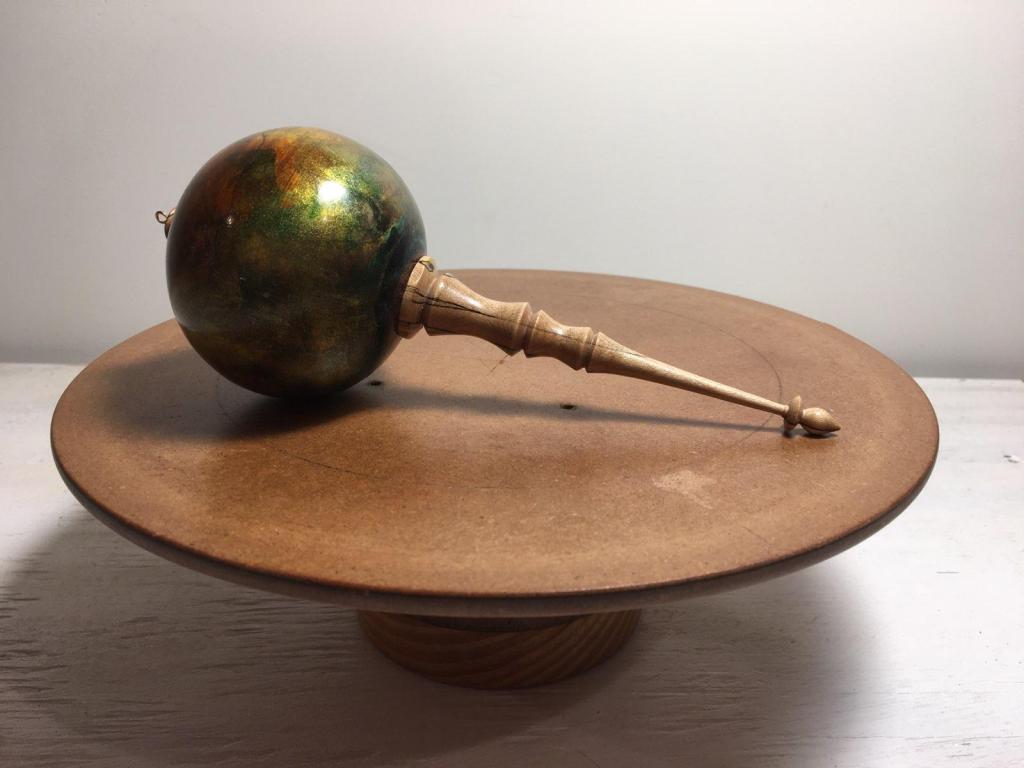
”Where you sit determines what you see”. I was reminded of this nostrum during dinner with friends in mid-December of last year. I had presented Marc and Deleah with a Christmas ornament that I made – a hollowed and dyed maple ball with a wooden final.

Marc said ‘What is this?’

“A Christmas ornament”, I replied – “or just an ornament if you don’t celebrate Christmas”.

“No, it isn’t,” he said.

Now Marc was not playing word games. He is a man with serious chops as an artist, professor, and businessman in the world of artistic enterprise… so, I listened. I believed that he was making the point that my labeling of the object presented limitations, both on the work – and maybe in life as well. He viewed the object as a mini-sculpture.

Photo by Marc B.

As a follow-up to our conversation, Marc sent me two items: a) a picture showing the ‘ornament/sculpture’ in a different presentation and b) a discussion of one of Rene Magritte’s paintings. The painting was “The Treachery of Images”, which presented an object (a pipe) with the painted words “Ceci n’est pas une pipe” – “This is not a pipe”. In this work, Magritte was declaring that the image of the ‘pipe’ was not an actual pipe, nor the drawing of the words themselves, actual words. He is challenging the audience to make a distinction between representational art and the object itself. His piece is a philosophical argument.

The philosopher Ludwig Wittgenstein followed a similar line of thought: he believed that the object that a word stands for does not convey the meaning of the word (or, I assume, its image). He is famous for the line “If a lion could talk, we would not understand it.” Bottomline, our language and communication of ideas is very much dependent on context and use, not simply pointing to an object while saying its label. Therefore, Magritte says his painting is not a pipe. (I think Freud would agree, even though he felt that ‘sometimes a cigar is just a cigar’).

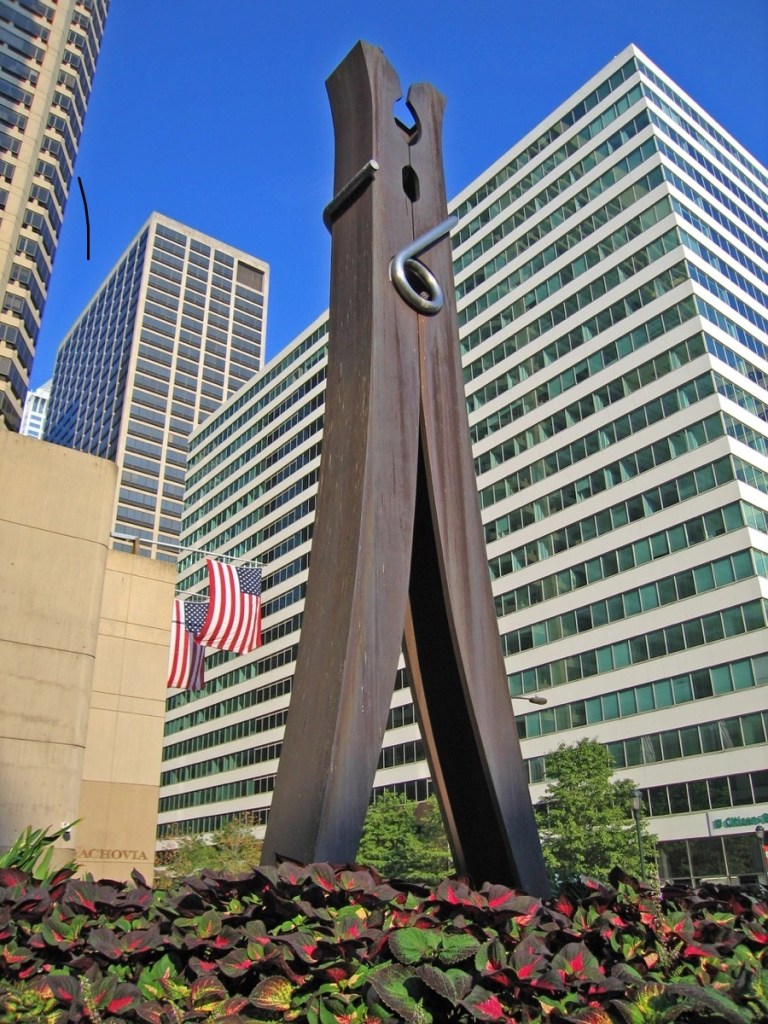
There are lots of ways that context and/or use can be altered. It occurred to me that another method of underlining the difference between an object and its representation, is by varying the angle of view – or its scale. After all, art is essentially juxtaposition – allowing the viewer to see something in a different way. To that point, two sculptures highlight the same utilitarian object – a clothespin – in a vastly different context.

Claes Oldenberg’s Sculpture

Claes Oldenberg created his work in huge scale in urban Philadelphia – and it is certainly representational! It’s easy to see that this piece distinguishes itself in context from a run of the mill clothespin. Yet another take on the clothespin theme was completed by Mehmet Ali Uysal for a park in Belgium. Now this is also an installation of grand scale, yet I think we’d all agree it is more ‘clothespinny’, because it speculates a use in line with a conventional pincer. 

Mehmet Ali Uysal’s sculpture

So now we come full circle. Where you sit determines what you see. The labels we use are rooted in the context of our experience. Sometimes a simple challenge will cause you to change where you normally sit and realize a different field of view.

Note from an Impressionist

Perhaps because it was December when Wally presented his friend with his beautiful handmade gift, he assumed it would be perceived as a Christmas ornament.  In spite of Christmas carols playing on the radio, Wally’s intention to make it an ornament to decorate a tree was not enough to prevent his friend’s perception to wander.  Perhaps his friend was planning his summer vacation or planting his garden, Christmas just wasn’t on his mind. Because of the situation, location, time of year, what he had for breakfast, when he opened the gift his first impression was not that of a Christmas ornament.  I’m not sure of the shades of difference between impressions and perceptions, but first impressions are strong persuaders of how we react.  Impressions and perceptions can change over time.  Fortunately, time allows us to adjust first impressions based on additional information, change of mood, time of day and degree of hunger!

Having owned an antique store for a short time and having been an avid antique hunter for most of my life, I always looked for alternative purposes to the items I purchased.   What I perceived as an end table, with a little creative thought could be repurposed as a plant stand, an aquarium stand, a book shelf and whatever one’s creative mind perceived it as regardless of its original intended purpose.

Perception is a critical process we experience daily.  It is essential to life.  It deceives us, comforts us, endangers us, supports us, and the list goes on… We all perceive constantly.  When Wally approached the topic. my first impression was not about objects and how they are perceived but rather about people.  I am an impressionist!  First impressions are my life blood.  More often than not, that protects me from behavior I might regret while giving me time to adjust my impressions ’til I feel comfortable with my perception of the person.  I think most of us do that.  When I go to a new doctor that first impression dictates what I will share.  That reaction more than likely changes with subsequent visits.  What about that crazy driver in front of you who is driving at a snail’s pace?  I have two friends (who shall remain nameless) who perceive that person to be someone on the spectrum somewhere between common criminal and mass murderer (slight exaggeration here).  But perhaps over a beer or glass of wine could be fine company.

I guess my point is perception is everywhere- all the time- an essential life skill.  I wish I could quote some world-renowned expert in the field, but I mostly read fiction.  I trust my first impressions and adjust my perceptions as time passes and I get to know more about those people who impressed me!

The Power of Embracing Perspective

After reading Wal’s story about perception I was struck by his ability and willingness to be open to listening to his friend’s interpretation of the gift that was given.  Despite the fact (reality) that he intentionally crafted this wood-turned Christmas ornament, he was still able to accept that his friend perceived it differently.

I have often heard, and used the phrase, “perception is reality.”  However, as I spent more time thinking and reading about perception, I realized that perception is not reality.  In an article in Psychology Today, Jim Taylor, Ph.D. suggests that, by definition, perception (“The way of regarding, understanding, or interpreting something; a mental impression.”) and reality (“The world or the state of things as they actually exist… existence that is absolute, self-sufficient, or objective, and not subject to human decisions or conventions.”) are not the same.  However, because our perceptions come from a myriad of personal experiences and influences and since these are often strong enough to create a sense of certainty within us, it is may be more accurate to say, perception can (and often does) become an individual person’s reality.  My “reality” isn’t reality.  It’s just a construct of what I believe, based on everything I’ve assimilated over these many years as fact and right and good.

Therefore, when one’s beliefs are challenged, ignored, or replaced with another’s opposing thought, it is understandable for the common response to dig in, defend, and spend time creating a convincing argument to help the other see the “error of their ways” and counter with the value of one’s initial viewpoint.  It is my belief that we are seeing this kind of behavior more than ever before.  And, more than ever before, there appears to be less trust, less compromise, and fewer examples of collaboration and community.

But there are a few exceptions! Case in point, Wal who reminds us that despite the inarguable fact that he intentionally made an ornament, he was willing to listen to another’s immediate challenge to his label (his reality) and substitute it with a term/realty of his own.  And, in doing so and by asking questions, Wal was able to understand his friend’s point of view.  Furthermore, he seized the opportunity to think more about art, perspective, and philosophy.  I would venture to say that he likely enhanced his relationship with this friend, as I know few greater needs than the need for people to feel heard.

Wal closes his piece with words worth repeating:

“So now we come full circle. Where you sit determines what you see. The labels we use are rooted in the context of our experience. Sometimes a simple challenge will cause you to change where you normally sit and realize a different field of view.” If we could learn to practice what these simple, but powerful words suggest we might be open enough to realize a different field of view, which in turn might allow us to better understand each other.  If we understand each other better and feel heard, then perhaps…  (I’ll let you finish this piece with your own perspective.)