Mercury Falling

I have been in a funk for the last couple of months. Call it winter blues, sundowners, or whatever, it started when daylight savings ended. I wanted to pull the covers over my head and hibernate. I’m not a napper – and yet Linda found me sitting up at the kitchen table, sleeping soundly at 5:30pm. Yikes. I don’t know about you, but it takes me another 30 minutes to get my bearings after waking up from one of those sessions.

Sting writes in Mercury Falling, about the “hounds of winter, they harry me down”. And that’s exactly how I’ve been feeling: under siege, no initiative.  In fact, this is the first year ever that we did not put up a Christmas tree… just lacked the motivation.

What the heck causes this malaise? At first, I just wrote it off as diurnal adjustment to greater darkness, but then I remembered warm summer nights, cool and clear,  with smells that carried on the breeze. I sure did not mind the darkness at that time of year.

Or perhaps it’s the cold. The northeast this year received an early taste of winter: a fair bit of snow and unseasonable temps. Yet, I have good memories of bright, sunny days cross country skiing and powdery snow. While winter is a bit more confining, outdoors is beautiful. I should take a page from Hen’s playbook and go outside more frequently – gather in those ‘outdoorphins’! Truthfully, I have as much activity as in summer, but it is all indoors: playing tennis and/or pickleball. It’s just that my activity level does decrease when the sun goes down.

Is it the evening news? Nah – the news is a downer all year long. Is it metabolism, tax season, holiday blues, aging? Maybe it is the barometer, after all. We’ve had a stormy season so far. Low pressure days just seem heavier. What’s your opinion?

In any case, enough is enough.  I am taking initiative to socialize a bit more. However, most of that activity takes place in daylight – I still have to rouse myself to go out at night for dinner or visiting. The NY Times suggested that when things seem oppressive: ‘move your horizons in’. Focus on closer goals, smaller tasks; practice self-forgiveness. This is the season of Hygge, right? Settle in, get cozy and don’t make unreasonable demands on yourself.

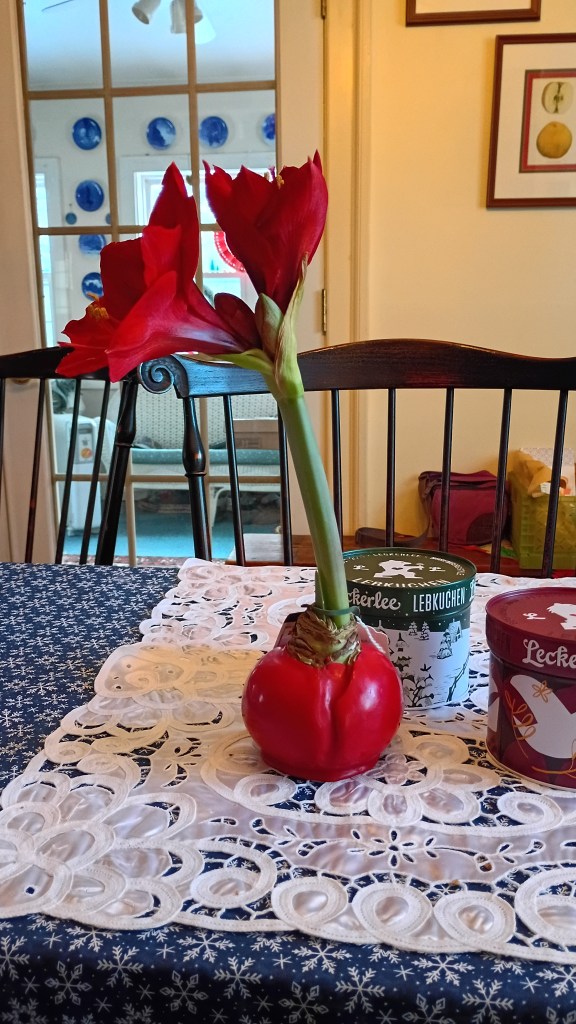
So, I have decided to focus on the “smalls” and close-contact activity: playing chess with  grandson Chris (who kicks my butt – but it feels good to lose to your grandson); thrifting  for electronic gear with grandson Alex (he was thrilled to find a Tandberg-Huldra radio and tuner – and I found old music cd’s which included a diverse mix of Boss Nova, Gregorian chants, Big Band, and Nat King Cole); and sharing Linda’s finds as she goes through old photographs. We both have been enjoying watching our amaryllis bloom over the past week. It is a pleasure to have beauty so close to hand. All of this has tended to elevate my mood.

However, the call of the bed still lingers and we’re rarely up past 10pm. I suppose that isn’t a bad thing. In fact, I asked my AI assistant which mammals seem to need the most sleep  – and there I was, right after the platypus and sloth! Can’t fight nature…

Now, you’ll read further to see Hen and George’s ideas. In fact, Geo’s piece was so bleak that Hen and I were really concerned; we reached out to him to see how we could help. George responded with an addendum and said that we shouldn’t worry – everything turned around because he is exploring a new relationship. That is certainly a way to cure the blues! So — What do YOU do to tame the hounds of winter?
Seasonal Adaptations

It’s not often that I hear Wal talk about being dispirited, gloomy, or despondent, so I take notice whenever he spends any time with those feelings—which is hardly ever. But for him to write about them takes it a step further in significance. After analyzing the possible contributors to his winter blues, he offers some thoughts on what might remedy—or at least reduce—them. Fortunately, it appears he’s finding some solace in his targeted actions. And, predictably, Wal asks what we think and what we do “to tame the hounds of winter.”

Here are some random thoughts about Wal’s topic:

Does this mean we all suffer some form of negative impact from the fundamentals of the winter season?

“Wintering” is a phrase used to describe “a period of retreat, restoration, and slowing down to survive an ‘inhospitable’ season.” But what if I react more negatively to heat and humidity—and to days that last until 9:00 p.m. when I like to go to bed? Perhaps this is more personal and situational than a universal syndrome.

Recently, I’ve become a snowbird—staying through late fall in Delaware and shifting south to North/Central Florida until early spring. As a result, my reactions to this discussion are shaped by not having to endure most of the typical winter issues faced by Wal and George, but they’re also influenced by memories of winter living for 74 years.  (Actually, I just booked a flight back to Delaware a week early so that I can be there for Winter Storm Fern and once more enjoy some time in the snow with my grandkids and friends!)

I’ve always loved the change of seasons and tried to embrace each one. I look forward to gardening and the rebirth of spring; more gardening, barbecues, swimming, and outdoor activities in summer; cool, crisp hikes on beautiful fall days; and the many times we gathered to go sledding, ice skating, or sit around our fire pit with hot cocoa and s’mores. Of course, not every day of each season is all fun, and each brings its own set of challenges. Wal mentions those of winter. Spring can be wet, muddy, and cold at times. Summer heat and humidity often limit my outdoor activities to the point that I sometimes long for fall—despite the shorter days and loss of greenery.

Enough musings. Here are my feelings about the winter blahs. They don’t impact me as much as they do some others. I enjoy being outdoors in the cold as long as the windchill isn’t in the single digits or below. I use the shorter days to rest more and to focus on indoor chores and activities I put off during other months. I read more, watch more TV, and lately spend more time on photography and writing.

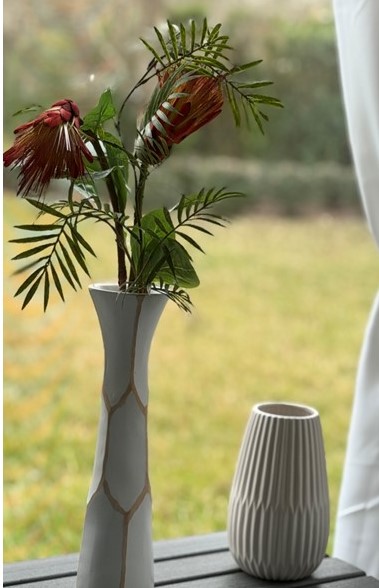
That said, I like Wal’s ideas of socializing more, being easier on myself, and setting shorter goals. They do seem to provide an uplift—even if I’m not particularly down. And I’ve recently reactivated my iPhone Academy photography course and am enjoying spending time learning and practicing picture-taking. (Below is my response to my first assignment, which focused on shooting a photo with focus in mind.)
So, you see, while some perceive winter as a festive time when their worlds are blanketed by the purity of snow, others feel they are being suffocated by a literally colorless existence.”
—Jessica Blaszczak, 10 Things You Didnt Know About Seasonal Affective Disorder

Year-Round Blues

Fall has always been my favorite season.  I love the colors of the flowers in Spring and Summer but Fall means new beginnings for me.  For 68 years it meant the start of school and new beginnings, new people and a kind of loving warmth I never felt in the warmer months.  There is something about the crispness of the days, the cool nights spent in front of a nice fire in the fireplace.  The crackling of the burning wood, the rustling of drying out leaves on the trees in a slight wind were sounds I welcome and enjoy.  It was always special to me!  When I was younger I also enjoyed the snow of the winter, snowball fights, snow men and snow angels, and of course the promise of snow days not only as a kid in NYC but as a teacher in Ulster County.  Snow days were God’s gift to overworked teachers and we were as excited as the kids were when they were called.  Back then the winter was exciting, it didn’t present the challenges that it does today to an aging body.  Shovelling snow is drudgery today for the 80 year old.  I say this as I just came in from shoveling my walks and driveway for the third time in two days.  But that isn’t what has me down.  Wal suffers from the winter blahs and I understand that.  The shorter days, being locked inside for most of the months, difficulty travelling or even walking around outside is intensified with a layer of snow over the possibility of hidden slick ice making the season difficult to navigate through. And that can certainly limit enthusiasm and activity to help lift our spirits.

Unfortunately, for me, it isn’t the season that led to my malaise.  My retirement from both of me careers- one of 35 years teaching and the other of 15 years of innkeeping, came at a time when my relationship was collapsing.  So at a critical time in my life I was without a purpose and alone.  Two very difficult conditions to deal with individually but worse when combined.  At first, the change of seasons was unnoticeable.  The lack of having purpose was very pronounced.  I didn’t know what to do with myself, how to occupy my days or how to participate in things that I used to enjoyed doing anymore.  The loneliness became almost unbearable.  The things I used to enjoy didn’t excite me  because I enjoyed them because I did them with other people.  Living alone for the first time in my life was new to me and I didn’t quite know how to do it.  Purpose is important to a fulfilling life without depression.  As time went by I began to realize I wasn’t enjoying things like I used to.  When you do fun things or when cool things happen to you the first thing you want to do is to share it with significant others.  I realized I had no one to share those times with so those events didn’t take on the significance they normally would have.  It wasn’t just the difficult times we go through in life that weights us down alone but the good things don’t feel the joy that they used to for me.  I wake up sometimes in the middle of the night with an unexpected ache or pain and I normally would wake my partner  and tell them what I was feeling and I would be reassured that it was probably nothing and we would deal with it in the morning, easing my concern.  Now those imaginary horrible ailments fester cause there is no one around to quell the scary thoughts that our minds imagine.

So for the most part, I have the feelings that Wally is experiencing mostly all year long.  I have an incredible dog who tries to comfort me with a tongue licking and it helps but can’t soothe away my concern with gentle words, though his cuddling next to me helps and he can always tell when I am struggling!  I do look forward to the approaching Spring, though it isn’t approaching quickly enough. Then I can plant in the gardens, enjoy the colors and the smell of the earth, and the  warmth that the season brings.  Along with the colors I pray it will bring remedies to the malaise I feel all year long with the hope of new friends and relationships, and a sense of purpose to a life that has been struggling without both for too long.
Wal is lucky!  He will get relief when the days lengthen and the seasons change, and his daily activities return to normal.  I look forward to perhaps finding the things I am lacking and  hope springs eternal!

This is a post script to my response to Wal’s Winter Blues.  When I wrote my response to Wal’s piece I had just met a person and had no idea how or if our friendship would progress.  Well, I am here to tell you that I believe my eternal malaise will be lifting shortly.  Not just shortly but it has already begun to lift.  The person I recently met has lifted my spirits immeasurably!  We share a great deal in common.  Our view of the world is in synch, we laugh at the same things and worry over the same issues our country is facing.  We both love animals, even our issues are similar.  I suddenly have someone I can call in the middle of the night if needed and he can do the same. I feel free of the worry and concern I have lived with constantly since retirement.  I don’t feel alone anymore!  The physical weight of living alone has been shed and I see a much brighter future ahead.  Time will tell, but at least now there is the promise of a happier future, the sadness and worry has been lifted and maybe Wal and I can both celebrate with the approach of spring and say goodbye to the Winter blues!
May

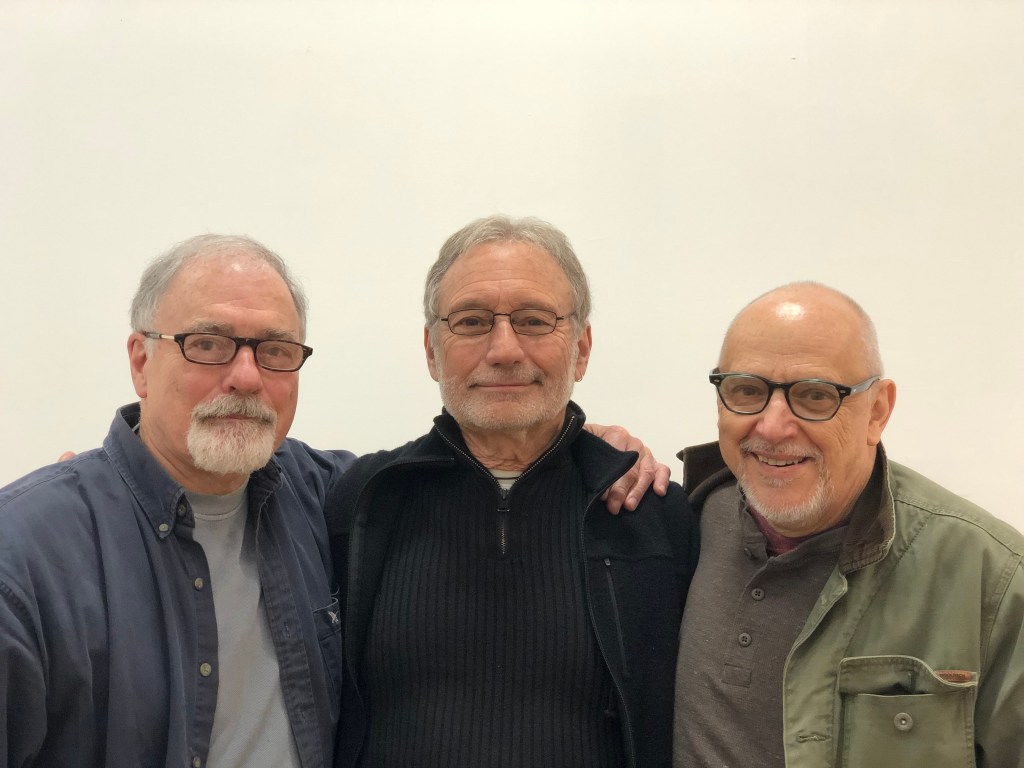
We Three Old Guys loved this poem by our friend OB. He granted permission to use it as a jumping off point for some of our own reminisces. Hope you enjoy Tom’s poem – and perhaps it will spark some reflections for you as well.

If you have any topics that you would like to share, send them along to 3ogblog@gmail.com  or provide them as a comment.

May: by Tom O’Brien

In May, I reminisce a lot.
I know the reason why.
Lately I‘ve been looking back,
Thinking about and dreaming of
The people who have shaped me.
My family and friends
Loves and confidants,
Colleagues and acquaintances.

All have had an influence.
Not equal but significant.
Some have left their mark and gone.
Others still have sway.
I often wonder who I’d be,
Where I’d be and what I’d be,
Without them in my life.
I reminisce a lot, in May.


Works of Art

OB wrote this at the beginning of the May – and here it is the last day of the month. I’m writing this during a day of constant rain! A day like today seems appropriate to consider those folks who are dear to me. In particular, special individuals who have departed this life.

Now I have to confess to a semi-creepy habit: I save obituary cards. To be clear, I don’t seek them out. However, I will pluck one up at a funeral to honor the life that is now gone. But then what? I just can’t bring myself to discard them – it’s like throwing away a marker that they lived. I see a responsibility to witness the significance of their existence. It’s like Harry Bosch says: “Everybody counts or nobody counts”.

What if we thought of ourselves as curators of an exhibition of a person’s memory, considering each life as a work of art? Of course, this is a mental exercise – how would you go about it? I considered two special friends:

  1. Michael N. Comiskey (‘N’ for No Middle Initial): I’m looking at a picture was taken in May, 1969. In it, my wife Linda, Mike, and myself are relaxing after college graduation. Mike is resting his right elbow on my left shoulder. Linda looks beautiful, I look dour as usual, and Mike is smiling. His smile captures his spirit. Mike and I were roommates for four years and  I know that smile well! Now we were all ready to set sail on our adult lives.

    Mike had all the tools to succeed in any endeavor. He had a presence: high school track star, president of our college senior class, a congenial fellow adventurer. His raspy voice could gather friends or quiet a room. When I think of Mike, the names of Dylan Thomas, Jack Kerouac, and Che Guevara, come to mind – people that passionately embraced life’s exploits. Mike joined AmeriCorps and rode his motorcycle around Texarkana for a year’s assignment. I expected Mike to enter public administration or become a writer, but he did neither. Instead, he drifted among a number of jobs, finally delivering potato chips to bodegas in the Bronx.

    He confessed that the blackouts started in our junior year after bouts of drinking. On a very sad day, his mother called to let me know that Mike had died of heart failure at 38. Minutes later, his father called back to be clear that it was alcohol that had killed Mike. The rage and grief in his voice made me wonder – and not for the first time – that if the heart were a chalice, how much pain might it possibly hold?

    An exhibit for Mike would be rich with literature; it would have a listening lab where his rendition of “Waltz Me Around Again Willy” would play (google the lyrics: illuminating) along with his favorite Dave Brubeck album, Take Five. I’d add the painting, Nighthawks, by Edwin Hopper and his fashion formula for wearing primary colors.

  2. Philip N. Whittington (Again, ‘N’ for No Middle Initial) – also, he is the artist formally known as Homer. You see, Phil’s mother altered his birth certificate to change his first name and birth date. Phil discovered in his 80’s that he was born Homer, had a different birthday, and also had a living sister. Phil’s mother did this in an effort to make sure that his father could not trace him. She also had difficulty caring for Phil, so he spent time in a juvenile home and later, with an aunt who lived in the Adirondacks.

    A former paratrooper with 60 jumps to his name, he graduated from Paul Smith’s college in forest management. He was the guy lumber companies would drop off in a wood lot with a map and compass, in order to evaluate the condition of the property.


Phil also had an alcohol problem and was a mean drunk. He recounted – and owned – all of his bad behaviors. Like Mike, he also had blackouts (he was told that once threw his best friend into a bonfire). However, the difference is that Phil beat his addiction and was 30 years sober when we met. He was on a quest to straighten out the mistakes he made earlier in life.

If one word could describe Phil, it would be ‘charming’. To me, he was a role model for ageing gracefully: Phil accepted his mistakes and made no excuses, just an effort to do better. Phil exercised for 45 minutes every day – even trying dance lessons and tai chi to alleviate his Parkinson’s disease. He strived to be open to change and live a life of acceptance. He taught me to turn wood and model how a person needs to let go, in order to move on. Phil died on Christmas Day at 88 years old and had no doubts that he would be called to his home in the cosmos. My exhibit for Phil would include his many large bowls and treenware from all species of wood; it would include art pieces that were colorful, since he loved to experiment with colored dye and paint in his works. It would include the oak bowl I made after his death which has the natural star at the bottom – his sign that he made it home.

The Paths Offered Up to US

I like Tom’s call to remember those who have touched our lives.  It recognizes that we are not just a sum of our separate experiences but rather an accumulation of those experiences shaped by the words, actions, gestures, and relationships of all of the people who have moved in and out of our existence.  Somehow, mostly without conscious intention, we absorb those communications into our everyday lives and adapt, adjust, and transform who we are or were into a slightly (or sometimes significantly) different version of ourselves.

As I think back about the more memorable interactions, I remember my 7th grade art teacher who had enough faith and determination to help me draw a pair of chickadees that actually looked like chickadees and my Little League baseball coach who convinced me I could actually play 2nd base.  But in my experience, often it’s been a simple gesture or word from another that affirmed a belief or a risk taken, at just the right time to influence the future me.  Additionally, as I reflect on those who triggered a change in me it was what I learned from a negative experience, a failure, or a poor role model that made a difference.  That is, I was inspired to not follow what I was told or repeat what I observed but to seek another way that was more compatible with what I believed to be better or right. As a result, I am grateful for those individuals too, for giving me those unfavorable experiences that would drive me to improve.

Tom’s poem exudes gratitude for all the people who played a part in shaping his life as well but then ends with the question of who and where he might be without them.  I remember one evening in college walking back from town with a person who offered me a choice, a new direction that would absolutely have given me an experience that would have been so radical to my “then” existence that I’m convinced my future would have been entirely changed. But as we were walking, we passed another friend of mine heading in the opposite direction who I had been looking for earlier.  We stopped to chat and in that brief exchange I lost my nerve to seize that radical opportunity and changed my mind. I turned and walked back to town leaving behind what I could only imagine would have been a very different future.  And that’s one that I remember vividly.  How many other turns in the road did I take that brought me here? No matter!  I have no regrets…but as Tom says, I wonder.

“I Go to Seek a Great Perhaps!”

Francois Rabelais

Reflection On Reflecting


This was a difficult piece for me to respond to.  And equally difficult to figure out why.  When Tom first mentioned that May was his month of reflecting, I tried to envision a month when I ever spent the time reflecting.  I realized that I tend to be more emotional than cerebral.  My quiet moments usually lean toward remembering and reliving, trying to recapture the emotions of the time.  To me, reflection requires experiences, things that have happened to me along the path of my life, plus memories, events that had special significance to me, and time to look back and analyze those events and memories.  That requires a great deal of thought and rethought whereas I tend to be more spontaneous and speak before thinking which has often gotten me into trouble.  Perhaps I should reflect on that!  When Wally submitted his piece, he caused me to reflect on our friend Mike.  But it wasn’t until Wally mentioned Mike’s raspy voice that it brought me right into the room and having conversation with Mike.  Without Wally’s reflection I would have missed an opportunity to lay back and really remember Mike.

What Henry’s writing did was give me permission to look back and review things in my life that may have helped determine who I eventually turned out to be or who I may still turn out to be.  He suggested that the course we thought we might take could, at the drop of a hat, make a U-i.e. and may find us going in an entirely different direction than we were headed.  And that struck a chord with me.  I was always a scrawny, skinny little kid who got picked on constantly, bullied, shoved around. I learned early on that if I could make the bullies laugh, they might forget about sticking my head in the garbage can on the way home from junior high.  I had some success with that through junior high but high school was a little bit different.  I had honed my skills by then and my humor became more sophisticated and wise-assy.  So much so that in senior year I was voted Wise Ass of the senior class.  There was no space for me in the officers’ page of the yearbook like there was for Best Dressed, Smartest, Best Sense of Humor, etc.  But I was ok with that.  Reflecting on this now I see multiple effects this had on me.  It helped me survive, I discovered I could hide a lot of unhappiness in humor, and  gave me hope for a more mature way of thinking in the next big adventure in my life, college.

I never had any problems with animals, pets, small yard creatures and as a result felt safe around them and just kind of assumed that being a Veterinarian would be the logical occupation for me.  I carried that around with me for the first two years of college.  All signals seemed to point to that as the logical direction to head in.  I was comfortable around them, they seemed to be attracted to me and all was good. Then reality began to strike after I had a conversation with my parents mid junior year.  Vet schools, in particular Cornel, were very expensive.  Where was that money going to come from?  It would mean an additional three years of study and possibly internships and blah, blah. blah.  Great, now what?  This is when I reflected a lot.  Looking back over time what other things grabbed my interest.  My aunt was a high school English teacher in Pennsylvania, and my brother who was 8 years older than me was an elementary school teacher in a very prestigious school district on Long Island called Garden City.  I always looked on him with some envy because he was like super teacher.  He would be written up in the Long Island Press for some innovative thing he did, his classes always put on big musical productions, he was Super Teacher!  I began to reflect over my years in school and trying to remember things that impressed me.  One name kept emerging in my thoughts, my 9th grade English teacher, Mr. Kraftowitz.  He was an older man but full of life and love for his subject matter.  If we did something really well, he would draw a cartoon on the top of our assignment.  Mr. Pear Head.  His head would be the shape of a pear with 2 big ears, big eyes, a wide grin, and a large fedora type hat on his head.  I don’t know why that image stuck with me so prominently.  I remember he was teaching us about colons and semi-colons and he had us write 2 sentences -one using a colon and one using a semi-colon but we had to act out the sentence in class and use our bodies in a way to indicate a colon and a semi colon.  I don’t remember any of the actual actions, but we had a blast.  He made something really boring fun!  That impressed me and made my decision for me.

I had a long conversation with my brother over the summer asking him how he came up with lesson plans and ways to keep the kids involved and told him I was scared that I wouldn’t have enough creativity to keep kids interested or engaged. He told me to relax about it. He said sometimes things just pop into your head and not to be afraid of them.  The crazier they seem the more the kids will like them.  I kind of adopted that theory and used it all the time.  I was going student teaching that coming fall semester and scared out of my mind.  I had just had a course in Children’s Lit.  I thought I would be bored out of my mind, but I loved it.  Our term project was to read a kids book to the class and make it interesting. I think Charlotte’s Web had just been published and I decided to read that to the class of soon to be teachers.  I planted some wool spiders that my mom knitted for me around the room, in some desks, on the chalk holder and such and began reading the book.  It wasn’t scary at all but every now and then someone would jump and yelp a little when they found a spider amongst their stuff.  My professor, Dr Kochant, a grandmotherly-type lady, was so impressed she told me I could use her as a reference when applying for a job.  That gave me real confidence and comfort.  And after my student teaching was done the following semester, my supervisor whose name was Dr. Jane Vreeland was doing her final observation of me before the end of student teaching and was talking to my cooperating teacher who was really old school (we recited the Lord’s Prayer each morning).  He was evaluating my student teacher experience in his classroom and gave me very high ratings and she said to him that she had been very concerned in the beginning about my ability to discipline and to present material in an interesting way but that was before she saw me in front of the classroom and that I actually came to life while presenting lessons.  I guess I have to admit that even though reflection was never my strong suit, it comes at you when you least expect it.  Reflection is good for the soul, the mind and the body.  Thanks, Tom, for coming up with this word!