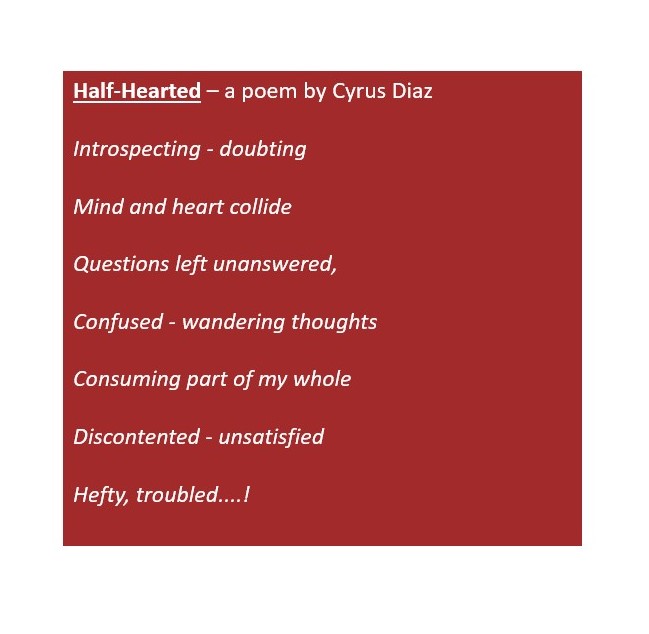
No Doubt

Linda and I were dining at our son’s restaurant, when something caused me to tune into a conversation at a nearby table. A person at that table was discussing my family and the circumstances under which we had purchased the business.

I did not recognize the voice… and when a sneaked peek was possible, I also did not recognize the individual. This person, clearly unknown to my wife and me, talked with confident familiarity about details for which he had absolutely no knowledge. As I listened, he shifted the conversation to other topics, but his tone remained the same: he was an expert on a variety of issues.

I was sorely tempted to go to the four-top where he was seated and introduce myself. Two things stopped me: a) I was embarrassed for eavesdropping – everyone has a right to privacy, and I had violated that right b) nothing offensive was said… in fact, he and his guests complimented the food. Why fix something that ain’t broke, I thought.

However, I could not help thinking about this situation: why would strangers elaborate on stories that involved my family – I mean, why bother, since he does not know any of us (I confirmed that my son also did not know this person)? I concluded that he had a strong need to be perceived as a ‘person in the know’ and we were simply ingredients in a larger narrative.

It seems to me that more and more people hold opinions that have a loose grip on actual data. I was going to say ‘facts’, but I’m reminded of a social psychology professor who informed me that “there are no such things as facts; only perceptions”. (I guess this conversation was pre-Snopes). True, it’s unreasonable to expect that the perceptions of others will match your own – the probability is larger that given the same set of circumstances, perceptions will vary greatly. The bothersome part of the restaurant episode was the tone of complete certainty expressed by the individual.

So, who are these people who spin elaborate yarns that travel far beyond the limited information they are based upon? Turns out there is a term for such individuals – and I thank Word Daily.com for this:

Ultracrepidarian:

A person who expresses opinions on matters outside the scope of their knowledge or expertise

In other words, people who are full of ‘crep’. Doesn’t it seem to you that there is an abundance of such folks these days, particularly on social media? Well, if I did such any soul searching, I’d have to confess to being an ultra myself on occasion. This will cause some self-examination on my part going forward.

The problem with ultracrepidarian behavior is that it adds to the noise in the world. Yet there is already plenty of noise to go around. And it is usually delivered confidently – with no doubt, whatsoever. I find that problematic, because I believe in doubt. I have no doubt about doubt. (Actually, I do have some doubt about that). However, I’m in good company: Richard Feynman agrees with me.

I’ve just finished Feynman’s book, The Pleasure of Finding Things Out, a collection of his short works. Feynman was a Nobel laureate, celebrated for his work in quantum physics, but also as a wonderful teacher. A constant theme in his works is the definition of science as a process of ‘doubting the experts’ and objectively rechecking accumulated wisdom. He concluded that the spirit of science rests on the ability to define meaningful questions and the predisposition for adventure. A priori opinions are held in check or tested as hypotheses. First-hand discovery is the joy, but uncertainty is a constant delimiter – there is always more to learn and always room for doubt. Feynman expresses a humble philosophy and a perfect antidote for the ‘creps’!

I guess the larger question is how we deal with our feelings of certainty and doubt in our lives. Here’s an interesting suggestion for responding to an ultracrepidarian:

I Will Have to Look That Up by PinkFaerie5 (from allpoetry.com)

I have no knowledge of that I say.

She continues speaking “facts” that are

opinions.

I will have to look that up I reply.

She gives me a sigh full of exasperation.

Letting me know that she thinks it is

Ridiculous

That I do not believe her “facts” like others

To whom she has spouted these fabrications

Prior history has dictated that I can’t.

Related Thoughts on Doubt

Some related thoughts on Wal’s excellent post on “No Doubt.”

When I was young printed information was taught and taken as fact.

If it wasn’t fact, it was, for me, considered to be a lie.

I was raised believing that if you spoke with certainty, you knew from first-hand information or trusted your source or researched it yourself.

Another thought I had after reading Wal’s blog post is that we tend to lean more heavily on believing what is said that is congruent with our views and doubting or denying that which opposes our perspectives.  Shouldn’t we give equal question to all communication that is splashed about, especially on social media?

When I was working full time, a person who showed up as knowledgeable, confident, and certain was more frequently sought after for leadership positions than someone who didn’t.  Of course, in personal practice, this often required thorough background work that would provide me with the moral permission to speak to parents, teachers, students, colleagues, and others with a sense of confidence in my discourse with them.  I also knew when it was prudent and honest to admit when I didn’t know.

While I’m not someone who joins organizations that work toward changing the world, I do believe that holding myself accountable to the behaviors I believe are universally important, makes a difference.  Now that Wal has raised the issue of an ultracrepidarian, I’ll seek to pay more attention to how I pass along information so that I’m at least, not contributing to the problem.

Regarding the idea of questioning current wisdom, Don Miquel Ruiz, author of The Four Agreements and co-author of The Fifth Agreement, concludes with the last agreement as “Be Skeptical but Learn to Listen.”  I find this to be an effective way to lead with strength, curiosity, and respect.

Stephen Covey, another favorite author of mine, wrote The Seven Habits of Highly Effective People as well as The Eighth Habit.  The last habit he describes as addressing the crucial challenge facing individuals and organizations today, which is “to find our voice and inspire others to find theirs.”  Perhaps we’re so eager to find our voices that we inadvertently sacrifice true knowledge and validated perceptions.   And, unless we “learn to listen” how will we inspire others to find their voices?

“I like the scientific spirit—the holding off, the being sure but not too sure, the willingness to surrender ideas when the evidence is against them: this is ultimately fine—it always keeps the way beyond open—always gives life, thought, affection, the whole man, a chance to try over again after a mistake—after a wrong guess.”
― Walt Whitman, Walt Whitman’s Camden Conversations

Sesquipedalian

A cultivated gentleman meanders into an alcoholic establishment and acquires a place to recline adjacent to a man already savoring a beverage from a capacious ceramic container.  The Sesquipedalian admonished the ultracrepidarian for his over indulgence of the beverage.The ultracrepidarian replied that according to medical research if the liver and kidneys are strong and the individual is not subject to various addictions there is no danger of side effects to the body drinking.  The sesquipedalian retorted, “Oh beloved celestial transcendental father figure, you think you ascertain all erudite data!” 

 Needless to say these men were talking past each other!  A situation that often occurs when people are talking to someone who may possess an alternate view or set of facts depending on his individual experience or the channel on the TV that he usually watches.  Facts are hard to verify even when we see things with our own eyes and hear with our own ears as evidenced by the two diametrically opposed views of what happened at the Capitol on Jan. 6, 2021!  One version was an insurrection but others who viewed the exact same visual saw it as a peaceful demonstration.  Those people are actually talking past each other and there is very little that can be done to convince the other of the alternate interpretation. Social discourse is difficult when debating politics right now in this environment and as a result we rarely expend the energy to actually hear what the opposing view is, because we are already embedded in our own opinion and nothing is going to dissuade us from it.

As Norris Clempfire wrote in his book, “It is Raining, No, it is Sunny!” different people can see the same information and can interpret it entirely differently!  And as Sargeant Friday often said, “Just the facts, Mam!”  There is no such author and no such book but Wally and Henry always quote from some authority from some lengthy tomb of a book that they read over breakfast.  I am a very slow reader and more often react from my gut than from my brain.  I try to interpret what I experience and develop my own facts from those experiences.  And as Wally’s ultracrepidarian did in his restaurant that evening,  I, too, have expounded confidently on subjects I wasn’t always well-versed in.  And I really don’t know how we can ever prevent this kind of discourse to stop because it is a human characteristic that develops during early childhood, and we revert back to as dementia sets in.  As Herbert Lostit said in his book, “You Already Ate, Dear,” you will never convince me of something that goes against my impression of what I experienced.PS-No such artist or book … or is there?

The Quest for My Next Sanctuary

I’m going on two years now in my attempt to find and buy my next and likely last, home.  Each week, when I participate in my Zoom call with the other two “old guys” my blog partners inquire about my search.  The last time we spoke, they suggested that this might be a potential blogging topic or at the very least, the experiences I’m going through as I decide which houses to pass, which to consider, and which to finally make an offer.

The first thing I do upon waking and the last thing I do before turning off the nightstand light is to check my online sources for new or adjusted listings.  Throughout my life I’ve subscribed to the belief that keeping a sharp focus on what I want often to the exclusion of other things and people, yields results.  Over the years, my rather arrogant and singular viewpoint has shifted into more of an understanding that while setting and keeping a goal front and center is a powerful and positive factor, I have less control than I once believed.  It will happen, but not necessarily when and exactly where I want it to happen.  Thus, I do what I can to take advantage of daily opportunities, but then sit back and let the universe do its thing.  This approach is not without some drawbacks.  While I would prefer to spend a portion of my winter days with Teresa in Florida, I accept that I may need to readily available when the right home presents itself.  Therefore, I remain ready and present, (fortunately with Teresa’s support) albeit 915 miles away from where I prefer to be.  In the interim, I remind myself to enjoy where I am and to appreciate what I already have. 

My quest is not a solo one.  I receive regular notices of properties for sale within my parameters of price, house size, acreage, and distance several times a day from my real estate agent.  In addition, my daughter and granddaughter send me possibilities from alternate sources on a regular basis.  My son is my voice of reason and is a perfect sounding board and advisor when it comes to tweaking buying preferences, financial considerations, and keeping me level headed when my emotions kick in.  My blogging buddies, check in regularly, offer alternative suggestions, actively listen, and offer good old-fashioned support despite the same old story I tell them week after week.  (Somehow they haven’t yet figured out that if they each gave me a couple hundred thousand dollars, my search would be over and they wouldn’t have to hear my boring Monday night monologue.)  Finally, Teresa, who is in the most difficult helping position as she has extraordinary real estate experience and expertise but is also my partner and has a vested interest in whatever I end up buying, parses her advice well and tells me what I need to hear even if it’s not what I want to hear.  So, when I start to feel sorry for myself as I drive by a property or go on a tour, alone, I’m reminded how fortunate I am, that not only am I living near my family and in a beautiful apartment, but I have so many caring people only a phone call away.

Like so many things we seek in life, despite our best planning and disciplined focus, there is always that subjective ambiguity that comes into play.  The questioning of whether to present an offer or not reflects a combination of my desire to finally be in my house with property to explore, a woodpile from which to fuel my fire, and a house with charm and character with my uncertainty that this is as close as I’ll likely get so should I settle?  Should I practice my gratitude mantra and be patient a little longer or do I grab what’s in front of me before the mortgage rates go up yet again and the investments I’ll use to make my home another welcoming retreat, continue on a downward spiral?

Of course here’s where I take a deep breath and remind myself of two things.  First, it will all work out whatever I decide, it always does.  And second, as I look around me near home and around the world, I realize this is a blessed choice that I have before me, not a problem.  The journey continues…

“There have been few things in my life which have had a more genial effect on my mind than the possession of a piece of land.” – Harriet Martineau

Home Sweet Homes!

Since I left my parents’ house in 1964, I have owned 5 homes.  Each and every home that I owned I have loved with all my heart.  We moved out of Manhattan in 1951 when I was about to go to kindergarten.  My brother was 8 years older than I and he had to pay 25 cents a week for protection to and from school to one of the local gangs and  my parents did not want their kindergartner to have to do the same thing.  They decided to move to the country, which at that time was Flushing, Queens.  As a result I don’t remember much about apartment living and very little about the railroad flat we lived in other than the dumbwaiter in the kitchen which would take our garbage up to the roof every week on garbage day to be incinerated.  The house we moved into in Flushing was a big old majestic home with plenty of charm and hiding places for a little kid to get lost in.  That has always been one of the features I looked for in a home.  Not to get lost in but perhaps a place to curl up with a book and get lost in that!  I actually measured all my subsequent houses against it.  The year I left for college, developers came in and bought up all the homes, demolished the beautiful architecture and put up brick two family houses all up and down the street.  The architectural diversity of those old homes was lost forever.

College years came and went, I began my teaching career in a small, rural community in upstate NY.  As  a wedding present my parents gave us a check for $2500 to use as a down payment on a house.  We finally found this old cobblestone house in the middle of nowhere but only a short distance from my school.  The purchase price was $11,500.  What  a bargain!  I remember our mortgage payment was $71.00 a month which included  our taxes.  Life was very simple then.   A year round stream ran down from up the road a piece, just  a few steps away from our beautiful side stone porch.  Another feature I have   always looked for in a home.  That  brook lulled us to sleep at night for the two short years we lived there.  The house needed work inside but we were young and naive and felt we could do all that needed to be done.  The living room fireplace was the center of our life there.  But as we came to find out, city folk were not always welcomed and accepted in the mountain towns of the boonies and an episode involving our dog who was shot by a neighbor became the deciding factor to get the hell out of there!  So much for home #1!  We were in the process of adopting our first child and felt our location would be a hindrance rather than an advantage to the process and so we began our search for Home #2.

This time we were a little more realistic in our capabilities and desires and after a fairly easy and quick search stumbled onto the perfect house.  Home # 2 was situated in Kingston, a nice small city in a neighborhood that had a local school and a lot of young families like ourselves.  The location was perfect and one step in the door we both knew this was going to be our house.  Original chestnut woodwork, pillars between the foyer and living room, and a split staircase.   The only thing missing was a fireplace and we decided we would put on a room with a second bathroom, laundry room and a wood burning fireplace surrounded by book shelves.  It even had our required rocking chair porch and several nooks and crannies that we loved.  We had the usual inspections done and everything seemed to be up to snuff and within two years we had saved enough to put on the additional room with all the character we wanted.  It seems we were more concerned with how the house felt and looked than how efficient or secure it was.  We were looking for a home rather than a house, and that particular structure provided us with that home.  Come to find out it was a Sears Roebuck Kit house and there were many of them in that area of Kingston.  We lived there for 13 happy years and loved that house.  Life has a way of getting in the way every now and then and we decided it was time to move closer to my work and the search began again.

This time we had expanded to 2 adults and 2 kiddies.  We thought it would be nice to have a little more property for the kids to play on without fear of the traffic on the road.  And with all of our usual “must haves” like a fireplace, modern kitchen, porch, etc. the search began again. I got a call at school from my wife telling me that our realtor found the perfect house for us but we had to see it that day. Right after work I drove over and met her at the house. Didn’t even have to go in!  It just “felt” right. Beautiful side porch, wood burning fireplace, 2 acres of lawn.  It checked off all of our boxes.  So what if it had a 1956 GE oil hot water Furnace.  I was 10 years older than that and still going strong.  That burner was still operating efficiently when I sold the property 18 years later.  The only thing  missing was the   built in bookshelves in the living room which my son and I added soon after moving in.  Home # 3 was just perfect for us  Sunlight streamed in  to all the rooms and I had a favorite spot that would heat up from the sun next to a large window in the living room where I could read the paper and relax.  Life couldn’t get any better than that and we felt very fortunate to have found the place.  Once again life comes rolling in and says it  is time!  My daughter went away to college, my son had moved into an apartment near his work and my wife and I divorced. The house was just too big for me.  Retirement was looming in a year after 35 years in the same little school.  I didn’t need all the rooms and all the maintenance and was starting a new relationship with a person whose dream it was to own and operate an inn.  So for the year prior to my retirement, every weekend we were gallivanting around the northeast looking for the perfect inn.  Our only requirement that was a true necessity was that there would be separate owner’s quarters.  We quickly discovered that that was a rare commodity and most innkeepers just lived in one of the rooms.  No way, no how!  So the search took several months.  One bright Saturday morning we walked into the Deer Brook Inn in Woodstock, Vermont and fell in love.  Not just with the 1820 structure but with the people who were selling it.  It had everything I always wanted.  Beautiful large front porch, wood burning fireplace, an outdoor dining patio for breakfast in the nicer months.  The Ottaquechee River whispered right across the road from us. We made an offer and were waiting for approval and when it didn’t come right away we began to get worried.  Finally we were invited up for dinner one Friday evening to discover their entire families were present. What we didn’t know was that the inn was owned by all of them and we had to be approved before the offer could be accepted. Apparently we got the nod.  They wanted to make sure that we would love the place and care for it he way they did.  The place was incredible.  We did all the work ourselves, 5 guest bedrooms all with private baths, a lovely 2 bedroom owner’s quarters  separated from the inn by the kitchen.  It was just perfect.  Even Mr Kole, our live in ghost was mischievous but pleasant.  We became good friends.  He built the house and ran the  dairy farm back in the mid 1880’s so I had to be respectful.  We ran that beautiful inn for 14 years.  Living in Vermont was very special and until life began getting in the way again we were very happy.  AIR BnB came along and destroyed all the small hospitality businesses in the area and our business began to fail and our occupancy rate just dropped right off.  We sold the inn at a loss but that was ok.  We felt relieved to be out of Home # 4 and I went off to search for Home # 5 alone once again.

I decided to head back to NY to be near the kids and started the search.  By this time I was running the inn all alone which was no fun at all.  After viewing somewhere around 30 possible houses with no    success my realtor and I were walking down the street of a house we had just looked at and I said to her, “See that house on the corner?  If that ever comes up for sale call me immediately.”  Two weeks later I got that call, raced down to NY, walked inside and fell in love.  Beautiful small brick cape cod, on a corner lot, oozing charm and coziness.  I was hooked.  Within a month I was moving all my furniture and belongings from Vermont to NY.  1300 square feet seemed like nothing compared to the 3800 square foot inn.  But I have come to appreciate the reduced size and maintenance required.  I love this home, the light coming in through my window on the world, the back porch that is totally private and all my neighbors who are there when I need them and fade into the world when not.  This time if life gets in the way again, at my age I imagine I will have to ignore those features that made me love the place and look for where i can get the most help needed, perhaps a communal living situation,  with meals included, a small apartment and any kind of care required.  But still a wood burning fireplace would be nice in the community room for me to share with the other residents.  Also a nice glass of red wine to complement the surroundings.  So much for Home # 6!

House Hunting

I admire Hen’s patience for waiting for what he wants. He has criteria which are specific; which must be met before he engages in a new household. And he does the due diligence to be as certain of the facts as possible. This what a rational person does. I am not that person.

My bar is set low. I believe that I could adapt to almost any house as long as safety, privacy, and sanitation issues are met. But that’s easy to say, because I have no intention of house hunting. We’ve lived in one house for almost fifty years. This house is small enough to be maintained by older people (us!). It’s a house my father-in-law recommended – and being young and inexperienced, we quickly made an offer. Certainly, this house is not ideal… sometimes this house irritates the bejesus out of me, like a suit jacket that doesn’t fit or the complaints of a needy acquaintance. It wants my attention; it is a dependent entity. Hen would not choose to live in this house.

When we moved into our house, we cherished the independence of being in a space we controlled. We bought the house from the man who built it when he was in his 60’s… and he had lived in it for over thirty years. His wife passed away in this house; at 92, he cried every time he mentioned her. Her touch was evident in the lilacs bordering the property; the bleeding hearts by the back door. This edifice had a presence – and memories of a good person. So whenever, I get frustrated, I think of her and how she made this home a happy place.

Perhaps house hunting is a metaphor for what a person wants out of life. It’s about choosing and acceptance.  I’d look for promise: what potentially could be made in concert with a new place of living. After all, it is a partnership – there’s give and take in what opportunities the structure and you are willing to provide to one another. Acceptance is key, but also is the willingness to create something better — within the framework of your energy reservoir.

After all, charm is where you find it. Even the least attractive structure will have nooks and crannies where dreams can fit. That may be enough of a basis to build upon. Of course, give me a house with good joinery: nice moldings and trim, sunny windows and some clear north light — and that would be a bonus. 

Even at our modest living quarters, we felled trees, knocked down walls, changed each and every window, rebuilt the small barn; paved the driveway, resided and reroofed the house, added a new porch and deck, put in a new well, furnace and oil tank, water heater, electric service… and of course, after 48 years, it all has to be redone. I have a friend who is restoring a home built in the early 1700’s. He realizes that the work will not get done in his lifetime… and I guess I feel the same way. I do not plan on looking for a new home, but if I were, I would not look for a finished product – even at my advanced age. I’d be looking for a structure whose personality I could partner with. Because every page should leave some room to write additions to the story.

House-Hunting: Edgar Albert Guest

Time was when spring returned we went

To find another home to rent;

We wanted fresher, cleaner walls,

And bigger rooms and wider halls,

And open plumbing and the dome

That made the fashionable home.

But now with spring we want to sell,

And seek a finer place to dwell.

Our thoughts have turned from dens and domes;

We want the latest thing in homes;

To life we’ll not be reconciled

Until we have a bathroom tiled.

A butler’s pantry we desire,

Although no butler do we hire;

Nell’s life will be one round of gloom

Without a closet for the broom,

And mine will dreary be and sour

Unless the bathroom has a shower.

For months and months we’ve sat and dreamed

Of paneled walls and ceilings beamed

And built-in cases for the books,

An attic room to be the cook’s.

No house will she consent to view

Unless it has a sun room, too.

There must be wash bowls here and there

To save much climbing of the stair;

A sleeping porch we both demand—

This fad has swept throughout the land—

And, Oh, ’twill give her heart a wrench

Not to possess a few doors, French.

I want to dig and walk around

At least full fifty feet of ground;

She wants the latest style in tubs;

I want more room for trees and shrubs,

And a garage, with light and heat,

That can be entered from the street.

The trouble is the things we seek

Cannot be bought for ten-a-week.

And all the joys for which we sigh

Are just too rich for us to buy.

We have the taste to cut a dash:

The thing we’re lacking most is cash.

All Aboard…

Feeling very nostalgic lately.  Always, after Christmas, the ritual of taking the tree down is bitter sweet.  Since the kids are grown that job is left for me to do all alone and stirs up the memories quite strongly.  I take the ornaments off one at a time and by categories.  The home made ones always the most precious come off first.  The little clothespin angel my daughter made in kindergarten out of a clothespin and a paper doily for angel wings, colored with crayon in art class is always the first on and first off.  The little woolen teddy bear my son dragged home from school one day is next and this ritual continues till all of the homemade decorations are down and counted.  The routine goes on til the tree is naked.  But with each one that the tree sheds, there is a story attached and as I hold it in my hand and look down on it the memories come flashing back.  There is no one there with me to share it with so it often brings a smile to my face or a tear to my eye.  Each ornament has a significance.  It might be one of our beloved pets, something from my parents, car replicas, a souvenir from a place we visited, anything that was a piece of our lives throughout the years. And when viewed in these moments of undecorating they actually tell the story of our life together as a family.  Nothing else chronologically tells this story the way the dismantling of the Christmas tree does every year. No doubt an arduous task but one that causes moments of pleasant reflection and nostalgia, laughs and tears, only to be boxed and put away til the following Christmas season. This was what I wanted to write my piece about this time but while in this process something else came to the forefront.

Those memories are precious and tender and I value them tremendously but there are other profound memories that come to mind that have much deeper impact.  Perhaps those impactful memories might best be described as traditions.  Memories that do more than just call to mind pleasant times from the past.  This year one of those traditions occupied my mind for pretty much the entire season bringing me back to my childhood.  The 1950’s and early 60’s were perhaps a gentler time personally for me.  Christmas didn’t even enter the psyche until the second week of December when stores would begin to be decorated.  The expectation of its arrival made it special and exciting, unlike today when right after Back to School displays are often replaced with hints of Christmas to come, elongating the Christmas season from the beginning of October taking away the mystery and special nature of the season.  Stores were open week days til 6 and on Friday til 9pm.  Nothing was open on Sunday.  Life was kind of slower.  I think I have mentioned before that the only thing my brother, father and I did together was centered around our model railroad.  I guess it started when my brother, who was 8 years older than I was born and my dad bought him a pre war Lionel train set.  My dad went away to war and I was born about 9 months after he returned and about 4 years later I got my Lionel train set.  Due to our age difference, my brother and I had very little in common and by the time I could run around the house and talk he was already in intermediate school and I was just a pesky little brother.  It wasn’t until one Christmas that my dad decided to build a platform for our trains on the living room floor that we began to work together on anything.

The platform took up half the living room floor 8 ft deep and about 12 feet long.  It stretched from one end of the living room to the other.  The tree never went up til the last minute.  My dad would go out just before Christmas Eve and buy 2 trees for 50 cents each, cut all the branches off one and drill holes in the trunk of the other where branches were needed and plugged in the cut branches.  My brother painted roadways on the platform and he and dad laid and secured the two sets of tracks on the community.  I was too inexperienced to be much help but that changed pretty quickly in subsequent years.  The wondrous thing about this memory/tradition is that it was more than just a function of the brain.  I remember the smell of the electric engine running around the track, the puffs of smoke pouring out of the engine as it came around the bend.  I can hear the sound of the wheels on the track and the sound of the whistle when one of us engineers would make it blow.  The little neighborhoods came to life for me as the structures became real and the little plastic figurines became families.  I could almost smell the exhaust from the small metal 1950’s Oldsmobiles and Fords traveling through on the painted streets my brother invented.  It was a thrill and there we were, my dad, my teenage brother and this little skinny 6 year old lying down on the floor watching for the engine headlight to come out of the tunnel in the pretend mountain in the corner.  For brief moments we were locked together in that little community imagining living in that little cottage or visiting a friend in the Plasticville Hospital.  lt allowed the three of us to escape reality for a brief moment and be imaginary citizens of this little make believe town.

Of course, as brothers, as the years passed we would fight and as a little kid at a disadvantage I would say to my brother, “Well I think this year I will put the church over in this corner and the 5 and dime can go across town and he would get pissed off!  But every year as the season approached Lionel and Plasticville would have a whole new line of structures and railroad cars for us to add to our village.  The local Woolworths was a treasure chest of trains and model buildings and it was always a big deal.  We did this every year til I went away to college and my brother no longer lived at home.

This is more than just a great memory, partly because all my senses were involved in the tradition and I can still bring them to mind and relive them!  Years later we did an abridged version around our tree with my kids and turned a bedroom in my house into a train room.  But even today, I go down to my basement and see all the boxes and accessories and the tradition comes rushing back and warms my heart.  Half of the pleasure was doing it with my dad and brother and to do it now seems overwhelming but that is not out of the question!

Aperture

As George talked about what he proposed to write – The Memory Tree – I had staked out a rejoinder based on our own Christmas tree. It brought to mind that the tree is a story of our life: saved ornaments from childhood and those added as our family grew, and finally from our departed parents. Our tree seems more like a legacy than a tradition. Linda has a cheap plastic reindeer that must go on the tree each year – a holdover from her toddler days. I have grown to love that ornament as well with its pure red luminescence. My favorite is a three dimensional, anodized gold star that was purchased at the Little Red House of Gifts for the first Christmas we spent in our new apartment; that always has a place of honor. Decorating the tree always brings back memories of my brother and I as kids laying under the tree looking up at the reflections from three large glass balls, each separately colored a beautiful deep green, blue and red. When I think of my favorite colors, these deep, true colors always come to mind.

But then George widened his aperture and described his train set and the wonderful exchange among his family when constructing the layout every year. That’s a special memory!  However, it got me off-track (pun intended) in considering what to write.

When George, Hen, and I later discussed George’s piece, Hen said that the broader perspective was about tradition and perhaps that would cause him to think about – and possibly write about — the traditions he has enjoyed. Hen’s traditions did not include a Christmas tree, so that also widens the parameters we might use to generate a response to George.

Tradition isn’t something I fixate upon, although I have many repetitious behaviors! Sure, we have Thanksgiving turkey, Christmas Eve services and Merry meatballs, New Year’s Eve herring, and New Year’s Day pork roast – wait! – are all my traditions food-related? Maybe, but it’s really who you share the meal with that’s most important…. And that can be accomplished in non-traditional venues.

So, I don’t wish to catalogue traditions just now. But in thinking about George’s piece, I realized how ‘one-track’ my mind really is (okay, I’ll stop with the RR connections).

 I once attended a seminar conducted by two professors from Bowling Green University. They declared that each written communication in the business world ought to have only one topic. If you have two subjects to bring up, then write two memos. Made sense to me… and I’ve tried to follow that dictum ever since.

However, I am no longer in the business world. And sharing a story is different than goal-oriented writing. Stories are rarely about one subject. They may have one title, but all kinds of details and sidebars attach themselves to the main narrative. Some may say that is the essence of a good story. I think George is a good story-teller. Me, not so much. But one thing George’s writing has taught me is that a widened aperture takes in a greater field of pleasure.

On Memories and Traditions

George writes about the “sentimental gallery” of ornaments (thanks to my friend and songwriter Leo for the phrase) that brings him to a yearly celebration of the symbols and gifts that came from a life well remembered.  As we grow older, it seems we spend more time remembering than perhaps looking forward.  The memories we place in the fond category, help us make sense of the life we’ve lived and maybe even guide us toward using our remaining days to fill any uncovered voids we discover during our many journeys down memory lane.

My mom was fond of traditions.  Every Halloween, our house was more than a pit stop for costumed candy grabbers.  It was the place most youngsters stopped to enjoy some hot cocoa and dunk for apples and get extended oohs and ahhs for the costumes they wore…especially if they were hand made!  

In our neighborhood of some 60 families, only three of us celebrated Chanukah instead of Christmas, yet it was a yearly tradition for all of us children to go house-to-house singing Christmas carols, hand in hand, with a joyful sense of togetherness. 

We lived with very little money and so vacations and going out to dinner, while common for our friends and neighbors, were not something we could afford.  However, at the end of every school year, my mom would take us out to the Chinese restaurant in the neighboring town to celebrate our promotions to the next grade.  I can remember climbing the steep stairs to the restaurant, the aroma of food as we passed by the kitchen on our way to our table, the waiters standing by ready to fill our water glasses every time we took a sip (it seemed), and the enjoyment of eating foods that were not served at home. Oh how we looked forward to that day each year.

There were other great memories that happened regularly.  Every spring we planted and tended our vegetable garden.  It seemed we always had a successful, ongoing harvest of tasty greens and too many tomatoes.  One of my sisters and I continued this practice but it didn’t catch on with my children or my nieces.  That’s the way it goes, I suspect.  Some behaviors and practices are kept, some modified, and some seem to disappear.  Perhaps they will resurface down the line, perhaps not.  But for sure, there are new traditions established and new memories made.

“Every man’s memory is his private literature” – Aldous Huxley

Car Story

I have always enjoyed driving.  Car selection for me was as much for the style and fun factor as it was for function.  Each purchase provided me with a host of experiences and stories, some of which I find interesting enough to share.

My first car was a used 1957 Volkswagen that I bought in 1967.  It was a rear engine bug with a full sliding sunroof and a center stick shift.  It was in that car that I invented the first mobile phone!  For fun, I attached a big clunky home phone receiver to the console and, at red lights I would pick it up and start talking into it.  I loved the look on people’s faces when they saw me chatting away in this old beat up VW.  Of course the rest is history.  By 1973 mobile phones became a reality.  Just sayin’.  Because it had a sunroof that could inadvertently be left open during a rainstorm, the floors were outfitted with two large rubber plugs that one could open for drainage or, to watch the road go whizzing by as you drove!  The other unusual feature was that it had no fuel gauge.  What it did have was a lever on the bottom part of the firewall just to the right of the accelerator.  When I would run out of gas, all I had to do was to turn the lever to the right with my foot and that opened up a one-gallon reserve for me to get to the next gas station.  Of course, on more than one occasion, I forgot to manually reset the lever after fueling and when I ran out of gas…well, I ran out of gas!

My first new car was a 1968 green VW Fastback.  It was unique in that it gave me a shallow trunk as the engine was underneath the rear storage area and a frunk, which also appears today in the Tesla cars.  Unfortunately if you closed the rear trunk gently, it didn’t latch as I discovered one day while driving my sister back to college and watched, through my rear view mirror, her unstapled term paper get sucked out of the trunk, page by page all over the Bear Mountain Parkway extension. She still hasn’t completely forgiven me. L

Then followed a 1972 blue Pontiac LeMans Sport and a 1963 used Austin Healy Sprite.  The Sprite had neither door handles nor any way to lock the car.  In order to enter, one slid the plastic window to the right and reached in to open the door from the inside.  Another interesting option to this canvas-topped convertible was that not only could you unscrew the windows but also a large Philips screwdriver could detach the windshield!  In size and design it was more of a toy than a safe transportation vehicle.

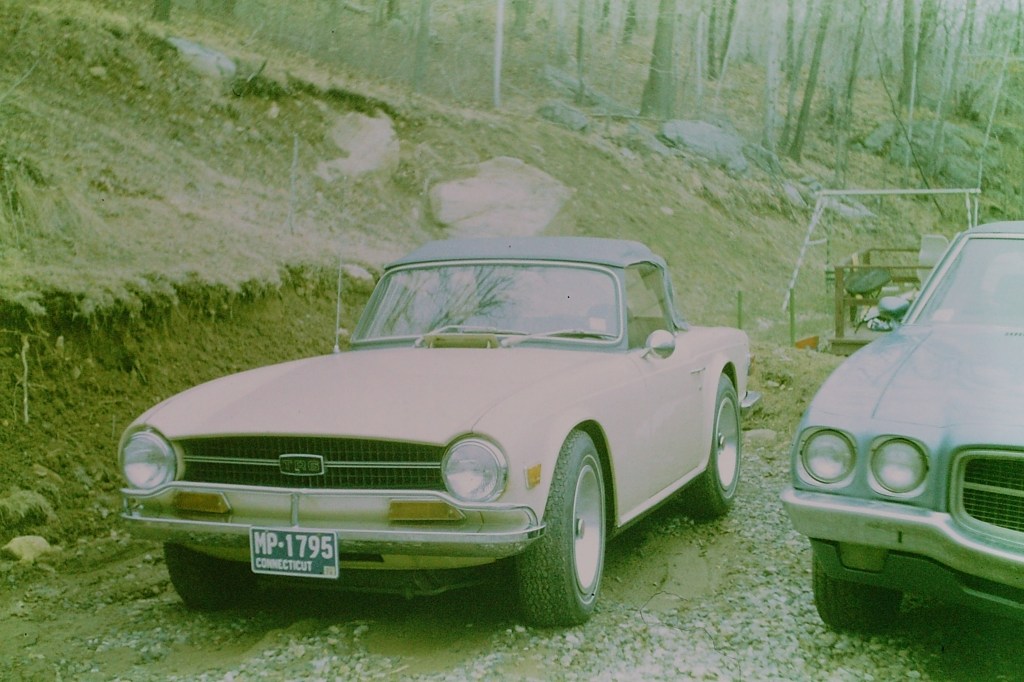
Around that time I graduated to a used, yellow 1970 Triumph TR6.  It was a two-seater British made sports car convertible.  I traded that one in in 1974 for a new blue one that continued my cruising pleasure for a short time.  By the end of that year my daughter was born and cruising around in a two-seater was a luxury I could no longer afford.

In 1978 I bought a Toyota Celica Fastback in the late fall.  One day in June, I was driving home along route 684 from White Plains to New Fairfield, CT.  It had been a hot day teaching in a hot classroom and as I drove in traffic with my windows wide open but doing little to keep the perspiration on the back of my shirt from sticking to the car seat I watched in envy the many of the cars around me with windows closed and their drivers enjoying air conditioning.  As I looked over my dashboard I noticed a single blue button labeled “AC.”  As I had never owned a car or a home with air conditioning and when I bought the car temperatures were in the 30’s, I had forgotten that my car came with air conditioning.  I remember pushing that button and feeling like I had just hit the biggest jackpot of all time!

Next came a secondary car that was a used white, VW that served more as a gasoline storage tank during the gas crises of the late 1970’s than for primary transportation.  At the time, one could only get a gas on alternate days depending on the last digit of your license plate.  Odd numbers were allowed fill ups or rationed gas (depending on the availability of the local gas stations) on odd-numbered days and even plates on even-numbered days.  When filled (it was either a 12.5 or 14.5 gallon tank), friends from Long Island could visit us in Connecticut and be sure to have enough gas for the return trip home!

Meanwhile, my family car, the Pontiac LeMans gave way to a Chrysler “woody-looking” station wagon that eventually became a black 1987 Jeep Cherokee.  My first Mustang a 1976, 3-speed, was a used purchase and served me well until I bought my friend Ralph’s 1982 blue 4- Speed Camaro.  This one came with a high-end sound system that allowed cassette tapes to create my first intense music experience in a car. 

In 1986 I bought a black Nissan 5 speed 300ZX.  It featured twin glass T-tops and remote controls on the steering wheel for changing the radio station and volume.  It also included a recorded voice that alerted me to low fuel levels as well as when my right or left door was ajar.  It was another first for me to have a talking car.  It was my version of the Knight Industries Two Thousand (KITT) as portrayed in the 1980’s TV show, Knight Rider!  This one lasted many years and eventually went to college with my son, nearly 200,000 miles later.

In the early 1990’s I bought a Nissan Pathfinder with off road capability. I not only explored wooded lots to collect firewood but enjoyed several vacations that permitted four-wheel vehicles on miles and miles of beaches.

In 2000 I took possession of a new black, Nissan 4X4 Frontier Crew Cab.  This enabled me to drive through the woods to collect firewood and generally go where I didn’t think possible.  Once, I tree I cut got hung up on another tree as it fell.  I tied a towrope to the base and the other end to the front of my truck and threw it into reverse to pull the tree down.  Unfortunately, as I pulled, the base of the tree struck a large root and stopped moving as the top of the tree continued, falling forward rather than backward.  With no room to back up any further I sat in the truck and watched this rather large tree come crashing down on the hood and roof of my Nissan.  Yet another lesson learned at an age when I surely should have know better.  

After I paid this truck off in 2005, I decided to treat myself to the newly redesigned Mustang GT convertible.  At the time, they were in extremely high demand and not only were they going above list price but there was a six-month wait for them.  Thanks to the Internet, I was able to locate one and put a deposit on it provided I picked it up by the end of the week.  I lived in New York and the car was located in a showroom in Los Lunas, New Mexico.  I called my good friend who lived in Bronxville at the time and was always open to an adventure and two days later we were on a plane heading to New Mexico.  We literally drove the car out of the showroom on a Friday afternoon and headed east.  Unfortunately, my buddy had to be home by Sunday so we tag-teamed driving the roughly 2100 miles back like two 20 year old kids on a road trip.  At the time, I was pushing 60 and he was 66!

My Frontier Crew Cab gave way to a white, automatic, new version in 2011.  By 2019, my awareness of driving vehicles that were continuing to contribute to the worsening climate crisis was growing.  One day as I was visiting my family in Delaware, I mentioned to my then, 13 year old granddaughter my need for a more environmentally friendly car.  She asked if I would consider an electric car to address my concerns.  The next day, while in the Christiana Mall, Kylie, Ben and I visited the Tesla showroom and scheduled a test drive for the next day.  Meanwhile, the dealership sent instructional videos (mind you there are no brochures or manuals to look at in a Tesla showroom) to watch prior to my appointment.  The test drive was more impressive than I could have imagined and a few months later I took possession of a black Tesla model 3.  There are too many features and attributes to write about but several are noteworthy.  The car comes with regenerative braking which acts as if you are downshifting every time you let up on the accelerator.  As a result of this one-pedal driving, I feel much more in control in traffic and around curves, it’s continuously adding additional charge to the battery, and I almost never need to use my brake.  Plugging the car in each evening assures I’ll have as much mileage in the morning as I’ll need and I only stop at charging stations for long road trips.  I also bought the full self driving feature and am now using the beta version which, takes me from my home to the destination I’ve entered, requiring me to only keep my hands on the wheel. (And, if I’ve already entered my destination in my apple calendar, it extracts it from there and I don’t need to do anything!)  Yup, it speeds up and slows down, stops and goes, signals and turns all by itself.  This is a fascinating but yet unnerving experience!  Tesla also makes the car playful which appeals to my inner boy.  It has built in whoopee cushions that can be directed to any seat an in a variety of styles, a light show that turns lights on and off, opens and closes windows, fold and unfolds mirrors and the charging port orchestrated to a complementary musical selection.  It even has a “dog” mode so when I need to leave Duke in the car while I’m at a store, it presents a large screen display that verifies that I (his driver) will be back shortly and he is sitting in the car at a comfortable 68 degrees!  Did I mention the summon feature?  The other day, Teresa and I left a restaurant with my granddaughter, Kylie.  She took my iPhone and held the target button.  We watched as the car drove itself out of the parking space and over to where we were waiting by the front door.  When I think of my first car and look at my current one I can’t help but think of the old ad for Virginia Slims cigarettes, “You’ve come a long way, baby!” 

Did I mention that I’ve already put down a deposit for the Tesla Cybertruck?  

Soon, one will be able to address the following quote by giving both the proper focus!

“Any man who can drive safely while kissing a pretty girl is simply not giving the kiss the attention it deserves.” ~Albert Einstein

True Love

It all started as a young lad attending New Paltz State and preparing for a spring semester of student teaching.  Coming from NYC I only had one friend who had his driver’s license because anywhere we had to go we went by subway or bus. So here I am in my second quarter of my junior year preparing to student teach in the fall.  Then suddenly it occurred to me that a) I didn’t have a car and b) I didn’t have a license.  A generous friend patiently taught me how to drive in her big 5 speed Buick on the mountain roads around Mohonk, including the S curve which was difficult to maneuver in her Buick.  And furthermore she let me take my test in her car and I remember having to drive up the steep hill on 44/55 in Poughkeepsie and praying I could stop at the light without sliding way back if I slipped off the clutch prematurely.  Anyway, she was a very good teacher and I passed the first time.  One major issue resolved.  Now this young lad had to cajole his parents to get him a cheap car for student teaching.  All that summer my parents discussed and lectured me about the responsibility that goes with car ownership.  I all but signed in blood that I would be a responsible adult.. First weekend of fall quarter my brother, mom and dad delivered my very first car- a 1962, it was now 1967, tan Studebaker Lark.  It was considered a compact car but once inside it was like a taxicab. I could have easily fit the entire floor of my dorm in it.  This was a new kind of freedom I had never experienced before and it was intoxicating.  I loved that car but unfortunately after attending my fraternity’s rush party and feeling less than clear headed I looked for someone to drive us home in my place.  My judgment was obviously impaired as he was worse off than I was and on the way home on the Post Road from Gardner, he drove off the road, flew into the air and we landed between two trees.  No one was hurt except I could hear my parents’ rebuke.  And now I needed another car to student teach the next quarter. I will spare you the details of dealing with my parents!

Car #2-1964 Plymouth Valiant.  Silver with an imprint of a tire on the trunk and a push button transmission. Loved it!  Occasionally it wouldn’t start but all I had to do was open the hood and play with the rotar and magically it would start.  Loved, loved that car.  One morning on my way to my student teaching assignment I had stopped for something in a parking lot in New Paltz, got back in and drove off.  When i go to my school I didn’t have my briefcase and realized I had put it on the roof of the car  when I stopped and drove off with it up there, never to be seen again. I passed student teaching anyway!

Car #3-1968 Plymouth Valiant- brand new- dark green.  Served me well- great dependable, practical car but small. Started really liking Chrysler products by then and Car #4 was I think a 1970 Dodge Dart, hard top convertible (which simply meant there was no bar between the front window and the back window).  Light green with a white top.  Loved that car too, but by then the family was growing and we had problems with the Dart so we traded it in for a used Buick Wildcat.  Monster in power and L A R G E.  From there we moved on to used cars rebuilt by my neighbor across the street.  We had 2 Volkswagon 411 station wagons which were constantly breaking down and in his garage for repair and then 2 Chevrolet Citations.  Nice roomy cars but not as gigantic as the Wildcat.  Those were cars 5 through 8.

My dad passed in 1975, so after that point we expanded our catalog of vehicles to non American made cars. The first was a Toyota Tercel Hatchback.  Fun little guy, great on gas, followed by a sequence of Honda Civics.  Drivers in the family were beginning to expand both in girth and number  and the Hondas were a little tight and therefore passed down to the kids.  I moved up to a Nissan Sentra Wagon, my first 4 wheel drive vehicle. and then from there moved on to a Nissan Frontier, their small pick up. From there to a Nissan Xterra which was a great car.  By then I had retired from teaching and opened our Bed and Breakfast in Woodstock, Vermont.  I needed a workhorse for the inn and switched to a Daytona Pickup and eventually to my all time love of a vehicle- a Jeep.

I needed a car that we could lug things in for the inn but I had had enough of pick ups.  I had developed a relationship with our local Chrysler/Jeep dealership and the salesman, Don, knew me better than I knew myself.  He called me and said they had a new product coming out that he thought I would like.  He was right, the 4 door Jeep Wrangler.  It was the size of a pick up but had the comfort of a passenger vehicle.  I had a supernatural experience when I sat in it.  I had to have it.  That was in 2009. Each year new features were added to make it even better, sound systems, heated steering wheels and seats. Traded up to a 2011, lifetime extended warrantee, who could pass these things up?  Stereo radio with free Sirius/XM radio, navigation system, blue tooth, then 2015 Wrangler then followed by a 2018 Jeep Wrangler Sahara.  This is the best car I have even had!  It greets me when I approach by blinking its lights hello to me, and unlocks my doors so I don’t have to put my packages down to get inside.  On cold days it starts while I am still in the house and warms my seat and steering wheel so by the time I get in it,  it is cozy and comfortable.  Who could ask for anything more?  Oh wait, that’s Toyota!  Scratch that last line.  And the best part is everywhere I go friends wave at me with that special wave and sometimes when I go to get in my Jeep there is a little rubber duckee waiting for me!  How cool is that?

P.S.- During our Zoom call Wally and Henry reminded me that I had a few more cars than I described.  Somehow I totally overlooked them during the writing of this piece.  While driving through Europe in 2008 in our little rented Smart car, I fell in love with this tiny little motor car that got incredible gas mileage and felt like you were wearing a glove while driving through the beautiful country side. I said to my partner driving this little toy, how cool it would be to have one in Vermont.  At that point they weren’t available in the States but I just never forgot how cool it was driving around in this cozy, comfortable pretend vehicle.  But shortly after returning home it was announced that the 2009 Smart car would be available in the States through the Mercedes Benz Company beginning in the Fall of 2009.  I could not contain myself and justified ordering one to complement my new Jeep so that we could scoot around Vermont   and conserve gas.  We drove that little guy everywhere.  And I felt like a big man owning two vehicles!  Two years later when I was turning in my 2009 Jeep for a brand new Wrangler, a guest at the inn offered to buy the Smart car at a price I couldn’t turn down.  That January we were in our condo in Florida and going through one of the malls and on display was this beautiful Fiat Cinque Cento in Red with a white racing stripe down the middle of it and it called my name.  I drove it back from Florida in absolute comfort.  To make a long story short, when I turned in my 2011 Wrangler in 2013, once again in Florida I turned in my little red Fiat and purchased a beautiful 2013 Fiat 500 S, which was a station wagon in a dark racing green.  Kept that little beauty until we sold the inn and I traded in both the Fiat and the 2013 Wrangler for my  2015 Jeep Wrangler which I kept until I purchased my present Jeep that I absolutely love and will probably keep for a long time to come.  But I can’t emphasize how much I loved touring the country side in those tiny, 5 speed standard transmission little European roadsters.  That was during my second childhood and I am much more mature now and no longer need as many toys as I did back then.

Arc de Triumph

I really enjoyed Hen and George’s recollection about their vehicles – and I hope to ride in Hen’s cybertruck one day, assuming Elon actually delivers one after all this time! Spurred on by my two old compatriots, I created a list of cars/trucks/vans that I have owned: eighteen up to the present day. How do you write about each of those machines which have provided immense freedom — and sometimes, immense headaches? I think I’ll just focus on one of them – the first!

Before doing that, I need to give a shoutout to my father, who really knew how to pick cars with panache… and could actually fix them as well. This is kind of a backstory to the car he gifted me when I was a college sophomore. My Dad loved British sportscars, so my growing years were spent as a passenger in a variety of British imports: MGA, Austin Healy MK2, TR4, and finally – the epitome – a 1961 XK150 jaguar drophead coupe convertible. The XK150 was a short-lived specimen which bridged the XK140 to the XKE classic sportscar. XK is the Jaguar motor type and the 150 was the miles per hour of the max speed. White with red leather seats and wire wheels, it sounded like a pocket jet engine… I remember being awestruck looking at the speedometer where the 80-mph marker appeared at the middle of the gauge!

Thanks to my Dad I went to my senior prom driving a 1961 Cadillac convertible (which I drove over a median on the way to the restaurant) and departed our marriage ceremony in a 1964 ½ Mustang (which my buddies decorated with white shoe polish). I was a living testimony to his trust – and patience.

Eventually, I inherited the 1963 TR4 – and like Hen – really enjoyed this ride. The TR4 was a step up from the MGA, which featured canvas convertible top and side curtains attached with snaps. The Triumph engine evolved from tractor motors and required constant tuning. While my father and brother dedicated a portion of each weekend to home auto shop skills, my interests lay elsewhere. Cars have always seemed magical to me (how on earth do they work?) and I fully appreciated the magic carpet ride of the TR, particularly up the hairpin turn approaching Mohonk Mountain House, where George learned to drive – what exhilaration! Until the door wouldn’t shut, or the engine wouldn’t start. Luckily, Dad and Bro would fix the window track and replace the burned exhaust valve – and other ailments brought on by my clueless mistakes. 

The TR served me well through college. Once I went to the parking area behind my dorm to find that someone had pried out my gas cap and filler tube! I did remember seeing a TR3 driving around with a rag in the gas tank (a rolling Molotov cocktail). Accompanied by my friend Gube, we drove around college parking spaces until I spotted it – with a new filler cap, which looked remarkably like mine. I confess to prying it out with a long screwdriver and replacing it in my vehicle – does that constitute theft or auto repair?

Well, my British Racing Green TR lasted right up to my first day at a real job in 1970. We drove from Long Island to our new apartment. Linda held our infant son in her lap the entire trip (infant car seats were not mandated until 1986 and the TR had only had jump seats in the back). We pulled into the parking lot and the steering wheel actually disengaged from the linkage. At that moment we realized it was time for a safer, more practical car (which turned out to be a hair-raising saga with a $400 VW411 squareback – a story for another day). 

You can never forget your first love – and I have kept the original gearshift knob and instruction book from my heroic TR!

In Loving Memory……

Even as a youngster I was always interested in going to antique shops and what we called junk shops back then.  My friend Adele and I would go through old deserted houses with her mom to see what was left behind.  In the darkness of an old house we would go from room to room to see what was left of the family that used to inhabit the place.  It was kind of scary and I remember one time going up a flight of stairs and in the hallway of the second floor was a floor to ceiling mirror.  As we got to the landing with Adele ahead of me, she saw her reflection in the mirror, jumped and screamed thinking she saw a ghost!  We were able to laugh about it later but that night we ran out and sat in the car.  I can even remember the smell of the antique shops and vacant abandoned houses and getting comfort from them.  I remember rummaging through things at a favorite shop and if I found a piece of furniture that I liked I would close my eyes and try to imagine where this night stand, or whatever, was located in the owner’s house and tried to imagine the family that used it.  I would imagine the members of the family and give them names and I imagined them using the night stand in their lives.  I always had a very active imagination that way. Even created stories about the family- what the father did for a living and where the kids went to school and had this whole scenario of these people. I felt at ease in these places and among the old treasures I discovered. The only thing that would interrupt my pleasure in such a situation would be a box of old photographs of people’s weddings, or family photos of little kids.  I find it incredibly sad and invasive into the privacy of people’s lives that all these prized family mementos are just dumped in a box for total strangers to view until eventually they are disposed of in the trash.  Very sad!   I think it must be some kind of sentimentality that I suffer from and explains a lot about my entire life.

As a senior citizen who is currently the oldest living member of his family I treasure such things as those photos of my family but also I have coveted certain family objects and pieces of furniture that I love and could never part with.  My home is furnished with many family heirlooms and many antiques I have purchased over the years.  On my twelfth birthday my Italian grandmother gave me a Miraculous Medal to wear on a chain around my neck.  She was a devout Catholic, purchased the medal and had it blessed by Bishop Fulton J. Sheen. He was a patient of the doctor my dad worked for and a good friend of my dad. We all had to sit around the tv and watch his show, One Life to Live, every week.  Anyway, to this day I still wear that medal around my neck and have never taken it off except once, 6 years ago when I had to have my carotid artery scraped.  Even then I held it tightly in my fist while I was being roto rootered!  I remember my dad always carried a money clip for his paper bills. He had probably gotten it as a promotion from Manufacturers Hanover Trust Co. when he opened an account with them sometime in the 1950’s. It isn’t very valuable, probably made of tin with the bank’s name on it but he always carried it.  He never put his bills in his wallet, always in the money clip.  When he passed in 1975, I searched through his belongings purposely looking for that clip.  I found it and have used it to hold my bills ever since. It has to do with continuance. By my using these items I am acknowledging and continuing the existence of the people who meant everything to me.  My mom was a graduate of Bellevue Nursing School in 1933 and worked there from her graduation til 1951 when we moved from Manhattan to Flushing.  She was incredibly proud of what she had achieved and I have a cameo pendant from Bellevue that she always wore on her uniform and the distinctive Bellevue nursing cap which was part of her uniform.  Back then each nursing school had a distinctive cap that was worn wherever the nurse worked as part of her uniform.  It identified the school that she attended.  She treasured both items. When she passed in 1986 I knew I had to retrieve them both.  I gathered them up and brought them home and kept them safely tucked away until my daughter graduated from college.  I knew she would want them and now she has them to remember her grandmother by.  Those are cherished items from my family that are constant reminders of where I came from. I also have collected a few items of my own that I also cherish.

When I got married, my brother gave us an original water color painting from a Long Island artist and that started a love affair with original paintings.  I wound up purchasing another 10 original paintings by the same artist.  My brother gave my mom a painting by the same artist for her birthday one year that she absolutely loved and I also have that painting in my collection as well.  I started reaching out in search of original water colors, attending local art fairs and galleries and amassing quite a collection of over 100 original paintings.  I made it a point to try and meet every artist whose work I owned and succeeded with the exception of original artwork I purchased in Europe during several trips there.  These paintings bring me sheer joy.  When I see a painting I like, I squint and if I can imagine myself in the painting, I have to buy it.  I was telling that to an artist one time at our inn in Vermont, and I told him how I imagined myself in the painting and he was so impressed and had never heard anything like that, that he gave me a huge discount.  I said I couldn’t ask him to do that because i understand the work and love that goes into the artistic expression of an idea and he said , “You didn’t ask, and I would rather the painting  be with someone who loved it than to sit in a gallery for weeks.”  That day, I purchased 4 beautiful paintings of his.  The walls in my house are literally covered with artwork and when I enter each room I am reminded of the artists who created all this beauty and the circumstances that led to their purchase.

One more thing I want to mention in my charm bracelet of memories- an 1864 Welch and Spring Co. Perpetual Calendar Clock.  It was left in the attic of the house we moved into in Flushing by the previous owners.  It sat in the attic leaning against the eaves for 14 years from the time we moved until the day we moved out.  My dad would refer to it every now and then with a great deal of respect saying he was going to get it fixed and hang it in the living room, but he never did.  When they moved to the new house in 1964, after I went away to college, I came home for Thanksgiving and discovered my dad brought the clock with him and of course he was going to get it fixed and hang it.  Well, when I graduated 4 years later the clock sat in the same place on the sun porch.  I brought it to my new home.  I had a friend from college whose dad worked on old clocks.  He fixed it in no time and said it was a pleasure to work on such a beautiful instrument.  I absolutely love that clock which tells the time, the month, the date, the day of the week and even knows when leap year is and adjusts accordingly. I haven’t found the exact right place for it yet but I will.  At least I got it fixed!  

I can’t explain why I am so attached to all of these “things” but I confess I am.  I love all of them, enjoy having them on display or on my person to give me daily reminders of who I am, what is important to me, and where I came from.  They are silent pleasures that I love being surrounded by. There is that old biblical saying….ashes to ashes, dust to dust.  I wonder what will become of all my prize possessions.  I know my daughter wants a few things and my son has his name on a couple of things but neither has expressed much interest in my paintings so I guess they will find their way into odd antique shops and random yard sales sometime in the future.  That is how the life cycle works and in the scheme of things perhaps it is how it is supposed to work.  As the artist at the inn said, I would rather the paintings be hanging in the homes of people who love them than stored and stacked somewhere in a basement.  There are a few other things that could be listed on my attachment list – the thousands of dollars of model railroad equipment boxed and stored in my basement, and of course, my 2018, 4 door Jeep Wrangler…………but that is for another time.

Sentimental Journey

In an earlier post, In Defense of Magpies, I detailed why I’m a devout collector even in this season of minimalism. It’s not about compulsion, hoarding, or simple greed. It’s not about material insecurity and fear of being without. It is about remembrance and esteem, when objects become markers for honoring people you admire and love. It is as though part of their essence is attached to a particular object. When you handle that object, it rekindles the memory of a significant time or individual.

Do you recall that in the movie, The Quiet Man, Mary Kate tries to explain to her husband why her ‘fortune’ (her dowry, which is being withheld by her brother) is so important to her? She says:

” Haven’t I been tryin’ to tell ya? – …that until you have my dowry, you haven’t got any bit of me – me, myself. I’ll still be dreamin’ amongst the things that are my own as if I had never met you. There’s three hundred years of happy dreamin’ in those things of mine and I want them. I want my dream. I’ll have it and I know it. I’ll say no other word to you.”

Three hundred years of happy dreamin’– George hits it on the head when he talks of ‘continuance’. After all, what is there to a life, if there’s no shared memory of what preceded the current moment? Sometimes, an artifact is a bridge to those that went before you. Even your own objects from a younger vintage make a connection to important times: markers along a sentimental journey that led to the place where you are now standing.

One might say that objects are not necessary to remember and honor important people – and I won’t say they are wrong. But the memories are richer when you have your father’s money clip or the miraculous medal gifted by your grandmother. Among my prized possessions are my grandfather’s well-worn fedora, my dad’s tobacco pouch, my mom’s high school art medal, and my brother’s small, unfinished sailboat model – they have no practical use, but I wouldn’t be without them and the memories they evoke through touch, sight, smell or feel.

Now, I don’t for a minute believe that all these items will have the same meaning for my children – or their children. Nor do I wish to saddle my kids with the obligation of unwanted objects. However, I do believe that it’s up to me to pass along the stories associated with the objects around me and to help them curate those items which hold some significance. They no doubt will preserve a few, as well as select new ones as markers on their journey – and to enjoy for many years of happy dreamin’. 

Essentials – Oskar Leonard

In comfortable life, one might
find artifacts, of a kind,
spreading upon dusted surfaces:
amassing an army over the years.

Not incredibly valuable, on their own—
a half-used candle, half-full stapler,
nearly empty Christmas deodorant
and three unused money banks—

but they bring thought to one’s mind,
soft memories, tinged with kindness,
a bright, youthful joy, and therein
lies their true value, these essentials.

On Remembrance

In this piece George reflects on his relationship with antiques and their importance to him.  He also talks about the notion of continuance and what it means to him and what it might mean for his children.   

Like George and Wal, I have a few articles that remind me of my mom.  However, one stands out from the rest.  When my mother died, my sister took pieces of her unused sewing fabrics as well as some of her dresses and had quilts made from them for each of us and our children.  In each one, there was a cup of coffee, a thimble, flowers, and music notes.  Each represented the things in life that brought her joy and contentment.  With the simple act of brewing and enjoying a small cup of coffee with a splash of cream, each morning she began her day with peace and calm.   A replica of her tiny one-cup percolator sits on a shelf in my cupboard.  I remember how she gently lifted her cup of freshly brewed coffee with her hand leaving her pinky finger outstretched as she savored the flavor of each sip through closed eyes.  The thimble stood for her sewing and quilting prowess, her patience, and her devotion to detail and excellence.  The flowers remind us of the beauty she brought into our home from homegrown fresh cut flowers to the most gorgeous and tasty vegetables.  Her connection to plants and her love of nature and gardening live on in me.  The musical notes symbolize her love of classical music and her extraordinary talent and passion for the piano.  Writing about this quilt reminds me to be sure to tell (or retell) these stories to my grandchildren so, in time, they will be able to pass along a piece of their family history.

What is not in the quilt but is significant to me is a symbol from the kitchen.  My mom’s rolling pin resides in my kitchen cabinet.  It reminds me of how extraordinary she was at baking and cooking.  And although I rarely use it, this is the item that brings me closest to my memory of her.  The smell of her cooking and delicious meals were a daily occurrence when I was a child and the cakes and pies she baked were so good that I still can’t find the right words to describe the overall experience.  

I don’t know what items I have that might remind my children and grandchildren of me.  But what I do have are stories.  When I lived four hours from my grandchildren I would often pick them up and bring them to my house for a long visit.  Before we got to the end of her street Kylie, my granddaughter, would ask me to tell her a story.  Sure, she enjoyed my made up stories or stories from books we had read, but her favorites were those from my life.  I remember wishing I could understand what she was thinking as I glanced at her expressions though the rearview mirror while I told and retold adventures from my childhood through present day experiences.  What I do know is that she absorbed them and through thoughtful questions gained an understanding of who I was and what I learned.  Both Kylie and Ben are engaging, entertaining, and humorous storytellers.  I suspect that if they choose to have children, they will continue their knowledge of our family through the stories they tell them.

Each of us, it seems, will remember those who have gone before us in our own way.  While I will continue to tell my family stories when the opportunity presents itself and I will have this blog of personal beliefs, stories, and reflections to leave them, I suspect they will pull from their time with me what they decide was important to them and how and what they feel will be worthy of passing along to future generations.

“Good bye may seem forever. Farewell is like the end, but in my heart is the memory and there you will always be.

– Walt Disney

On Time

How good are you at estimating time?  That is, how accurate are you when you guesstimate how long it will take you to finish something or arrive somewhere?

Teresa and I spent one day last week visiting nearby Pennsylvania.  Our plan was to visit Kennett Square, known as the mushroom capital of the world for growing and distributing 500 million pounds – half of the total mushroom crop in the US, and then spend the late afternoon and evening in nearby Longwood Gardens.   We arrived around 2:00 pm with plenty of time to explore the village and mushroom venues before driving the ten minutes it would take to get to our 4:30 reservation at the Gardens (after all, they allowed a 30 minute flex time for arrival.)   We enjoyed a leisurely walk through town and it’s quaint shops and explored The Mushroom Cap store/mini museum on the main drag.  Finishing early we found a splendid nearby park with hiking trails and spent one of those ideal fall days walking over streams and through fields and stopping at a playground to remember what it was like to swing as high as we once did as kids.  As we neared the time to leave, we remembered there was one more mushroom farm/store we had heard of that was about a mile out of town but, based on Apple Maps, well within range of getting there and then out to Longwood Gardens on time. (after all the latitude provided by the reservation guidelines allowed us to arrive as late as 5:00!)  Who knew how fabulous the store would be or how friendly and accommodating the proprietor was as we arrived just after closing time but were welcomed in to explore, just the same.  Yup, you guessed it, we found lots of mushrooms and other items to buy as gifts and for ourselves, listened to the history of the farm and received numerous recipes and ideas for cooking with mushrooms whose names were both common and unknown to me.  What seemed like a few minutes turned out to be more than a half hour and all of a sudden, we found ourselves reading a GPS arrival time of 4:51.  Fortunately, the reservations allowed that 30-minute delay; unfortunately, we found ourselves enroute at the height of tourist traffic.  You likely know the scenario regarding what we were thinking and feeling as we realized we were possibly going to miss the water-light show we had been planning to see since July.  We arrived, were directed to park in the lot furthest from the gate and proceeded to fast-walk/run past 50 or so slower paced walkers to get scanned-in just minutes before our time limit. Not the best way to start a garden walk…

More often than not I underestimate how long something will take.  My research on the subject tells me that this is likely the result of two factors: we fail to consider how long similar tasks have taken us in the past – we ignore past and recent history, and we remain optimistic that obstacles and unanticipated hindrances will not interfere with our timeline.  Guilty and Guilty!  After all, I reason, I’ve taken the route before, I’ve painted this room before, I’ve run this many errands before so surely I can do it faster this time because I’m more experienced and clearly today nothing will interfere with me getting them accomplished on time, last time was a fluke!

Yes, I’ve gotten better about leaving extra time for travel and I’ve also been more conscious of saying no to squeezing in an extra chore or errand into my plans.  But the allure of doing more, especially when I’m with others, still pulls me quickly into the abyss of missing my mark when it comes to accurately estimating how long something will actually take.  

Some thoughts on the subject that I used to believe but have relegated to the trash bin of things I’ve let go of…

If I don’t try to fit everything in, I’ll miss something.

If I overestimate the time it takes, I may end up sitting idle and wasting time.

Life is short, there’s no time to waste.

Where do you fit into this conversation?  Don’t worry, you’ve got lots of time to write it down and send it in to the comment section!!  J

“The trouble is, you think you have time.” – Jack Kornfield

Time is on My Side……No it’s Not!

I have always had a very specific relationship with time from the time I was a little kid.  This might have been due to having to wait for everything and everybody, whether it was a friend to go bike riding or a doctor’s appointment where I had to sit in a waiting room for 20 or so minutes getting nervous.  Early on I decided I would never make anybody wait for me. But I overcompensated by getting to scheduled appointments at least 15 minutes early but often as much as  half an hour.  I didn’t want other people to feel the way I used to feel because of me.  As a result and to this day, I always allow time for me to get to a meeting place or an appointment that will allow my arrival a good 15 minutes before the scheduled time.

Add to that, is the problem that I still have trouble with the estimation of how long things take. If I am meeting friends for dinner, especially if we are going to a place I have never been to before, I have to estimate how long is it is going to take for me to get there. I not only figure in the travelling time but what about traffic? What about unexpected events lengthening the time, and yes, even parking?  Then I have to add on the additional 15 minutes early that I want to arrive.  Very complicated but I go through the process everywhere I go. If it is a far distance, like to a city or out of state there are other factors I have to consider.  Traffic jams, tolls, not knowing where I am going and the possibility of getting lost. It sounds complicated but it is a process I go through silently in my head before I am prepared to leave my house.  I have gained the reputation of always being early.  When the doctor’s office calls to remind me of my appointment and request that I arrive at least 15 minutes early for me that means a half an hour.

One would think that at my age, I would relax and chill but I have discovered something with old age.  Time goes much faster than it used to.  Some mornings I wake up and the next thing I know I am tucking myself in bed and wondering where the day went.  I make an appointment with the doctor, annoyed that it is so far in the future and the next thing I know, it is tomorrow..  Days go by so quickly and weeks go by even faster.  Not sure when that started to happen but somewhere around 70 I began to take notice of it..  I will sit down with my phone to read something on the  internet and I look up and an hour has passed.  It just seems to slip away, slip being the operative word. It suggests you lost control of where you were walking and your foot lost its traction.  Same is true of time.  Our lives have lost traction and things just happen before you know it.  We use that expression all the time. Before you know it, it will be Christmas.  This flu shot won’t hurt, it will be over before you know it!  Calm down, you’ll get your driver’s license before you know it!  And it is all true but in youth time, “before you know it,” seems like an eternity.  Unfortunately, that eternity lasts for decades until one day you hit  elder time like I did around 70.  Suddenly, before you know it really happens before you are aware of it. And year by year, that time squeezes itself more and more into imperceptible moments.  Just look at your kids. Somewhere between college and now, my daughter turned 51…….51, how the hell did that happen so fast?  It probably wasn’t fast for her, but I blinked and it happened.

I guess what I am saying with the time speedometer on high, at my age it gets harder to estimate the time it takes to do anything. Time seems to speed up but the body seems to take much more time to accomplish the usual activities we do each day- showering, getting dressed, feeding the dog, yada yada yada!  So now into the equation of all the surprises that can occur on your way to reach an appointment now you have to add in extra time for the extra time required to get the old body to move.  Damn, life is complicated..  Maybe I don’t have to be early anymore. After all, I’ll get there before I know it!

The Planning Fallacy

Hen tackles the issue of why we tend to ignore history when we estimate the amount of time needed for a particular task. In his example, Theresa and he planned to be at a venue at a certain time, but got sidetracked with other interesting activities. Of course, you could say that they simply amended their original plan to accommodate a more attractive alternative. That’s the way I’d look at it, anyway. They added one more item of enjoyment to the plan.

If you consult the literature, there’s all sorts of research as to why we tend to gloss over history and underestimate time demands. It seems that this is a common occurrence – one which each of us would find it easy to relate. Psychologists Kahneman and Tversky called this the Planning Fallacy. In experiments, subjects consistently underestimated the time needed to complete a task. One result showed that students estimated the average time needed to finish a senior thesis was 33.9 days – they actually took 55.5 days on average and only 30% of the students finished in the time that they had predicted for their thesis. 

George weaves in the theme of aging in the propensity for underestimating time. Despite Geo’s self-professed bias toward “glass half-empty” outlook, some have pinned the blamed for poor time management on a different bias: ‘optimism bias’. Buoyed by enthusiasm, we tend to assume that we can brush aside typical obstacles, because we have been there before. Despite the fact that folks usually recognize that their past estimates have been overly optimistic, they still believe that their new (optimistic) estimates are realistic. Unfortunately, ‘we don’t know, what we don’t know’ – those new variables that tend to be attracted to our easy-peasey, straightforward plans.

I’ve spent a good chunk of my working life as a planning manager or consultant to international projects. Delays and unforeseen problems are always expected, be it budgetary, resource turnover, or internal/external political conflicts. Mitigation is an oft-used term in project management. In these circumstances, a team of capable folks is on hand to catch problems early and provide opinions about realistic plan revision. Feedback from others is an excellent tool for modifying overly optimistic time estimation.

However, I’m always surprised that the approaches we use professionally do not necessarily become integrated with our personal tactics for estimating time. Like Hen and George, I’m a hawk on arriving early. I agree with George that the steps required for punctuality seem to multiply the effort. Oscar Wilde noted that “Punctuality is the thief of time” – maybe he’s referring to the extra overhead assigned to early arrival?

So why am I frequently racing for a self-imposed deadline? I’ll assign two reasons, of which the root cause is inadequate preparation.

The first has to do with dependence on other individual’s priorities. Rarely do my plans involve only myself. Loved ones, vendors, and service providers may not buy into my timeline. Worse, their plans may conflict with my vision of successful task completion. Time management always involves negotiation with others.

Second, I will agree with George that aging is a factor. But not because time moves faster. Rather, it’s because aging has introduced a certain brittleness in my task management approach – a bit more anxiety in executing. In turn, this task-anxiety reduces my ability to stay with the flow and I forget things. Halfway to an appointment, but forgot my wallet. Arriving at the tennis court without my racquet. You get the picture.

Linda says, make a checklist. Um, I’ve currently got six different checklists active: one for the restaurant, two for properties, and three for organizations. Add to this, a separate daily checklist (‘One list to bring them all, and in the darkness bind them’, as they say in Mordor). So many checklists, that I forget to consult them. My method of dealing with this has been to overcompensate. I’ll break a task into component parts (‘work packages’ for you PM 101 enthusiasts) and knock off each smaller task in turn. It works, but takes considerable energy. How I look forward to simply going into my shop and creating something! I don’t use checklists there (although I could – and maybe should). But, it’s my checklist-free zone.

In short, I find that it is in the doing where I’m happiest. And in those situations, I don’t worry about estimating the time needed – it takes what it takes!

Fly Like an Eagle: Steve Miller Band

“Time keeps on slippin’, slippin’, slippin’

Into the future

Time keeps on slippin’, slippin’, slippin’

Into the future

I wanna fly like an eagle

To the sea

Fly like an eagle

‘Til I’m free….”

I Spy (Rarely)

Linda and I are doing our monthly drive to the Adirondacks, and she says, “Did you see all those turkeys by the side of the road – there were eighteen of them along with two jakes?” and I reply: “Nope, I’m watching the road.” She says, “Look at where those wildflowers used to be in the median, did you notice that they were mowed down.” I reply: “Nope, I’m watching the traffic.” She says, “Those guiderails are out of date, I wonder why the DOT hasn’t changed them?” I reply: “What guiderails?”

Now, the significant part of this interchange is that Linda is driving and I’m in the passenger seat. She notices every license plate and every person using their phone. She has stories about each of them. She spies every live creature. Our running joke is the vast amount of activity she takes in while driving — and in almost every other situation, actually — leaving me to wonder if I need new glasses or a brain transplant (where are you, Igor?). In my defense, I argue that one of us ought to be looking at the highway (but I know this is simply deflection – Linda is a good driver)!

Now, I am talking about observation while in motion… not the watchful stillness that challenges you to keep still and take in all the detail around you without reacting. I’m also not talking about forest bathing (which until recently I thought was washing in the woods). Most of the time, I am in motion – rushing to get something done, planning ahead, because I’m always behind. I miss a lot. For instance, Linda and I are on a walking path in Old Forge and we pass a property sprouting garden gnomes under a copse of old pines. When she stops to look, I remind her that we trying to achieve an aerobic experience. She replies: “Details are important – and you miss them. How many gnomes were there?” I say: “Seven… and Snow White was in the tree?” She says: “There were four gnomes — I really worry about you!”

Well, true dat! Then I read this contribution in Quora… and it got me to considering….

As Told by Jay Matthews in Quora:

———
A student visited a Zen master and was shocked to find him naked in his cabin.

The student said:

Why don’t you put on some pants?


The master replied:

The world is my body and this cabin is my pants.

What are you doing in my pants?

“This cute story is designed to get us thinking about whether awareness is actually located in the body.

When you look at a tree, where exactly does your looking stop and the tree begin?

What we call “the world” is a collection of sense-impressions. Beyond and apart from these impressions, there is no world. The Vedic sages had a brilliant way of describing this:

They said what we think of as the body, mind, and world can be better described as a series of layers, like Russian dolls.

The world” is visual, auditory, and tactile sense-impressions.
[I’d add gustatory and scent as well– wc]

The body” is impressions of pleasure or pain.

The mind” is emotions and thoughts.

When we don’t have any impressions, there is no world, body, or mind. When we have impressions, all three arise together.”
———

Linda clearly is open to the world-impressions. So what impressions am I working with? It seems to me that I tend to retreat inside mind-impressions. When I’m driving a distance, I either drift into daydreams or focus on counting regimented items, e.g., how many Walmart vs. Target trucks we pass. If I’m really inspired, I add Dollar General, Family Dollar, and Amazon. (If you’re interested, Walmart trucks generally out-number the rest of this group two-to-one). In order to remember the count, I keep repeating the count to myself (e.g., ‘28-9-5-3-1’) and so forth, upping the count with each new truck. Well, this becomes a mantra while I drive and after a while, I fall into a frame where the flow of traffic and branded highway haulers become a drumbeat.  My mind flows to another place. Is this meditation – or just a mind-numbing trance? Maybe I’m just an enumerator? Who knows?

Now, I’m curious — what do you spy, when you are in motion?

Return to Sloansville by LL Barkat

I close my eyes,
blot out one hundred
and fifty shale driveways
pickup trucks, Ford
pintos, trailers barely
tied to this ground
by wires, gas lines
cable TV.

I can still see
dirt road, Queen
Anne’s Lace, goldenrod
blue chicory,
field mice nesting
under leaning timothy
and the apple orchard
rooted beyond tall firs

where a woman
in navy sweat pants
and red Budweiser t-shirt
is just now hanging laundry
to drift upon the wind,
sing with ghosts
of spring white
blossoms, honeybees.

Observation in Motion

This topic has me puzzled.  I tried doing some research on how one makes observations while in motion; more specifically, what equips an individual to make accurate and lasting observations of unrelated objects while attending to the priority of safe driving?  Other than the scientific explanations of the role of neurons in the frontal section of the brain, I was unable to find any useful information.  This is likely due to my inability to construct a meaningful (to Google) question that gets at my intention.

In Wal’s scenario, Linda is able to read license plates, notices drivers talking on cell phones, and sees turkeys on the side of the road while safely driving but Wal, a passenger with no obvious responsibilities for arriving safely at their destination, does not.  Now one could infer that noting the license plates indicates where the cars are and how close, drivers on their cell phones could become distracted, and turkeys on the side of the road could decide to cross the road.  All of these are potential threats to safe driving and we could conclude that Linda is using her powers of observation to support her defensive driving mode.

I am rarely a passenger so I easily defer to my lack of seeing what my partner Teresa sees while we’re driving because I’m clearly focused on driving.  However, she too, observes far more details when driving than do I.  And, she too is a good driver.  So, in this sample of two – Linda and Teresa – one might point to a gender-based difference.  After all, based on Jose Mathew’s very clever and funny explanation (in my humble and biased opinion) of how men and women’s brains are wired, the explanation is quite evident! (https://www.youtube.com/watch?v=JQJTbCAAc6w)

Or is it possible that Wal and I notice different things to inform us to also drive safely?  Or, could we see the same things but send a latent message to our brain to ignore the details and focus only on the big picture of how any of these might impact our driving?  Is one style better than another in terms of driving safety? In a NY Times article written by Nicolas Bakalar on April 27, 2020 he states,  “Women tend to be better drivers than men — much better, judging by the number of deaths they cause on the road.”  And, in an article in The Blog, written by Rebecca Shambaugh in March of 2016 she states, “Women tend to absorb more information through their senses and store more of it in the brain for other uses than men do. Therefore, women generally have more interest in details and pay more attention to them than men do.”

While I don’t know if there is a direct correlation between safe driving and attention to details, based on these findings, I may want to spend more time training myself to use both sides of my brain more often than does a typical male!

I also suspect age may play a role here.  I process things much more slowly and tend to remember less, especially details.   Perhaps I used to see many more things while still paying attention to the road.  Of course, in my over-confident youthdom I may have done so without paying the attention I should have to my driving and was just lucky.  Unfortunately, I’ll never kqnow because…I can’t remember!

On the positive side, I’m grateful to Wal for posing this topic for consideration as I now find myself spending a little more time looking around at my surroundings while appreciating even more, Teresa’s ability to notice so much.

“All of us are watchers – of television, of time clocks, of traffic on the freeway – but few are observers. Everyone is looking, not many are seeing.” Peter M. Leschak

Do You See What I See?

I never gave this much thought until Wally brought the topic up. But since then, every time I drive now I’m paying attention to what I am observing.  I should start by saying that in general I am observant.  I usually observe the little details as opposed to the big picture! If I’m sitting on my porch looking out over the yard, I tend to notice not just visual things but noise as well, and smells.  But they usually aren’t the predominant visual, sound or fragrance.  I see the mole hole in my grass but not the gully formed by the rain running off the gutters. I hear the mourning dove on the garage roof before I hear the ambulance siren going down the street.  It must be just the way I’m wired! 

So now when I drive away from my house I am trying to catch myself observing things without purposely trying to manipulate what it is I am observing.  I haven’t had a ticket in 7 years so I am assuming I am an ok driver.  For two of those years I was driving to Vermont and back every weekend so I was putting quite a few miles on my jeep. What I have discovered is I study the cars around me. I don’t always identify the make as many of the models today all look similar.  But what I realized is, I study stickers and decals from places visited.  I get annoyed at the “Baby on Board” ones like if there aren’t babies can I crash into your rear end?  Or the cute little mommy and daddy with 5 or 6 little stickers next to them and maybe a pup or kitty.  I had to laugh the other day seeing such a sticker with 7 little stickers following them and someone finger wrote on the dust of the trunk, “how do you have time to even drive around?”  Something I might have written myself!   I also read license plates, especially the vanity plates and if I can’t figure out what it is supposed to be saying I invariably remark to myself, “What the hell is that supposed to mean?”   Unfortunately, I don’t notice the big things, just the details! 

Now, here is something I realized I go out of my way to do when I am driving after dark and on local roads in my neighborhood.  I discovered I do it all the time when driving alone.  I look into people’s houses. Into windows that have lights on just to try to imagine what their lives are like. I like to see how the room is decorated and imagine their lives and then I develop an entire history of the family.  The husband is a school bus driver and his wife is a registered nurse. They have one daughter who is an honor student in high school.  Christmas times is especially fun to see the Christmas trees and decorations as I drive passed the bright windows.  If there is a silhouette that I can see from the car as I drive by, that is an added bonus and helps me fill

in the details of their boring or exciting life bed judging from what I observed as I passed by.  Making up stories about their lives just prevents me from getting bored while I’m driving.  If I am not near any buildings then I have to check out who is in the car next to me, assign a destination for them and a story as to why they are going there. 

Thanks Wal, I never realized how weird I am until now.  The observations are important but creating the stories that go along with them is really fun.  I’ll go away now!

ASDF…JKL, Semicolon

In junior high school, a concept that no longer exists, we were required to take a course in typing, to prepare us for the future.  We each sat in front of a typewriter, a machine that no longer exists, that had no letters on the keys.  Instead we had to look up at the blackboard, replaced by white boards, with a chart that had all the letters on the keys. We were not allowed to look down at the keyboard but had to learn which fingers were used for which letters.  Home base was “a,s,d,f—j,k,l,;” The thumb was only used to hit the space bar! I got pretty good at it and could type a lot of words a minute- which was how we were scored- words per minute and accuracy, another obsolete concept.  You always indented 5 spaces to start a new paragraph, and after a period you had to have 2 spaces.  Simple, easy to understand and easy to read!  All that has changed over the years.  My life is like the typing class!  Things were simple and consistent giving me a sense of security and comfort. 

     But just lik….ooops

But just like typing, life as changed as well.  Things that I used to feel comfortable with and safe have evolved to things that are not as comfortable for me today.  I would like to say Change is my middle name!  But I would have to change my first name to Can’t!  Of course I know change is inevitable, I grew taller, went through puberty, my voice changed, hair styles changed, friends moved on and new ones entered my life, I couldn’t wait to be older!  Sorry I spent so much time wishing for that one!  Life goes on……and most of the time we don’t even realize it is happening.  The changes just get incorporated into our lives and we don’t even realize it.  

I have been thinking about my Aunt Eleanor, who was born in 1907 and lived to be 99. In her lifetime there were incredible changes, advances in every possible field and life in general. I wish I had asked her how she dealt with it. From horse and buggies, to motor cars, from walk up apartments to elevators, ice boxes to refrigerators, it is mind boggling.  But through it all she survived and prospered.  She went from being a tatter in the garment district in NYC to being a key punch operator for Horn and Hardarts.  No such jobs exist today.  Things are constantly changing. As kids we used to make crank calls. Picked a number from the phone book (remember those?) called the number and when the person answered we would ask, “Is your refrigerator running? and when they would answer yes we would suggest they better run after it!  Harmless!  Today I get crank calls all the time that there is a problem with a bill but they can fix it if I send them $200. in gift cards. I’m too smart for that, but there are many people, especially seniors who get scared and do it.  I guess my point is that change isn’t always good.

I wonder what Aunt Eleanor thought when a man walked on the moon?

I have adapted to change out of necessity!  Can’t say I like it all but I have to learn to live with it.  At my age now, with my body working slower and my mind in rhythm with my body, things can sometimes be difficult.  I have a lot of friends who are pretty technical and can ride with the tide all of these computer advances, while a smaller group of us have to be pulled along into acceptance whether we like it or not.  My friends schedule activities and say they have to check their phones.  Phones are for calling people not for keeping track of stuff!  I, however have to wait to get home and check my wall calendar to see if I am available on that date.  Laughter and jeering subside after a few moments.  I also get all my bills through the US Post Office, an admirable institution and neatly pile all my bills on my desk until it is time to write the checks and record them in my little register to make sure I don’t over draw my resources.  You should hear my friends then……guffaws, you still write checks????  Yeah! I still write checks and still balance my checkbook, how else do you know how much money you have?  I can take being the dinosaur of the group and being the brunt of all the jokes but it is one place where life slows down and I can comfortably deal.  I will let you in on a little secret… I still double space after a period and no amount of joking will make me change.  And even though I have learned to text on my phone, I can never do it with my thumbs.  My one pointer finger sends all my messages and I’m proud of it.

Call me old fashioned, I have been called a lot worse.  I sit on my back porch with a glass of wine and my dog and in that peace and quiet, I take solace from that one brief moment where nothing seems to change, and all is good with the world!

Doing the Two Space

It’s interesting how we all criticized our elders’ resistance to change – until we became them! Is it possible that each generation enacts change partially to distinguish themselves from their forebears?

A lot of change is effective technical or cultural enhancement, but a portion is simply fashion…  like demonizing punctuation (and maybe the two-space guidance after a period). That sort of change for change’s sake leaves me cold if I can’t see a tangible benefit. In fact, I see a degradation of information by eliminating periods or other markers which help stage manage communication. A continued trend toward simplification in language increases the speed of communication, but not the quality. If you figure that George has inserted those two spaces between sentences at least 100,000 times in his life, you have to conclude that it is a pretty well-worn behavior – and that he’s really good at it. So why change? 

Needless change distracts from other important tasks – and it’s made more difficult by ‘proactive inhibition’. That’s when the old behavior competes with the new resulting in a lot of inconsistency. It’s worse, when the change is not much different than the old behavior (one space after a period). Change is also practice. The temptation is to stick with the tried and true (e.g., adding two spaces after the punctuation). It not only (literally) makes a statement, but it also expresses homage to those who taught you – a mark of loyalty. And it sets the azimuth of reality at a comfortable angle.

Yet, there are plenty of innovations that are worthy of adoption – perhaps even necessary for safety and survival. Years ago, I took a class with Margaret Mead titled Culture and Communication, in which she underlined the speed of cultural acquisition – the ability of disparate cultures to integrate breakthroughs introduced in far-away places. Good ideas travel quickly! However, she also believed that the rate of change was rapidly accelerating, leaving some individuals incapable or unwilling to make the leap that cultural change demands. Her example (at that time) was how the children raised on TV differed from their WWII predecessors who lived in a world of radio and print communication. I wonder what she would have thought of the generation raised by the holy trinity of internet, wi-fi and cell phone?

To large degree, we all tend to stick with the tried and true, but what might work at low-tide, is a losing proposition at high-tide. Settling-in can also mean sinking under. Some of my older friends eschewed computers and internet service as unwanted complications — and found that neighbors knew more about their children’s activities (through social media) than they did. They discovered that vaccination appointments had to be made online. One could rightly argue that there should be safety nets for the vulnerable (or simply stubborn) segments of our society, but the message is clear that it is unwise to ignore the tidal influence of change.

“We’re Only Haunted…” by Bridgett Devoue

we’re only haunted

by the things

we refuse

to accept

Embracing Change

Experience has provided the opportunity for me to understand and embrace change.  Like George, I don’t always seek it or relish that which is thrust upon me, but I accept that change is inevitable and ongoing.  Nothing really stays the same.  Just like the saying that you can’t step into the same river twice, everything around us, including us, is in a constant state of change.

I remember watching my grandmother forcefully resist change.  What she was taught and what she taught her children was the right way.  She was certain that her definition of manners and discipline were everlasting and the modern, more casual behaviors with dress, how children treated adults, and dating outside one’s religion would lead to society’s downfall.  Her children’s taste in music was questionable but listening to and watching such wanton people as Elvis Presley convinced her of the demise of my generation.  And when Russia launched Sputnik in 1957 she knew that climatic anomalies were the consequences of dabbling in areas we weren’t meant to be.  She knew what she knew and no logic or other forms of reasoning were going to change that.  When I entered my twenties, I vowed to remember the things I so loved about my grandmother but not to close my mind to an ever-changing world and isolate that part of myself from my children and grandchildren.

Fast forward to today and I find myself better understanding from whence she came as well as George’s happy place on his porch, with his dog and a glass of wine.  But I also appreciate that my high school typing class allows me to use the computer with relative ease and my enthusiasm for learning new things has endured these many years so that I look forward to the latest IPhone, the software updates on my Tesla, and learning the sport of pickle ball in my seventies.  I admit I sometimes vacillate between the “simplicity” of the good old days when there seemed to be fewer choices that then seemed limiting but now feel less complicated, and the wonders of today’s limitless technologies that help make our lives easier and medically, more repairable.  And I also realize, that it’s how I bring myself to each change that I face, that helps decide whether it is friend or foe.

Change is inevitable

Growth is optional

– John C. Maxwell

“Change is the law of life, and those who look only to the past and present are certain to miss the future” -John F. Kennedy

On Listening

The need to be heard is deeply embedded in me.  When I feel the listener gets what I’m trying to convey (even if they don’t agree) a physical sense of contentment comes over me.  On the flip side, when my words are ignored or replaced with the listener’s own story or interests, a combination of anger, upset, and frustration consume me.  It’s the way I’m wired.  

As a result of being this way, I purposely remind myself (because I still forget to follow my preference for being a good listener) to use one of the seven habits of highly effective people created by author Stephen Covey: Seek first to understand, then to be understood.  I actually prefer to listen first.  It helps me determine whether it is a good time for the other person to engage in an open dialogue or not.  What I hear gives me clues about what they are interested in and enables me to make a connection before I enter into a dialogue that might be important only to me.  Often, I’m not even aware that I’m doing this.  Only now, as I develop this piece on listening, am I cognizant that this seems to be what I do and why.  

I’m not sure why I get so frustrated by those who appear to be disconnected from what I say or disingenuous when they ask me a question and then choose to ignore my response and follow a strand that leads them to tell their own story.  I remember vividly, being in a meeting with about 15 school administrator colleagues and the topic was an issue that I felt was extremely important to the future of the district.  We were asked to prepare our comments ahead of time and we would all be given a chance to present them for discussion before a decision was made. When it was my turn, I spoke with what I felt was intention, clarity, and passion.  When I finished the facilitator simply said, “Okay” and when on to another person.  There was no asking if anyone had any questions, how they felt, the pros and cons of my proposal on the issue, or even a thank you for my thinking.  It was as if I hadn’t even spoken.  I didn’t know it at the time, but my friend and colleague seated next to me said he felt me rising out of my chair and, sensing my immense frustration, rubbed my back as one would do to a small child who was about to explode with rage.  The final decision appeared to be a fait accompli and therefore, in the end, none of our ideas or suggestions seemed to matter.

As I thought about that incident throughout my career, I vowed never to allow any of my constituents to feel dismissed or unheard.  Of course I had no control of how people might feel and even though I worked hard at getting to understand what my staff and teammates might be saying, I’m sure I missed some along the way.  But I realized that as long as I tried to understand and acknowledge their meaning and intention, they should never feel as dismissed and unheard as I did at that meeting.

I have known both extremes to the behavior of listening.  I once worked with a woman who had developed such a devotion to listening to others that she never spoke of or about herself.  She deflected questions with one or few word answers and immediately defaulted to asking about the other person.  She remembered details about their last conversation and quickly engaged them.  People felt heard, cared for, and valued by her.  Somehow, for me, there was a void in not knowing her opinions or more about her own life.

There are others, of course, who have such a need to share or vent or explain that they often dominate a conversation or take what I say and link it to their own story.  Sometimes, it enhances what I was trying to illustrate but much of the time it misses my point and becomes more about them.  It is in those times that I become quiet.

I’ve learned a few things about myself when it comes to listening:

  • I need to increase my tolerances for listening, interruptions, and storytelling             
  • Less talk and more thought make conversations more fulfilling
  • Blogging gives me all the time I need to tell my stories and share my opinions

“When we listen, we hear someone into existence.”― Laurie Buchanan, PhD

The Wise Old Owl

I have a problem.  Ask Henry or Wally and they will tell you.  But there is a reason, and I know I have used this excuse before in defense of other bad habits, but it is fitting.  I am Italian.  As Henry and Wally let me know every time we are together, either by a roll of eyes or a forced cough, I interrupt, break into their discourse and have to share an idea. A jury would find me guilty. But back to the Italian thing.  My extended family consisted of about 15 free ranging Italians all hungry and waiting for dinner to be served.  Momentarily while the food was being placed on the table there was a hush that came over the dining room.  As soon as my dad sat down at the head of the table all Hell broke loose.  My aunts would announce that they weren’t really hungry and they would just pick, as they filled their plates with everything in sight.  At first the conversation was, “please pass the macaroni” and then evolved into ,”Gimme the Italian bread!”  This wasn’t done in polite courteous discourse, it soon became cruder and louder and all at the same time.  As a child I learned that I couldn’t just wait for a pause in the chatter because there was never a pause, so you had to raise your voice and as a kid occasionally stand up and point to what you wanted.  If I just waited for a pause in the conversation I would starve plus after a few minutes my mom, my dad or my aunts would shout across the table to me with, “What’s the matter, why aren’t you eating anything? ” So with that as my background it is a hard habit to break.

On the other hand, my Welsh grandfather would quote the wise old owl (not sure what scholar really came up with this so I can’t include his name in the credits) and tell my brother and I that we were born with one mouth and two ears, so we were meant to listen twice as much as we spoke. Not bad advice at all.  But being a little kid and a snarky one at that, I would always say he should come to one of our Sunday dinners and bring that owl. But Grampa would just say, “When in Rome……” which I didn’t really understand because we lived in Flushing  So breaking the habits of interrupting and speaking loudly has been a life long goal and obviously one I have not yet achieved.  I don’t do it to be rude, much of the time something that was said got me excited and I wanted to contribute and having no vocal boundaries I just jumped right in. I do admit that sometimes during a conversation, a pretty bird or an insect or something attracts my attention and I want the other people to see it too so I interrupt again.  Habits are hard to break and having little self discipline interferes with my success.  To this predicament aging is also a contributing factor. If I don’t tell you my idea right now, by the time you stop talking I may have lost it…….just sayin’.

I was a teacher for 35 years and a union president for the last 10.  So I had to listen. The union position was especially difficult because I had to listen to a teacher’s problems. If I was sitting at my desk in the office I would be pinching my knee beneath my desk reminding me not to interrupt.  And that worked for the most part.  Everyone wants to be heard. I know that and it is probably because of my insecurities that I force myself on others to be heard.  It isn’t because I’m not listening or not interested, it is just that I am convinced I have something so important to share that I just can’t wait for the pause so I watch very closely to see when the person takes a breath and jump in.

I have a lot of work to do still and I’m running out of time.  Old dogs take a lot longer to learn new tricks.  Shiny objects always attract my attention and I am so sorry to hear about your broken leg, but Look, an army tank just drove passed the house!

Vocal Boundaries

I think George is onto something in raising the issue of vocal boundaries – and crossing them in order to be heard. I suppose that in a competitive environment, you need to be assertive to make a point, even if that means interrupting or changing the topic of conversation. But is all conversation really competitive? Is conversational space a scarce resource?

George and I kid about interrupting Hen before he can say 25 words.  It’s a joke, because Hen does not blather on, but rather gets to a point pretty efficiently. We can tease Hen, because he is generally pretty tolerant about being conversationally short-sheeted. Similarly, I might roll my eyes at George, whenever he jumps in to take the conversation in a different direction. The eye-roll is not meant to be demeaning:  I (and Hen) appreciate George’s spontaneity and wit – and the conversation usually becomes more interesting. The bottom line is that we are comfortable with each other and realize that we all care enough to eventually give one another the opportunity to express a point of view, despite eye-rolls, interruptions, and lots of laughter.

Caring is the key. George’s family could cross vocal boundaries, because they demonstrated in a hundred ways that they recognized each other as people that mattered. It seems to be a different story when someone demonstrates that you are not valued enough to be allowed conversational space – and worse — gloss over your ideas without really listening. Unfortunately, I’ll bet we’ve all been on both sides of that discourse!

It seems to me that the urge to dominate the airwaves increases with age. Many of my senior friends feel compelled to share their stories — either before it’s too late, or before they forget. There is rarely a drop-the-mic moment, because the mic is held in a death-grip. I don’t buy George’s point that the urge to share doesn’t interfere with listening (sorry for the double negative!). Of course it does: the teller is focusing on the next point instead of asking questions for clarification. 

To go even further, I suggest (as many others have suggested) that the inability to repeat back what another person has said to you – in a manner that causes the other to signal that you heard correctly – is a major national problem these days. Wonder what would happen if we took a rule to share stories, one-for-one and asked as many questions as we used declaratives?

excerpt from Please Just Listen by Jessie Swick

…”Perhaps that’s why prayer works—because god is mute,
And he doesn’t give advice or try
To fix things,
God just listens and lets you work
it out for yourself.
So please listen, and just hear me.
And if you want to talk, wait a minute
For your turn—and I will listen to you.”

Half-Hearted

When we started this blog, it was our goal to depict a first-person record of our thoughts for our friends, children and grandchildren. Maybe this record could start a conversation or provide an insight that would benefit someone. Sometimes this writing is tough for me, because I’m just an ‘everyman’, whose experiences are mostly alike to just about all the folks who read our posts. So, here’s a recent dilemma – perhaps you’ve felt the same.

I believe that most people make decisions with their heart and then rationalize why they are logical decisions. However, there are times when logic and doubt put the brakes on that decision, rendering a full-hearted decision into a half-hearted enterprise. I tend to do that frequently. A case in point:

An acquaintance asked me for a favor, a man in his later nineties. Would I act as the executor for his will as he had no family or close friend to help him? Sure, I said – of course. “Whoa”, my brain’s executive function replied – “What are you getting us into?” Well, said I, it’s the right thing to do, after all, he’s alone and I’ll just provide the administrative work to satisfy his last wishes, which were to donate his estate to a charity that helps burn victims – and to ensure that the ashes of his deceased dog get buried with him.

It started off with some bumps. I realized soon into the process, that my friend (I will call him friend, because we now have a certain relationship) has a communication style which tends to alienate quite a lot of folks. If asked a question he does not wish to answer, he simply refuses to acknowledge the query, stares straight ahead, and pretends he doesn’t speak the language (yet English is his only language). If the question is repeated, he may deflect by becoming antagonistic. This pattern makes it very difficult to deal with lawyers, who want to define the set of assets and stipulations in his will and funeral directors, who attempt to identify the conditions of being laid to rest. Later, I found out that this style also doesn’t help medical professionals who are trying to determine what hurts and under what circumstances. Clearly, his needs were less for an executor, but more for a care-giver and public relations specialist.

It became starkly apparent when my friend slipped in his steep driveway and had to go to the emergency room. From there, he was shunted to a rehabilitation center for two months. During this time, we worked through his bills and arranged a safe return to his house, with added handicapped assistance and occupational therapy. Bill-paying took some time, because my friend only pays with a credit card and only by telephone, and only when his hearing aids worked. His philosophy is that if creditors didn’t make it easy to pay (e.g., no checks, no computer, no long telephone menu, no foreign accents), well, then they didn’t need his money. Shopping also became an issue, because he has specific – and limited — tastes which are distributed among several grocery stores.

Around this time, I became half-hearted. Although I wanted to help, nothing seemed to satisfy my friend. Every problem had a particular – and not quite obvious — acceptable solution. Also, running around to different stores for special cereal, orange juice brands, bread, and non-dairy creamers is just not my thing. In addition, desired brands were not always available due to stocking and supply chain issues. Bananas with absolutely no spots, white bread with expiration dates of two weeks or more, one brand of cheese, two types of cereal in a particular volume, razor-thin sliced angus, and one type of non-dairy creamer – a gallon at a clip, were judged to standards beyond my enthusiasm level. Products and people all seemed to be sources of irritation to my friend, even those people who were helping him in some fashion. I found myself parlaying excuses for delaying my visits. I kept saying to myself, I’m supposed to be learning something from this situation, but I could not figure it out.

I was mad at myself for not really engaging; resentment was weighing me down. Being half-hearted is bad for your health. The Bible has a relevant verse about this:

“I know your works: you are neither cold nor hot. Would that you were either cold or hot! So, because you are lukewarm, and neither hot nor cold, I will spit you out of my mouth.”

Boy, that fit. Yoda also has a verse:

“Do or do not. There is no try.” 

Well, that pinned me – either do or don’t. I realize that I needed to see this as a situation where I should be happy that I’m able to do something to help my friend… and lucky that I have a wife who is game to assist. Finally, I became content with understanding that I may never figure out what I’m supposed to learn from this experience. And as soon as that happened, I learned some things!

  1. People, particularly seniors, want to be recognized: they are afraid of becoming irrelevant; want to be seen and understood. But that’s not enough
  2. People want you to care. You cannot do that in a half-hearted manner. Showing up isn’t enough: you have to listen to their stories and be invested. Regularity and attention to detail will also help
  3. Understand that even if help is required, it is rarely welcomed. Folks may not show their best side, particularly if that have reason to come from a position of general mistrust. In my case, being judged for shopping skills was not the point. It was to ensure that I listened to my friend’s needs. Once that was satisfied, he compromised on his brand requirements
  4. Those abrasive and judgmental behaviors could easily be my personality style in similar circumstances. Look at yourself and learn to age with grace.  

Age with Grace

I was having trouble trying to connect with Wally’s half-heartedness.  I have never been in a situation like that where I have been tested.  Wally is his own worst critic and I admire how he stepped up and helped this guy out.

I aspire to be like him, Wally not the cranky old guy.  Perhaps I have never been in that position because I have been too afraid to make that leap of faith and people recognized that in me and never approached me. Wally has shared his experiences with this gentleman, and I often thought were it me I would be stomping my feet, throwing things, and cursing at the moodiness and abruptness that Wally’s generosity was dealt with by this guy. I just couldn’t ‘relate until the last three words of Wally’s text….. Age With Grace.
I immediately was enveloped in the snarky state that I am known for…. But Wally, your wife is named Linda!  Sometimes I do that because the topic of discussion is too painful to address intellectually.  I have accomplished much in my life that has made me proud but doing it with grace is not one of my strong suits.  To age with grace is quite a concept., and quite a task to accomplish.  Those of us who are fortunate enough to age, do it in various ways. Our culture doesn’t revere aging the way other cultures do, and as a result we are often taken advantage of, teased, or discounted.  Aging gracefully may be more an aspect of how those around us treat us rather than anything we do “gracefully.”  I often joke that I have earned my curmudgeon license and enjoy using it. Old people are known for their crankiness, and ornery-ness.  Our society doesn’t always treat seniors with patience and respect, and as a result many seniors respond to society without that value and respect, they/we expect.  Just look at all the hackers and computer thieves who prey on seniors to get our money over the phone or through the computer because we aren’t smart enough to know better.  Throw in some fear and add confusion and we are easy prey to these crooks.
I fear growing older more like Wally’s friend than Jimmy Carter and that troubles me.  Being alone late in life is very difficult.  Sure, I have caring kids who will always take care of me but I don’t want them to have to do that.  And having kids is different than having a partner.  You can’t talk to your kids the same as you can with a spouse or close friend.  At least to me it seems inappropriate to talk about certain things with my kids that I could easily share with someone who has known me intimately for a long time.  I guess I am quickly approaching the category of cranky old geezer and leaving behind the helpful younger caretaker who graciously gives his time to help out someone in need.
I turned 76 a few weeks ago and suddenly felt old.  Nothing changed from how I felt the day before, but the number was scary.  Sure, 76 trombones led the big parade but I don’t have a parade in me anymore.  I have friends around my age who are dealing with problems with their hands and feet, pain and numbness like I do.  I am waiting for the day to come when my kids decide dad shouldn’t be driving anymore- one of the last strongholds for seniors to feel independent Thank goodness for back up cameras because I have trouble turning my head around to see what I am backing into.  The camera allows me the security of signaling if I am in danger of crashing into anything.  But there are so many little reminders like that that seniors experience in a day, and the indignity that accompanies them.  You really have to be brave to get older, the body slowly deteriorates and so does the mind.  In the course of a conversation, we lose words.  That bugs me most of all, when you have to use the definition of a word because you can’t retrieve the word itself. I went to the, ah, you know, the heart doctor….. right the cardiologist.  So, I understand what Wally’s friend is going through.  Sometimes I wonder if he gives Wal a list of things just to see how far Wal will go to get everything.  But you can tell even with this gentleman his recent life has been very lonely and having a human to talk to every now and then is essential. I know the guy has a good heart because he wants his best friend’s ashes to be buried with him.  I know how deep that connection is.  I wouldn’t have made it through Covid without mine.  I will strive to age with grace…….or Rick, or Mary….or Fred, but perhaps that aspect of life will escape me.

With a Full Heart…

In this thought-provoking piece, Wal asks us to think about how fully we bring ourselves to the task of helping others, how we respond to those things that get in the way of making it a fulfilling experience, and what we can learn from the entire experience.  These questions also apply to relationships and work. 

There have been numerous times when I did the right thing for the right reasons but not with a positive attitude.  I was unhappy about my commitment and wished I was somewhere else, but I had given my word and felt I needed to honor it.  And while I’m sure it was apparent to everyone around me, I still felt that they should accept my unsmiling face with appreciation since, after all, I was doing what was expected.  This was not how I wanted it to be, but, at the time, didn’t feel there were any viable alternatives.

I remember one time when I was to accompany my former partner and her daughter to the wedding of her friend.  I hardly knew the friend or the groom and it was a weekend long affair.  To add insult to injury, it was one of those spectacular fall weekends when the weather was perfect for hiking, biking, or anything outdoors and I was really unhappy.  Then, I realized that I had a choice!  I decided that it would be better off for everyone if I stayed home and excused myself from the wedding event.  My partner and her daughter could enjoy the event and they wouldn’t have to worry about me sitting indoors with people I didn’t know and wishing I were somewhere else.  I assumed that this was a legitimate request as my partner had excused herself from an outing or two that she wouldn’t have liked and that had been acceptable to me.  I was wrong.  Even though I was clear and direct, they both were adamant that I should come, that I would have a great time, and they would be extremely unhappy if I didn’t.  So I went…begrudgingly, angrily, and more moody than I’ve ever been.  I was miserable and so were they.  We arrived, they got out while I parked the car, and when I entered the venue, I discovered it was actually a surprise party for me for my fiftieth birthday!

Eckhart Tolle offers three healthy ways to address such issues that move us closer to acting with a full heart and with less suffering.  He suggests that when we are faced with a situation in which we are a participant who is struggling with the conditions or circumstances of what we are doing, we can actively seek to change it, completely accept it, or leave.

In the case I described above, I did first seek to change the situation by offering to stay behind and supporting their interest in going.  However, instead of accepting the situation after I agreed to go, I feel back into a less than half-hearted position.  I made myself miserable and those around me who were, in fact, trying to surprise me with something I would truly enjoy.  I have never forgotten that lesson.  All I had to do was take a deep breath, let go of where I wanted to be, and enjoy the ride.  Instead, I not only lost those hours of living well but numerous minutes and hours regretting it.

“If you’re willing to give me
Give me your all
I like things whole and imperfect
So don’t give me perfect halves
For I don’t like to go for things
half-heartedly
and I don’t like to be gone for
half-heartedly.”

― Sherihan Gamal