Life in the Slow Lane

71……That’s when this whole adventure began.  I retired from teaching at  57 and immediately moved to Vermont and my new career.  Inn keeping really keeps you busy.  There is no time to waste as things have to get done on a schedule.  Rooms had to be ready by 2pm so when the new guests arrived they could be taken right to their rooms.  I had it down pat.  I moved smoothly from one task to the next, making beds, cleaning toilets and bath tubs, replacing towels and of course leaving time to chat with our resident ghost.  I was all over it.  Then of course there was the necessary snow shoveling of the parking lot and all the paths to  the inn itself.  And even with those added responsibilities everything had to be done by 2 pm so that we could greet the guests with a smile!  We were like a machine, I would strip the bed, throw the used linen down the stairs for them to go in the washing machine.  Then move from one room to the next effortlessly.  I even learned a trick to fold fitted sheets.  I was in good form, my body moved perfectly and effortlessly.  After 14 years of inn keeping we had to sell the inn because the advent of Air BnB’s pretty much killed the market for all the little inns and BnB’s.  Homeward bound back to New York and on to the next adventure.  Not knowing what to expect I bought my own little house and spent the first few months setting it up.  Still in good form I could mow all the lawns, shovel the walks and driveway and then chill with a nice glass of wine.   AND THEN, I TURNED 71!

Something happened to my body.  I think it wanted me to slow down but I was fighting it. It won!  Acid reflux and other discomfort necessitated a trip to the  emergency room, an ambulance ride up to St Pete’s in Albany and two stents planted in the widow maker as the doctors called the vessel.  They said I was lucky, no heart attack, but I had to slow down and recuperate.  While I was recuperating, doing lunches with  former colleagues and students, emergency number 2 struck.  After two weeks of my dog licking the right side of my neck, my cardiologist discovered that my right  carotid artery was 99% blocked and needed another procedure.  They slit my throat and scraped the artery clean and inside of 3 hours I was back home and having to slow down even more. So I looked like a lopsided Thanksgiving Day parade balloon  for almost 2 months which pretty much slowed me down out of necessity.  I didn’t want to scare innocent children in the grocery store.  But once again the doctors said I was lucky because they caught it before I had a stroke.  My body then began to slow down without me having much control over it.  I began to notice little things……When I got out of bed often I would fall back onto the mattress.  No problem, I was tired!  After all I wasn’t a kid anymore.  Both my kids reminded me of that on a daily basis. I could deal with that annoying but not serious problem.  Then, I noticed when I would pick up a stemware glass my hand would shake.  That never happened before and bothered me because it was something  other people could  see.  Obviously, I had to develop some coping mechanisms to deal with the balance and shaking issue.  Activities that I could do in a split second all of a sudden required a moment of thought before attempting the activity.  The rest of my 71st year was uneventful and I was beginning to feel myself again.  MY activities were not interrupted and my energy level was back to normal.

Then 72 came!  And with 72, I began to have pains in my wrists and thumbs.  Annoying at first but not really limiting.  Add to that a painful few months with plantar fasciitis which really limited my walking, but luckily I broke my foot and had to wear a brace for 6 weeks and it magically cured the pain .  I started an alphabetical list of all my old man ailments.  As the time passed I adapted my lifestyle to the  restrictions left by the refusal of my body to move in the way I wanted it to.  Unfortunately, though the fasciitis disappeared, the arthritis intensified and continued doing so up to the present..  I was beginning to get the rude awakening that I had to start making amendments to the way I do things.  My wrists got so sore that I had to develop alternate ways to accomplish simple tasks.  Common everyday activities became challenging,  The most difficult was opening cans and jars, door knobs became hurdles, trimming my shrubs caused hours of pain.  Doing the laundry, which I hated in my 40’s became unbearable, even lifting a pot off the burner for dinner was a chore.  While this was going on, my balance was intensifying, My hearing was getting worse to the point where my kids , thinking they were humorous, would mouth words carefully so I could read their lips.  It was time to do something about all of this.

The worst pain was from the wrist.  I was mowing my back lawn and the mover went over a wire cable that twisted itself all around the blade.  There was nothing I could do to untangle it.  The strength in my wrist couldn’t clamp down on the handle of the wire clipper, so I went to Home Depot with a piece of the wire that fell off and searched for a tool that could actually do the job.  I finally found a long armed clipper meant for this kind of thing but I still didn’t have enough strength in my wrists to clip it.  Suddenly I realized, that because of the long handles, if I used both hands and my knees to compress the handles I could experience success.  I was very proud of myself.  Bought the tool, got home, turned the mower over and with one clip of the coil which was wrapped around the blade hopelessly entangled, the whole thing fell right off and I could continue mowing forever more.  There is a solution to all problems.  Opening jars became more difficult.  I found that if I bang the  lid several times on opposite sides and then arrange my body so that my left hand was grasping the lid, my right hand wrapped around the jar and my shoulders were extended forward, the lid would begin to break its seal as I turned the jar instead of the lid.  I even had to buy pants a size too big so that I could snap the waist band pain free.

Because of my balance issue, which has improved by a series of exercises in my shower(there is a safety bar) I can now stand on each foot for at least 25 seconds without losing my balance.  This is important for me because I had fallen several times in the last year.  This slows down my life considerably because I always have to think about what my next move will be especially on staircases.  Which brings me back to the laundry.  My clothes sometimes sit in the dryer for several days.  The process of getting the clothes down to the basement is difficult.  The basket is always full, the dog is always under my feet and I have to stop at the top of the stairs and think,  I had a friend who was doing her laundry, fell down the stairs and hit her head on a metal radiator at the bottom.  I developed this two part system of getting my dirty clothes down to the laundry.  If my laundry basket was overflowing, I developed a rope system that I tied to one of the handles, and slowly and carefully let the basket slide down over the steps until it hit the bottom.  That works really good but now I feel more comfortable and I know the number of steps in each of my staircases.  When going downstairs I naturally hold the handrail, count the steps going down and make sure that my heel hits the back of the riser as I descend.  It works great!  Going up is easy cause you can pull yourself up by using the handrail unless you have an overflowing pile of clean laundry. I actually know how many stairs there are in most of the places I frequent just to be on the safe side.  All of these processes require us older people to think before acting.  The joy of spontaneity is certainly reduced but it beats a trip to the emergency room or worse.  One other thing…..My neck doesn’t move as it used to .  Driving can be difficult because of it.  When roads merge at less than a 90 degree angle I have real problems discerning whether there is on coming traffic so what I have learned to do is all the way at the end of the ramp I position my Jeep as close to a right angle as I can so that I just have to turn my head to the side which then allows me safe passage off the ramp and onto the larger highway.  Anyone who has ever tried to merge onto Route 9 South after getting off the Mid Hudson Bridge knows what I mean. These things all take time, thought, and patience.  Though the days seem to go much faster than they used to, individual actions are slowed down to allow for careful consideration and safety.

I’ll just end with the problem of the fading memory.  Of course, names and words become hard to retrieve so I make a habit of writing lists, especially to go to the grocery store.  I carefully compose the list, post it on the refrigerator door and head out only to realize when I get to Shop Rite that the list remains magnetized on my refrigerator door.  That old 60’s song, “Slow down, you move too fast….gotta make the morning last.”  That is my new theme song!

Life Accommodations

George reminds us of the adjustments we need to make to maintain our lifestyle without having to endure major changes or eliminate those things we need or want to continue to do. When I first read his piece and realized that I was also making these kinds of adaptations, oftentimes without realizing it, I was disappointed that I had reached this point in my life. But as I continued to think more about the concept, it occurred to me that I (all of us) have been making accommodations all of our lives.

When we were children and weren’t tall enough to reach something we wanted, we found something to stand on. When we wanted to go swimming but couldn’t swim, it was a flotation device. We biked with training wheels when we wanted to ride.

As young adults, we were faced with developing coping mechanisms for transitioning from being cared for by our parents to becoming independent tenants, shoppers, finance managers, etc.

As middle-aged folks, we used physical and emotional supports to address unexpected health issues, trauma, and relationship challenges.

With this mindset, I no longer felt as vulnerable and frail as when I first read George’s piece. Now, I can more readily agree that as my body and cognitive fluency are more limited than they once were, I check and adjust to continue my forward momentum in life. While I can’t think of a story to share that makes this point, I can tell you that I have made many accommodations to my daily living behaviors. Each morning as I slide out of bed, it is with greater caution than in the days of old. Before I leave the bedroom, I must put on my glasses to find and place each hearing aid in its proper ear. I no longer bound down the stairs hands-free but walk down holding the handrail (most of the time). I move more slowly, do physical work in shorter periods and with more breaks, and my list of tasks to accomplish is decidedly shorter than I’m used to.

For me, the greatest adjustment has been letting go of the shame I used to feel about getting older and allowing others to see my limitations. My ego was much larger than I believed it was and had (still has) a greater influence over my ability to be fully authentic than I thought. Getting in the pool with my looming love handles showing and wearing a hat while swimming to cover my growing bald spot was, and still is to a degree, a conscious hurdle to overcome.

“It’s not a question of how old you are, but a question of how you are old.” – Jules Renard

“Age is an issue of mind over matter; if you don’t mind it, it doesn’t matter.” – Mark Twain

Thinkey, Thinkey

I liked George’s point about needing to adapt to physical limitations as we age. Let’s face it, nothing stays the same. But what’s really amazing is our internal gyroscope which keeps us spinning true, no matter how circumstances change. I’m talking about our ability to process information and integrate it into the “new normal” of the moment. That gyroscope smooths over the vast amount of change in a manner that allows our basic organization of the world to remain consistent.

As a result, I read George’s account as almost a cheerful reckoning with limitations of a physical nature. His strategy is risk abatement and he cleverly baked in solutions to overcome vulnerable areas of his day-to-day challenges. (Except for his “War of the Roses”, which he’ll have to relate).

I’m all for the special accommodations that allows us to continue to pursue the activities that we love – or need – to do. Lately, I’ve purchased a couple of items that have made a difference: a folding rolling platform – like a dolly with a handlebar – which lets me move heavy items or lots of boxes pretty easily and a pneumatic lift table which can raise a 500 lb. object 27” off the ground (so that I don’t have to).

Super helpful! So much so, that I envisioned a method for single-handedly loading a very heavy 6’ tall storage cabinet into my truck bed. Asking myself. ‘What would Archimedes do?’ I developed a scheme to roll the cabinet next to the tailgate of my truck, pump it up with my lift table and topple it into my truck bed. What could go wrong?

Well, I don’t know what might have gone wrong, because part way through this exercise a younger and stronger friend stopped me. He said that if each of us took a side of the cabinet, we could lift it into the truck. Testosterone took over and I agreed to a team hoist. Unfortunately, he lost his grip part way through and I awkwardly handled the unexpected weight.

Now, my plan probably would not have worked well, but this approach resulted in a shoulder injury which has not fully healed after two weeks. I was moaning to Linda about my inability to do the things I really love (no tennis, no woodturning) and she simply said “Thinkey, thinkey, next time” (since this is a made-up word, I reserve the right to spell it thus). Boy, that ticked me off! But she was absolutely right – as is George: ageing means planning ahead a bit more.

But yet … what’s a life without some risk?

Risk – by Anais Nin

And then the day came,
when the risk
to remain tight
in a bud
was more painful
than the risk
it took
to Blossom.

The W’s of Walthamstow

Two professors from Bowling Green University taught me an important lesson: don’t crowd two topics into one message. But here I am thinking about freewill vs. determinism, heritage, secrets, and judgement.

Now, my DNA analysis shows the majority of my paternal heritage is concentrated in Southern England with an admixture of Danish, Swedish and French. That’s no surprise, since Southern England was overrun by Vikings and Normans at various times.

It seems that my family may have come from Walthamstow, a section of Essex (although since 1960, a borough of London). However, I know little about these folks… and what I do know gives me pause.

Waltheof, the Anglo Saxon Earl who owned the manor at Walthamstow, joined the Danes in rebellion against William the Conqueror shortly after 1066. His wife Judith, betrayed his intentions to King William I (her uncle) and he was eventually beheaded in 1072. Reportedly, Judith did not care for Waltheof very much.

Walthamstow remained a sleepy agricultural and sheep farming community until the railway was built through the marshes to the village in the mid 1800’s. It then became an industrial hub, known for a variety of manufacturing enterprises, from minting coins to building omnibuses and Swedish electric motors. The first “all-British aeroplane” (the Avro1 ‘Yellow Terror’) was launched from Walthamstow Marsh. Alumni of Walthamstow include William Morris, David Beckham, Alfred Hitchcock – and apparently, my forebears.  

I’m looking at a picture of a smallish balding man and his more substantial wife. Given the shape of his face and nose, I place him as an ancestor: likely, Edwin Wilson, my great grandfather. Folklore says he owned a bicycle manufacturing business in Walthamstow in the late 19th century. That would be about right: the modern bicycle was developed in Walthamstow, resulting in a craze for the new contraptions beginning about 1885 and culminated in the “bicycle bubble” which collapsed around 1901.

Walthamstow

Edwin had five offspring, including my grandmother Winifred. Winifred is recorded in 1901 at sixteen years of age as marrying a boarder in the Wilson house, George Fields. George – also an employee of Edwin Wilson — signed up for the Royal Navy 8 months later and disappeared for 25 years. In the 1908 census, Winifred marked her status as “spinster”.

That same year, she married Walter Alfred James Cook, a railway porter. For reasons unknown, Edwin did not support the couple’s intent to marry and essentially disowned my grandmother. Was it because she was still married to Fields? Was it something about Walter? This is interesting folklore, as Edwin died three years before Winifred’s marriage to Walter. Walter variously listed his occupations as railway porter, electrical engineer, costing clerk, and packing case carpenter. He joined the Royal Navy in 1917 and was transferred to the Royal Airforce in 1919. I’m guessing that he had a hands-on technical bent. I’m told he could play the piano and apparently was very social. I don’t know, because I never met him. Walter and Winifred had five children and emigrated to America in 1922. He listed his occupation as ‘manager’. The story goes that he secured a job with a company based on his experience making ivory billiard balls. As far as I know, he had no such background.

They named their first-born son Alfred (known as “Boy”); their second son Walter Charles (“Charles” after Charles Smith, grandpa’s half-brother). They also named their oldest daughter, ‘Winifred Jr’, so naming traditions were important. In fact, one of the strongest disagreements I had with my father, was when he insisted that I name our first-born Walter Charles (WC the III and Walter the IV), saying that it was convention to name a son after the grandfather — but too many ‘W’s!

Well, my Nana may have had a roving eye, because, as a consequence, Walter Alfred left her, took Boy, and by 1927 was ‘whereabouts unknown’. Soon after, Boy stole a car and not being a US citizen, was deported and conscripted into the Australian Airforce; he died during WWII.

That left Winifred raising four kids during the depression. Life was difficult and the whole family worked at odd jobs. Nana went out to bars with her second oldest daughter Mary. She made Mary say she was her older sister. Mary drank a lot but was a sweet and warm soul. (I always wondered why Aunt Mary always stocked ginger ale in the fridge; never considering that it was for mixing drinks).  In the late 1940’s Winifred moved in with my father and mother – but it did not last: she tried to beat my pregnant mother with a broomstick and that proved to be the last straw. Dad got her an apartment and I saw her sparingly. I’m told she loved my brother and I – and that seemed genuine. But all I really remember is her love of watching boxing and wrestling on TV on the rare occasions that she babysat.

Now, why have I shared this unflattering narrative? I’ve always viewed myself as the latest issue of a long-running magazine, owing my story to those who came before. Yet these stories make me cringe and I have judged these folks harshly.

I linked up briefly with a long-lost cousin Jorge, who filled me in on his branch of the Wilson family: yet more tales of questionable merit. It seems that Winifred’s older brother (Jorge’s grandfather) emigrated from London to South Africa early in the 20th century as a railway engineer. He apparently was responsible for a major accident and escaped to South America to avoid possible consequences.

I mean, Come on! As Kate Atkinson would say: When will there be good news? It makes me wonder if I’m cut from the same cloth. My father used say “Scratch an Englishman and you will find a pirate”.

I say, ‘Arrgh, Matey’, who am I to judge!

Freewill or determinism – what do you believe?

 Sitting In Its Lap – Brian Rihlmann from allpoetry.com

let it go
is the standard advice

(from others
with their clenched fists
concealed in pockets)

but outside
my own fingers

wrap thicker ones
scaly and rough

like a father’s hands
they enfold mine
vice-like on the wheel

as i sit in its lap
driving an abandoned backstreet

while feet below
out of sight
work the gas
the brake

No Cowboys and Indians for Me!

Even as a young kid, I was aware of my heritage. By that I mean I knew the nationalities of my parents and figured early on that I was a mutt.  Both my parents were born in America, and all my grandparents emigrated to America in the late 1890’s or early 1900”s.  I knew that my dad was Italian, and my mom was Welsh.  Two significantly different cultural traditions that at times were hard to co-mingle. The Italian side of the family was centered in NYC and the Welsh delegation was centered in coal country in Pennsylvania.  On holidays when the two traditions intermingled it was quite apparent that the two cultures were diametrically opposed to one another.  The incredibly stoic, low key and unemotional Welsh contingent could not understand the loud emotionality of the Italians.  At our dinner table everyone talked over everyone else and in loud voices in order to be heard.  My Welsh grandfather could not understand why everyone was yelling at each other.  They weren’t angry or anything, but it is how they communicate.  The other conflict between the two cultures was how the Italians pushed food on everybody.  “Mangia,” was heard above all else as my father was filling someone’s plate for the third time.  That being said I thrived in all the confusion and was actually comforted by it all.  As an aside, when I got married in 1969, my parents had everyone over their house after the reception for yet another meal.  My dad passed 6 years later in 1975 and while the family was preparing the house for sale and selling off the furniture, there was a ledge that went around the circumference of the table upon which we found compacted Hors d’oeuvres resting peacefully on the ledge and hard as a rock that were served at the dinner after my wedding.  I can just picture my Aunt Fay, unable to politely refuse my father, inconspicuously hiding her
second or third portion on the ledge of the table.  We got a good laugh out of that.

I guess what I mean to express in that long paragraph is that even as a kid I was proud of my two diverse heritages and still am today.  Back in 2006, I had the opportunity to go to both of my grandfathers’ villages. I was more closely associated with the Italian side because we lived amongst the rest of the family in New York City.  During the summers we were off to Pennsylvania.  My Welsh grandfather came from a small little village just north of the English border.  We drove there after having high tea in Bath near the Welsh border.  To my disappointment we arrived in the village and to where my grandfather’s house was to find a Ford Dealership.  The village name was Pwf.  My aunt told me it’ s pronounced sort of like a sneeze.  That was disappointing but we stayed for dinner at a restaurant and attended an Evensong at the local church.  Every night the men’s choir sang, and it was quite a beautiful tradition throughout Wales.  We toured Wales which is quite beautiful especially Northern Wales before heading to Italy.  Our adventure there began in Naples where we rented a car and began exploring.  My Aunt Eleanor told us about her only visit to Italy that occurred when she was 5 and my dad was not quite a year old.  My grandmother always sent money to an orphanage in Naples every year and my aunt told me about her memory of going to the orphanage and getting a tour by the manager of the orphanage. She remembered holding his hand as they toured the building.  When we got there, we found that that man was going through the process of beatification.  He was soon recognized as a saint and known in southern Italy as Papa Longo. My aunt was beside herself when she realized she had held the hand of an actual saint.  From there it was on to Pietrapertosa, the little mountain town in the Dolomites in Basilicata where my family came from.  The trip became very emotional as we drove into the village and found our hotel.  Walking out on the cobble stone streets that my grandfather probably played on brought tears to my eyes.  As soon as they heard my name, we were escorted all over the town to meet the few remaining relatives and of course we had to go to the mausoleum to see the DeFina family Mausoleum.  The land is too rocky to bury people, so they are all interred in Mausoleums. It was an incredible experience!   As in Wales, there was an after-dinner ritual in Italy called the passegiata.  The entire town goes for a stroll, men arm and arm, women chatting with their friends and the children running up behind- a really beautiful tradition cementing the community together. But what does all this have to do with tracing my roots?  I joined Ancestry.com figuring they would find that I was 50% Italian and 50% Welsh.  Not so fast White man!

When a said I knew I was a mutt I had no idea… So, I am 38.8% Italian, 37.6% British/Irish, 4.5% Greek/Balkan, 1.5% Spanish/Portuguese and then a smattering of Broadly Northwestern Europe (whatever that means!) 2.4% Western Asian & North African and….and… .2% Western Asian and Native American.  So, I must have one or two ancestors who crossed the land bridge between Russia and Alaska.  I never expected that, but it might explain why I never liked to play Cowboys and Indians when I was a kid.

Wally and Henry ask the question:  How has that influenced my life or contributed to who I became and how I behave? I suspect that my immediate and grandparent generations had the most impact on who I am and what I became.  I did discover in my grandfather’s village in Italy that all of my relatives there were teachers.  Not only that but a cousin, 14 times removed (my great grandfather, Rocco DeFina and her great, great grandfather were brothers) who took us around the area was a teacher and then opened an agriturismo (Bed and Breakfast) right in the village.  Coincidence?  Perhaps or perhaps preordained!  My mom’s sister was a high school English teacher, and my grandfather was the president of the Mahanoy City, PA school board……more coincidences?

I am considering doing the Ancestry process again just to see if it comes back the same.  I am proud of who I am but also curious.  Is that pride just a natural feeling or were all of my ancestors proud.  They were certainly adventurous to make such huge life decisions to emigrate.  I do not share that adventurous spirit!  But the entire search is fascinating. When I started this search, I discovered that my Italian grandfather was one of 7 children. My dad only knew of five.  Come to find out Rocco DeFina had seven children, Guiseppi, Maria, Antonio (my grandfather), Sebastiani, Vincenzo, Guiseppi and Maria.  It was not uncommon in Italy back in the mid 1800’s for parents to name later children with the same names as earlier children who died at young ages. I also discovered that Rocco DeFina was a symphonic Violinist and toured the US with an Italian Orchestra sometime in the mid 1850’s, did not like the United States and returned home.  Then every single one of his children emigrated to America to follow their dreams.  I guess the story isn’t over yet!

Considering the Role of Ancestors in My Life

Wal’s description of his family ancestry and detailed family folklore generated an interesting conversation at our last Zoom meeting.  During that time and in Wal’s subsequent follow up email, several questions evolved related to the purpose of his post, what – if anything – do I owe my forebears? – are we truly able to exercise free will or are we governed by determinism? and – who are we to judge those who came before us, or should we judge them at all?

Inspired by George and Wal’s treasure of DNA data, I recently spit in a bottle and sent if off for analysis.  As of this moment, it won’t arrive for another 2-4 weeks so I must choose another approach regarding my genetic background and family history.  Soon I’ll have more information to contribute to this ongoing conversation.  However, a void I can no longer fill, are the stories handed down from past and surviving relatives answering the who, what, where, and why that Wal and George seem to have in relative abundance.  My family was small, disconnected, and prone to taking stories and secrets to the grave.  For my part, I didn’t ask many questions when I had the chance as the busyness of the present moment always seemed more important than seeking out stories of the past.  Today, when I have the time and interest, it’s too late.  And, for my children and grandchildren who are furiously (and successfully!) dealing with the demands of the present, I’m hopeful that somewhere woven into the now over 100 posts we’ve written, there will be answers to the questions they may have when the tugs of the present give way to the questions of the past.

I wish my mom were here with me now as I sit on the patio, listening to the birds, feeling a gentle breeze, my bare feet resting against Duke’s warm fur as he sits under the table as I type this rejoinder.  This time, not to ask all those questions I’ve garnered over the years, but to just sit beside me and to enjoy all these things that make me happy.  Because, you see, these are the things that made her happiest.

Regarding any allegiance to those who came before us, we at least owe them a thank you for our being here.  At most, we can choose to carry forward their beliefs, teachings, and behaviors that helped mold us into the parts of who we are that we admire.  Despite family folklore, we don’t really know what they were thinking or what motivated them to do what they did.  What we can do is take the apparent knowledge we have and use it to both understand what possibly influences us as well as what we seek to do differently because we don’t necessarily like the story outcome.  I honor my mother’s parents as they came from Austria and Romania, worked hard, and led respectful, caring lives.  I honor my father’s parents (although I never met them) for giving me a father.  My father escaped with his brother from Mussolini’s Italy in the late 1930’s to America.  Before my father’s parents died in an internment camp, they were apparently wealthy as they owned a large shoe factory together and his mother made her living as a doctor (called a woman healer at the time).  Whether they were honest and hard working or not, I don’t know.  My father, after he came to the US held a number of high-end jobs often ending in issues with the companies and often with the law.  Eventually, there was an arrest warrant for him in the state of NY so he fled to Texas and never returned.  He abandoned his family and made only excuses for it when I tracked him down and met with him – 6 months before he died.  He was smart, charming, elusive, controlling, and self-absorbed.  And while I inherited some of those traits, some I accepted without self-question and others I chose to change.  Perhaps I am a better person today because of him, perhaps not.

And in answer to the question of free will vs determinism, I say both are acting on us, often simultaneously.  I’m aware that I have similar traits and perhaps ambitions to those of my ancestors that influence my actions and yet I am able to amend or diminish or augment those that I deem unacceptable as they currently exist.  Of course, the bump in this opinion is, what if I’m not aware of those traits that I’ve inherited and thus, unknowing they exist, offers me no opportunity to use free will to change them?  Hmmm…

Finally, what is the purpose or role of judging our ancestors?  What if we compare them to ourselves and, if we believe in free will, find ourselves to be better?  Or, if we seem to pale in comparison to our past relatives, are we any less, based on the challenges we face today vs yesteryear?  If we can find motivation to better ourselves because of our ancestors, all the better.  After all, isn’t any motivation used for betterment, of value?  Otherwise, why allow judgement to confuse us by adding yet another layer of information (true, false, or in-between) to cloud our already exhausted minds as we seek to be content with our lives.

There is no king who has not had a slave among his ancestors, and no slave who has not had a king among his.

Helen Keller

Pop and Lucky – An Adventure to Remember

It began as a conversation over dinner with my friend George (not my blogging buddy but a different George)  It was the kind of dialogue that begins with (“Wouldn’t it be cool to…”) Being bikers, we had often heard stories of the mecca to Sturgis in the Black Hills of South Dakota held each year during the first week of August.  Founded in 1938 and pausing only during World War II from 1942-1944, it is has grown to be the largest motorcycle rally in the world.  It was over dessert on a warm spring evening in 1991 that we made the commitment to go.

George had a trailer that would hold both his 1976 Harley Sportster and my 1982 Yamaha Seca 750.  His Honda Accord was sufficient to tow the weight but close enough to keep us vigilant.  We called ahead to book a room and discovered that everything within 100 miles of Sturgis was taken. We knew it was a popular biker destination but didn’t know between 50,000 and 60,000 bikers would descend upon this town – population, 5000.  (Today it has grown to around 7200 but the rally attendance hovers around 500,000!)  We finally found a room outside of the 100 mile mark and a stone’s throw from Wyoming.  We were all set.

A few weeks before our departure I attended a fund raiser sponsored by the school district I was in.  It was focused on gathering food and clothing for the Yankton Sioux on a reservation in Southeast South Dakota.  I had the opportunity to speak with the Sioux Elder, Ellsworth Chytka,  who was making the presentation and before I new it, we were invited to spend time with him and his family on the reservation on our way to Sturgis which was located on the western most part of the state.  What a rare opportunity for us to see first hand what life was like for these Native Americans who remained separate from mainstream society, what part of their culture still mattered, and what issues they faced.  We exchanged numbers and addresses promised to do our best to get together.

August finally arrived, we strapped our bikes to the trailer in Somers, NY, put our gear in the back seat and a plethora of maps in the front seat and we were off!  Spelling each other, we drove over 12 hours the first day, regularly checking the car, the bikes, and the trailer and keeping our speed only slightly above the 55 mph speed limit suggested by the trailer manufacturer.  We found a motel that night and went to bed with no incidents to report.  The next day we agreed to pick up the pace and did pretty well until early afternoon when one of the trailer tires blew.  George guided the car to the shoulder and after a replacing the bad wheel with a spare, we were cautiously on our way to the next town where we paused our trip to have our flat tire repaired.  Since we had lost some time we decided to drive well into the night to get back on schedule.  I believe we were in Indiana as we drove into the setting sun and we both remarked that the sun seemed to be taking a long time to set.  We wondered if driving due West on a straight, flat road actually prolonged the process.  For the rest of the trip to Sturgis we often remarked about the extra long sunsets.  (I haven’t done the math to see chasing the setting sun really kept it in view longer or if we imagined it.)

As we entered South Dakota we left the highway and traveled on some rather bumpy and pot-holed back roads. It was then that we noticed an odd noise and the smell of burning rubber so when we stopped for gas we checked out the trailer only to find that somehow the axle was bent and causing the tires to wear unevenly.  Luckily, we weren’t too far from Ellsworth’s reservation so we slowly pushed forward and made it to the reservation and his house without further incident.

His home on the reservation was set on numerous acres of open land dotted by islands of woods.  Roaming free within a spacious fenced in area were chickens and horses.  In one corner was a sweat lodge with a generous quantity of unevenly piled firewood and nearby was a rather large vegetable garden.   Ellsworth and his two wives and ten children along with multiple dogs and cats lived together in a large and rambling farmhouse.  Largely self sufficient, there appeared to be a clear division of labor that was upheld by even the youngest of the clan.  Our visit included an off road tour of the reservation by jeep, at night, with only moonlight to guide us, dinner and a room (we later discovered that we had displaced a couple of the younger children who had to double bunk with some of their other siblings), and breakfast the next morning.

Ellsworth told us of a nearby mechanic/welder who was known to do good work but had an intense dislike of Indians so when we went to him to have our trailer looked at, we were not to mention who recommended him to us.  (Note:  When we talked to Ellsworth about Native American issues he said he was an Indian and didn’t much care for the term, Native American.)  We followed his directions to an isolated home with a huge barn surrounded by a collection of nonworking cars, trucks, tractors, and trailers and asked him if he could help us with our bent axle.  Without saying a word or offering a gesture, he crawled underneath, shook his head, unhitched the trailer and pulled it into his barn.  About 40 minutes later he pushed it out, showed us an axle thicker than the old one and refashion so as to fit our trailer wheels.  He said, “ That one won’t break that’ll be twenty bucks.”

We drove straight on to our motel room and grabbed an early dinner and went to bed so that we could leave early the next morning, on our bikes, for Sturgis.  Bikers were everywhere and cars were few and far between.  Not only were bikes diagonally parked along both sides of the street but down the middle of the main drag leaving little room for anything much wider than a motorcycle.  It was a visual overload of scantily clad female bikers, chaps, vests over bare chests, tattoos of every kind, and decked out bikes.  The bars were mobbed and the only rule we were told to follow and that remained cemented into my brain was not to look directly at any biker woman who was wearing the colors of the Hell’s Angels! 

The areas surrounding this little town offered bike races, concerts, open spaces where bikers did near impossible things with their bikes, vendors, and campgrounds.  We spent a second day in Sturgis and then used the remainder of our week to ride through the Black Hills, tour Deadwood, and to visit Mount Rushmore.  Experiencing those places in the open atop a motorcycle feeling the temperature changes, smelling the varying scents, and seeing the unimpeded views was indescribable.  

On our way home we stopped in Indiana for the night. The following morning George found that a thief had cut the chains that tethered his Harley to the trailer.  Apparently, my Yamaha was unworthy of his effort and, for the first time throughout this trip I realized my Harley envy that hadn’t yet resulted in a purchase, was a good thing.  We contacted the police who said they knew of a man who had a history of stealing motorcycles in the area and they would let us know if they came up with anything.  We recentered my bike on the trailer and left for the last leg of our journey.  Somewhere in Pennsylvania, on a country road we stopped for gas and upon checking the trailer noticed that one of the hubs was glowing cherry red from overheating.  Apparently, the wheel bearings had little or no grease left to lubricate the spinning wheels and the friction was creating a great amount of heat.  There was little chance it would last a few miles let alone the 100 plus miles we had left.  It was getting dark and we knew there was no chance we could find a repair shop open and nearby.  As we stood next to the gas pump discussing who would get the back seat for a more comfortable bed for the night, a man putting gas in his beat up pickup wearing ripped and soiled clothes and walked over looked at our wheel and reaffirmed (in rather crude English) that we weren’t going to get far with the trailer in that condition.  He smiled and said that if we wanted, his father lived a mile and a half down the road and he would most likely be able to help.  He gave us directions, told us to go all the way down the disappearing driveway, knock on the door and asked for Pop.  He said, “Tell him Lucky sent you.”  We figured either this friendly and helpful offer was sincere or he was sending us to a local chop shop where not only they cut up and sold stolen cars, bikes, and trailers, but maybe the people who brought these items as well.  We talked it over and decided to take the chance.  He said he would be along shortly but was sure to tell is that when Pop answered his door, not to be afraid of his coy dog (a coyote and dog mix).  Lucky pulled out of the station and we now had a chance to reevaluate our decision but in the end, decided to give it a try.

In the middle of nowhere we pulled up to an extremely run down house next to a huge barn in similar condition.  Sure enough, Pop answered the door, the barking coy dog came charging to greet us but stopped short of attacking us.  So far, so good.  He came out to look over our trailer situation just as Lucky pulled in behind us blocking any chance of escape should the friendly offer to help change for the worse.  But that was the last time our level of defensiveness was raised.  Together, with Pop’s wife and a young girl looking on, they jacked up the trailer, took off the wheels, poked around in the barn until they found matching wheel bearing on some old and rusting pieces of equipment, repacked the wheel bearings in some fresh grease, and put it all back together.  It took them over two hours to put us back on the road and with deep appreciation we asked them how much we owed them for the parts and their labor.  “Nothing” they replied.  We couldn’t believe how fortunate we were to happen upon these people in our time of need and to top it off, they, who were by our calculations living below the poverty level, asked for nothing in return.  We insisted they take what we felt was a generous payment, and asked where we were so we might send them a thank you once we returned home.  “Oh, don’t you know, we’re in the Promised Land.”  Shivers went through us as we realized we had we had broken down and were rescued in Promised Land, Pennsylvania.  Indeed!

(A few days later George received a call from the Indiana State Police telling them that Andy Anderson had indeed, stolen his bike and but for a few scratches it was in good shape and ready for him to pick it up.  On his way back, George stopped at Promised Land and brought Lucky and Pop and his family, some food and beer.)

This, my friends, gives credence to the saying, “It’s the journey, not the destination.”  

“Life is about accepting the challenges along the way, choosing to keep moving forward, and savoring the journey.”  – Roy T. Bennett, The Light in the Heart

Evitandus

(That which must be avoided)

What a great story! When we discussed Hen’s piece, George and I were a little lost in how to respond in kind. Hen challenged us by asking us if we had an adventure we could recount. “NO!” was my emphatic response. I have spent my entire adult life avoiding adventure. I’m the guy whose idea of adventure is wearing a plaid tie with a striped shirt… I’m the Jon Arbuckle of adventure.

Occasionally, I might try something that tiptoes into the unknown. Once, I accompanied my brother in a rock-climbing attempt. We went to the area of the ‘Gunks known for practice climbs. In fact, there’s a climber’s route book which shows step-by-step pictures of various approaches and where to obtain hand-and-footholds, belaying points, and such. Rich was pretty experienced climber and assured me that it would be straightforward. I got three feet off the ground. My body actually froze – could not move my feet. They needed WD-40 to remove my hands from the death grip I had on the rocks. My hand prints are still there. Archaeologists think the marks are ancient petroglyphs, but I know the truth.

I can’t help it – I think it’s post traumatic stress from riding the Cyclone at Coney Island when I was a kid. Ever since that experience, I have striven to evade that life-ending feeling of rapidly escalating heartbeat, which usually accompanies the internal mantra “How in Hell did I get here?”

Sometimes a person can back themselves into an adventure, such as that time when the armed security guards emptied out of their booths and rushed me at the Imperial Palace in Tokyo – or when that gang in Rio surrounded me at the beach – but that’s a different story. I didn’t mean to have an adventure. Now that I’m thinking about that, is it likely that ALL adventures are unplanned? I’d really be interested in hearing other points of view about this.

And, yeah, I get Hen’s main point: it wasn’t about being in Sturgis – it was about what happened enroute. It was the adventure within the adventure. True enough, the journey is all important. Surviving it is also nice.

George suggested that adventure is a mindset. Once you let go of your fear, you realize that every anxiety-provoking possibility is simply an adventure waiting to happen. Thanks, Geo – that is a helpful outlook! It’s also a surprising take from a ‘glass half-empty’ guy – maybe you are a secret optimist!

Even though I may choose the spinning teacups ride over the Cyclone, who knows: my next adventure may be waiting in the queue. I’ll get back to you on that.

Here’s a stanza from Walt Whitman’s Song of the Open Road, which captures the spirit of Hen’s story for me:

Afoot and light-hearted I take to the open road,

Healthy, free, the world before me,

The long brown path before me leading wherever I choose.

Henceforth I ask not good-fortune, I myself am good-fortune,

Henceforth I whimper no more, postpone no more, need nothing,

Done with indoor complaints, libraries, querulous criticisms,

Strong and content I travel the open road.

I Beat Adventurous Adversity

After reading Hen’s piece I was a little perplexed as to how I could respond to it.  As a person who lived a relatively safe life, I would never expose myself to such an adventurous experience as Henry writes about.  I am sure I lost out on many opportunities as a result.  But sometimes life throws us surprises and adventures occur whether we want them or not.  I am  getting up there in years and very happy being a cranky old man who hates technology.  I like it when it is working smoothly but the minute it breaks down I am flustered as to how to fix it.  My adventure began with technology.  Last Wednesday morning I woke up, the arthritis in my wrist and thumbs seemed exceptionally painful, and went to turn on my new Smart TV that my daughter got me for Christmas.  She set it up for me and showed me how to turn it on and get to the regular cable channels.  This particular morning I turned it on as instructed and  there was a whole new screen which I could not remove to get back to my home screen. So frustration was already creeping in……..I was supposed to meet Henry and Wally in New Paltz for lunch so I had that to look forward to, or so I thought.  I went out to get in my Jeep and tried to turn the Jeep on and nothing.  Tried it again, tried it several times…… nothing!  I figured I better text Wally and Henry to let them know that I wouldn’t be joining them.  Henry called right back and said he had his truck and jumper cables and he’d come to my house and give me a jump start.  Wally joined us at my house and we decided to have lunch in Kingston nearby.  We jump started the jeep and it was purring nicely so we left with the Jeep running to get a good charge.

I was frustrated with my Jeep and outsmarted by my Smart TV but otherwise things were improving.  I got back from lunch and took the Jeep out for a long run, came home, watched a little TV on my regular unsmart TV in my bedroom.  For 2 days the Jeep started as usual and I was mobile and getting things done.  Saturday morning I had errands to run and jumped in the Jeep and ………nothing.  I tried it again and again and again. Probably 10 times  and this is where my adventure actually began.  I called AAA and they came and gave me another jump start.  Great. He told me to let it run for about 45 minutes…no problem.   My son suggested that maybe it was the battery in the key fob and that I should try the spare fob.  Sounded like a good idea, so headed out to the car, locked the door to the porch.  The car was still running since the jump and I was going to take it for a long run to really charge the battery.  As I was driving out of my street a light came on my dashboard that said, “Fob is not detected in the vehicle.”  On a Jeep if the fob isn’t in the car while you are driving, it just shuts down,  but I was close to home and turned around to get my other fob.  I pulled in my drive way, accidentally shut the car off, and went to get my other set of keys.  I got to the back door and realized, because I switched keys I did not have a key to the porch door cause I had just had the porch enclosed and didn’t put a spare key on my other set of keys.  I immediately went into cursing mode….but wait!!!!! I hid a porch key outside for my kids.  Whew, no problem, go get the key from it’s hiding place in my generator and open up the house.  I opened the top of the generator and there it was.  I tugged on the little leather doo hickey it was attached to and nothing happened.  I pulled harder…nothing!  I tried to get my finger in to where the key was stuck to no avail.  The key had slipped into the hole in the hinge where it was hidden from all invaders and then twisted.  Now I was scared.  How the Hell am I going to get in my house?  I do not want to have to break a window so now I started freaking out.  I think maybe I gave Jennie the key so got in the Jeep, tried to start it and ……..dead as a door nail!  Now I am really not enjoying this adventure.  What am I going to do?  I decided to walk around the whole house and see if by chance, one of the windows wasn’t locked.

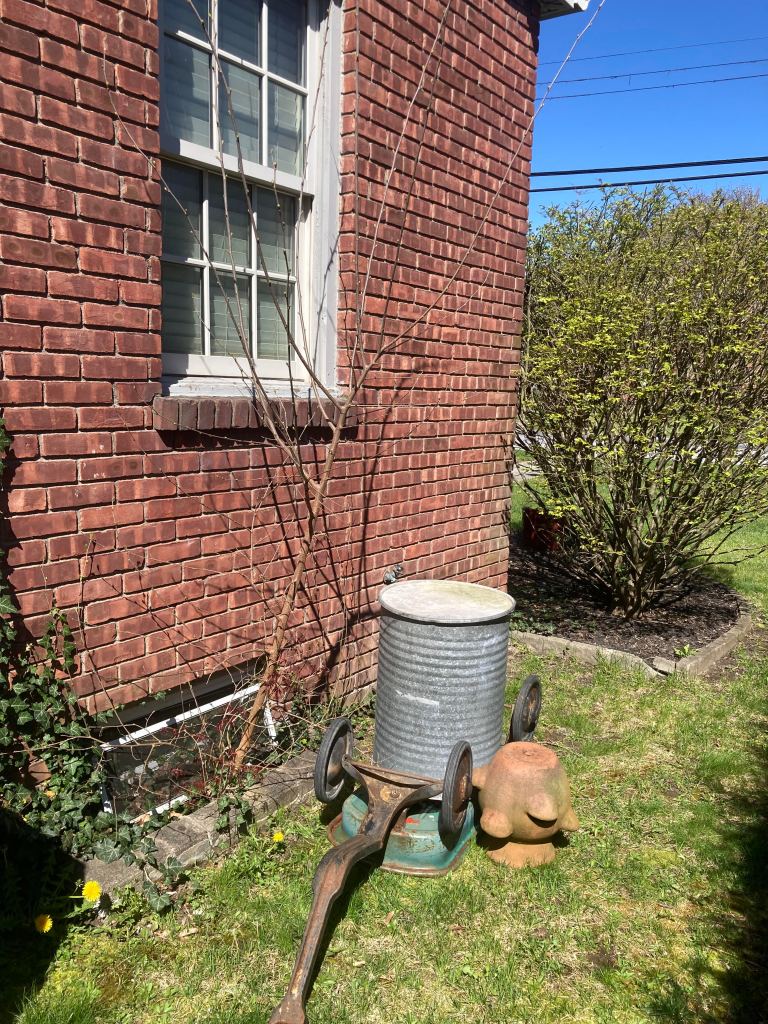
On that side of the house the bottom of the windows are about an inch above my head.  I reached up and was able to push the window open and relief ran through my body!  I let go of the window and it slid back down but I could get in the house this way.  I stood wondering how I was going to  get my body up to the window.  Because I had the different key chain I couldn’t get into the garage either where I had a nice step ladder, so what was I going to do?  I told myself to calm down and think!  OK, I have to make a Rube Goldberg kind of gadget to replace a ladder.  I found a large wide flower pot so I put that under the window upside down but that only brought my eye brows to the window sill.  Another trip around my house and I found an old wagon that I pulled over to the window,  turned upside down and put the flower pot on top.  As I climbed up on the upside down, wobbling flower pot, I realized it still wasn’t high enough for me to climb into the window.  Another trip around the house and I found a large antique metal can that I put flowers in on my front porch.  This would definitely work.  I carried it to the window, took the flower pot off and piled the large can on top of the upside down wagon, put the flower pot back on the wagon so I could use that to help me step up onto the top of the can.   This contraption was even more wiggly, but up I went. Now my chest was level with the bottom of the window.  I pushed the window open again, higher this time but it slid down again.  Jumped off the pretend ladder and  found a stick that I could hold the window open with.  OK!  Proud of myself, I climbed back up on this rickety contraption and stuck my head in the window.  I was immediately head bumped by my dog Devon who thought this was a fun game.  Licking my face over and over and nose bumping my forehead as part of the game, I had to persevere!  In spite of my arthritis I was able to get my left heel inside the frame of the window which excited my dog all the more and began jumping up on the windowsill, having a wonderful time.  Inch by inch I was able to get more and more of my left leg inside the window.  At that point It didn’t matter how much pain it caused I felt victorious and I was going to get in that damn bedroom, get the damn keys and succeed.  I managed to slide my body across the windowsill just as the Venetian blinds came crashing down.  I didn’t care, I beat the challenge!  I got the keys, went out to the car with the old fob and tried to start it…….nothing.

I did not choose to have this adventure.  It challenged my rickety body and my distorted mind but I roughed my way through it.  It wasn’t as much fun as Henry’s challenge but in a weird way I felt like I had climbed Mount Everest.  My car was dead until Monday when I called AAA again, the guy came within half an hour, jump started me again,  and after letting it run for an hour I drove it over to the dealer.  Lo and behold it wasn’t my main battery but in the recent Jeeps they have that Start/Stop feature that is supposed to save gas by turning off the engine every time you stop for a light or anything else.  When I first bought it I thought the car kept stalling out every time I stopped, so I turned that feature off, but apparently the smaller battery when dying draws energy for the main battery.  So it spent all of Monday at the Jeep dealership, is home now resting comfortably, ready to start whenever I need it!  My daughter also came and spent an hour fixing my Smart TV.   So I am GOOD TO GO!

The Year with No Winter

Even as a kid I looked forward to the change of the seasons.  Each one offered a variety of activities, options, colors, smells, and even different toys.  With Christmas being over, Winter provided me with my friends and I taking our American Flyer sleds up the block to the Rabbi’s house because it had a raised driveway, and with a lookout posted at the bottom we could safely sled down and out into the street with out danger.  Our gloves were encrusted with pieces of frozen snow clinging to the knitted mittens we wore.  After a couple hours of sleigh riding my hands would be frozen and stinging as were my galloshed covered feet.  Time to go home, stomp the snow off our feet, clap the frozen nuggets off our gloves and head inside straight for the old wrought iron radiators most houses heated with.  I can still feel the sting on my fingers as they slowly began to warm up and the stinging sensation as your finger tips heated.  Tomorrow we would throw our ice  skates over our shoulders and head down to the kitty pool in the park on the next block for a day of skating around in a circle for a couple of hours and then returning home to face the same rituals as the day before.  Life was cold but fun!  Gradually as the earth warmed up and the sun got stronger we would put our sleds, galloshes and ice skates in storage and with the approach of Spring, a new set of paraphernalia was gathering by the door.  Out came our metal skates and skate keys, baseball gloves and bats, soon our bikes would be getting ready for long rides.  There were ab out 20 kids on our block so there was always somebody to play with.  Once again in our strapped on roller skates we would gather at the Rabbis house so we could glide down the driveway and into the street without worry.  Those days were pretty worry free.  The biggest decisions we had to make were skates, bikes or just street games.

The days were warming up and we were outside from the time we got home from school til the street lights came on.  The trees popped, flowers filled the air with the scent of lilacs, tulips and daffodils decorated the houses  and gradually the days warmed,  A new excitement was ahead as the last days of school before summer vacation were slowly being eaten away..  Summer brought on a whole new range of possibilities for us kids.  We could stay out later cause it stayed light longer,  Tag, freeze tag, Hide and Seek, I Declare War were games that most of the kids on the block could take part in.  And that was interrupted by families going away for a week or two.  Instead of coming in and huddling around the radiator we sat in front of the fan.  Drank ice cold lemonade to cool the body down.  During this time of year everything was green and a little sticky, and just as quickly as it came, it was ebbing and the days of freedom were coming to an end.
Subtle changes were starting to take place…. the grass wasn’t growing as quickly and had a little yellow tinge to it.  The nights were cooling down and it was getting dark earlier.  But it was exciting because the colors were changing.  The maples in my yard turned bright red making them look like the tree was on fire.
Up and down the block the various tress had turned yellow, orange and red,  there was a new fragrance in the air.  You could smell wood burning in people’s fireplaces.  It was an exciting time.  Spring and Summer always seemed peaceful and calm to  me but  Autumn and Winter were exciting. Halloween costumes pumpkins, hot chocolate were seen in most homes.  Sweaters, and light jackets at first were put on over our xhort sleeve shirts and soon to be replaced by heavier coats. Excitement was in the air.  Holidays and families and FOOD were the focus.  The first snow fall created a fairyland.  Catching snowflakes on our tongues and that first snowball fight and snowman were expected with great expectations.  The five and dimes were decorate for Christmas.  I was so excited because my brother and I would go to Woolworths to see what the new Lionel train equipment was to get ready for our Christmas layout on a platform that took up half of our living room floor. Everybody seemed in a good mood….Twas the season!

Of course as the years passed and we became teenagers, the equipment of the seasons changed.  We still went sleigh riding and ice skating but we picked up snow shovels to earn a little extra cash up and down the block shoveling for the seniors who lived there.  Ice scrapers for the windshields.  Time was picking up the pace and young adulthood was approaching fast.  But the Springs still smelled of lilacs and the deep green leaves of summer still presented themselves.  Instead of snow shovels now we had lawn mowers and rakes to earn some extra cash and to help the neighbors who couldn’t do it themselves. But there was always the anticipation that after Spring, Summer would arrive, followed by Autumn (which has always been my favorite season).  you could count on it! These things were expected, the normal evolution of the years.  It was comforting to know that one season followed the other and allowed me to grow up with a sense of order, safety and the normal revolving of the Earth.

So what happened?  This year Spring and Summer came and went.  The Autumn started just like all the others but this year it just kind of held on, and not the pretty part. The colors of early fall faded and as the leaves dropped off the trees.  The cold breezes began to blow and rain showers replaced early snowfalls. There was no pure white snow to decorate the land. Even a homemade crumb cake looks better with powdered sugar sprinkled on the top.  You know those tasty grayish brown crumbs are underneath the beautiful, powdered sugar!  But this year Mother Nature didn’t sprinkle her powdered sugar on the crumb cake we know as Earth.  The land, deserted by the beautiful colored leaves, looked gray and worn.  The temperatures dropped to uncomfortable, and we were pelted with one nasty rainy day after another all winter long.  It was like Fall refused to leave and Winter didn’t seem to care. The beautiful winter days of watching the snow fall and covering the earth and everything on it painted such a beautiful landscape, but not this year.  Now I am not sure if I can count on anything anymore.  Is Mother Nature angry at us??? Food for thought!

Redefining Winter

Despite not being a winter person, George laments the loss of crisp, white, snowy winters as we knew them.  I appreciate his joy and anticipation of the demarcation of the seasons and especially winter as it transforms the graying leafless vistas left at the end of fall to a sharp black and white wonderland of fresh, soft, snow covered landscapes.  He missed that this year and so did I.

Mine, I’m sorry to say, is even more certain than climate warming portents.  I moved some 200 miles south to where George’s description of this year’s winter in the Northeast is historically what winter is without a warming planet.  To make matters worse, I spent a chunk of my winter in Florida!  Yes, I miss winter for many of the reasons George so skillfully described but I also love winter.  I prefer to immerse myself in it, often and with a full heart.

My children and grandchildren know how much I like to play.  As a child, winter, provided many opportunities for me to engage in sledding, skating, and snowball throwing.  As an older “kid” (defined as from my teens through my seventies) I added, skiing, igloo building, snow hiking, and sitting around outdoor campfires.  For many years, I hosted “Winterfest” where friends, family, and colleagues were invited to come play in the snow for a day.  I hold those many wonderful memories close. My daughter called me this winter while I was in Florida to describe the substantial snowstorm they had received.  Knowing how much I was missing it, she remarked that if I continue my new trend of spending winters with Teresa in Florida, I will likely never see snow again.  Somehow, I had never taken the time to add that consequence to my newly written equation and it hit me hard.  Ugh!  Is this part of my life that brought me so much joy and energy and feeling of being a real kid again, over? Perhaps, but with every loss there is always something that moves in to fill the void.  I look forward to the new adventures that lie in wait for me next winter.

Go North!

I loved reading both George’s and Hen’s homage to wintertime! Geo’s descriptive reminders of childhood winter activities brough back a lot of memories. Although, truth be told, most of my cold weather sports were played indoors – snow and chill were simply background features. Oh, my goodness, ice-skating was the last thing I hankered to do – and I did not strap on skis until my wife challenged me to the slopes.

Now I’ve been to one of Hen’s Winterfests and he is clearly the Snow King! He reveled in the delight of towing kids up the hill to an excellent sledding point. Fire crackling in the outdoor firepit and friends enjoying each other’s company contributed to the celebration of the frozen season.

Now, as George pointed out, this winter barely visited us in the Hudson Valley. It was the warmest winter on record, according to the weather-prophets. Snow did not last – and neither did the sunshine. So, I have a cure: go North!

The Adirondacks also had an El Nino winter, but there was heavy snow on the occasions it came knocking. And the north country people know how to enjoy their cold weather! We have been to Saranac to visit the vast ice castle that is constructed each year. The ice is cut into locks from the frozen Lake Flower and built with care over a couple of weeks. A king and queen are coronated; Gary Trudeau of Doonesbury fame designs posters, and colored lights show off the ice – it is a pageant!

The Town of Inlet hosts the cardboard sled competition for kids. These are not just cardboard boxes – they are cleverly built tanks, race cars, school buses, and fire trucks roaring down the steep hill – there was even a ‘Batman Saves Inlet’ entry. Prizes are awarded for fastest, best crash, and most original sled. The creativity is worth the visit, as is the joy on the faces of both winners and losers. However, the most curious race is the annual outhouse race on Fourth Lake as part of the Frozen Fire and Lights Festival. Contestants build an outhouse on runners; one participant sits in the outhouse, while two teammates push the outdoor toilet across the ice to the finish line. This year the winner was ‘Holy Crap, Batman’, followed by the all-woman team of the ‘Flapper Crapper’.

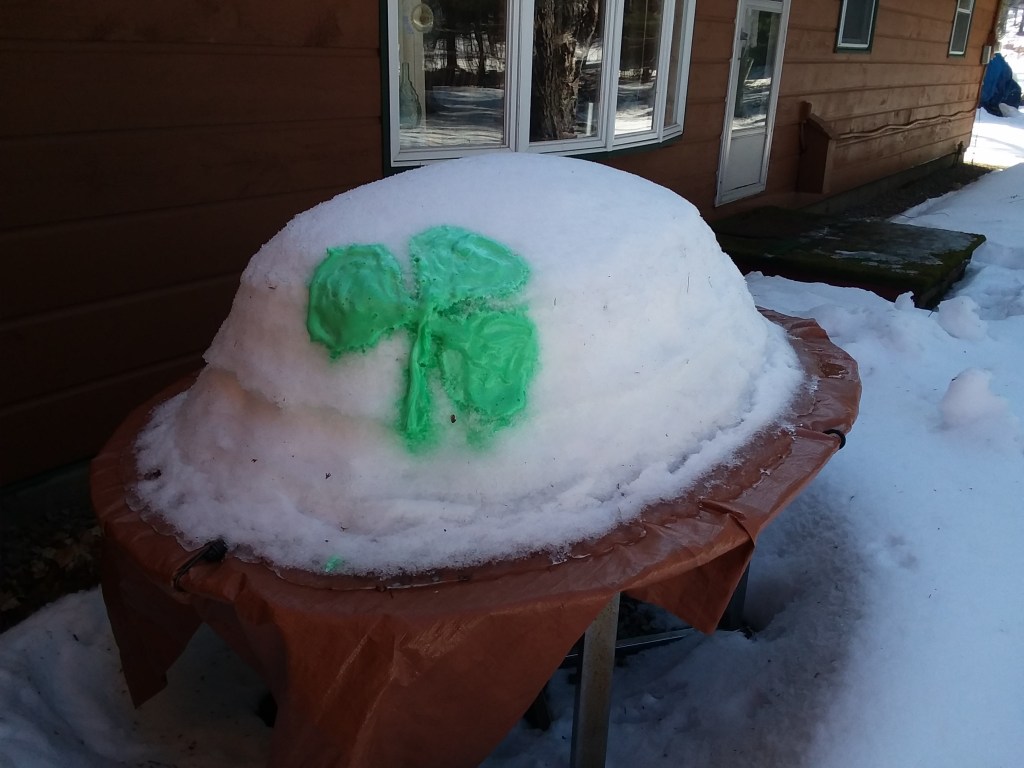
My favorite, though, is the annual St. Patrick’s Day parade in Old Forge, NY. This community will seize any opportunity for a parade! The entire town comes out to cheer on the choreographed snowplow trucks; the shopping cart flotilla; the Irish Setter club (any dog with a green sweater), and numerous floats. Fun is in the air, whether the winter is fully or partially revealed.

Even if Mother Nature is playing coy, winter fun is in your attitude.

Winter Magic: Charles Messina (from poetrysoup.com)

An adrenalin rush, rocked my head 
When I saw a child- on her sled
It made me think; should I go slide
I'm eight-two...So, before I died
Just one more time, before I'm dead
Or before I'm ridden...in my bed
What could happen, something tragic?
I'm eighty-two, can you call that tragic?
So here I go, down the hill ....Wheeee!!
Oh my God- ((Tragic)) ...."Peeee"

The Story Stick

I’m looking at a cedar log and wondering how it’s going to help me make sense of my life.

For the better part of a year, a question has been rattling around in my head – an earworm that just won’t go away: how would you symbolically represent your life? I believe that this topic originated in a discussion with my buddies, Hen and George and has kept me thinking: How would I do that?

The question is both repelling and compelling. After all, it reeks of self-absorption. In addition, perhaps I would not have the energy or skill to do a reasonable job of whatever approach I undertook. Of course, I would like to be remembered, but memories are short-lived. More importantly, I would like to remember – remember the experiences and people that have helped me to be where I stand today – and commemorate that experience.

So, I put it to you – What would you do, in order to render an accounting of who you are, or where you’ve been? I guess the easy answer would be a collection of written memoirs or an autobiography, maybe even a blog like this one. Perhaps it would be reflected through a particular focus, like Stanley Tucci’s book, My Life Through Food. Or maybe, it is simply a series of recipes or other works that speak for you?

I mean, some people paint self-portraits and murals, compose symphonies, sew quilts with personal meaning, construct buildings. Let your mind run free — What would you do?

I’ve decided to give it a shot… that’s why I’m looking at this log, which I mounted on a lathe. For millennia, people have erected monuments to reflect incidents, achievements, boundaries, and laws. These belong loosely to the family of stelae – or stelai if you prefer the Greek. Inscribed gravestones, obelisks, menhirs, and totems all strive to tell a story. So that’s what I intend to do – on a smaller scale – with this log.

I’m going to shape this log so that it is tapered on each end, the thickest part will be near the middle. It will stand vertically on a base. The base will remember my parents and brother and life’s journey will proceed in a spiral fashion from bottom to top. The center will reflect the wedding rings that my wife designed and cast.

The progression of the piece will follow Eric Erickson’s life stages and challenges, representing the development of virtues that are associated with each stage: hope, will, purpose, competence, fidelity, love, care, and wisdom. Let’s hope it’s not too late for wisdom.

When I was eleven, I read The Illustrated Man, by Ray Bradbury – a collection of short stories. It tells the tale of a person covered in body art. Each tattoo represented an event from his past, present – and future. When the man fell asleep, each individual tattoo became animated and reenacted the experience depicted in a short story. Ultimately, the last tattoo foreshadowed his death. I guess I won’t go that far! But significant events reflecting the life stages will be carved or engraved within the spiral, but the top may remain unfinished.

Centuries past, soldiers called aquilifers carried a standard which were emblematic of their particular Roman legion. Many times, these were mythic or fierce beasts. The top of my work will feature a mayfly, representing ephemeral quality of life. Mayflies live most of their existence underwater in moving waters or streams. They emerge and morph into spinners that live for a day or two. This stage is short, because their digestive organs are repurposed for reproduction – they cannot eat; they have no defense and can neither bite nor sting. They can fly gloriously for a brief period, dipping into the surface of water to lay eggs, avoiding predatory trout. When they finally alight, exhausted, on a fragment of grass or window screen, they have a characteristic pose with their front legs raised almost in an attitude of prayer. Somehow, these creatures capture my sympathy. So, a mayfly must be incorporated in my work as a standard, although I’m not sure how to accomplish that just yet. All of this is going to take some time and I’ll report back on progress periodically.

Does any of this get your wheels spinning? Let your mind run free: What would you do?

Wheels, by Lauren Coles ( https://pickmeuppoetry.org/wheels-by-lauren-coles/ )

Wheels can spin in your head,
An idea can spark from anywhere,
The mind is a creative genius,
If people don’t know what the world needs there will not change.

Memories May be Beautiful and Yet… Thank You Barbra

Many people around my age open up the newspaper each morning to the obituaries.  We joke that if our names aren’t listed, we know we are good for another day at least.  Humorous, no doubt, but also a truthful assessment of what life is like.  When I recognize one of the names, I read through the story of that person’s life.  I skim through the part of the “survived by…” and focus on the kind of person he or she was.

More than once while doing this I couldn’t help but wonder from whose perspective this life story was written. That isn’t always the way I remembered that person, cast as a super hero, or a gentle soul, when I remember a situation where that person was anything but.  But we must speak kindly of the dead!  I wonder if one of his kids wrote the obituary or is there an obituary writer who writes the story after a brief interview with the family.  Or, perhaps, the deceased wrote his own obituary.

Of course, our lives are composed of significant events and special people, but also of our character. All of these things made up who we became in our adult life.  But significance is in the eyes of the beholder.  I want to be remembered as a good father, and a caring effective teacher, and if I were writing my obituary, I would certainly include those traits, as well as being an effective caring innkeeper who always tried to assure the guests’ a positive experience at our inn and community.  I want to be remembered as kind and funny, and trying to accommodate the individual needs of whoever I was teaching or giving directions to.

I guess what I am getting at is that if I wrote my own obituary and someone else wrote one about me, would they be symmetrical?  And if not, which one is going to be the one that people remember?

Which raises the question how do I want to be remembered?  Do I want people to remember me the way I envisioned myself or do I want to be remembered the way they actually remembered me?  Scary thought!
Hopefully the amalgam of all my parts will come up on the positive side, but there have been dark times, angry times, and sad times that I would choose not to be remembered for.

Wally is putting significant symbols of his life on a story stick.  He has the ability to carve those significant symbols and include them on his story stick, and Henry’s sister was able to patch together her mother’s life story on a quilt.  Wally’s story stick and Henry’s sister’s quilt can be on display as a constant reminder to what that person’s life was like for all who have an interest in being reminded.  I don’t have the ability to display the important events of my life like either of those.  My symbols have always been in words.  Years of journals recording significant events year by year on a daily basis: the adoption of our kids, our various moves and houses, family happenings, births and deaths, sicknesses, achievements, all the things that happen to most families. But journals are not always visible as a life reminder to those who want to remember what life was like. I am afraid I will have to be content to be remembered from good deeds I did for others over however many years I survive.  I hope and pray that the good deeds far exceed the bad.  I hope my kids can someday look back on their dad and fondly share their memories of him and laugh at his silliness and cry at his misfortunes.  I hope some of the kids who were in my classes over the years will remember their fourth-grade teacher as someone who listened and cared about their well-being and remember fondly some of the activities, conversations and lessons they learned from him.  Maybe a guest or two will remember fondly their visit to Woodstock, Vermont and the late-night conversations around the blazing fireplace of the Deer Brook Inn. with a bottle of wine.  Unfortunately, we will never know what we are remembered for or the answers to these questions. 

Defending My Life

Defending Your Life is a light-hearted 1991 movie starring Albert Brooks, Meryl Streep, and Rip Torn.  It focuses on two unrelated early to mid-life people who died and wake up in a midway place where each, with the help of an attorney-like support person must represent their life before two impartial judges who will determine whether they are evolved enough to go forward or who need to go back to Earth until they’ve reached an acceptable level of worthiness.  This process involves their assigned support person using video snippets of their lives as evidence to support the premise that each was either ready to move on or not.  What an interesting way to represent how we spent our lives and how we arrived at our present state of who we really are.  However, since no one has been filming my life since birth (whew!) I do not have the video data necessary for this approach.

Continuing on with the medium of film to illustrate who we are, I am also reminded of the section of Don Miquel’s book, The Four Agreements.  In his discussion of perceptions, he proposes a scenario where one enters a movie theater to watch the movie, “This is Your Life” as lived and remembered by you.  Then, you go into the next theater also showing the movie of the same title but written by you or a member of your family.  As you watch this one you realize it’s not the same.  In fact, you are certain that many of the events never happened the way they are shown and the meaning behind them are way off or completely incorrect.  Hmmm, what if my choices for what captures the essence of who I am are only my perceptions and not those of my family, friends, coworkers, and neighbors?  Will this graphic collection of renderings of me be valid only to me?  And if so, then, will this representation matter?  I believe it will matter if I accept the notion that the meaning to those who see it after I’m gone, is that this is what I remember experiencing and what I found to be meaningful.

For my 75th birthday, my granddaughter gave me a workbook entitled, “Walk with Me. – a Grandfather’s Story.”  It is a guided journal of my memories with 112 written prompts to include different segments of my life’s experiences and how I felt and acted at the time of their unfolding.  When completed this will be a comprehensive way to address Wal’s challenge but not a consolidated rendering that summarizes my life.

Shortly after my mother died, my sister collected my mom’s unused fabrics and material from her skirts and dresses and commissioned a quilter to create several 3’X3’ square quilts for each of my mother’s children and grandchildren.  The quilt, made from mom’s own clothes and favorite quilting fabrics, displayed coffee cups, flowers, spools of thread, and music notes.  A perfect representation of her love of music, gardening, sewing/quilting, and her morning cup of fresh-brewed coffee!  It hangs in my bedroom and revives fond memories each time I look at it.  I think this is most like the kind of expression of our lives that Wal has in mind.

I wish I could think more simply, just as my sister did with the quilts.  I often bog myself down with too much detail fearing I’ll leave something out or deprive the viewer of the fullness and richness of what I’m describing. 

As I tried to hone my ideas I thought I might proceed with a combination of some of the approaches I mentioned.  One would be to collect items (pictures and objects) that I see as symbols of important times, people, events, and changes that had a significant impact on who I came to be.  I would photograph each item or find or create a picture of intangible experiences and write a brief phrase of explanation below it.  Perhaps I would capture the most significant items from my granddaughter’s book and exchange each section with a photo.  This picture book would be a bound publication that could also be converted to a digital version.

But then I remembered a challenge I faced when I was 40.  When I went north for my outward bound-like Temagami experience, they had us draw a life map representing significant parts of our lives from birth to present day on a round piece of oak tag.  And, in the center, we were to draw a symbol of who we were and who we wanted to be.  I recently retrieved this artifact from a box in my basement.  Partially because of my inability to draw well as well as the faded print and my fading memories, I no longer remember the meaning behind all of the figures.  And yet, this child-like rendering still serves as a clear reminder of my journey.  As I continue to mull over this query, and if I choose to follow through with it, this may very well be my response to Wal’s challenge.


In Appreciation of What Was and What Can Be

As all years that are in our past, there are events and experiences that we wished hadn’t happened and those that we recall fondly.  This post is about those things we remember favorably about 2023 and those that we hope to recall joyfully, at the end of this year.

Last year’s favorable experiences:

Mine included finding a house and property, moving in, and making some renovations to suit my likes and interests.  

I made more time for being physically active which included hiking with Meetup groups as well as projects in and around my home.

I experienced the joy of following my granddaughter’s college application and decision making process and felt pride in how well my children are doing in spite of all of life’s challenges.

I spent more and more quality time with Teresa and am making progress on learning how to be a loving and accepting partner.

I enjoyed the company of new acquaintances and am realizing how important this social interaction is for me.  I love finally living in a neighborhood and enjoy the chance and purposeful interactions that fill my weeks.

There are more but these are the “big rocks” that fill my 2023 bowl of positive experiences.  Which ones stand out for you?

This year’s anticipated positives:

I’m already mind-gardening!  I plan to build a fenced in/raised bed vegetable garden this spring.  I’m thinking of starting with peppers, carrots, radishes, lettuce, beans, and chives.  As I look back on this at year’s end, I’ll find ways to make it even better.

Visiting Kylie in her first year in college and reflecting on her new friendships and interests.

I will have played more pickleball.  (I’m also considering taking some lessons to improve my game.)

I look forward to recounting the year with more experiences with my son and daughter-in-law and adding more Washington, DC attractions to my list of visits with them.

My first visit with Teresa to her son’s family in the Sierra Nevada mountains of northern California this spring will likely become an annual event.

I’m moving the process of planning and preparing meals up a notch on my weekly schedule.  Yum!

And you?

“Life can only be understood backwards; but it must be lived forwards.”

Soren Kierkegaard

Gratitude

We wrote about worry in the last post, so elevating the positive memories of 2023 seems like a way to restore balance in the universe! 

I would love to report a series of firsts in looking back at 2023 – new experiences that bring a sense of accomplishment and joy: milestones which document growth. Boy, I’m hard pressed to identify any. Last year was a service year, mainly devoted to carrying out tasks which began as obligations, but ended with a deeper understanding of responsibility. 

The concept of service entails subordinating your own desires to attend to someone else’s needs and desires. Last year my focus was caring for a person at the end of his lifespan, supporting an organization in distress, and shoring up a challenging business. A better person than me would find obvious highlights in those activities, but I’m not yet that better person.

When I look at how folks find joy in the midst of the scuffle and “trudgery” (yes, that’s a made-up word) of everyday life, it seems that a common sentiment is a version of ‘It could have been worse, so be thankful’. I can sign up for that point of view: the old Khalil Gibran idea of deeper sadness hollowing a vessel to hold greater joy.

Alternately, I like the poem below from Nancy Carmody, which looks at each chore and turns it on its head: the silver lining playbook. She is on target — I am sincerely grateful for the ability to do the tasks I would prefer not to do. It is right to celebrate the fundamental joy of being alive, having choices, and simply ‘doing’. In that vein, I nominate these meaningful successes of 2023:

  • Spending time with friends, remembering past shared experiences and creating some new ones
  • Sitting next to my love on a couch laughing along with Kim’s Convenience
  • Teaching my grandson to play chess and then watching him beat me 
  • Hitting that great tennis backhand down the line – once
  • Making an edition of pens from 300-year-old wood
  • Updating the history of the local church

Those are highlights which I’ll cherish… and here’s what Nancy says:

I Am Thankful For — Nancy J Carmody (reposted from Gratitude – The Life Blog)

…..the mess to clean up after a party
because it means I have been surrounded by friends.

​…..the taxes that I pay
because it means that I’m employed.

…..the clothes that fit a little too snug
because it means I have enough to eat.

​…..my shadow who watches me work
because it means I am out in the sunshine.

​…..the spot I find at the far end of the parking lot
because it means I am capable of walking.

​…..all the complaining I hear about our Government
because it means we have freedom of speech.

​…..that lady behind me in church who sings offkey
​because it means that I can hear.

​…..lawn that needs mowing, windows that need cleaning, and gutters that need fixing
because it means I have a home.

…..my huge heating bill
because it means that I am warm.

​…..weariness and aching muscles at the end of the day
because it means that I have been productive.

…..the alarm that goes off in the early morning hours
because it means that I am alive.

Moments to Remember

After reading Hen’s post my head was spinning. I was trying to remember an event or happening that was outstanding enough to raise my spirits or make me recall it fondly.  Daily life has its ups and downs certainly, and whether good or bad we learn from both kinds. Scratching my head, I tried to pull something up in this old brain of mine and I kept shooting blanks.  Is my glass really half empty?  That troubled me more than anything.  Was my joking about it all the time a self fulfilling prophesy? I closed my computer and walked away.  But it stayed in my mind all day and would pop up when I least expected.  Later that afternoon I stopped what I was doing and thought that a day, a year is made up of moments.  I was looking for the wrong thing.  I was looking for the spectacular instead of those little moments that bring a smile to my face when I remember them, or bring on a sense of pride or accomplishment, and the thoughts began to flow.

Just the day before I had such a moment while having blood work done at our local lab.  You have to sign in when you arrive.  They have little stations set up where you have to put your driver’s license on a tray so it can be photographed and then you have to follow a series of prompts til the end.  It only takes a few minutes to complete.  As I was heading to take a seat and begin my wait, a man stopped me and asked if .  I could help him sign in because he left his glasses at home and couldn’t read the prompts  No problem, I read the prompts to him and  told him where to put his license and insurance cards and walked through the whole procedure.  I didn’t think anything of it.  As I was heading back to the waiting area the man stopped me and thanked me for helping.  It really seemed like nothing to help him.  As I sat down, a woman who was sitting right next to where we signed him in, looked at me and smiled and  winked.  After my blood was harvested, the woman stopped me and said how nice it was of me to treat that man with such patience and respect and she said she didn’t think he could read at all.  That little moment lightened my heart.  It was something that I thought anyone would do for another person.  But for  whatever reason the whole day I felt good about having done it.  Now I was starting to see how I could measure my gratitude in little events instead of the fireworks and applause events that I had none of,

Realizing that things like that happen frequently and without fanfare, I began to collect my thoughts about this topic.  I remembered at Christmas time when my daughter, son and girlfriend were opening gifts and I had sort of stepped back and watched from afar, I remember smiling and watching as if I wasn’t even in the room , and remembered how heart warming it was just to watch the interaction among them.  My gratitude didn’t have to be for big events.  Small person to person connections were worthy of acknowledgment.

Earlier in November there was a neighbor who just moved in two houses away and she stopped me one day and invited me to a get together with other neighbors on the block.  I went to her house on the date of the gathering and to my surprise almost the whole block of people were there.  I had been living here for 8 years and hadn’t talked to several of them.  It was such a nice group of people and I met every one.  The conversation was about the neighborhood, the houses, jobs we used to have as most were retired and it made me feel at home and safe with these people.  Now people stop and talk while walking their dogs or putting out the garbage cans.  Just a nice feeling of camaraderie that was fostered at that one gathering by a total stranger who had just moved in.  A former student who I have been in touch with for about 45 years  sent me a newspaper article about her being appointed to Assistant Superintendent for Curriculum Development for the Kingston City School District.  Her note simply said she knew how I liked to keep track of my former students and follow their careers. MY heart filled with pride.  There were many of those moments- too many to keep track of, but reflecting on them, I felt a whole new sense of gratitude and whatever the opposite of malaise is!

Onto 2024 and the future!  I have no idea what that will bring but at least now I will be attempting to recognize those moments that lift me up.  And lifting up can mean, fun, pride, accomplishments, gratitude and a list of other emotions that I haven’t even thought of yet.  I hope this year will be good for all of us, will have high points  and low points from which we learn.  Mistakes that won’t be repeated, new friendships being made, old friendships revised, all intertwined with humor and love.  Fill up that glass, I’m in it for the long run!

Worry Patterns

The holidays are over!  All the fuss and bother which used to be fun when the kids were little has become a chore now.  Both my kids came home for the holiday, my son brought his girlfriend and Christmas Eve and Christmas day were excellent!  Everybody got along, we laughed and gossiped and cried together and it was really great.  As the father in the group, at times I stood back and just watched the dynamics between my son and daughter, between my son and his girlfriend and between my daughter and my son’s girlfriend.
Everything went smoothly, everybody got along and seemed to enjoy the company to make the holiday successful.  Truth be told, I worried about how everything was going to progress, and with my half empty glass mentality it was a concern.  However, nothing could have gone better!  The needless worry beforehand was just that, needless.
In our later stage of life, we are never free of worry, just the patterns are different.  Growing up as a kid we worry about getting along in school, not getting picked on and stuff like that.  We worry about being liked which only intensifies as we head into the teen years.  They seem huge at the time but upon reaching my stage of life, seem cute and even humorous.  Perhaps our teen years in high school and college are our least worrisome stages.  Sure, there are social pressures that weigh on us but as teens we shrugged a lot of that stuff off and just hoped for the best.  Our years in college, at least for me, were the most worry-free years of my life.  Fun, independence, intellectual growth were the key words of those years.
Graduation happens and all of a sudden responsibility descends upon us. Pressure to get a job, to marry, to raise a family looms on our shoulders and we are reminded everyday of what we are supposed to do.  Get married, have kids, a house, dogs and cats (I had to add them because they are family members as well).   Bills, the house, kids get sick, problems with neighbors, the car breaks down, all of a sudden, the weight of worry presses down on your shoulders, The weight of all that is intense. It is what ulcers are made of!  Years pass by, things get a little easier, but you still worry about your kids, their health, their social wellbeing, their jobs etc., etc.  Heavy worries!  You go crazy trying to figure out how you can “Fix” everything, make things easier for yourself and those loved ones around you.  Then all of a sudden, you sit back, take a breath and watch like I did on Christmas Day, and you realize that, sure you are concerned and want to help out but at some point, you have to release that worry energy over to those directly involved.  It is courageous on your part to let go, but now the baton is passed to the next generation.  You can relax, the torch is passed, or is it?
Suddenly, you are in your seventies.  I hit 77 in August which means I am already halfway through my 78th year.  the worry pattern once again is directed inward.  If you are fortunate enough to have a spouse or loving partner that eases the weight.  When you waken in the night with that pinch in your chest your partner can ease your worry with soothing thoughts, it is probably just a muscle spasm, but we will check it out tomorrow if it still bothers you!  Two minds are better than one to ease worry.  To those of us who live alone, the pinch keeps you up the rest of the night, poking at it, testing it, you know what I mean because we have all done it!  Worry is on the night table waiting.  This worry, now directed solely at yourself starts to infiltrate your entire life.  I recently fell one night unlocking my back door while having my arms full and fell into the garden fortunately and not onto the sidewalk.  The landing was soft from the mulch, but it could have happened differently.  Laying on my back in the darkness, I took inventory of my body parts.  I used a tree to pull myself up.  All working parts were still working but boy was I sore the next few days.  Made me begin to worry about falling.  I have to focus on what I am doing at all times especially on staircases.  But the worry creeps in….. what if I broke a hip or a leg?  How would I survive.  How would I be able to maintain my life in my house where I have to take care of everyday things. At this stage of life this is real WORRY! The pattern has suddenly shifted inward.  These are serious things we all have to worry about.  Just when you think the “Golden Years” are going to be all hugs and kisses, reality attacks.  Real food for thought- assisted living? condo? sell the house?  This will keep me up tonight!

The Big W

We’ve written about worry before (What, Me Worry?), but our Three Old Guy discussion has caused me to reconsider the topic. Hen used the term ‘situational worry’ when we were reviewing George’s piece. This is a useful marker. It’s got me thinking about ‘Worry’ as a bunch of “little w’s” running around in our brains – possibly fueled by the generalized “Big W” capacity of anxiety.

Some might say that the vast number of situational worries – the little w’s – increases the amount of our Big W, but I believe it is the other way around. Just as a rising tide floats all ships, the flood waters of Big W’s general anxiety intensify all those little w’s.

After all, there is no shortage of little w’s. I used to drive the Camp Creek parkway in Atlanta, which parallels the landing pattern of jets into Atlanta Hartsfield-Jackson Airport. I could see the lights of three incoming aircraft lined up right behind each other. As one roared overhead, there would still be three sets of lights in the distance: it never stopped. Worries are like that: one passes, but a new one always comes into focus.

Actually, that’s healthy. Little w’s are problems, and we are problem solvers. Question: What would we do without problems to solve? Answer: We would create problems.

As I sit here writing, I’m reconstructing my current worry list:

  • Moving my friend to long term care and handling his finances
  • Cleaning and sell his house
  • Our restaurant is understaffed and my son is working too hard, yet we cannot afford more helpMy youngest son’s health and well-being
  • Post-secondary programs for my neurodivergent grandson
  • A new roof needed for our restaurant
  • A dental implant for my wife, despite insurance not covering the procedure
  • An injured wrist preventing my free-weight program
  • A throbbing heel resulting from Achilles tendon damage
  • Renovation of the upstairs bedroom
  • Relocating our woodturning group from its current workshop: finding a new location and disposition of a lot of heavy equipment by Spring
  • Coordinating volunteers to host a major event in the Saratoga City Center: we are short of the number needed
  • Healing a non-profit board issue, where serious accusations have been made about fellow members, sparking a number of resignations

Is it fair to say that I worry a lot? Sure, I do – but all of these worries are situational – little w’s. None are existential, but two hurt my heart. If you examine the list, perhaps all are time sensitive in some manner, but they can be ranked and mitigated: action is possible – and as actions are taken, my list will likely look a bit different next month. So, I am not feeling what George has described, which I define as DREAD. I think dread is a derivative of the Big W and is what you feel when you have given up hope of addressing a worry.

Said differently, worry without hope equal’s dread. Hope is the antidote to the Big W. I like what Jane Goodall said about hope – that it is humbler than faith, but “… it is often misunderstood. People seem to think that it is simply passive wishful thinking… This is indeed the opposite of real hope which requires action and engagement.”

Here’s what US President Thomas Jefferson thought about hope:

‘Tis hope supports each noble flame

‘Tis hope inspires poetic lays;

Our heroes fight in hopes of fame,

And poets write in hopes of praise.

Worry, Is Nothing to Worry About!

In his post, George discusses the concept of worry and closes with his concerns about issues that may impact his ability to continue living alone in his current house.  I agree that we all entertain some form of worry that we consider potentially detrimental to our current or future happiness or security.  But, depending on how we engage this worry, it may not necessarily be all bad.

I looked up several definitions of worry:

Webster – “Mental distress or agitation, resulting from concern, usually for something pending or anticipated.”

Cambridge – “To think about problems or unpleasant things that might happen in a way that makes you feel unhappy and frightened.”

Oxford – “To give way to anxiety or unease; allow one’s mind to dwell on difficulty or troubles.”

Wikipedia – “Worry is a category of perseverative cognition, ie. a continuous thinking of negative events, in the past or in the future.”

I would suggest that worry is the result of our assessment that something or someone is or could be in jeopardy and that jeopardy is simply something we don’t want to happen. For example, the potential for discord between and among George’s daughter, son, and his son’s girlfriend, or another fall that might result in a temporary or permanent disability results in cause for George to worry.  In Wal’s case a couple of his little w’s could be not failing his friend as he handles the many financial transactions as well as the intricacies of guiding the long-term care process or that he may be unable to heal the non-profit board issue. Yes, these are situational but still contribute to the weight we carry while we worry.  But both of my colleagues have given me an idea from their pieces on worry that suggests a softer way of articulating our worry.  

Hope.  What if George, hoped his kids and his son’s partner would get along during their holiday visit and hoped that he would be able to use the circumstances of his fall avoid or diminish future falls.  Wal could hope that his efforts would result in the best financial outcomes for his friend and hope that he is able to convince the board to reconcile their differences in an amicable way.  What I’m wondering is are we capable of shifting our approach to worry and use that feeling of anxious concern as a call to action and, instead of fearing the worst, expect the best and then do what we can to get there? If our attitude has any effect on the outcome, it will likely be in a positive manner.  If it doesn’t, the result will likely be the same whether we agonize about it or meet it head on, hoping for the best.  The big question is, can we create and sustain this change.

I also believe that the benefits and detriments of worry show up as both a helpful mechanism and an inevitable source of harm.  If we seek to manage our worry by becoming more mindful, engaging in creative problem-solving, and seeking support from others to address and alleviate concerns, initial worry can be a benefit by acting as an alert to prompt us to address potential threats and challenges.  If on the other hand, we allow ourselves to worry excessively it may lead to detrimental effects to our mental and physical well-being. Succumbing to feelings of hopelessness and (as Wal suggests) dread can impair our judgement as well as our physical well-being.

“Worry does not empty tomorrow of its sorrow.  It empties today of its strength.”

Corrie Ten Boom


Thrills and Chills

It turns out that while the brain loves predictability, it celebrates surprises – at least, small ones. Those little momentary shivers we sometimes feel are a result of those surprises. There’s even a term for that: ‘frisson’.

Although this sensation can be connected to a startle of any kind (remember the horror movie The Tingler, where some audience seats were connected to a mild electric shock generator?). Most of the time, however, frisson is a sensation associated with music — and specifically, a change in octave/pitch.

Researchers have determined that during a song, a 1% change in a tone can cause a frisson. The change may occur while the momentum of the melody is increasing in pitch/tempo – or decreasing in pitch/rhythm. It has been reported that a Rolling Stones song, Gimme Shelter, was boosted by Merry Clayton, whose raw wail: “Rape, murder, it’s just a shot away” in the background vocals helped make the song a hit. In fact, a film clip was made about this situation: Twenty feet from Stardom. I listened to the clip: her phrasing is plaintive and close to a low howl. Which is interesting, because the kilohertz range of a human scream is precisely where human hearing is most receptive.

Frisson is a term that explains some memorable songs for me. Do you ever get a ‘chill’ when listening to a favorite tune – or become surprised by the direction of a song? Children’s a Capela Choral groups can do that for me. Copland’s Fanfare for the Common Man also produces that result. Copland is known for changing the loudness of his compositions (soft to loud), but I think the depth of the orchestra often surprises me when more instruments are suddenly brought to bear at a particular moment. It seems to create an extra dimension of sound. But that’s not only what causes the tingle for me; rather it’s the pristine/plaintive harmony of the horns. Maybe the saturated orchestral sound reinforces the little frisson?

Other, less bombastic, music can have the same effect. The first time I heard Joni Mitchell’s Conversation, I was laying on a bare hardwood floor at the same level as two large speakers. There is a point where the intro brings in strident guitar chords followed by Joni’s voice and then it kicks up a notch when she changes octave with the lines, “Comfort and consultation, He knows that’s what he’ll find”. It was as though the small room expanded into a large auditorium. Sound filled every corner – no doubt augmented by sound bouncing off the hardwood floor. I definitely felt a momentary chill – as well as a feeling of there being “something more” out there. Who knows what that “something more” was or is… but I still feel echoes of that sense when I hear that song. Joni is characterized by her ability to change octave and try different harmonies – and maybe the that’s the common denominator between Fanfare horns and Joni’s intro.

So, I talked to audiophile friend to ask his opinion. He said “Well, it sounds like you are talking about ‘brilliance’, when there is an overload of treble”. It turns out that the vocabulary of acoustics has its own language: fullness vs. clarity, warmth vs. brilliance, texture and time intervals for reverb, blend and distribution, ambiance and presence. While I would have thought that these terms were solely poetic descriptors, I found mathematical definitions which involved decibels, tone repetition, and time between reverberations. It was as though a new door had opened to a land that was brand new to me, but well-traveled to many enthusiasts. Did you know that there is a ‘Frisson’ community in Reddit? Some posts debate where a frisson starts (arm or scalp?) – or is it different than an ASMR (autonomous sensory meridian response)?

There are times when I wonder if in our striving to pinpoint a concept, the deconstruction of the elements makes it more difficult to grasp the essence of the experience. I guess I’m a gestalt person and prefer to think the whole is greater than the sum of the parts.

Yet, I have been working my way through a Spotify “Frisson Playlist” of 700 songs that has been compiled. Many of the pieces aren’t what you might expect. There’s plenty of diversity: classical, rock, blues and country tunes. Each is related only by its ability to provide a little shiver of frisson.  Here’s the link: Spotify –

Try it and report back your feelings.

Here’s one description of frisson from poet Black Hamlet in allpoetry.com

Frisson
Skin of lower back will flex,
a shiver rising upward,
inward from the shoulders, neck,
extending to the forehead.

Piloerection follows,
hair aping face that’s flushèd;
waves pound the back like quick blows,
involuntary gasps, small deaths,

Breath ragged like a memory
informs the nature of the debt,
reminding you you have not seen
nor touched real friction, e’en though wet.

So set your clock to fate o’clock
and feel the frisson take its hold,
the only question, one of when,
not if, or could, I be so bold.

Frisson, Perhaps

It is said that music soothes the savage beast.  I’m not sure where I qualify in the savage beast category, but I certainly am soothed by the music I enjoy.  The first record I ever bought was probably when I was 5 or so.  It was a little yellow golden record of Dinah Shore singing Buttons and Bows.  And the next one was probably Doris Day singing How Much is That Doggy in the Window.  As the years passed and the record industry became more sophisticated and technical, I moved on the 45 RPMs with the big hole in the middle that either needed a plastic adapter for, or a wide spindle.  My Webcor  HiFi record player in green and white was my prized possession in my bedroom. The first two 45’s I bought were Born too Late and Twinkle, Twinkle Little Star and the rock n roll years began.  I learned to dance using my bedroom door as my partner and the doorknob as my partner’s hand.  I learned to do the Lindy that way while watching American Bandstand.  Nobody was in the house when I was doing that.  I would play these songs over and over again to the anguish of my parents.  Music was in my blood by then. I was drawn to it and listened to it all the time.  It made me feel good, put me in a good mood and lifted my spirits.

Being a baby boomer myself, my parents always played Big Band music.  I came to enjoy that music as well,  along with the old time crooners.  The lyrics and the music could make you feel sad, angry, happy just by the stories they told.  My parents didn’t want any rock n’ roll music on the big stereo console in the living room.  The only popular singer they had on an album was Connie Francis because she sang a few songs in Italian. My dad would sing along with her songs and somehow it was comforting on a hot afternoon listening to Connie and Dad sing a duet in Italian. It made me feel safe and secure.  Music can do that to you.  Like the music on Twilight Zone when some monster was about to appear and the music would get faster and higher pitched until at last the monster appeared.  No doubt designed to make the goose bumps rise and create tension.  I had never heard the term frisson until Wally exposed me to it.  I always thought that my reaction to music was more a reaction brought on by association of the circumstances and the people sharing the experience with you. It never occurred to me that it could actually be a physiologic, biologic response to the actual sound of the music.

I remember as a young kid going to watch the Memorial Day and 4th of July parades in my neighborhood.  Northern Blvd would be crowded with sightseers from the surrounding areas waiting for the parade to commence.  My friends and I had our bikes all decorated with red, white, and blue streamers braided through the spokes of our bike wheels and usually a playing card clothes pinned to the axle of the bike so that as we rode the card would clack in and out of the spokes.  As the parade approached, the drums could be heard and as it neared  our viewing position all the men would remove their hats and hold them over their hearts as the American flag passed by,  At that moment my arms would feel the sensation of pins and needles and invariably a tear or two would slide down my cheek. It wasn’t yet 10 years past World War II so patriotism was fresh on everybody’s minds.  Frisson or situational association?

As a teen,  Friday evening was airport night.  We would jump into my friend’s Nitro and drive to Idlewild Airport (the name hadn’t been changed yet to JFK) to watch the planes landing and taking off with a lot of other kids.  You could go right out on the observation deck and see the passengers sitting in their seats.  While driving there on the Van Wyke Expressway we would listen to Cousin Brucie and invariably the Beatles’ song, If I fell, would be on and we would be singing at the top of our lungs along with the radio.  Today whenever I hear that song it brings me right back to the expressway and the three of us singing at the tops of our voices. I get the chills thinking about the music, the company, and the setting.  Again, frisson or association?

When I was travelling with my partner through Wales we would stop in small towns for the night.  It seemed that every evening it was common practice for the churches to be open and for male choirs to sing. I believe they called it Even Song and we got to the point that we would look for signs of that wherever we stopped. The power of men’s voices singing in deep harmonies, in dark candlelit churches not only caused goose bumps but shivers down my spine as well.  My question is the same, but not being a scientist or biologist or whoever studies such things, I may never know.  I just know I will continue to feel the chills, and goose bumps, and hair standing up on my arms just the same.  Frisson?  Perhaps or maybe just memories surfacing up to skin level while the brain works overtime.

The Power and Potential of Frisson

Wal writes of the power of surprise and the physical and emotional effects we can feel from it, especially in music.  It’s in the change that captures our attention and often stimulates an unconscious physical reaction.

When Wal asked if we had listened to any music that brought us the feeling of chills or shivers, “Chariots of Fire” came to mind.  The movie and music came out in 1981 and overlapped my training for my first NYC Marathon in 1982.  Not a runner by instinct, for me, it was a personal challenge to be met.  Putting in the long hours of running to prepare my body for a single 26.2 mile race, I often struggled as much psychologically as I did physically.  By that I mean, it was as much an effort to make the time, overcome obstructive weather, and resist the excuses posited by family and work, as it was to actually keep enough air in my lungs and strength in my legs to run for hours on end.  Whether it was from a Walkman-type device borrowed from a friend or music played at local races I ran to build up my training miles, when I heard “Chariots of Fire” my entire body reacted.  Yes, chills first, followed by a natural euphoria that enabled a feeling of increased energy, stamina, joy, and a psychological boost that seemingly reinforced my ability to overcome the effects of lactic acid build up in my muscles and to believe that I could run faster and longer than ever.  This “frisson” like a powerful drug injected into my body, took effect immediately.  Even though I no longer run (does a quick shuffle to the bathroom at 2:00 am count as running?), the remnants of that feeling still resonate when I hear that music.

As I read Wal’s post and thought about the components of frisson I was reminded of an experience from my past. Years ago, as I considered a career change, I sought advice from my former assistant superintendent for an interview for a principalship in another district.  After a detailed, comprehensive, and helpful but rather predictable mock interview session with him, he leaned forward and said, above all, read the faces and body language of those around the table asking you questions.  If you see them fading, loosing interest and sitting back in their chairs, do or say something to regain their attention!  I don’t care if you have to drop your pants.  Just make sure they are intrigued and will remember you. Although I told him, after the interview and with a straight face, that I had literally taken his advice, (I didn’t, of course) I did follow the notion that I needed to do something different to create a kind of surprise if you will. On two occasions during the interview, I intentionally increased the pace of my response and elevated the volume of my voice to accentuate something I was passionate about.  I was hoping that this change during a rather routine and predictable process would illicit a reaction in the listeners that was to my advantage. 

While technically not “frisson” this strategy of creating a sudden shift in sound that causes a reaction in the listeners was, for me, somewhat related.  Now, if my actions would have given them shivers and chills, I might have made an even better case for the connection!  But, alas, my success was limited to keeping them from falling asleep, so I’ll have to submit this line of reasoning as a feeble but sincere attempt. I really appreciate people like Wal, and Wal in particular, for bringing new words, and ideas, and meanings into my life.  In this case, it inspired me to look at the past in new and augmented ways.  It helps me consider and reconsider how to apply those refreshed perspectives to my present existence and, perhaps, better adapt to my remaining future.

“Music is what feelings sound like.”  Author Unknown

Riding With Reg

This blog, for me, is a way of recording who I am and, when my physical being ceases to function, who I have been.  This is a collection of my thoughts, ideas, opinions, and personal stories targeted for my children and grandchildren (but available to any who wish to know of me).  

I love good stories.  Listening to a storyteller reveals as much about the raconteur as the story they are telling. Two connections for the price of one!  I also enjoy spinning a tale or two.  Usually it’s about a personal experience and often to my grandchildren, who are, especially in their pre-teen days, the very best of listeners. One such story that they requested over and over again was, Riding with Reg.

One fall day back in the 1990’s my friend Reg, invited three of us to go horseback riding on the trails near his home, aptly nicknamed Rancho Rinder.  I jumped at the chance to spend a day with these guys because I liked them all and was ecstatic that we would be spending our time outdoors.  The least favorite part was that we’d be doing so riding horses.  I didn’t ride, or have any real experience with these powerful, thousand pound creatures. A little background…in college at the school’s campsite I was introduced to well trained trail horses.  I went up to the closest one, to pet it.  Standing a bit too close it adjusted its stance only to put its front left hoof on the top of my foot (I was wearing sneakers at the time).  As I tried to back away it pivoted ripping the top of my sneaker, the sneaker tongue, and the top layer of skin off of my foot.  I suspect he didn’t even know my foot was under him but I certainly did!  And while I did sit in the saddle on a couple of occasions, the horse basically took me for a ride going where it wanted and how quickly or slowly it wanted. Never in the front of the pack, it generally played “follow the leader” and took me where the fly-swishing tails of the others horses went.  The experience was more like sitting on a merry-go-round but with better scenery.

A photo of an earlier time when I rode with friends…

When we arrived at Reg’s stable, I carefully described the limited extent of my equestrian prowess as well as my apprehension of  riding with these experienced riders.  Always one to assure and calm, Reg laughed and guaranteed I would have absolutely no problem and all I needed to do was trust him. (This was from a man who often threw caution to the wind and would jump full tilt into one adventure after another.) So, knowing I was likely going to have to depend on my own resources, I gingerly got on the horse, he said, would be best suited for me.  Off we began on a narrow, one horse at a time, trail from his barn toward the open fields bordering his property.  I was second in line trotting slowly along on this beautiful day.

For some reason, my horse Frightful (not his real name but definitely appropriate) crowded the trees on the left side of the trail. And, despite my yanking the reins to the right, my left leg was scraping bark.  I yelled to Reg to ask him what was up with this left-listing horse.  “Oh!” he replied slapping his forehead with his right hand, “I forgot to tell you that he’s blind in his left eye.”  I asked if there was anything else he forgot to tell me but he said no. Again, the words “trust me, this is going to be easy” found their way to my doubtful ears.

On we rode toward an open field where Reg motioned for us to pull up alongside him so we could ride abreast and engage in conversation.  Following orders I had no idea that Frightful must have interpreted this as pulling up to the starting gate at a racetrack.  And, as soon as one of the other horses moved ahead of him, he bolted, reaching full gallop in seconds despite my many whoas and attempted pull backs on the reins.  At that point all I could do was hold on tight to the saddle horn and his mane as we reached the end of the field seemingly at the speed of light.  When the others caught up I, once again, raised my voice asking Reg what that was all about.  “Oh!” (with a simultaneous slap to the forehead) I forgot to tell you, he’s a thoroughbred and thoroughbreds love to race.  I’ll be sure to stay ahead of you so that won’t happen again. Trust me!”  (It was then that I began to realize those two words must have different meanings for different people and/or situations.)

Nearing the end of our ride I was finally getting a bit more comfortable and less anxious that anything else could cause my horse to behave in a way that might send me to the nearest hospital so I began to enjoy the last of the trails home.  One such path was narrow and uphill and Reg decided it would be fun to turn our trot into a gallop up the hill.  He was certain I was sitting well enough on the horse by now that I would enjoy the challenge.  Of course, as you may have guessed, I was soon to learn that there was one more thing he forgot to tell me.  Reg led the gallop up the hill and peeled off to the right as he reached the top, the next two riders did the same as he crested the hill.  Now I could see why they took their horses to the right as there was a stone wall directly ahead at the top of the hill.  Gingerly (still at full gallop) I began moving the reins to the right.  However, one-eyed, thoroughbred racing, Frightful had other plans for us.  Looking straight ahead, I could tell in a flash that my horse was not slowing down to turn but was maintaining enough speed to jump over the wall!  Screaming at the top of my lungs for him to stop and yanking hard on the reins, he came to a full but abrupt standstill inches from the wall and I found myself with my arms wrapped around his neck looking him straight in his good eye.  “Reg! I shouted hoarsely, what the heck happened this time?”  “Oh!” he said slapping his forehead yet again. “I forgot to tell you, your horse loves to jump if he gets the chance…”

The last mile of our trip home was led by Reg on his horse, followed by our two friends on their horses, followed by me, walking my horse to the stable.  I had many more adventures with him but I never rode with Reg again…trust me!

I’m not sure why some stories appear to be more interesting and worthy of retelling than others.  I suspect it’s a combination of the content, facts riddled with humor, the style, energy, and gestures I infuse when telling the story, and/or the personal relevance  to the listener.  But I’m pretty sure that there’s another element that is less obvious.  Perhaps there is an accidental coming together of words that exudes intrigue or mystery or a joyful indulgence that somehow connects the teller with the listener.  And then, if I can recapture that engagement upon the second telling, somehow the magic ingredient, yet unidentified, becomes increasingly entrenched in the whole of the story and the telling.  Somewhat similar to the repeated use of neural pathways causing thoughts to become deeply embedded in the brain, the retelling of the adventure helps cement the secret component that pulls it all together into a worthy reiteration.

Are there memorable stories from your past or ones that you enjoy sharing with others that perhaps helps continue the family narrative?

P.S.  I started this piece at the beginning of the week and was about to finish it when I had the unexpected pleasure of my grandchildren coming over for dinner and a sleepover.  Teenagers now, and probably more than 8 years since I had retold this story to them, I began telling my them another story they might not have heard.  And sure enough, after much laughter my oldest interrupted and asked me to tell her the Reg and horse story before I had the chance to tell her I had just written about it!  Life is good!

After nourishment, shelter and companionship, stories are the thing we need most in the world.

Philip Pullman – an English writer

Tell Me a Story

I loved Hen’s story! It sort of follows the framework of an escalating punchline – a rapidly deteriorating situation told with humor. Just when you think the ride with Frightful couldn’t get worse, the words of St. Ginsu come back to haunt: “But wait, there’s more!” No wonder his kids and grandkids ask for the retelling. 

Hen’s challenge back to us is to think about stories that we enjoy retelling… and there are many! Stories are the glue that bind family and friendships. Recently, we three old guys were at a reunion with our college fraternity. It was great fun – and almost every conversation started with “Do you remember…” followed by mythic recounting of heroic (and some not so heroic) deeds of our youth. The spectacular football catch, the spectacular almost-catch, the pranks, the shared experiences, the people that were a big part of our lives – all were celebrated. 

That’s what stories do: they celebrate moments, vignettes, milestones that characterize a life shared with others. They are the signposts on the highway of our past. We share that journey with so many others – even over generations. After all, the journey did not just start with us.

Some people have a real knack for storytelling… unfortunately, I’m not one of them. But my Adirondack neighbor Jodi is a champ! She has a way of building a situation, so that you feel part of the story. Some deal with danger averted (my favorites). They leave you in suspense as the tale proceeds, such as when the bear chased her and her three-year old son down a secluded hiking trail – you would have thought they were goners, but the bear ran right past them without breaking stride. Or when she was attacked by a mama turkey while trying to free a gosling from a net; or when she inadvertently stowed away on a European ship headed to France… or when she was stranded on a Bavarian ski trail 10 miles from the nearest village. Or…. It goes on and on. Now there’s an adventurous life!

We have tried to encourage Jodi to enter the local “Howls”. If you haven’t heard about them, they are local storytelling competitions where folks tell a short (5 min) story on a common topic. These convocations are hosted by National Public Radio and are recorded in events across the north country. For instance, the last howl was on the Halloween theme ‘You Are Not Alone’. 

I love the idea of memorializing these stories. They have the benefit of being brief, but having big impact. Perhaps, that’s why Hen’s story is so attractive – and it would make a great ‘howl’.

If I had to pick a personal story, it would likely be in the theme of that last howl. In 1957, when I was nine years old and my brother Rich was seven, we were alone in our three-story house one evening. Mom and Dad were out at an event and I was babysitting for the first time. We had always rented the second floor as an apartment to bring in some needed income. But Dad had gotten a better job and we were able to fix up the space into three bedrooms, a narrow hall to a bathroom, and one large erstwhile kitchen. The kitchen was a little creepy and Rich and I avoided it. But the attic was foreboding and we rarely opened the door to climb up the dark, steep, narrow stairway into this world of the past. The attic was composed of two rooms, all paneled in weathered wainscoting. The large windows were placed only a foot from the floor and the wind rattled the panes of glass in warning not to get too close. Literally, there were boxes of broken toys and porcelain dolls with cracked faces watching your every move (and that was before it became a horror film trope!). The partitioned space was a bare bedroom with an old metal bedframe and mattress, covered with spider webs and dust. Once in that space, the atmosphere just pushed you out the door. It was rumored that a prior owner had died in that room and I always wondered why the boxes under the eaves in the main room were never cleaned out. 

On the night in question, Rich and I were becoming used to our new bedrooms. As we turned out the lights and said goodnight, I hoped that Mom and Dad would not be too late. After a bit, I heard some rustling in the attic over Rich’s room, followed by Rich running into my room and jumping into bed with me. “Did you hear that?”, he said. “Someone is upstairs”. 

I did hear that. It was the sound of footsteps walking up and down the main room in the attic. Up and down; back and forth. We pulled the covers tight, but with our ears primed for listening. We decided to pretend that we were not there, breathing quietly as to make as little noise as possible.

Then I imagined what might happen if we heard steps on those rickety stairs coming down from the attic. What if the door handle began to turn. What would we do? We listened even closer to identify where the steps were headed – were they getting closer to the railing that was at the top of the stairs? That railing which moved when you touched it – was that the sound?

That night, I experienced what being ‘scared stiff’ really meant. I was paralyzed as we listened to the marching feet. I knew I had to protect my asthmatic brother, but I was too afraid to get out of bed, open the stairway door and scream: “Get out of our house!” I was too frightened and my skin was crawling with goosebumps. Rich was crying softly. We huddled together for an hour as the footsteps traversed the attic rooms. Eventually, the walking stopped and we heard no more from the attic prowler. But that didn’t stop the fear.

We tried to be as silent as stones, hoping the marching being would not come back. Perhaps the presence had halted to listen for the evidence of small boys lying in their beds. Rich was shaking and we held each other until our parents came home and then we ran downstairs to them. Dad and Mom immediately went up to the attic and reported that all was fine – perhaps it was a squirrel. 

But we knew better.

Laughersby Langston Hughes

Dream-singers,
Story-tellers,
Dancers,
Loud laughers in the hands of Fate—
   My people.
Dish-washers,
Elevator-boys,
Ladies’ maids,
Crap-shooters,
Cooks,
Waiters,
Jazzers,
Nurses of babies,
Loaders of ships,
Rounders,
Number writers,
Comedians in vaudeville
And band-men in circuses—
Dream-singers all,—
   My people.
Story-tellers all,—
My people.
   Dancers—
God! What dancers!
   Singers—
God! What singers!
Singers and dancers
Dancers and laughers.
   Laughers?
Yes, laughers . . . laughers . . . laughers—
Loud-mouthed laughers in the hands
   Of Fate.

In Search of a Legacy

When Hen first introduced his idea for our blog he was unsure what direction to go in.  We tossed around a few ideas and he identified his legacy as his ability as a story teller.  He wanted something that would be significant to his grand children in years to come and since he has the ability to weave stories that  his kids and grand kids enjoyed, he realized that is what he could pass along.  They often asked him to tell them the story about the crazy horse again, and hence his legacy began.  Now I have enough to worry about without having to worry about what my legacy might be.  For about a week I began to brainstorm what would be my legacy.  I have no grand children to be remembered by for whatever my legacy might be, so who is going to remember me?  Sure I have friends who will think of me and of course my children but after the next generation is gone it will be as if I never existed.  Hmmm, pretty sad!  So I began to think seriously about what my legacy would be.  I could be one of the world’s best worriers.  Worriers not warriors!  Yeah, but who would care? Oh that guy, yeah he worries better than anybody.  Not such a good thing to be remembered for.  I began to realize, that in my life I had had a lot of interests and abilities but I never explored any one thing to the point of developing an expertise in  it.  My brain storming list was short and not too impressive.  A week went by and we were scheduled to have our zoom meeting again.  I discussed my predicament with Wally and Hen.  Wally suggested my teaching career and the effect I had had on my students.  That gave me pause for thought and pausing for thought was never one of my strong points.

But the seed that Wally planted was germinating in my mind for days.  I started to jot down a few notes.  I loved teaching and loved communicating with the kids.  When I retired in 2003 I thought that that would be the end of my connection with them and time to move on.  I soon realized  that former students were making reservations to come and stay at my inn in Vermont.  It was always a pleasure  to greet these students, now young adults.  I loved seeing what these kids became as adults and over the years have kept in touch with many of them.  When I retired from inn keeping and moved back to New York I connected with many more thanks to the help of Facebook.  We would meet for lunch, laugh and relate stories of their memories of 4th, 5th or 6th grade classes with me.  They remembered mostly the simple communication between us rather than big events.  The personal touches seemed to be the most effective.  Every day they had to write in their journals anything they wanted, and I would answer them the same day and return them.  I did this religiously and the impact was tremendous and rewarding for me as a teacher.  How can you expect a boy to learn when he watched his dog get hit by a car as he was getting on the school bus? Or how do you get a student to focus on their times tables when he had just come off the playground where he was made fun of the whole time at recess?  We developed a trust where they knew it was safe to write things that were bothering them.  Sometimes they would write some very personal things but they knew I would listen and  the information was safe.  Many lunches I spent hearing about how they still had their thought books on the bookshelf at home.  Sometimes the parents would send me notes through the thought books to let me know if something happened at home or if something was coming up that the parents were worried about. It was an incredibly helpful tool for me as their teacher and apparently for them as well.  The other big thing that they would frequently mention is when I would read books to them.  I would use different voices for the different characters where I could be as dramatic as I wanted without feeling self conscious.  Through the years and over many lunches, I had the joy of seeing who these little kids became as adults.  One of my favorites experiences was with a girl in one of my 4th grade classes who was having divorce problems at home.  She became a high school administrator, got her doctorate degree in education, but the best part is she became a hot air balloon pilot.  I love these stories!

Shortly after that zoom meeting I had an interesting experience that made me realize I did have an impact on my students.  It was shortly after the election and I got a message from a former student who had befriended me on Facebook.  I never connected with him other than brief comments back and forth.  He wrote me very hesitatingly that he was concerned about the past election. He is now a 45 year old man who was devastated that his candidate lost.  He went on to say he believed I was probably of the opposing political party than he,  which is why he wanted to contact  me.  He wanted to hear the other side of the argument without all the screaming and arguing.  He wanted to have a civil discussion about elections and political candidates and needed help understanding the opposing view points without the anger and hatred that seems to have taken over our political system today.  I was touched that he would reach out to me and thought his request was very sincere.  And part of me wanted to hear what caused his frustration. I wrote back  that I thought it was a great idea to help both of us better understand what is going  on..

Now I haven’t seen this man for over 35 years.  The last time I saw him was the last day of his 4th grade year.  I didn’t know what to expect but we arranged to have dinner the following Friday night at a local restaurant and discuss his concerns.  He was even going to prepare a list of  questions for us to discuss.  I was expecting to see this short little kid that I remembered but this large 6 foot tall law enforcement officer came in and joined me at the table.  I had had his sister in class too so we  chatted about  his family for awhile and then over bowls of linguine in white clam sauce and lasagna we talked about his concerns.  The discussion was polite and respectful. We even  found things we agreed on.  We talked for almost 2 hours and I think the discussion helped me as much as he said it helped him.   As we walked out to our respective cars  he thanked me for taking his concerns seriously and for being willing to listen as he had no one else with whom he felt he could discuss this topic .  I felt really good about the situation and was pleased that I was able to help.  We said goodbye and I may never see him again but the night was significant.  I knew I was a good teacher, but never gave much thought to what effect I would have on their lives.  I finally found my legacy!  Maybe years from now some former students will tell their own kids about their 4th grade teacher and I will be remembered fondly!

I guess that is what a legacy is all about.  I can rest easy now that I don’t have to worry about that anymore.

From Samara to Burning Leaf Piles

Society depends on symbols. Symbols are used to keep us safe on the road where they direct us which way to go, where people might be crossing, or deer or where road crews might be working. They tell us where it is safe to park and where handicapped people can park to make it easier for them to navigate on our streets.  Symbols are used by professions to indicate their purposes. We know there is a pharmacy when we see the mortar and pestle, a restaurant when we see a fork and spoon,  the caduceus to indicate a doctor’s office.  Even in athletics, symbols are used to identify the different teams.  We use symbols on our clothing to indicate different organizations  we belong to or different causes we support.  We even use symbols to locate rest rooms or to tell us when it is safe to cross a street.  The upright red hand means don’t cross and the green silhouette of a person tells us it is safe. Most major organizations use symbols for their advertising.  Symbols are easier to understand than words and even people who don’t speak the language can identify the meaning of such symbols.

I have a few symbols, one in particular that is meaningful to me and that I have carried around with me my entire life.  My family left New York City when I was 5 years old.  They didn’t want me to start school there and have to pay 25 cents a week to the local gang on the lower East Side to guarantee my safety back and forth from school.  My folks decided to move to the country, which back then was Flushing, Queens.We moved into a big old house with 4 bedrooms and a backyard that had trees and grass and bushes.  From the very beginning before I developed any friendships with the neighborhood kids I found a huge old maple tree in the corner of our yard.  The roots stuck out of the ground in a circular pattern and I found l could sit with my back against the trunk and color in my coloring books or draw, even draw patterns in the earth with an old broken off twig.  I loved it there, I felt safe and comfortable.  I didn’t know it at the time but our street was lined with maple trees.  Coming from the Lower East Side of NYC, trees were few and far between and I didn’t know there were different kinds of trees.  That maple in my backyard became my friend.  There was something about the shape of the leaf that I thought was beautiful.  I can remember plucking a leaf off a low branch and twirling it in my fingers, studying each side, following each vein and tracing the shape of the leaf with my finger.  For a  little kid, I was enamored with that tree in my yard,  As I got older I would go there to escape arguments inside the house or times of sadness,  The tree never failed me.

Entertainment wise, maples always afforded us kids on the block with a lot of fun.  In the Fall, you could look up and down the block and see kids with their dads raking the dead leaves into piles on the curb.  Then the kids would go from house to house and take running leaps into the heaping piles of dried crunchy leaves.  I can feel the crunchy scratching of the leaves that wound up going down the back of my shirts, but the fun wasn’t over yet.  Around late afternoon, just before it would get dark, the dads did the unthinkable thing that dads of today can no longer do.  They would strike matches and those leaf piles became alive with orange and yellow flames and the incredible smell of autumn leaves burning could be smelled throughout the block. and the kids would stand around with the flames reflecting off their faces while their outstretched hands could feel the comforting warmth of the fire.  We always stayed til the last of the embers had cooled and the fire was just a puddle of ashes until the next raking session in a few days,

But the Fall wasn’t the only time we were entertained by the many talents of maple trees.’ When they went to seed the trees would shed their seed pods and we would catch them as they  twirled their way to the ground like tiny helicopters  They looked like old men’s mustaches and by puckering your top lip you could hold one between your nose and lip and talk like we thought old men used to talk.  And better yet, if you broke the seed pod in half, and separated the actual covering of the seed, there was a sticky substance that allowed you to stick it to the tip of your nose and walk around like that until the stickiness wore off and it fell to the ground.  The seed pod of the maple I came to discover was called a samara.  

As I got older, I began to appreciate the beauty of the maple leaf and discovered the many varieties of maples that exist.  I loved the shape of the leaf, the points and valleys between them.  I loved how the veins brought nourishment to the foliage.  They would branch out toward each of those points assuring me that life can be fulfilling and sustaining.  And then the added bonus of the changes in colors as the seasons changed and they could produce brilliant reds and yellows depending on the variety of the maple.  Sometime in my teens I saw a copy of Vermont Life magazine and it was all about maple syrup and I actually bought a subscription to the magazine.  Vermont seemed like a wonderland of nature, and I wanted at some time to live there with all the maples and syrup I could stand.  The maple leaf became my symbol!  I would draw a maple leaf on my schoolbooks that we all covered with brown paper bags from the supermarket.  To this day I still enjoy the beauty of that simple pattern of nature. I always imagined getting a tattoo of a maple leaf on my arm but never was brave enough to actually do it.  The closest I came to it is putting a maple leaf decal on both sides of my Jeep hood to keep the memory alive.  I did fulfill my dream of living in Vermont after I retired from teaching.  I owned and operated a Bed and Breakfast in a beautiful Vermont town and Vermont proved to be that amazing place where maple trees thrived, and life just seemed simpler!

Reverence for Trees

Don’t get me started on trees! The Ents were my favorite characters in JRR Tolkien stories.  To me, those large, slow moving, ancient tree creatures represent the power of stewardship. It’s no wonder that people have such strong attachment to the mighty entities we call trees. Once I was called to evaluate the fallen carcass of a beloved tree, in order to judge whether the wood was viable for a sculpture. The owners grew up with that tree (as George did with his maple); had named it; climbed it as kids; and wanted the memory of their tree-friend to be showcased in a sculpture.  They felt so strongly that they engaged a wood artist from Ireland to create life-size ballerina figures from their maple.

Actually, I’m doing something similar: making a series of twenty ‘steeple’ pens from pine used in an 1853 construction (as a result of some remodeling of our church’s steeple). When you consider that the 16” boards that came out of the steeple were likely from a 200 year-old pine, this tree was a youngster in 1650!

If you’ve kept up with current events, no doubt you’re aware of the recent outrage over the felling of the Sycamore Gap tree which stood by Hadrian’s wall in Britain. The logger initially (falsely) accused of the illegal cutting said, “If I’d have done a murder, I’d be getting less hassle, you know that?” – and now wears a wig to disguise himself. People have a connection with trees!

The connection is so strong that many animistic religions claim a self-aware life force – a consciousness — in trees. From the sacred ash tree in Norse cosmology (Yggdrasil) to the shinboku trees of the Shinto belief, trees have been used since early times as a means of approaching the divine, particularly through specimens which have lived for many human generations. Some tree populations – especially clonal forests – are estimated to be among the world’s oldest living entities (The Pando Aspen Grove in Utah is said to be between 14,000 and 83,000 years old, connected by a common root system). Some communities respect their elder-trees by taking their name, e.g., Elmsford, named after the 300-year-old Elm used as a landmark by George Washington. George’s maple tree may have been over 100 years old.

And trees communicate. Some call the interconnectivity of the root system the “wood-wide web”, due to the ability of trees to send chemical messages to other trees through mycorrhizal network – an interaction of root and fungi. German author and forest steward Peter Wohlleben described tree interactions in his book, The Hidden Life of Trees (a great book btw).  

All that said, I’m totally on the same wavelength as George! And while I love the many varieties of acer, my strongest association with a tree symbol is quercus, the strong and enduring oak. In fact, I use the oak leaf symbol – a sigil, really – for my woodturning venture: Lost Leaf Turning.

The use of the oak leaf comes from a very intense dream that I had as an adolescent. No doubt it was influenced by the 1954 movie, Prince Valiant. I used to read the comic strip as well, but the movie made an impression. Specifically, Valiant wore a sigil of a horse on his attire, including his over-tunic. In my dream, I was fighting evil-doers and had the pointy red oak leaf on my chest. Very specifically, my over-tunic was white, with a cutout in the shape of the leaf – and the under tunic was forest green, showing through the negative space – producing a green leaf on white background. In a way, it’s kind of reminiscent of George’s green maple leaf on his white jeep.

Of course, I was fascinated with knights and at the right age for such fantasies. However, the image in the dream persists, even sixty-plus years later. The symbolism of the oak for me represents the ability to hold strong to purpose and to live with honor, participating in the mysteries that the ancient celts used to call ‘oak-knowledge’.

This sense of endurance and resilience is found in the poem The Oak Tree, by Johnny Ray Rider Jr.


A mighty wind blew night and day
It stole the oak tree’s leaves away
Then snapped its boughs and pulled its bark
Until the oak was tired and stark

But still the oak tree held its ground
While other trees fell all around
The weary wind gave up and spoke,
“How can you still be standing Oak?”

The oak tree said, “I know that you
Can break each branch of mine in two
Carry every leaf away
Shake my limbs, and make me sway.

But I have roots stretched in the earth
Growing stronger since my birth
You’ll never touch them, for you see
They are the deepest part of me.

Until today, I wasn’t sure
Of just how much I could endure
But now I’ve found, with thanks to you
I’m stronger than I ever knew.”

I Am Phoenix!

The legendary Phoenix is my symbol!  I didn’t meet this noble creature until I was in my early forties.  It began in the best darn elementary school east of the Mississippi! (Actually west too but I love the phrase so why not?) I don’t remember how I came upon the book but loved reading it aloud on Friday afternoons to all the fifth graders.  Each of the many mythical characters who came in contact with the Phoenix was unique and I was able to formulate a different voice for each.  For years I took these ten and eleven year olds on one adventure after another as the Phoenix attempted to teach David the “important and meaningful” lessons of life.  At the time, it was a great way for me to connect to the students while being appropriately childlike along the way.

Years later, I found myself drawn to the symbol of the Phoenix as well as the traits (admittedly they were embellished in the story) affixed to this creature.  In time, it became somewhat of a representation of both who I am and who I aspired to be — rebirth, passion, tenacity, courage, flight, wisdom, common sense, kindness, competitive, love of sweets, friendship, mentor/coach, love of outdoors, and a playful sense of humor.

The book, written by Edward Ormondroyd, follows the adventures of a young boy named David, who stumbles upon a mythical creature, the Phoenix, in the woods near his home. The Phoenix is a majestic bird with brilliant plumage and the ability to be reborn from its ashes. The two of them quickly become friends, and the Phoenix takes David on a series of magical journeys.Throughout their adventures, David and the Phoenix encounter a variety of mythical creatures and engage in various challenges. The Phoenix imparts wisdom to David and teaches him about courage, friendship, and the importance of kindness. The story is not only a tale of magical adventures but also a coming-of-age narrative, as David learns important life lessons from his extraordinary friend.

At various times in my life I considered getting a tattoo.  The Phoenix, of course, would have been displayed on my forearm. The tattoo will likely never happen, but if it does there is no other symbol I would choose.

My experiences in Temagami, in the Canadian wilderness created lasting changes in how I saw myself and who I was.  And while I didn’t have to enter a funeral pyre and arise from the ashes as did the Phoenix, my fire walk and related encounters provided the ingredients necessary for me to significantly change the course of my life — a rebirth if you will.

At times I am an idealist, a dreamer, and a believer in mind over matter.  And while I am also realistic and relatively grounded in a scientific belief system, I know there is more than meets the eye, more than we can prove, and there are things that defy logic and human understanding.  And in that space between reality and fantasy lies possibilities…maybe even a Phoenix!

“I have been sent to you to see that you get into some trouble. People who never get into any trouble are usually very sad and lonely people.”

 – The Phoenix