The Power of Words

In the last post, Hen raised a question about words: can they result in physical change, perhaps even at the cellular level? I think the answer is yes, emphatically. The words you choose – and the words you choose to remember– not only order your universe, but affect self-concept, physical posture, health, and your general state of being-in-the-world. Words have power.

Humans have recognized the power of words for millennia.  Anthropologists have reckoned that human morphology allowed for expression of words about 135,000 years ago. Some believe that the word itself existed much earlier: at the dawn of creation. “In the beginning was the Word”, says John 1:1. Perhaps, as John wrote, the Word is divine. Perhaps the word is what helped humans form community – “The first human being  who hurled an insult instead of a stone was the founder of civilization” (attributed to Sigmund Freud). Words expressed are powerful, but unexpressed words may be more powerful.

Augustine described the essence of words which remain unexpressed: “For a word is a thought formed from a thing which we know; which word is spoken in the heart, being neither Greek nor Latin, nor of any language, though, when we want to communicate it to others, some sign is assumed by which to express it.” A word is a symbol, a construct, which is known more fully – and has more power – then is easily expressed. Why wouldn’t words have a direct influence inside our bodies?

In my opinion, words kept close in the heart exercise great influence on our physical being. Consider the strength of just one word: “cannot”,  as in ‘I cannot’. This word is more powerful than ‘can’ or ‘will’. ‘Can’ and ‘will’ recognize opportunities, but don’t guarantee achievement. ‘Cannot’ on the other hand, guarantees failure. Sometimes ‘cannot’ is the reasonable assessment. But a lifetime of ‘cannot’s’ clearly shapes choices and its consequences for our physical being.

Personally, a word of power is ‘harmony’. I keep this word at my bedside and look at it each night. I hope the act of writing this word, of contemplating it each night and seeing it each morning, will help me achieve this state more consistently. I view this word as representing a place where the individual and the world intersect peaceably. It is a place of balance, from which actions feel right. ‘Grace’ is another word of power for me, because it recognizes the importance of goodwill  in our lives, where our abilities fall short and ‘cannot’ looms large.

I am sure that my two other Old Guy friends – and you readers as well — have words of power that are held dear. Would you feel comfortable is sharing why those words are important to you?

The Power of Words by Letitia Elizabeth Landon (from poemhunters.com)
‘Tis a strange mystery, the power of words!
Life is in then, and death. A word can send
The crimson colour hurrying to the cheek.
Hurrying with many meanings; or can turn
The current cold and deadly to the heart.
Anger and fear are in them; grief and joy
Are on their sound, yet; slight, impalpable:
A word is but a breath of passing air.

Eat Up!

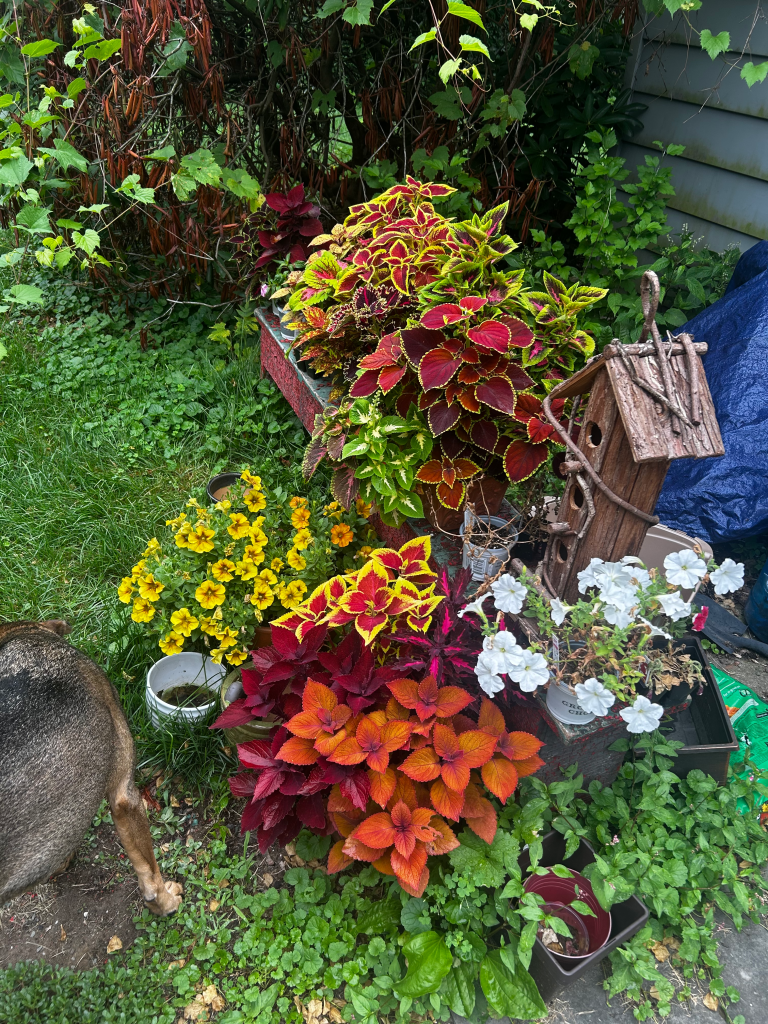
After reading Wal’s piece I couldn’t figure out a way to respond so I waited to read Henry’s rejoinder hoping I would get some inspiration from it.  That didn’t happen.  I spent one day fretting over how to respond or was this simply over my head.  As we talked about in our last blog words were always important to me but I couldn’t narrow it down to one word that had the kind of significance Wal was talking about.  I understood exactly what he meant and the importance of the word and its significance to his conversations and to his life.  So I pushed the idea aside and went about my usual chores.  I began to clean up my yard, visited some plant places reminding myself that it was really a few weeks too early to put out the petunias because a frost was still possible.  I remember that the safe date for planting outside in our area was Mother’s Day, which is still about 2 1/2 weeks away. With this still on my mind, I got my car washed and vacuumed the inside carefully but Wal’s piece was still encroaching on my mind.  I am rambling because that is how I felt scouring my brain for that one word that had such an influence on me throughout my life.  Enter my dog, Devon.  I always talk to him as if he were a person.  If I am frustrated I sometimes shout at him, if I am scratching my head about something I usually phrase my words as a question that he would answer. Just a little while ago I called him in from outside and when he didn’t respond I went out in the dark with a flashlight to find him munching on what appeared to be a baby squirrel or bunny. Needless to say, my words were not warm and fuzzy. and he sensed my upsetment and has been avoiding me ever since.  But back to the blog, this afternoon around 3 o’clock, which is his and his feline sister’s dinner time, I had prepared their dinners and placed his bowl on his little eating platform.  Devon will not touch his food until I give him the okay to go ahead and eat.  Until then he looks up at me with the whites of his eyes staring at me and looking so damn cute waiting for me to tell him to go ahead and eat.  He is the first dog I ever had where he lets me take his food away from him, I can pull a bone out of his mouth without so much as a growl because he knows I will give them back to him right away.  So he is staring up at me with those big brown eyes surrounded by the whites waiting for me to tell him to go ahead and eat.  He made me smile because he looked so cute so I said, “Devon, mangia!”  He doesn’t understand Italian but he knew what I meant.  It was like being hit over the head with a brick—“Mangia”

 Growing up in a loud Italian family, weekend dinners were always large and loud. We always had antipasto, a lasagna course and then the main dish usually meat and veggies.  None  of us ever learned to speak softly so the table was noisy, laughing, shouting, not yelling cause it was never out of anger, just you had to speak loudly if you wanted to be heard.  Dinner would start with a quick grace, everybody made the sign of the cross, and then from somewhere, usually my grandmother or one of my aunts if it was their table, or my dad if it was our table, would shout, “Mangia!” which was the signal for everybody to dig in.  You could hear the sounds of silverware against the china of the dishes.  Grandma would then go around the table, put her hands on your shoulders and say it again, “Mangia”   No one ever told me what it meant.  I instinctively knew it meant to eat up!.  But really it meant so much more.  It meant LOVE!  To the person who said it, it meant that he/she worked all day in the kitchen to make this for everyone with the best ingredients and the love that went into the preparation.  To those of us sitting at the place settings it meant that we bet it was going to taste good and even if it didn’t we knew the love that went into its creation and would eat it anyway.  We were rarely disappointed.

 As dinner progressed, the volume at the table would rise and fall in waves.  Gramma would every so often navigate around the table looking over at everyone’s dish and comment about the quantity of food on the various plates and if there was too much food there that word would be heard above all the conversation. When she got to me I would hear, “Mangia, what’s a matter you?  You no hungry? You skin and bones, mangia!” and then she would add that she made a little something special for me for dessert.  Mangia was so much more than eat up!

 It was an expression I used with my kids, eating at my brother’s house he would shout, “Mangia!”  It just became part of the family’s vernacular.  If anyone ever said something  like, “Go ahead and eat” we would have frozen in place and wonder when the roof would fall in.  In Italian, mangia means love, the word means eat up, but behind the word is years of relations, families, love, fun, companionship, hugs, cuddles on the couch, a shoulder to cry on, and of course, incredible food!  The concept is so much larger than just its English translation.  It wasn’t a life goal to aspire to but rather a concept that I could keep in my heart and conjure up through my entire body to comfort me and to remember that feeling it  gave me when my grandmother shouted it out. I wanted to be able to bring that same warm comfort feeling to my friends and family too.

 So something that just slipped out of my mouth while talking to my dog made perfect sense to me.  Every meal I ever had as a kid began with that word.  Whenever I heard it amongst the loud shouts and laughter at our dinner table, my mouth would begin to water, I’d pick up my fork and a warm sensation would fill my body with a sense of security knowing that I was lovable enough for someone to tell me to eat up!  I hope my dog realizes that, too..  The next time you sit down to dinner,………”Mangia!

More than Words

Wal eloquently expresses the power of words in his most recent post.  For me, he has captured the essence of their undeniable ability to manifest our thoughts and beliefs.  That words created within our mind and influenced by our hearts, extend beyond their physical written or verbal expression and into the realm of “effective sensory projection”* is my reality.

I also appreciate how Wal, has weighted the power of words in his example of can and cannot.  Truly, if you begin with how and why you cannot do something, what likelihood is there for success?  While there may be some who begin at the lowest point of expectation (without really meaning it) and then make a concerted attempt at accomplishment, they would possibly feel some success even if they only achieved some of the intended goal.  However, Wal’s posit holds true for me in 99% of the cases I can imagine.  And his comparison to “can” which he defines as recognizing opportunity implies that there is a chance, perhaps a good chance, that the momentum from a positive “can do” mentality will yield successful accomplishment.  But this is not a guarantee.  To this point I would argue that “can” and “will” carry more weight than my colleague gives it.  Yes, “cannot” trumps “can” on the scale.  However, I have seen the power of belief in oneself that is so focused and unyielding that walking on fire without harm is accomplished by the very notion of, “I can!”

There is another word that I find to be powerful, but like “cannot” is often limiting.  That word is “try.”  When one sets out to do something and they use as their motivation, “I’ll try” I believe they leave sufficient room for failure.  Knowing it will be an effort with the outcome uncertain telegraphs to the body that the expectation is a possibility not even necessarily a likelihood.  Of course, each of us measures effort with varying degrees of commitment and expectation.  So, your “try” could mean a heck of a lot more dedication to accomplishing the task than someone else’s “try.”  However, I still contend that using the word try instead of will or can, lowers the bar for success by the very nature of the fact that I’m not promising to succeed.

Finally, Wal, gave us his words of power which are deeply meaningful and inspirational to him.  In turn he asks for ours.  Although we hadn’t shared these before we each wrote, I also have two words that I fall back on to keep me moving forward in the direction I feel is right and best for me and one of them is also harmony.  I seek to remember that I am part of everything and everyone around me.  I am part of a much greater whole that, without a reminder, is easy to forget in my day to day interactions.  I often use “harmony” as my mantra when meditating.  I am also devoted to “acceptance.”  Acceptance of what is rather than what I think, should be.  A reminder that my judgements often set me up for disappointment.  My practice is to change my thoughts from, “What in the world was that person thinking?” to “Isn’t that interesting?”

“We cannot change anything until we accept it. Condemnation does not liberate, it oppresses.” Carl Jung

*A phrase originated by Jose Silva as he sought to redefine ESP.

On Words, Trust, and More…

How carefully do you chose the words you speak?  Do you pause to find the best word you know to match your meaning or intention as closely as you can?  Do you over promise and under deliver when you give someone your word?  When you say, “ Let me be honest…” are you saying you’re not honest with your words unless you state that you are?  What is your relationship with words?  Do you understand how you are perceived by the words you chose and how correlated they are to your actions…for others as well as yourself?  Do you believe that your words influence your thoughts (through energy) and your thoughts have the power to manifest happiness, success, and self-healing?

I am drawn to people who “walk the talk.”  When my friend says he’ll meet me at 6:00 and is consistently there on time or early, I can trust that with rare (and out of his control) exception that’s what I can count on.  In turn, I reciprocate.  I trust less (and am drawn less) to the person who is inconsistent with keeping their word.  This doesn’t mean I’m rigid or inflexible.  I am okay with someone who (knowing they have difficulty keeping to their word regarding being on time) gives me a time range they can commit to.  This gives them flexibility they require and gives me the information i need to plan my schedule.

Recently, it seems to me, words are given more casually and with less intention as if to say, I’ll try but I’m not making any promises.  And, that appears to be “good enough” for most people today.  I understand the appeal.  If I accept that when someone tells me they will do something and they don’t or if they do it’s not entirely what they said, then I might feel less obligated to keep my word.  And if I feel that makes my life a bit easier because I can pay less attention to holding and being held accountable, I can make easier, more palatable choices for myself with little to no consequences.  It feels to me like we as a society are drifting in that direction.  Do you agree or do you see it differently?

I am in the process of developing a friendship with a neighbor who is relatively new to me.  I love the way he thinks, his deep knowledge about many different disciplines peeks my curiosity and challenges my ideas about certain things.  I would describe him as a polymath.  (How’s that for a word in a post about words?)  One of the things I enjoy about him is his ability to break complex concepts into words that help me understand what he’s describing.  Often, in conversation, he will pause before he speaks as if he’s first gathering and organizing his thoughts, pushing them through a series of personalized filters, and then speaking his mind as precisely as he wants to be heard.  Recently, he appears to be expanding the range of his vulnerability filter as we spend more time together.  

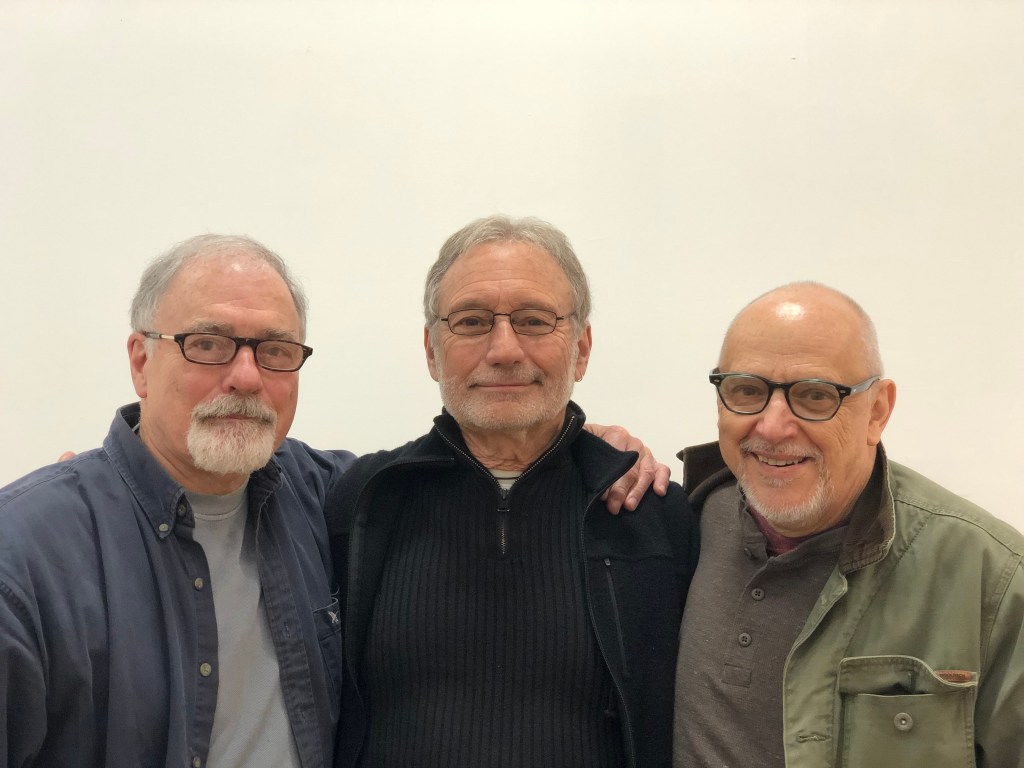
I also admire my dear “3 Old Guys collaborators” and how they use words.  George fuses his language skills and love of conversation to spin a yarn, tell a story, and reminisce.  An expansive conversationalist, he weaves his stories with humor and emotion often making for a compelling listen.  

Wal, is a wordsmith with the gift of articulating a clear and engaging notion with brevity and wit.  While George entertains me, Wa makes me think.  His ability to make connections between and among, historical fact, religion, personal anecdotes and the written word, readily and in such a seamless manner is unparalleled in my experience.  I am blessed to have reconnected with these men at a time when I can appreciate them for what they offer.

Early on in bogging infancy we wrote about Don Miguel Ruiz’s first agreement – Be Impeccable With Your Word.  Going beyond being honest with others, it extends to avoiding talking badly to oneself.  Derogatory or negative name-calling about ourselves can do no good and can only reinforce harmful perceptions about who we are.  The concept that words are powerful enough to do harm or good to those who are the recipients of such thoughts is echoed in other readings we referenced over the life of our posts and rejoinders.  I’m in the middle of reading The Silva Mind Control Method by Jose Siva and Philip Miele.  It contends that our thoughts (words being the instrument for thoughts) create the energy to impact our cells and thus our physical and emotional well being.  The authors argue that being able to tap into and control those thoughts/words to use in a helpful manner is not only a proven scientific fact but can be taught.  Stay tuned as I finish the book and practice their suggestions for enhancing my ability to self heal!

Do you have any stories about the power of words?  We’d love to hear them!

“A Man’s Only as Good as His Word”  – Rodd Thunderheart – author of See Through Love

Word is Bond

After a second read, I think Hen is really talking about making commitments and being predictable, not about the words and language used. I agree that on a purely transactional basis, we prefer to deal with individuals who actually do what they say they will do. I say ‘purely transactional’, because sometimes we don’t want people to do the things they say they will do!

A subtext to Hen’s post is that ‘words have consequences’ which became quite a meme during the election cycle. Playing loose with language can create havoc: false claims, red herrings, over-hyped platitudes, emotionally- invested labels, and ambiguous messages distort how people rationally process communication. Is that really new?

But do I agree that ‘giving one’s word’ counts for less than it used to? I’m not sure. Yes, I do agree that it’s hard to count on folks doing what they committed to do. Anyone who has depended on a contractor to do work on time, on budget, can understand that there’s a certain amount of wiggle room in the process. And aren’t we pleasantly surprised when statements are backed up with results? The ‘surprise’ part of the reaction kind of says it all.

But is that new – is it increasingly true that people discount their word? I can see evidence to support that in our little restaurant business. My son schedules interviews for open positions on his days off – Monday or Tuesday. Most never show up. Tim will text them – and they usually answer with a tragic excuse. They ask for a reset and a new appointment which invariably is not kept. Perhaps the fact that “gaslight” and “ghosting” are terms recently added to the lexicon proves Hen’s point.

Yet, I have a hard time accepting that such behavior is increasing. Maybe that’s just a yearning, rather than a conclusion. People are molded by their circumstances… and some do not like being cornered into making commitments: they want to keep their options open. Some individuals will say what think others want to hear, because they cannot find it in themselves to understand or express that they are not invested in the outcome – or incapable of meeting the request.

Thirty years ago, I was part of an industry and school system task force to evaluate life skills certifications for our local high school. As part of the process, employers were asked what were important transferrable skills needed to supplement subject related knowledge. Items such as reliability/dependability, time keeping, clerical skills and accuracy checking, and so on were raised. These attributes were translated into learnable skills: keeping appointments, time tracking, basic social greeting skills, practical goal setting by breaking jobs into manageable components, using word processing and office applications. We incorporated some written certifications into various curricula for all graduating seniors. Perhaps these actions don’t work over the long haul – or perhaps people have been complaining of the paucity of those behaviors for thousands of years. For me, the jury is still out.

Words by Anne Sexton

Be careful of words,
even the miraculous ones.
For the miraculous we do our best,
sometimes they swarm like insects
and leave not a sting but a kiss.
They can be as good as fingers.
They can be as trusty as the rock
you stick your bottom on.
But they can be both daisies and bruises.
Yet I am in love with words.
They are doves falling out of the ceiling.
They are six holy oranges sitting in my lap.
They are the trees, the legs of summer,
and the sun, its passionate face.
Yet often they fail me.
I have so much I want to say,
so many stories, images, proverbs, etc.
But the words aren’t good enough,
the wrong ones kiss me.
Sometimes I fly like an eagle
but with the wings of a wren.
But I try to take care
and be gentle to them.
Words and eggs must be handled with care.
Once broken they are impossible
things to repair.

Manner, Time, and Place

When I read Henry’s essay I wasn’t sure what I could add to the discussion.  Even now as I sit down to write my contribution I am still not certain how to be relevant to the topic.  Words were always important to me and I remember as a young person I would marvel at adults who could speak in clear coherent sentences with big impressive words included in those sentences.  I remember early on being turned off by people who would verbally include words that really added nothing to the sentence but perhaps were fillers until the words they were looking for popped into their minds.  For example, inserting the word “LIKE”  several times in a sentence drove me nuts.  I was driving to the like grocery store.  I wanted to yell, “Were you driving to the grocery store or not?” Or, “I had to, ya know, pick up something for dinner.”  How the hell would I know what you had to pick up!  I was very careful not to include those two, for lack of a better word, expressions in my speech.  Even today on TV news programs during a question and answer segment the narrator will ask a question and a guest will answer it by saying, “Well, I mean, it was an invasion of our privacy, bla bla bla!”  How do I know what you mean when you didn’t tell us what you meant ?   I am sure there are other examples of exact speech atrocities that we all have heard.  During my teaching days, each morning on the chalk board (I’m dating myself cause it wasn’t a green board or a white board, but a chalk or black board) I would write a word of the day with its definition, and any student who used that word during the day either in conversation  or in writing would get extra credit.  I am not sure if it improved the kids’ vocabulary but it certainly expanded mine.  Many of those words on the board I still use today.  I still experience a sense of ennui when I am home alone and have nothing important to do with myself.

In the course of writing that rambling paragraph, I came up with an idea I want to express. There are many types of words and I don’t mean nouns, verbs, adjectives and adverbs but rather words used to describe different emotions.  We could even classify them as different types of languages..  There is the language of love.  Words of love are usually softly spoken with tenderness and close to the person who is the object of that love.  It is often accompanied with gentle touch, hugging and tenderness.  Smiling also accompanies the words and a warm sensation runs through the body as it happens.  It is a wonderful feeling and often lasts within us for a long period of time.  It is directed at an audience, lover, child, parent, pet and the vocabulary is usually adjusted for the particular audience.  Words are carefully selected to enhance the expression of the love you want to share.  Your words are different if you are addressing your child versus your husband or wife or dog, as well they should be, but in all instances touch is usually essential to the overall expression of the feeling you are trying to communicate.  In juxtaposition, there is the language of anger.  The words used in anger are often pronounced louder than the words of love, with a sharper tone.  The  purpose of these words is to cause discomfort in the individual they are directing the tirade at(sorry, at which they are directing the tirade). Angry words are often accompanied with dramatic body movements- stamping of feet, slapping of hands against our sides, pounding fists on tables. I have to include this thought. I remember as a kid around 1954, my family was watching probably Walter Kronkite where they showed a newsclip of Nikita Kruschev speaking at the UN and banging his shoe on the desk screaming, “We will bury you!”  I remember it because it scared the Hell out of me. The language of anger is also terminated with the angry party storming off and slamming the door behind him.  Unfortunately today, the language of anger overwhelms the  language of love and I think we need to adjust that soon.

There are several other languages as well that are common to all national languages on the globe but have different sounds to them. There is the language of confusion.  The words used in that English language often begin with “Huh?”  Sometimes, “Wha?” and often followed with expletives.  People speaking confusion are often seen shrugging their shoulders, arms bent at the elbows and palms facing upward.  Facial expressions usually include exaggerated forehead wrinkles, often one eyebrow raised, and head tilted to one side.  This is not to be confused with the language of fear which can often be expressed slightly differently. Fear usually starts with words like, “What the…?”  but the body language is a little different than confusion.  A fearful person is usually turning his head back and forth, looking for danger around him.  His eyes are quickly swirling around in their sockets in order to see the danger coming at them.  Words of protection are used……..be careful…….look out……..duck.  And most importantly on their minds is escape!

I would be remiss if I were to omit the language of learning.  It is often recognized by the use of words that question things.  Unlike most of the other languages, the words in this language are usually followed by a question mark.  The  voice speaking  these words often rises in pronunciation toward the end of the word or sentence.  Are you going to the store?  The word store rises in the voice box to indicate that it wants to learn something.  These learning words include WHO?  WHAT?  WHEN? WHERE?  WHY?  and possibly, ARE YOU CRAZY?

In conclusion, I am afraid I think differently than many people.  I am not scholarly, and am not involved in deep intellectual thinking because I am not sure I have the capability of that kind if thought.  Humor and sarcasm are more my style.  I admire Hen and Wal for the way they think and are lifetime learners.  But I do love language but just at a lower level. I will share one last teacher story.  When I was teaching fourth graders grammar I would always try to find a hook to get the kids involved because grammar can be deadly.  I came up with this wacky idea to teach the class about adverbs, normally a very dry lesson.  Adverbs are pf three types. Adverbs of manner tell how an action (verb) was done.  Adverbs of time tell when an action (verb) was done, and adverbs of place tell where an action(verb) was done.  Dry, dull, boring lesson and more than likely not remembered beyond playground time. BUT— by making an adverb Conga Line where the entire class got up, stood in a line with their hands on the person’s hips in front of them and began singing, Manner, Time and Place, UUNNHHH! and kicking one foot out on the UUNNHHH, as we danced in a line around the classroom I hoped it would help them to remember that.   I still have students in their 50’s who may remember not much else from 4th grade, but remember dancing around the room singing manner, time, and place.  What more can I say?

Downsizing

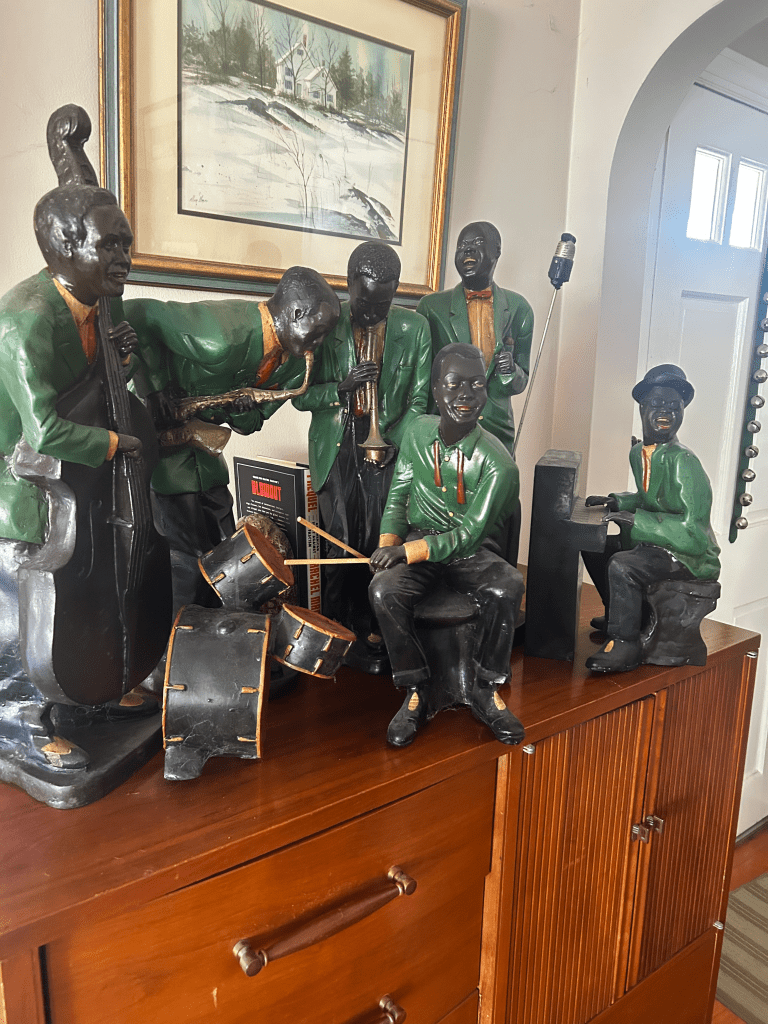
This idea of downsizing has been haunting me for a long time. As I get closer to the big 80, it just has to be done however my ability to procrastinate far exceeds my need to do certain things, one of which is downsizing.  I like to collect things, pretty things, practical things, meaningful things.  I always have and always will.  I have things from my early childhood that I have saved because it reminds me of my growing and the people and places that were very important tome.  I wear a Miraculous Medal around my neck to this day.  It was given to me by my grandmother on my 12th birthday.  A Miraculous Medal is a pendant with a raised figure of the Virgin Mary, a very Catholic piece of jewelry believed to protect us from evil.  The day she gave it to me she was very excited. She had it blessed by Bishop Fulton J. Sheen who was a friend of my dad’s.  She had me turn around and she clipped the chain to the back of my neck and told me never to take it off.  66 years later and I have never gone a day without it around my neck.  It is like part of my body. I never take it off cause I always listened to my grandmother.  She and I were close because every Sunday for years I would go to her apartment and watch her favorite show with her.  Hopalong Casadeetch was her favorite and she always had homemade treats ready for me to eat during the show.  I have other stuff like that too. In my basement I have a collection of model railroad paraphernalia worth a lot of money that I have collected over the decades.  It is a collection that started very early on.  My dad bought my brother, who was 8 years older than I, his first Lionel prewar model train.  Back then they were all metal.  When I came along 8 years later I got my Lionel train set from my dad but it was plastic by then.  My dad made a large platform for our layout which covered half the living room floor and every year the three of us would create a beautiful town for our trains to run past. Because my brother and I were so different in age we were never very close but at Christmas every year the three of us would work together to set up our Christmas village for everyone to play with.  When I was graduated from college and bought our first house, I took claim to all the boxes in the attic and set them aside for my family to develop our own village,  Later on I devoted an entire bedroom to a raised train layout and played with it for years.  Even as a kid I collected things.  My dad built a floor to ceiling bookcase in an alcove in my room.  I wasn’t much of a reader but those shelves were filled with ceramic dogs and cats, plastic figurines of people in their traditional national garb.  That kind of thing always fascinated me.  As I got bigger and older so did the things I collected. For my graduation from college my brother got me an original water color painting from a young Long Island artist.  I was hooked.  Now I have a collection of about 125 original watercolors that I collected over the years.  Every trip to Europe usually increased my collection by one or two original paintings of Italy, France, Wales, Spain and Portugal. I am out of wall space in my house now so a lot are still sitting on the floor of an unused bedroom upstairs.  I won’t even tell you about my 250 plastic Santas from the 1950’s and 60’s that come up from the basement every December to adorn my mantel.  My last occupational adventure was an antique shop in Vermont where I found this incredible papier mache Jazz Band that I just could not pass up!  I am hopeless I know.

You can see where I am going with this.  As my next birthday is speeding toward its arrival which actually puts me living in my 80th year I have begun to seriously think about what will happen to all my stuff.  I have furniture that has followed me from house to house to inn and house again.  I saw first hand through my antique business that brown furniture had fallen out of favor.. Brown meaning original wood color. People are now painting the beautiful brown furniture with milk paint or chalk paint or other new paint varieties because the brown was what old people had. And shortly after the store started to catch on Covid struct and ended that chapter of my retail experience.  I have some beautiful pieces of furniture from my dad and mom’s house that no one will want.  I ask my kids and they roll their eyes as they do with so much of my stuff.  I do think my son will probably claim all the train stuff and both of them have a few favorite paintings they will keep but that is about it.  Although recently I have noticed new collections popping up in my daughter’s house so there is hope. I do have to go about downsizing all these things so my kids don’t have to be burdened with it all when I pass?  And this is without even mentioning clothes. I have teacher clothes upstairs in a closet.  They include pants that can’t be zipped, dress shirts with 17 inch necks that I can no longer button, I have a beautiful new suit that i cannot even button the jacket.  So accepting the fact that these clothes can no longer fit I decided this would be a good place to start the downsizing process.  There are all kinds of clothes drops around the community so that makes things easy….HA!  I started going through the pockets of my pants and jackets checking to make sure there is no money and then folding them neatly and putting them into plastic garbage bags. So far so good.  Next, down to my dressers and closet in my bedroom.  I have a lot of jeans that no longer fit. For years I was a 30 waist but now I can no longer fit into a 32 inch waist unless it has a stretch waist band.  But to donate, I first have to try them on, check the pockets for money, fold neatly and place in those garbage bags.  Same with the shirts, but the folding is a real pain.  Then there are the sweaters and sweatshirts that I love and do I really want to get rid of them?  I’m just not sure, but I have done enough for one day and I’ll do some more tomorrow……if tomorrow ever comes. I failed to mention that trying on pants is no longer easy. I used to be able to stand up and put my pants on quickly,  Now I either have to sit down to put them on or hold onto furniture while I put one leg in, turn around, hold onto the dresser with my other hand and put my other leg in.  This takes time.

Whenever my son comes home I try to get him to take a few moments and walk with me through the house to see if there is anything he would like to take now or later, to which he usually replies, “Nah!”  I have a few paintings of trains I think he will want and with my daughter there are a few things she wants.  I have some decorative delft plates she likes and some family china but the one thing she definitely lays claim to is my aunt’s piano bench because my aunt would attempt to teach her to play the piano.  The bench seat has a pretty embroidered flower bouquet on it.  Jennie valued her time with my aunt whenever she came from Pennsylvania to visit or we went there.  When you think about it there is so much stuff that is cherished by people that will wind up in a garbage dump, a thrift shop or yard sale or just discarded.  Our lives come down to a pile of stuff that was once cherished and now is pushed aside and has no place to go. When I had the antique shop I used to get upset when someone would bring things in to sell and set up their booth and somewhere in the booth was a basket or bowl filled with old photos of people’s lives- wedding photos, baby pictures, family gatherings, graduations, you name it.  Special important events in those families’ lives. No one ever goes through the baskets, no one ever buys old photos of people they don’t know.  Aren’t there other family members left that should keep these old photos for posterity sake.  Don’t get me started!  There is a lot more that I could say but I am picking my daughter up to go to an estate sale before it closes..

Letting Go

George reminds us that over our lifetime we have accumulated a variety of inanimate objects that were or are still, significant to us but not so much to those who will inherit them.  Thus, those of us in our final years are faced with the conundrum of what to do with this “stuff”… as well as when.

Recently, AARP published an article entitled, “AARP Smart Guide to Decluttering” – 39 strategies on how to donate, ditch, and downsize the things filling up your home.  The premise is that like a diet, where we lose weight only to regain it over time, purging and accumulating also seem to be a constant work in progress.  Therefore, they suggest we begin with a shift in our mindset.  That is we have to dig deep inside to agree that we honestly want to reduce the amount of our stuff before we commit to beginning the process.  I like this step as it reminds me that there are times when I begin a project because it seemed like a good idea at the time but later I replace it by something else that catches my attention.  If I had made it a conscientious choice based on what was truly important to me, I would be more likely to maintain my commitment to it rather than move on to something else.  From personal experience with such matters I would add an additional step to increase the chances of success.  I find that asking someone I trust to check in with me on a regular basis helps keep me accountable.  Knowing my friend, partner, or daughter would be asking me how my decluttering work is going adds another layer of responsibility to my task at hand.  

When I moved in 2021, I seriously began this process.  I offered friends and relatives to take things I no longer needed, I scheduled furniture pick up with Habitat for Humanity, I donated unwanted clothes to the local church which had a “Goodwill” like store to help the less fortunate, I brought items to the recycling center, and as a last resort, I filled a large dumpster with things that remained but weren’t coming with me.  This was a huge effort and a great start.

When I bought my new home in 2023 I found that I still had more than I needed or wanted as well as some furniture and decorations that either didn’t fit or I replaced.  Many of these things I donated to neighbors, contractors who did work on my house, and new friends, and donated items to The Salvation Army, and Habitat for Humanity. Some of furniture and fixtures remain in my basement waiting for me to find new homes for them.

Our aging generation is growing and the challenge faced by our children/family members of getting rid of the stuff we will leave behind is increasingly daunting.  I can’t help but think, what if?  What if there were an agency that was designed to assist the elderly in the entire process of going through their things, deciding what needs to be repurposed or disposed of, and making the arrangements to do so?  Perhaps just putting this idea out there might lead to some additional resources down the road.

For now I think long and hard before I add anything to my home collection.  If I choose to do so I look to take something away and all the while, I keep in mind how much I have and can still let go of while my partner helps me keep this conversation alive.

“Letting go of items that no longer serve you is freeing.”  

Author Unknown

A Festival of Things

I’m late to the party… after a sojourn to the north country without computer, I’m just catching up on George’s post and Hen’s rejoinder. 

Geo voices something I think we all struggle with: what happens to the objects we enjoy when we’re no longer around to enjoy them? In addition, the sad truth is that objects we enjoy may not have the same meaning to others – so what do we do with them? George confronts the dilemma, doesn’t quite come up with a solution, and then heads out to corral some more objects.

Believe it or not, this makes sense to me.

Look, most normal folks gather ‘things’ for at least several major reasons:

  1. Gain: these are commodities to trade, sell, or give away
  2. Use: items stockpiled as ingredients for future projects
  3. Souvenirs: placeholders for memories of individuals or powerful experiences
  4. Beauty: to surround our existence with inspirational art, literature, or music

Knowing George, he is not focused on Gain or Use. He often talks about having his father’s money clip and the Lionel trains of his youth. He also describes his many collections, including cityscapes by various artists, as well as the personal experience of interactions with the artists. For Geo, the beauty of the object and its significance to his relationship with the owner or maker is a data point of joy. I get that. Why not surround yourself with a symphony of objects? It seems autobiographical. Matthew Kelly writes that truth, beauty and goodness are the only things people never get bored with. Why not search after more object’s d’art?

Okay, but what constitutes ‘too much stuff’? I’d say that varies. Possibly, you have too much, when the sheer volume prevents enjoyment of the individual pieces. But maybe the collection is the gestalt – the interlocking puzzle of elements that defines your world. 

Now you have curated a collection, do you continue to add to it as your perspective changes? Of course!

Years ago, I got some advice from Mirni Kashiwa, an esteemed lover of the arts. In her household, they had a tradition of revolving the artwork, in order to focus on various objects and see them afresh. She did not discard her art, but rather archived pieces. It reminds me that you can both be reconnected with a strong memory and also come away with a new meaning by resampling earlier saved objects.

But life is more temporary than things. Our objects will outlast us – even if they are discarded. George’s sadness to see old photographs in a junk store represents our difficulty in accepting our transitory nature. It is not the things themselves, but the significance to the person that is now removed or discounted. I have no answer for that. That we — and memories of us — will evaporate is the hardest truth to accept.

Hen suggests a variety of approaches to assist in managing the disposition of household collections. I like the idea of having an agency to assist people in finding homes for treasured objects – or maybe just ‘stuff’. It goes further than recycling – it’s reassigning. An artist friend’s family arranged a ‘retrospective’ show of his art and then invited people to take pieces that they admired. A little part of Steve went away with everyone that knew him. That would personally make me happy to arrange such an experience for my collections: a festival of things!

Collecting Peace, by Susan Noyes Anderson from her website: susannoyesandersonpoems.com

Collecting is a testament
to life already lived –
a witness of the future
still in store.

The past holds value far beyond
the grave in which it lies;
we are wraith-ed in peace and yet left
wanting more.

Our ghosts inhabit weathered woods,
etched glass, revolving clocks –
every tick marks a beginning
and an end.

So we gather warm and lovely things
to comfort and surround,
ground ourselves in new tomorrows
with old friends.

Identical Harvest

It’s funny how connections are made. Several years ago, the Old Forge Library excessed a series of books, including a twelve-volume set of the Interpreter’s Bible. Heavy duty scholarship: about a thousand pages in each volume, covering various translations and exegesis. It was written in the early 1950’s, so newer editions became available. The whole shebang cost three bucks: so, I bought the set.

Actually, I liked the fact that it was written in the 50’s, featuring a newly postwar-influenced attitude. In reading commentary on Paul’s Letter to the Galatians, the editor made a reference to “identical harvest” in association to the sentiment that ‘you reap what you sow’.

The term stuck with me. A quick internet review brought me to the Law of Identical Harvest – a philosophy described by Neville Goddard through the early 50’s to 1970’s. His work is carried on – and there are several sites/blogs that continue to build on his conceptions, which, in brief, are:

  1. Every thought is a seed that will eventually bloom
  2. What you imagine is projected onto the frame of consciousness that you perceive (‘reality’ is you pushed out to the external world)

Of course, there’s lots more. It is similar to the Law of Attraction – and is basically the ‘reap what you sow’ foundation. However, the approach to dealing with who you are and what you want is one I find appealing. The analogy of your life as a tended garden is congenial. In this context, you can choose what seeds to plant – and if you tend your garden (by constant attention, weeding, and soil preparation) your desired seeds will flourish. Makes sense to me.

What caught my attention is a similar theme featured in an old self-help book I read as a preteen (Think and Grow Rich by Napoleon Hill). Published in 1937. What that book showcased, is that what you believe, you can achieve, but it first challenged you to examine what you truly believe. In that sense, the book focused the reader on the “seeds” that you really wanted to grow. The other similarity to Goddard, is that Hill advocated for writing down an outcome you wished to achieve on a slip of paper each night and placing it by your bedside. It may sound corny, but I’ve found it helpful. Goddard also suggested bedtime is an opportune time to plant a thought-seed that you wish to nurture. Perhaps, the difference between the two is that Hill focused on resolve, while Goddard talks about planting a seed while linking it to it a strong emotion.

We’re in that time when people talk about making resolutions for the new year. Some folks disregard the process as wasted effort, because so many resolutions are quickly discarded. However, Goddard makes a different point: just listing a desired goal results plants a seed – a seed that remains forever! It may not flourish in your garden – it could be crowded out with competing seeds or poor soil preparation – but it does not die. Your life – and your garden — is simply a reflection of all the seeds that you have planted by your imagination and how you have tended the crops.

In that respect, listing your wishes for the new year is essentially planting a new crop for the season. Whether the yield is successful lies in good part on the suitability of the seed for the soil you have prepared and your intention to be a constant gardener. What seeds will you plant this year?

P.S., It’s our custom to discuss our writings among ourselves before publishing. Hen challenged me to list the “seeds” I will be planting… George said two things: a) all this sounded like too much planning and it’s never worked for him b) why can’t we write from the heart and stop quoting authors.

First, for Hen: Actually, right after I posted my draft, I listed my seeds on a small card, which I placed by my bedside table: Harmony, Health, and Prosperity. I will keep focus on those goals this season and see what grows!

Second: I met George 50 years ago in our freshman dorm at college. But you only need to talk with George for 5 minutes to understand that his garden is a bouquet of his former students. Even after a long career in teaching, he meets with them for breakfast and lunches; he keeps I touch by social media. Engagement is his gardening technique and he is all in. Don’t ever believe that he just responds to “Holy Crap, I better do something”. As far as his second admonition not to quote authors – sorry, buddy: “you can’t harvest wheat if all you ever plant is grass seed.” – C.S. Lewis

Sunshine Wishes: Anonymous from tinypoetry.com
In a garden where the sunbeams play,
Wishes dance on a golden ray.
Soft and gentle, like a hummingbee,
Moments of hope, so bright and free.

Close your eyes and take a breath,
Whisper your dreams, let go of the rest.
With every wish, the flowers bloom,
Filling the world with sweet perfume.
Clouds may gather, but don’t you fret,
For sunshine wishes are never forget.
They sparkle and glimmer like stars at night,
Guiding our hearts with warming light.

So dream, dear child, and believe in the day,
With sunshine wishes, find your way.
Wrap your hopes in a soft, warm hug,
And let the world feel your love, snug as a bug.

Growing Your Garden with Intention

I enjoyed learning about the Law of Identical Harvest as introduced by Wal in his lead post this week.  After a short Google search I came upon a rather lengthy online audio explanation from Neville Goddard.  It also reminded me of the Law of Attraction which is the belief that what you spend your time and energy on becomes your reality.  For example, if you dwell on your bills and debt and lack of finances you will conjure up a life of debt and insufficient money.  If you focus your thoughts and energy around living with financial comfort and visualize that scenario then that’s what you’ll have! 

What I gleaned from listening to Goddard’s talk about The Law of Identical Harvest is that it’s a thought or idea, once imagined, is created (seeded) and is available to all to be cultivated or not. Each of us is born with this capability.  And, cultivated with a singular focus and great intensity, one can reach a spiritual level to achieve a wish or desire beyond even physical limitations or scientific explanation.

While I have read about such accomplishments, I’ve never experienced this ability.  However, there are a number of things in my life that have occurred that I either wished for fervently over time or wrote down a future goal with deliberate intention and consistent attention.  They were once but a dream or hope with low percentages of coming to fruition – but they did. I am a believer in the notion that we have great influence in achieving what we really desire and that intention, attention, commitment, and a positive attitude works!

Recently, I came upon an article written by Ron Shaich. In the article taken from his book “Know What Matters” he talks about writing a Pre-mortem rather than a New Year’s Resolution at the end of each year.  He images his final days or hours, how he struggles to draw each breath and is acutely aware of his impending death.  Then, he writes a news story, journal entry or obituary drawing on that hypothetical future.  He focuses on his accomplishments and he plans out how to get from his present state to this future version of himself.  Then, he chooses what projects he should plan for the coming year.  In other words, he goes through an exercise to see what garden he wants to leave when he’s gone and what seeds he needs to plant and cultivate each year to create that garden.

Similarly, Stephen Covey presents his second habit of “The Seven Habits of Highly Effective People” – Begin With the End in Mind –  where he also offers a funeral exercise.  He suggests we write our own eulogy based on what we would want a representative from our family, our work, our friends, and our religious congregation to say about us when we die.  And, as with Shaich’s pre-mortem concept, he then asks us to look back on what we are doing or need to do so that those who know us will indeed see us in that light.  He is basically asking if we are planting and nurturing the seeds that will leave behind the legacy we aspire to.  And if not, why not start today?

Wal ends with asking us what seeds we will plant this year.  Mine, coincidently, is to literally establish an actual vegetable garden on my newish property.  I’ve already begun mind-gardening as I envision where it will be placed, how I will build the raised beds, what and how many vegetables I will grow, and how I’ll fence it in.  As to more figurative seeds, I see an improvement in my cognitive and physical health through focused attention on healthier behaviors.

“A goal properly set, is halfway reached.”  -John Doerr (American Investor and Venture Capitalist)

Spiritual Refuse

I admire Wally and Henry for their scholarly approach to life.  No matter what topic we discuss, Wally has read extensively about it sometime in the past. And the very next e mail inevitably is from Henry who just did some research on the topic and found a couple books worth reading about it.  That seems to be the way they led their entire lives. While they were reading scholarly works of all the philosophers and scientists, I was reading fiction books.  Perhaps I chose that category of books because I always did have a pretty vivid imagination and a total lack of desire to wade through heavy topics in which I had no interest.  Actually while they were reading such treatises, I was usually reading children”s literature because one of the things I loved to do was read to my classes but I always read the books first before I would introduce them to my classes. And that is pretty much how I lived my life from early on  til recently.  While Wally and Henry were discussing growing their garden with intention, my garden was pretty rocky without a neat path to follow.  So instead of Growing my Garden with Intention, my philosophy would better be defined as Holy Crap, I Better Make a Decision because what just happened needs to be addressed!  Planning ahead for things wasn’t on my dance card.  I have always been a reactor more than a planner.  My New Years Resolutions were usually never to make New Years Resolutions and for Lent I would give up homework.  I would always try to go with the flow, rather than try to figure out where the flow was going to take me and arrange for alternative approaches if the flow didn’t take me where I thought it might.  I adopted this philosophy in my teens as a protection from life as I knew it.  There were big decisions in those days that had to be addressed.  Where was I going to go to college. My parents were pushing for me to attend City College which I didn’t want to do because most of my high school graduating class would be going there. So did I investigate other options? Absolutely not.  When the time came to apply I asked a couple of my friends what they were going to  do. My friend Norman was going upstate to New Paltz cause his aunt lived there and he said that i should go there too because I could always get a ride home on the weekend with him.  My friend Anne was going to Fredonia and she suggested I go there with her but that was a little too far for me at that point in my life.  I wrote out 3 applications- one to Queens College, our local  city college, one to Fredonia, and one to New Paltz.  No plans necessary, it was out of my hands, I would go wherever I got accepted., or so I thought!  As the acceptance letters started coming in I made sure I got the mail before anyone else and there it was Queens College, I hid the letter until others came in so for the moment I was safe from parental pressure.  Within a week the other two letters arrived and I was accepted at all 3.  I had hoped that the  decision would have been made for me by two rejections and one acceptance, but no luck.  That night was difficult.  I wanted to go to New Paltz but I knew my folks were pushing for the local cheaper choice, So I hid the Queens acceptance letter at the bottom of my laundry basket and announced I wanted to go to New Paltz.  Norman’s argument that I could go back and forth with him won out.  I never told Mom and Dad that i was accepted to City College!  They never asked!

Once in college, you have decisions to make all the time.  For the first time in my life I was on my own, nobody was telling me what to do or how to do it.  All of a sudden I was living with 2 guys I had never met before.  So I had to look like I knew what I was doing, what elective courses should I take, what will I major in.  In the back of my head I thought since childhood that maybe I would become a veterinarian, but that was just a lazy thought that sat there until junior year was approaching and some decisions had to be made.  My brother was a teacher and so was my aunt in Pennsylvania.Decisions were always hard for me and this one was sort of the most significant decision I had to make so far.  Time was running out so I signed up for participation in the campus school, a pre student teaching  requirement, and I Ioved it.  I began to become a little full of myself, thinking things were always going to just fall into place.- not so fast!

So, this is pretty much how I made most of my major decisions in life. Something would happen requiring some kind of immediate decision and when the pressure was on, the decision is made more easily. The old…Holy crap… I better do something about this till worked for me. This approach was used for deciding on my employment, where would I live, should I buy this house. As an adult I have lived in 5 different homes. Each decision to buy a new house was made because of a new situation change that had to be addressed. I never said, I guess I should plan out where I am going to move to next, I’ll make a list and do some research as to where I want to wind up, that never happened. Instead, it was one decision made that would require additional decisions to follow relatively quickly! My brain seems to work best that way and honestly, this helter-skelter approach to decision making has served me well, financially it worked well for me and career wise as well as life in general. The decision to retire arose quickly with my school district and the State of New York deciding that us old geezers who were hired on Tier 1 way back in the 60’s were getting too expensive to keep us all on the payroll. My school district came up with an incentive to retire, a severance package for unused sick days and then the State of New York came up with a retirement incentive just to get us off the payroll. With the district incentive and the state encouragement that decision became easy. It turned out to be perfect for the direction my life was going in at that time. We opened an inn in Vermont, loved doing it, loved meeting people from all over the world. And once again I settled into a lifestyle that provided me with income, excitement, and new contacts all over the US and Europe. The one thing I can never say is that all the decisions made in my life were carefully planned out and executed in a logical, orderly fashion that would set me up for future decisions that would have to be made for me.

All of this has led me to where I am today. Decisions being made today are of a lesser difficulty degree but still depend on unexpected situations that arise. The inn was doing really well, we were number 1 on Trip Advisor for 2 years in a row and we were voted ‘Innkeepers of the Year’ by the State of Vermont Things were smooth sailing until all of a sudden they weren’t. A new development began to spread across the country called Air BnB. They weren’t required to have inspections, insurances, weren’t required to pay hospitality tax to the state and as a result most of us little inns could no longer compete. Our business was no longer able to sustain itself and so the next decision had to be reached. The inn was sold and I headed back to where my kids were in Kingston, NY. I am pretty exhausted right now so I think I will decide to put an end to the musings of one old crazy guy. I really can’t recommend this approach to life for others. I am practical enough to realize many things could have gone terribly wrong but for some reason things fell into place and provided me and my family with an enjoyable, comfortable life. As a kid, I used to deal with disappointment by imagining the worst thing that could happen in a situation. When the situation passed and the resolution was negative I could shrug my shoulders and figure it was what I anticipated. I wasn’t disappointed because it is what i expected to happen. BUT, if the situation resolved itself in a surprisingly positive way I could rejoice in the moment and enjoy the unanticipated favorable resolution. Hey, it worked for me!

I really can’t recommend this approach to life for others.  I am practical enough to realize many things could have gone terribly wrong but for some reason things fell into place and provided me and my family with an enjoyable, comfortable life.  As a kid, I used to deal with disappointment by imagining the worst thing that could happen in a situation.  When the situation passed, and the resolution was negative I could shrug my shoulders and figure it was what I anticipated.  I wasn’t disappointed because it is what i expected to happen.  BUT if the situation resolved itself in a surprisingly positive way I could rejoice in the moment and enjoy the unanticipated favorable resolution.  Hey, it worked for me!

Speaking to Me Without Words

Many years ago I was traveling with two buddies toward the Florida Keys when we stopped at the Seminole Hard Rock Hotel and Casino to try our luck at gambling.  I decided to sit down at a low stakes poker table to apply my newly learned skills at a game called Texas Hold’em.  I sat quietly, suppressed my usual friendly banter with the players sitting next to me, and folded my cards often when someone bet on their hand which I assumed was better than mine.  I remember being dealt an off suit K and 3 for my pocket cards (which was nothing to get excited about) but no one raised before the flop so I called the minimum big blind to see how I would do on the flop, which was three open cards for everyone to use.  To my wonderful surprise, the upturned cards were two kings and a 3, giving me a full house with two more cards to go!  Since I was one of the first to bet or check at the nine person table I used my limited knowledge of disguising the strength of my hand by checking to the next player.  Usually, with a family pot (a hand where everyone at the table has called) someone is likely to bet either because they have matched at least one of the open cards on the table or because they assume no one caught a good hand and they want to bluff and make believe they have a strong hand.  In this case, however, no one did.  After the next card was revealed, my turn to bet or check came with no one adding any money to the pot.  Thinking I would be crafty playing with what appeared to be seasoned poker players, I bet the minimum amount so as to not scare away any or all of the other players and to build the pot of chips for a bigger bet at the end.  To my dismay, everyone immediately folded.  I had won the minimum amount with a hand that could have brought me a very large amount of money.  Chalking it up to bad luck I turned to the player on my left and asked him in jest if it was that obvious that I had a big hand.  He smiled and told me it was!  “How did you and likely all the others players know,” I asked?  Well, for one when the flop was revealed you immediately sat up straight in your seat as if something had caught your attention.  You were more attentive as the players each checked their hands and you kept looking at your chips, a sign that you likely have a betting hand.  There were more but I only remember those.  

So there I was, thinking that since no one could see my cards, all I had to do was wait for a good hand to clean up.  It was then, that I learned that while knowing the odds and probabilities of poker hands is a major factor, reading the other players definitely matters in playing winning poker.

I’ve always had a fascination with body language.  According to the Oxford dictionary, body language is “the process of communicating non-verbally through conscious or unconscious gestures and movements.”  Sustaining an equanimous demeanor despite losing, winning, bluffing, or betting with a strong hand relegates only good math and luck to those who can play well against you.  Thus the term “poker face.”  A skill and behavior I continue to practice but find very difficult to achieve.

Of course poker “tells” such as talking during a hand, looking at your chips, becoming quieter than usual, covering or touching your face during a hand are subjective and are never a sure thing.  As with reading people at work or in public, they are only indicators that might yield helpful information.  

Last night Teresa and I went to dinner with a couple she had met last year but, except from what I heard spoken about then, they were people I did not know.  So, before we went, I decided to think about the kinds of body language behaviors that might give me some additional information about them beyond what they said about themselves.  They both stood straight and walked easily into the restaurant.  They embraced us each and immediately began to make conversation.  They spoke quickly and inserted lots of humor in the early parts of our introductions.  They both answered our questions and followed up with questions of us.  We truly enjoyed our evening together.

As I looked back over the evening, a few “tells” about them came to mind.  I realized that I enjoyed their company not just by our verbal conversation but by the way they leaned in when we spoke, their warm and welcoming eye contact, and by the way they held themselves in a comfortable and confident manner.  They were huggers, as am I, and a hug often conveys an intimacy and vulnerability that adds to my willingness to connect.  

Except for this experience, I don’t prep myself to look for body language when i meet people.  But I do often ask myself afterwards why I liked my time with someone and often come up with a behavior or two that was nonverbal and likely subconscious that contributed to our positive interaction.

Are there any such tells that you find helpful when being with other people?

 “Body language is a very powerful tool. We had body language before we had speech, and apparently, 80% of what you understand in a conversation is read through the body, not the words.” –Deborah Bull (English Baroness, dancer, writer, and broadcaster)

Panto-Mine

Panto, short for pantomime, is usually a production that expresses intent without speech. This is the first word that came to mind when reading Hen’s piece about body language. Honestly, I hadn’t thought much about the importance of “tells”, until reading about Hen’s Texas Hold-em experience.

So, true to form, I did an internet search to survey the subject of non-verbal cues. One site indicated that there are eleven varieties of body language that you can observe. These involve:

  1. Facial expression
  2. Body proximity
  3. Gestures
  4. Ornamentation: style, color, etc.
  5. Interest markers
  6. Eye gazes
  7. Self-soothing activities, like neck rubbing
  8.  Haptics – touching
  9. Blocking – like touching ears, eyes, mouth
  10. Emblems – common gestures, like ‘thumbs-up’ (or others)
  11. Paralanguage: pitch, tone, cadence

Wow – that’s a lot to process! I’m too lazy to focus on all of this. Plus, I’d probably send all the wrong body signals while trying to notice or decode these behaviors while interacting with other folks. Yet, we all engage in this communication – receiving and broadcasting cues – in a subconscious way. 

I think that a lot of the body language we process is both culturally endued, as well as idiographic. Culturally endued, because we are embedded in a society that recognizes common signals like greeting behaviors. Idiographic, because as individuals, we have been conditioned to react to certain triggers.

For example, my mother was a sweet and loving person, but very anxious. She also had profound hearing loss. During a conversation, her body language and particularly her facial expression could change unexpectedly. It was difficult to know if she was reacting to what she heard (or thought she heard) – or whether it was initiated by an impinging anxious thought. I’d guess that Hen would declare such signals as a tells – and he’d be right. However, the cause of the tell would be difficult to ascertain: her cards, current conversation, misheard noises or discussion, past memories, or future concerns. I think my Mom would have been a tough person to play poker with, due to a plethora of tells, which could mean many different things!

At one time, I was responsible for management training in an organization. Two of my instructors went to a neurolinguistics course and came back believers in delving into body language. Eyes flashing left meant combing for solutions; flashing right meant looking for excuses. Really? Mirroring became a popular behavior in meetings – that is, adopting the body posture and gestures of the person you were conversing with in order to promote a positive connection. They lean in, you lean in; they cross arms, you cross arms, etc. Now, I don’t disagree that a certain amount of mirroring fosters intimacy, but the intentionality of the behavior became too obviously disingenuous. It was a short-lived program.

Hen asks what body language signals are important to each of us: I look for posture that says ‘hanging loose’ vs. ‘holding tension’. There might be excellent reason for either of those postures, but the signals lead to different conversations. I also look for eye crinkles – wrinkles around the eyes that accompany a true smile. That’s my two sense!

At the Door by David Wagoner from poetrysoup.com

All actors look for them-the defining moments

When what a character does is what he is.

The script may say, He goes to the door

And exits or She goes out the door stage left.

But you see your fingers touching the doorknob,

Closing around it, turning it

As if by themselves.
The latch slides

Out of the strike-plate, the door swings on its hinges,

And you’re about to take that step

Over the threshold into a different light.

For the audience, you may simply be

Disappearing from the scene, yet in those few seconds

You can reach for the knob as the last object on earth

You wanted to touch.
Or you can take it

Warmly like the hand your father offered

Once in forgiveness and afterward

Kept to himself.

Or you can stand there briefly, as bewildered

As by the door of a walk-in time-lock safe,

Stand there and stare

At the whole concept of shutness, like a rat

Whose maze has been rebaffled overnight,

Stand still and quiver, unable to turn

Around or go left or right.

Or you can grasp it with a sly, soundless discretion,

Open it inch by inch, testing each fraction

Of torque on the spindles, on tiptoe

Slip yourself through the upright slot

And press the lock-stile silently

Back into its frame.

Or you can use your shoulder

Or the hard heel of your shoe

And a leg-thrust to break it open.

Or you can approach the door as if accustomed

To having all barriers open by themselves.

You can wrench aside

This unauthorized interruption of your progress

And then leave it ajar

For others to do with as they may see fit.

Or you can stand at ease

And give the impression you can see through

This door or any door and have no need

To take your physical self to the other side.

Or you can turn the knob as if at last

Nothing could please you more, your body language

Filled with expectations of joy at where you’re going,

Holding yourself momentarily in the posture

Of an awestruck pilgrim at the gate-though you know

You’ll only be stepping out against the scrim

Or a wobbly flat daubed with a landscape,

A scribble of leaves, a hint of flowers,

The bare suggestion of a garden.

Do You Hear What I See?

I learned about body language very early in life! I had a cousin, Linda, who was two years younger than I was and tended to be dramatic even at the youthful age of about 4.  When she got scolded, her face would wrinkle up, her eyebrows would crinkle above her eyes, she would give one stomp of her foot, fold her arms over her chest, drop her head, and turn around so that her back was to whoever scolded her.  Not a word was spoken but the stomping of her foot and the crunched face spoke louder than words. She was not a happy camper!  I also remember as a young boy when being called into dinner from the baseball game going on in the street, my mother would be standing at the door, dish towel hanging over her shoulder, arms folded across her chest, right foot tapping in syncopated rhythm.  As I ran the bases I was more concerned about her foot than making the  base safely.  As the moments passed, my mother’s foot tapped more and more rapidly indicating to me and my friends I had to go home NOW.  I would hit the base running, never stop and just headed straight for my mother  at the door.  All the kids knew what that meant.  My dad had been a Marine, and patriotism was part of our lives.  Every Memorial Day,, 4th of July, whenever there was a parade, my dad, mom and brother would head out for the parade route, usually Northern Blvd in Queens to watch the parade go by.  As  veterans groups or active duty bands passed by, my brother, myself and my dad had to remove our hats and while still holding the hat placed our hand over our hearts.  If we failed to do it immediately all we had to do was look at my dad and his warning eyes gave us the signal to show respect.  These body movements and positions never were explained to us but somehow we just knew what we were supposed to do.  And if we didn’t understand something, we would crunch up our shoulders,  make a stupid face and raise our hands up to our chests with the palms facing skyward, and with a simple shrug of our shoulders express the universal body language signal for, “Huh?”

School was full of body language symbols as well.  But because there were kids from all different countries, religions, cultures you had to be astute enough to pick up similarities in order to understand the body language of others.  Usually there were just minor variations on the theme.  I had a 4th grade teacher who   when trying to get an idea across and we just weren’t picking up on it, he would   turn his back to the class and with his right palm, he would slap the top of his forehead and allow his hand to continue toward the ceiling.  We all knew it was his way of saying, “OY, these kids are thick!”  Invariably one of my classmates would imitate his body language from the back of the room and we would have to stifle our giggles because that would bring a different  body language vocabulary to the classroom.  You didn’t have to be real smart to pick up on the  meanings of these movements.  We just knew!  In junior high school, for the first time we moved from classroom to classroom for the different subjects.  We would start our day in homeroom and end the day in homeroom.   My homeroom teacher in 9th grade was Mr Montalbaum, who was also my gym teacher.  When we returned to homeroom at the end of the day we were kind of loud and shouting across the room to our friends and he had a unique way of getting us to quiet down so he could take attendance or whatever he had to do before dismissal.  He wouldn’t yell or bang on the desk or anything.  While we were filing back into the room he would very quietly put his right hand pointer finger next to his nose on his face and he would walk around the classroom while we were packing our books and getting our coats.  As soon as you saw this, you had to put your right hand pointer finger next to your nose and shut up and take your seat.  You did not want to be the last person to do this because if you were you had to get up in front of the room and sing a song to the class.  Cruel? perhaps but efficient!

Body language in society is constantly in use.  You cannot walk down a street without seeing people using an assortment of words and body movements used to make a point, express a feeling, show affection…. it is used all over.  I guess I learned my knowledge of body language early and became quite fluent in it and what opportunities it provided me.  I taught elementary school in the same little community school for 35 years, and developed quite a vocabulary of movements and expressions without vocalizations.  When I needed my class to come to order (4th, 5th and 6th graders) and they really weren’t focusing on what I wanted, I did a very simple thing that always worked.  I would  go to the blackboard and begin to write in cursive from RIGHT to LEFT what my message was.  For some reason I was always able to write backwards in cursive and when I started doing that they would have a look of amazement on their faces and then the shushing started trying to tell their friends to quiet down.  I  always thanked Mr Montalbaum for the inspiration to do that in a gentler manner than he used.  I am not sure we could exist as a society without the use of body language.  How would we ever be able to express our road rage when someone was crawling in front of us on the thruway without the use of our middle finger?  How would we be able to flag down a cab without a wave…yelling certainly wouldn’t work.  How would a cop directing traffic be able to get his message across without frantically waving his white gloved hand  and pointing at you when you didn’t respond!  And the best thing about it is that body language is multi- lingual , it is pretty much universal from culture to culture..  Too bad there aren’t more things like body language to bring us all together rather than the misunderstandings and confusion the spoken language leads to.  Just sayin’!

History – Stolen or Lost

My brother and I were not very close when I was a kid.  He was 8 years older than I was  He was born before WWII and I was born 9 months from the time my dad got back from Iwo Jima. As a result I was just a pest to him and we had little in common other than our family history which included on one side, two aunts, an uncle, one cousin, and my grandmother.  On the other side it included an aunt an uncle, and two cousins and my grandfather..  In addition to those folks our extended family, mostly on my dad’s side, consisted of 4 great uncles and one great aunt and several cousins a couple of times removed.  These were people we saw mostly at holidays, and special occasions.  We were closer to the relatives on my dad’s side of the family because we lived closer to them, my mom’s family lived in Pennsylvania.  During my growing up years, holiday dinners consisted of a cacophany of conversations, often in half English half Italian.  They mostly spoke Italian when they didn’t want my brother, my cousin or me to understand what they were saying.  The conversations around the dinner table was usually my grandmother and aunts pushing food on everybody.  My dad would chime in telling them they didn’t know how to cook and complaining about the turkey, the lasagna, or whatever.  It was almost as if this kind of table talk was required.  In addition there were always stories about when they were youngsters and stories of Italy when my grandmother was a little girl.  I loved those stories and listened carefully.  Because of the volume around the table it was hard to hear all of it because a burst of laughter from the other end of the table would drown out the ending!   Aside from my brother and I creating our own stories I was intrigued especially by the stories of the old country or war stories not often shared by my dad and uncle.  These were our stories, our history !

Over the years, the older family members began to die off, the noise around the holiday dinner tables quieted a little, but the stories were told with new ones about the family members no longer with us.  Over the years my brother and I would call each other to question the details of these stories and to confirm what we thought were the conclusion of events and who was involved in them.  My dad was the first to pass away at 65, then my mom at 74. Little by little the people who knew me and knew my history were disappearing and the people to commiserate with about the details of those stories were also fading.  One by one the older generation were passing away and the family was shrinking.  MY three aunts aged 99, 97 and 96 passed away in the early years of the new century.  Suddenly my brother and I were the only ones left.  We had grown closer as I followed in his footsteps with my career, both being elementary school teachers which gave us new things to talk about and steal ideas from.  At this point the upper generations had all passed and my brother and I were all that was left of our family.  But we had each other to reaffirm our collections of events in our past and often took time out from our  families to reconnect and remember those stories and some of the crazy things we did.  Every New Years Eve we would spend at my grandmother’s apartment and after dinner, at the magical moment of midnight we would all be fortified with  pots and pans, lean out the 5th story windows and bang the pots together along with occupants of all the buildings up and down the street,  I guess fireworks weren’t allowed in New York City.

And then one day in April, 2012, my brother passed away.  He was 74. With his death I had outlived every one in my immediate and extended family.  The feeling of loss was intense but I didn’t quite understand why I was feeling the way I was.  Gradually, slowly I was coming to the realization that no one knew my entire personal , history from the time of my birth up til his death.  Gradually the idea was sinking in that there was no one to remind me of the details of so many family events, no one left to call to find out who was at this funeral, no one to laugh with, no one to fill in details, and no one to cry with over those sad portions of our lives that everyone experiences.  I sat with this profound sense of loss for years.  Feeling a part of me had been stolen, parts of my history I couldn’t remember, but there was no one to call or commiserate with. I couldn’t shake the sense of loss I felt and the loss of protection that my extended family provided.  I sat with this feeling until last Tuesday!

I was scrolling through Facebook on my high school graduation page when I realized that I hadn’t heard from some of my high school friends in a long time.  One girl, Anne who I was extremely close with must have dropped off my feed and I decided to write and see how she was doing.  I sent her a long message to find out how she was doing how her grand kids were and how life was generally in Columbus, Ohio, closed my computer and got ready for bed.  About 15 minutes after writing her that message, the phone rang.  The voice on the other end called me by name and I knew immediately who it was.  Anne said she was so happy to have received my message that she had to talk to me.  We caught up on each other’s families, life in general, and then the conversation turned to reminiscing.  We learned to dance together.  Everyday we would run home from High school to watch American Bandstand and pick up the latest dances.  She asked me if I still remembered how to do the Penguin, which was a dance we invented  and it would only work with Be My Baby by the Rhonettes. We learned the Lindy, Cha Cha, Twist, the Mashed Potatoes, and many other dances of the time in front of her tv or mine.  I loved her folks.  When I got home from college for Christmas and Anne wasn’t home yet I would go visit her mom and help her make Christmas cookies.  Her dad and I had a unique relationship, and i always felt he was very fond of me.  His nickname for me was “Stupid Bastard” which I always took as a term of endearment.  We laughed, Did a bunch of…”Do you remember the time when….”
We were on the phone for over an hour, and we got into a heavy conversation about this topic and she said she felt the same way and then said, “You know, you can always call me!”  And suddenly I didn’t feel alone anymore. I had someone from my past who didn’t know much of my early history but was there during our high school years, which were filled with all kinds of stories and emotions and people we both remembered.  It was a weight lifted off my shoulders that I had been carrying around with me for years.  A welcome relief!

Reaching Back

George writes about his family history, what it meant to him, the erosion of resources for family memories (and validation), and a reason for hope because of a reconnection with a childhood friend.  I enjoyed the journey he took me through as he recounted the people and traditions which created deep meaning for him.  

Like George, but for different reasons, I no longer have access to reliable assets to either initiate these kinds of conversations or to corroborate childhood memories.  But unlike George, I don’t miss them.  One reason, perhaps, is that I’ve remembered those that I chose to and, accurate or not, they fulfill what I need from my past to move forward to live as best I can in the present.  Or, could it be that, not having the resources and thus a lack of awareness about them, I am naively satisfied with more recent memories?

I don’t know what, if any, benefits I’m missing in my apparent disconnect from my early days.  If one would reappear, would I be able to resolve some ambiguous recollections?  Would I feel greater comfort in being able to share past memories with those who were there rather than from my retelling of stories to my grandchildren?  I don’t know.

What I do know is that George’s story moved me to action.  For years I’ve thought about looking up and reconnecting with a childhood friend from high school.  Today, I found an email address associated with that name and sent him a letter.  If this is the same person and we get to talk, perhaps I’ll find some answers to the questions I raised.  Or, perhaps I’ll just have a good time enjoying my old friend.

The best part about reconnecting with old friends is realizing nothing has changed, yet everything is different.” — Unknown

Affirmation

George paints such a compelling picture of family life, both of his and Anne’s: a chaotic, passionate, welcoming experience. It is a crucible that forms our world view — a human chorus of which we are part. This is the birthplace of stories that we call upon time after time, whether they are cautionary tales or celebratory moments.

But what do you do, when you can no longer share these stories with the principal actors? I can feel George’s lament – and his yearning. After all, what is a single puzzle piece without the rest of the puzzle?

We all have a fundamental need to be recognized. I don’t mean the term in the sense of “awarded”, but rather in the down-home sense of someone calling out ‘Hi There – good to see you’– someone who knows you and affirms you. I think that is the resonance that George found in his conversation with Anne. It’s clear that they “get” each other.

I suppose that’s why I enjoy college fraternity reunions. It’s fun to link up with friends that you made while coming of age – before fully understanding the responsibility of many obligations. It’s not really about getting stuck in history, but it is about checking in with those who shared the same experience.

This sense of mutual understanding sparked a memory of a term I haven’t heard in a while: “grok”. Of course, this was a term used when two folks understand each other so well that they almost meld. What a gift that is. I’m glad George had that experience with Anne!

Side bar: Do you remember the book, Stranger In a Strange Land, by Robert A. Heinlein? The story covered contact with Martian culture and their ability to “grok” another entity. In the 60’s it became a short-lived fad term, as in “I grok you”.  However, it does have some relevance here. Here’s how Wikipedia describes it:

“Grok means “identically equal”. The human cliché “This hurts me worse than it does you” has a distinctly Martian flavor. The Martian seems to know instinctively what we learned painfully from modern physics, that observer acts with observed through the process of observation. Grok means to understand so thoroughly that the observer becomes a part of the observed …”

Affirmation by Laurie Grommett from allpoetry.com

Another face beyond my nose
            smells sensient scent besides a rose.
                 I walk his earth to feel my toes
                and when I pen, I hear echoes.

Doing My Part

Early this summer I decided to give back about 1/4 acre of my back lawn (It’s about half of my existing back yard) to nature by no longer mowing the grass or clearing encroaching branches from neighboring trees and shrubs .  Currently, this section has longer blades of grass interspersed with the beginning of several shrubs and a very small tree.  The Japanese honeysuckle, the Multiflora Rose, and the Bradford Pear tree are, according to my Picture This app, all hardy and healthy plants and I have every reason to believe they will continue to flourish and multiply. So far my bordering neighbor who is out back as I write, hasn’t said a word.  Either the difference is still negligible, she and her husband don’t care, or I’ll hear from them soon.  I’ve also stopped trimming the side of my lawn that borders the length of the woods along the side of my house which also allows tree and shrub branches to grow into the lawn area and for the undergrowth to develop unabated.

I didn’t make this commitment lightly. In fact, when I moved in a little over a year ago, I vowed to clear portions of the forest. These portions interrupted my line of sight and bumped out into the lawn. But I’ve come to realize that in addition to giving me more lawn to mow it continues to further diminish the local ecosystem which sparsely supports the shade we need or the natural elements that ultimately provide the food we depend on. I hope to make a difference by giving back space for regenerating this habitat.

Years ago I watched a webinar in which Doug Tallamy – entomologist, professor, and author – talked about how the non-native plants we nurture or simply accept and the manicured lawns we dote over have greatly diminished insect life – particularly caterpillars – to the detriment of birds and their survival.  He reported that in the last 50 years we have lost 3 billion birds in North America alone and 1 million species face extinction over the next 20 years worldwide.  Birds are actually responsible for pollinating about 5% of our food and medicine and for rebuilding damaged ecosystems by dispersing seeds through their droppings.  And insects he explains, drive the production of essential seeds, fruits, and vegetables via pollination which are essential for our survival.  They are at the heart of the food web, the main way nature converts plant protoplasm into animal life. And, insects and birds are often plant specific for their food.  Many of the beautiful trees and plants that surround our homes are invasive.  The three I mentioned earlier that have taken root on my dedicated back lawn are among them.  The owners before me left my property beautifully decorated with flowering trees: mulberry, crepe myrtle, eastern redbud, and southern magnolia.  The first two are also invasive.  And while they all eventually will provide more shade as well as a habitat for animals, they are not likely to enrich the local ecosystem with the necessary insects and bird populations that are in serious decline here.

As I walk in the evening I notice a marked temperature difference when I leave our cul-de-sac which is surrounded by forest and move towards the center of the neighborhood which is beyond the cooling effects of the woods.  For years our town has been clearing forests and farmland and building homes and retail centers.  Homes with lawns and few trees and retail stores with huge heat-holding parking lots. I’m not telling you anything you don’t already know.  Shade lowers temperature.  Large shady areas cool larger areas of air which helps cool the surrounding environment.  According to recent data from NASA and NOAA, the last 10 years have all been recorded as the warmest 10 years on record.  2024 is expected to continue this streak and break last year’s record high temperature globally. Every little bit we give back has to help.

“The sparrow heard that the sky was falling, and while all the other creatures fled, she asked herself, ‘What can I do? I’m just a sparrow.’ But then, in a flash of brilliance, she lay on her back, pointing her tiny feet towards the sky. ‘What are you doing, Little Sparrow?’ the others asked. ‘Well, I’ve heard the sky is falling, and so I’m doing my bit to hold it up.’,” Nipun Mehta recounts a story told to him by a young teenager from a village in India. In an address at last month’s annual Eurpoean Forum Alpach, Mehta palpably builds on the profound parable: “From the lens of impact, the sparrow’s actions may seem insignificant. Yet, where critical mass and ‘critical yeast’ converge is not in quantity, but in the organizing principle of the field in which they operate. The sparrow’s intention to serve without condition sustains the very platform of consciousness that allows a thousand flowers to bloom. She doesn’t just add a drop to the ocean; she sees the ocean in that drop. Her act, because it is given freely, without expectation, becomes the yeast of the heart, drawing a delicate line from the fleeting to the eternal, carried forward by the unseen currents of nature. And in that way, even the smallest act becomes a seed of transformation, a spark that ignites the unimaginable…” From the Daily Good – by Nipun Mehta

Reduce, Reuse, Recycle

I admire Hen – he not only stands on principle, he acts upon it. His experiment with the naturalization of his property will be interesting to watch. I can see many benefits for the habitat, as well as for addressing an important aspect of climate: absorption of carbon dioxide. I also like his fable, but more on that later on.

The problem is where to begin to comment on this huge topic. It’s easy to get lost. Just perusing the vernacular of climate improvement is confusing, because the terms have been co-opted by various entities: recyclable, biodegradable, non-toxic, sustainability, circular economy, advanced recycling, greenwashing. Think about it — are you certain that you know what they mean?

I thought I did, until doing a swift read of the internet. Biodegradable means it will melt away on its own, right? Well sure, but if it takes 450 years to do so (like a plastic bottle), is it really practical to name it biodegradable? How about ‘recyclable’? It turns out that many items labeled as such, can’t or won’t be recycled. Why? It seems that if any part of a recyclable product is contaminated, it can either impurify the rendered product or worse, gum up the industrial process used to do the recycling. The plastic windows in envelopes, the sealing membrane on yogurt cups, and other hybrid packaging prevent the recycling of the entire item. In addition, some products named as recyclable need specialized apparatus not widely available. Did you know that ‘compostable’ items should not be recycled (compostable means the same as biodegradable, except needing human intervention)? At the end of the day, only 5% of American plastics are recycled.

The good news is that these terms are being standardized by the Federal Trade Commission as we speak – the first revision since 2012. The European Union has formalized some of these terms as well. For example, “biodegradable” can only be used when greater than 90% of the original material must be converted into CO2, water and minerals by biological processes within 6 months.

All of that still leaves the world in a position of too much stuff! We have presided over the creation of a disposable culture. Tons of used clothing is buried under the sand in the Sahara as chronicled by a recent National Geographic article. Flip-flops will live forever, apparently. And let’s not even discuss the space junk flying around up there…

Well, I have a solution. My goal is to store 3% of the world’s cast-offs in my garage. I’m almost there. In 450 years, at least some of it will go back to its natural components: green timber drying in the shade, screws, fasteners of all types, old machinery, new machinery, forgotten decorations, rescued items with hopeful futures – it’s all there (at least in one garage bay). I’ll keep checking the progress!

Actually, I have another small goal: to upcycle waste items into some artistic result. It’s a movement: check out Sashiko (the craft of mending and swatch stitchery) and Recycl’Art. Linda’s friend Helene (no relation to the Hurricane) has been weaving plastic bags into usable items for years. I’m starting with making cupcake shaped boxes from detergent caps. However, check out the serious art installation in the picture attached – I wonder if this installation used any of the fashion detritus buried in the desert?

Lastly, I want to say that I loved Hen’s fable. It can seem sometimes that a lone person can’t make a difference. But if we all align with the sparrow, nothing can stop us!

My Frog Recycles All His Trash: Kenn Nesbit (from Poetry for Kids.com)

My frog recycles all his trash.
He eats organic food.
He cares for the environment.
He’s quite the hipster dude.

Reduce, reuse, recycle
is the motto of my frog.
He drives a solar-powered car
to cut back on the smog.

He helps endangered species and
opposes climate change.
He knows that, since he’s just a frog,
this might seem kind of strange.

But still he does his very best
to keep our planet clean.
He thinks it’s only natural.
He’s proud of being green.

Recycling

This is a tough one for me.  I am not sure what to write because after our zoom discussion this week I learned that I was doing it all wrong.  I had no idea you are supposed to remove the clear plastic  that protects the tissues on your tissue box before it can be recycled or else they can’t recycle it.  That was a real blow to my recycling activity. I have been recycling cans with the paper labels on them, not to mention all of the stuff I have been recycling that isn’t recyclable!  Live and learn!  At 78 I am learning new things all the time!  My system is pretty straight forward.  As I use stuff up and I don’t need their containers anymore, and if it is messy I rinse the inside to rid it of excess dog food, ketchup, mustard and whatever other condiments I use.  I have a neat system.  Right outside my kitchen door in the back room I have a large black, swinging lidded, multi use container, larger than a waste basket and smaller than the garbage and  recycling barrels that get rolled out to the street every week.  As I finish using a container or whatever, I rinse, shuffle over to the door and with the lid partially open I can throw most of my recyclables right into that container and save me a trip out there.  Then once every week I drag my little container full of used merchandise out to the Waste Management rolling bin and take it all to the curb.  That pattern is comforting,  The routine done weekly every Sunday evening for early Monday morning pickup is strangely reassuring.  But now since Henry and Wally brought this to my attention, that pattern is broken for fear I may have put an unrecyclable thing in my bin that doesn’t belong. That comfortable, reassuring routine will never be the same!

Recycling used to be simple.  Growing up there were all kinds of recycling, we just didn’t call it that.  I know I have mentioned this in other pieces but we had a metal box on the porch labeled, “MILK”.  Each week mom would put the old used milk bottles in the metal box and there  was always a curled up note in one of the bottles’ necks telling the guy what we needed for the next delivery.  They would deliver regular milk, skimmed milk, cream, and some other milky like products.  Easy…….no hassle.  We as kids would collect soda bottles, I am not sure the soda can was invented yet, and we would go up and down the block collecting other soda bottles to return to the A&P or Bohacks, Waldaum”s or King Kullens, and for every bottle we would get 2 cents in return.  It may have gone up to 5 cents a bottle by the time it was undignified for a high school student to be collecting and returning soda bottles.  Of course the other major source of recycling or repurposing was the dependable paper bag.  I had to give the cashiers at grocery stores real credit because they could fill every inch of that bag neatly and balanced so that it wouldn’t tip over if you had to put it down on the way home.  I think the boxes of stuff back then were designed to fit neatly in the bottom of these bags so that you could get the most efficient amount of groceries into the bag.  When we got home, Dad would empty the bags, taking each item out and putting it away before getting the next item. This procedure took a few minutes but it too was comforting to watch the system at work.  Then when each bag was empty my dad would fold each bag making sure it would lie flat when he stored them away, until their next job came around.  The best time for recycling paper bags was in September when school started.  We would bring our school books home and we were instructed to get them covered ASAP.  Out came the paper bags.  They were cut into one long sheet of bag that would be folded top to bottom to fit the exact height of the book.  Then you would fold the ends in so that it would cover the entire length of the book .  You had to make sure that the open folded end top and bottom on each side would slide over the front and back cover of the book and fit snugly when the book was closed.  The remaining bags were used for various and sundry things, linings for the kitchen garbage cans, etc.

Families recycled all kinds of things, we just didn’t think of it that way.  Luckily I was 8 years younger than my brother, and half his size so my cousin got stuck with the hand me downs from him. But lots of other things residing in the attic were taken down out of the box marked Jerry and given to me like baseball gloves, hockey sticks, ice skates. and of course the old metal roller skates with the ears to attach to your shoes and the skate keys to tighten them.   It was rare that I would get anything new until my brother went away to college and then I started getting new stuff.  when I think back there were a lot of things that we repurposed or recycled but it wasn’t a big deal.  Everybody did it!  I even remember my mom would carefully remove a stamp from a letter that was in the mail box that wasn’t post marked and then she would glue it on to something she was sending  out.  She would also sew curtains for our bedrooms using old tablecloths or bed covers.  That is the other thing people did back then that would fall into the category of recycling perhaps.  She would darn socks, sometimes I had socks with two or three scars on them.  People were just more resourceful perhaps back then and just did things because it made sense and saved money.

In my adult life I think we started becoming aware of the recycling phenomenon perhaps sometime in the mid 70’s.  I remember when we lived in Woodstock, we would have to separate our recyclables.  Glass in one container, cans in another and cardboard and such in a third.  There was no curb side collection back then so we had to take everything to the recycling center ourselves and make sure we were dumping our recycling in the right areas.  So I have been blindly recycling this way for probably 40 years plus.  I thought I was being a good citizen by doing this.  Conservation goes along with recycling and for many years as an innkeeper I drove two little Fiats, which I loved and also a Smart car which was really cool.  And I did it to be conscious of the environment.  Recently, the last few years I have been conscious of the fact that honey bees needed dandelions to be able to produce their honey so I made sure not to cut my grass until the first dandelion crop was in full bloom.  I also purchased a battery operated lawn mower which I love even though it sometimes shuts down in the middle of the lawn . I equipped my house with mini splits for heat and air conditioning to save energy and money and it was the best thing I ever did,  Now I have to sit and contemplate what can I 
do now to meet the new demands on recycling.  I will have to talk to Wally and Henry about this.

The Sand in the Hour Glass

Next week I celebrate my 78th birthday!  That actually means I have already lived 78 years and will be starting my 79th year.  The common greeting now when old friends meet and share their ages is, “How did this happen?”  Because 78 sounds very old I have decided to divide my longevity not into years, but into decades.  8 sounds much better than 78.   In looking back over those 8 decades, the 8th decade coming to an end next year, I can see purposes  to many of them.  And identifying those purposes is much clearer than remembering  the purpose of one particular year.  My first 2 decades are pretty much the same for everybody.  You are meeting your relatives for the first time and being dragged around in a baby carriage, something I don’t think is used anymore.  The ride was smooth and your line of vision was more up toward the sky rather than from side to side The first half of my first decade was spent in a railroad flat on East 23 rd Street and 1st Ave.  I don’t have many memories of those years with the exception of the little girl around my age who lived in the next apartment over and who I only saw on garbage days when the dumbwaiter was at our floor.  My mom would open the door to the dumbwaiter which was in the kitchen and put our garbage on the dumbwaiter.  That was the only time I ever saw the girl next door and only through the open doors of both of our kitchens.  We would both see portions of the other’s face intermingled with whatever garbage was being transported up to the roof to be incinerated.  And to this day, though I never met her, I remember her name.  Maureen and I only saw each other through garbage and boxes and such.  The second half of this decade was full of new challenges.  My family moved out of the railroad flat and out to the country as Queens was referred to back then.  From a 2 bedroom flat in Manhattan to a big 4 bedroom house in the country was quite an adjustment.  My world was expanding because I could actually go out and play with the neighbors’ kids in the street and  I began school.  I figure those first two decades were for training for what was to happen in the remaining years of decades 1 and 2, that followed, to develop independence, enough to be able to walk the seven blocks to and from school every day.  The learning experience was much wider than just what we were taught in our classrooms.  We learned our neighborhood, what garage roofs you could jump off without any problems, which neighbors gave out money at Halloween and many other valuable lessons.  These two decades were building a foundation for what was to come. Jr high and high school taught us how to socialize with other kids, learn to dance by watching American Bandstand every day after school, and visit friends who lived in far away neighborhoods on our bikes.  So all of that went into the making of my first 2 decades, the decades of learning.

The tail end of decade 2, was scary at first. I was never away from home before and here I was in a dorm room with two other equally frightened new college students.  More social learning took place this time with girls.  Up til then, girls were just hide ‘n seekers, freeze tag players and just boys with long hair.  This was definitely , serious learning time and learning with a purpose, serious decisions had to be made, like declaring a major, whether or not to join a fraternity and which one.  Serious stuff.  It meant serious study too. Focused study on what we thought was going to be our life’s profession.  Then suddenly in the beginning  years of decade 3, graduation arrived.  I was interviewed on campus for a teaching job and was hired as a fourth grade teacher for the following year.  I was in a serious relationship then which would lead to marriage that year also.  This decade was full of adult activities, marriage, buying a house, adopting kids–all serious and wonderful things  The third decade sped by because of all the changes, the concentration on work and kids,  maintaining the house- the usual stuff.Good decades that flew by.

Decades 4 and 5 offered more learning.  We moved to a new house. the kids had real difficulty in school.
Much turmoil through out Decade 4. House maintenance, construction of a new addition -all good stuff but then with the sneaking in of decade 5 everything I knew was about to change.  Divorce and finally admitting who I truly was and trying to maintain an equilibrium in order to function at work and at home with the kids. All of a sudden I  had 35 years behind me  in the classroom and the uncertainty of what was beyond crept into my psyche.  What was I going to do? Would I keep the house now that both kids moved out?  Each decade it seems brings new and specific questions that have to be thought out.  As it turns out, the day after I retired from teaching I was in Vermont working a beautiful bed and breakfast.  Even more than teaching, innkeeping demanded my attention all day, but I loved it.  But inspite of everything the years and decades continued to fly by.  I am now at another one of those life events that are worrisome, interesting and exciting all rolled into one.  

Decades 6 and 7 flew by .  I am soon to be on the doorstep of number 8 looking in with hope and trepidation. The last few years were years of loss.  Friends and colleagues have passed.  We kid that our social lives consist of doctor appointments and funerals, said jokingly but knowing there is truth to it.  I have a large bay window in my living room that looks out on to the street and the surrounding houses. We call it the geriatric section of our town cause we are all over 65.  I stand in the darkness looking out this window and imagining how are they coping with  senior citizenship.  I don’t have any hobbies that I would do alone, I have been looking for adult classes to see if there are some that would interest me, or volunteer work , something to keep my mind off regular life.  Luckily my dog stays by my side and I admit I talk to him as if he were human  Just waiting to see the challenges, experiences and adventures the 80’s will bring.  I’m ready for them I guess!

Forward!

Eckhart Tolle, in his book, Practicing The Power Of Now, explains that there is no past or future, there is only now.  Whatever happened before, happened in the present moment and whatever will happen will likewise, happen in the now.  Because we allow our mind to dwell on the concept of time as we know it, we give undeserved importance and attention to what was and what is to be.  We often obsess with the past because it gives us an identity and we dwell on the future because it may offer us hope or the predilection of fear.  Accepting this belief that spending more time in the present will be logical and beneficial to me, this rejoinder will focus on the present with the expectation that practicing it will enhance my remaining days, weeks, months, years, and, yes, maybe even decades.  

Babette Huges is currently 101 years old and recently published her ninth book.  She says, “There’s an idea in our culture that’s so wrong: that life is over when you get to be a certain age. But your golden years, like mine, can be the best years of your life.”  She also gives 8 rules she lives by that are lessons she learned that contribute to her happy longevity.  I aspire to them all but want to single out two, which, for me helps power all the others:  “Don’t ever believe you’re ‘done’” and “Move your body, rest your mind”

Jokingly, I attribute failure to adhere to the first one as bad math.  That is, those who give up, throw in the towel, and/or admit that they are too old to do thus and so, must have added up some of their reduced, declining, or lost abilities and came to the sum(mary) that there’s not enough left for them to carry on with joy or satisfaction or hold a mindset of grateful living. And to them I say, “Recheck your numbers!  Reevaluate the weight you gave to each addend.  Rewrite the problem so it concludes with a positive sum!”  Following Eckhart Tolle’s suggestion, I would ask as you are reading this, what problem do you have at this moment?  While you’re reading these words, thinking about the concept, maybe even conjuring up an argument against it, none of the problems you believe you have are preventing you from this experience.

If I continue to recognize how much I can do, understand, appreciate, and enjoy while I’m doing it, I believe, even without additional effort, I will have many more of these positive moments eliciting positive feelings, going forward.  If I allow my mind to wander backwards to what I had in the past or forward to what I’ll have even less of in the future…I won’t.

What will I do now to prolong my health, happiness, and value with what I currently have is the question that guides me forward.

The history of how I arrived at this present place in my life is somewhat storied in these one hundred plus blog posts and rejoinders.  It is also revealed to those who care about me through my observable behaviors and actions. The stories and pictures and conversations remembered, are there for the pleasure or information of the viewer but basically serve as a benchmark for the process of how I’ve morphed into who I am today.  However, how I show up today, every day, is how my story continues.

“Do not grow old, no matter how long you live.  Never cease to stand like curious children before the great mystery in which we were born.” – Albert Einstein

Story Stick Revisited

I always enjoy George’s writings – and of course we discuss these posts prior to publishing. The discussions are the best part of doing a blog: having a chance to match perceptions and dive deeper where the writing stops.

His retrospective looking at life by decade is an interesting approach. This reminds me of our attempt to record our personal history in some concrete manner – like our previous post on the Story Stick. I decided at that time to create a record of my life by carving a three-foot cedar log with inflection points and memories. Well, I’m still working on it. But that’s all right, I’m in no hurry with this project. 

If you are going to memorialize your life experiences, there ought to be a basic design first. My story stick is divided into two parts: life before marriage; and that portion after. Before marriage, I was responsible for only myself. Life certainly changed as responsibility for others increased. So, my Story Stick will reflect a simpler trajectory in the first part, but a more complicated journey in the second half, dealing with many threads: gains, losses, and the incorporation of new relationships, but culminating in a place where life’s work is done.

I could have divided this journey into decades, as Geo did… but Eric Erickson’s developmental stages seemed right for what I wanted to explore. If you recall, Erickson’s life stages progress from developing a basic sense of trust; exercising will and independence; learning to take initiative; developing competence and a particular identity; learning to share in an intimate relationship; caring and contributing to family and society; and finally, consolidating what you’ve learned and its meaning. 

Of course, I have paraphrased Erickson and his challenges for each portion of maturation: from Hope to Wisdom. He details choices that we make to trust or not-trust, to fold inward or reach out. I reckoned that a neat idea would be to memorialize episodes that followed his psychosocial stages.

A neat idea – but still unfinished. I’m not going to jump in to a quick taxonomy just yet. However, one early theme is sure. I’m a child of the shoreline. Many early memories have to do with the beach. The first half of my story stick features an undulating pattern that represents waves. At three years old, my mother taught me to dive under the breakers at Beach 109th Street in Rockaway. When you are three, every wave looks big! Standing stiff will get you knocked down time after time. But you can learn to gauge its crest and dive right under. That skill stands as a learning point for me. Problems can seem big, but engaging them and diving under their energy can help you come out the other side — or learn to time the crest and use its energy to ride into shore. The sense of trust instilled by my parents helped me to learn to dive; it also also helped me to trust myself. Trust is the first big choice.

Aria, by Shahaf Yefet (from allpoetry.com)

Let’s trust each other
and see what happens.
Let’s strengthen one another
and see what happens.
Let’s care for each other
and see what happens.
Let’s make an effort
and see what happens…..

Finishing the Finish

Wood is a wonderful material: it has direction which can be surprising and pleasing – parts which show the strength gained by adapting to strong winds, as well as seasonal temperature changes. Individual trees may vary in coloration caused by the absorption of particular minerals. They display evidence where they fight against disease or decay. Trees are like us and working with wood can provide insights about our own lives.

When you work with wood to fashion a product, generally the first step is to make a rough shape, which is gradually refined. The surface of the wood is smoothed and a finish is applied. Typically, the first layer of a finish is sanded back to the original surface to fill the pores and provide an “optic surface”, where light is evenly reflected. Next, thin layers of separate finish may be built up over time. While there are many types of finish – each with its own discipline – a rule of thumb is to always place a softer finish over a harder finish. Sometimes, this is referred to as “finishing the finish”. It involves either minutely scoring the surface to achieve a bond with each additional application – or choosing a finish which ‘melts’ into the preceding layer.

I attended a lecture and demonstration with Richard Raffan, a world famous woodturner. He advocated a process where a finished piece is refreshed continually with just a drop of oil, rubbed into the wood on a continual basis. Over a year (or many years) the patina is incomparable. His point: a finish built up over time displays a luster which stands out from a piece finished in haste and neglected.

Again, I find a lesson in this analogy. Our substance and grain pattern are influenced by the type of wood we are, as well as the environment in which we grow. We are roughly shaped and then refined by experience. We spend a lot of our time ‘finishing the finish’, adding protective layers and creating our own personal patina. And that luster is what we have learned and put to good use.

I find that there is no benefit to rushing the process of patina. The aspects of life that mean the most to me are the areas where I have spent the most effort in practicing and developing life skills. Like layers of film, each succeeding year adds to the finish. Setbacks and mistakes can cause damage and rework, but that is part of the process. It highlights the need for continuous renewal of the ‘finish’ – and a strong reason to apply myself to the work, even as energy and ability wane.

Are the things you treasure most, hard won over time?

Here’s an excerpt from a poem by Justin Farley: One Step at a Time (from alongthebarrenroad.com)

“…Life is one continuous climb.
Each day one step closer to
the potential written in your heart.
No need for giant leaps
or desperate measures destined for defeat,
but Ed 4 you must find somewhere to start.
Progress comes to those who push onward,
planting seeds even when tired
and a day off is a tempting reward.
For excuses quickly become reasons
to idly watch months go by
without a step forward.
It’s the small choices you make
compounded over a lifetime
that leave you in the plains or push you to the peak.
At the end of life’s journey,
the number of seeds you’ve sown
determines the character you reap.”

The Finishing Never Finishes

When I first read Wally’s topic I was totally unable to think how i could respond to it.  He has experience working with wood and using various techniques to make the wood come into its own.  With his work and patience he turns the raw wood into a beautiful, useful article or simply a beautiful work of art.  I have no such talent, nor do I work with any raw material over which I have any knowledge or ability to improve, make it a work of art or turn it into a functional tool for me to use.  When we first started our blog Wally made each of us a beautiful pen, perfectly formed, smooth and shiny surface, almost too beautiful to use for fear of somehow carelessly damaging it. I display this pen proudly in my pen holder on my desk alongside a collection of stolen writing utensils from various banks, restaurants, inns and anywhere I see an attractive writing tool , but none of those shine through the way Wally’s does in my holder.  I have to admit when I am with my kids and they see a pen they think will attract my attention, they hurry out of the establishment not wishing to be embarrassed by their father.  Kind of funny after years of dealing with embarrassment over their antics, but that is for another blog entry.

So I stewed over how I was going to respond.  For days I tried to find something I did as a hobby or practice that could fit into the category of Wally’s wood working and kept coming up with blanks.  A week went by and even some lack of sleep trying to appreciate some raw material that I was familiar with.  I read Wally’s piece over and over hoping suddenly something would pop and I would find my inspiration of how to respond, and actually that is exactly what happened.  I was reading this on face value.  Suddenly the word metaphor popped into my mind and as I read his piece once more it became so obvious.  He actually already wrote about it as a metaphor.  The ideas finally started flowing and I knew it was what I had to write about .  It all had to do with being a teacher for 35 years.  My material, which had always been in the back of my mind wasn’t wood but rather students.  So many similarities between wood and students.  When I thought about it the similarities became stronger.

The raw material came from all different environments. With some it was  obvious to see that this individual object had come from a very difficult and harsh environment, while another may have come from a loving, caring environment, and every other possible circumstance you could imagine.  The finishes that would be applied to these human objects would be applied slowly and to various successes over 12 years and continue on ad infinitum until the final project was almost complete. Unfortunately or maybe luckily, these applied finishes would be adjusted over the years by the various finishers whose job it was to do just that.  But with this natural resource the process went on throughout life perhaps never to end until the end!!  You have to evaluate how the last finish was applied, determine whether it was an improvement to the original or needed correction as it passed through the years and as the finishers applied their finishes systematically year after year.  But the process never stops.  We never seemed to be able to finish the finishes!

Today, I am a retired finisher.  Not often enough, I have the distinct pleasure to share a meal or a drink with some of my pieces.  I look and study them across the table to see if I can see any of the finish I applied, and the times I can see my effect on them it brings a warmth to my heart and a pride in my ability to have been able to contribute to the completion of this beautiful work of art… my students!

With Time Comes Treasure

I’ll begin my response where Wal ended his post: “Are the things I treasure most hard-won over time?”

Not always.

I once treasured the nearly two miles of trails I created—through much sweat, sore muscles, and even a bit of blood—on my property in New York. I don’t remember exactly how long it took to complete them, but they were definitely hard-won. Although those trails are no longer mine, I still carry them in my inner treasure box.

I also value the accomplishments of my career. For me, reaching those milestones involved hard work: countless hours of thinking, researching, planning, revising, and practicing. However, my consulting work in later years was invigorating, engaging, and interesting. I did it because I wanted to, not because I needed to. Something I treasured, for sure.  According to Merriam-Webster, the first definition of work is “activity that a person engages in regularly to earn a livelihood.” By this definition, my consulting work wasn’t actually work even though it required perseverance and significant effort.

My current home, which I consider a gift in my life, took almost three years to find. The psychological and emotional efforts of living in a temporary apartment and avoiding opportunities that would take me away from the area certainly qualified as hard. Clearly, this is another example of what Wal’s question addresses.

However, it seems to me that the day-to-day things I treasure—relationships, daily routines, enjoying nature, engaging in playful activities, reading a compelling book, and having exciting conversations—aren’t necessarily hard-won and often happen spontaneously. Reflecting on this, I realize that it was the satisfaction I felt at the end of each hour or day working on the trails that I treasures most, more than their actual use. Similarly, it wasn’t just putting together workshops and activities for my consulting gigs that I found rewarding, but also the ideas and insights I gained from the material.

Being fully engaged in an activity or conversation is now more treasured by me than working hard for the future. Perhaps this perspective arises because my future grows shorter with each passing day, or perhaps it’s because I’ve slowed down enough to realize that all we really have is the present moment. 

But how did I get to this place of understanding and perhaps wisdom?  Living a life hard-won over time!

We can only be said to be alive in those moments when our hearts are conscious of our treasures.” – Thornton Wilder

Expanding a Sense of Community

Teresa and I often walk Duke through our neighborhood in the early morning or late evening or both.  Earlier this week, we noticed one of two book sharing station situated between two properties alongside the road.  Much to her surprise, Teresa noticed that a number of books by one of her favorite authors were there for the taking.  As she scanned each one, she made her selection and made a mental note to drop off one or more of the books she already read to replace and enhance this simple neighborhood resource.  At the base of the station was a large dog bowl and a sign that said, “Water for your dog.”

As we continued on our walk we recognized how these simple additions by our HOA contributed to our sense of belonging and a connection to our neighbors.  I wondered what else neighborhoods could offer (with or without an HOA) that would both provide a useful service and add to a sense of community.

A little background about our neighborhood may help clarify why I’m intrigued by this and why I think it’s so important.  We are a collection of about 250 houses on properties ranging from 3/4 acre to slightly over two acres in size.  There is only one road leading in to this almost 30 year old development.  If you drive straight in and keep turning left at the end of each stop sign you’ll find yourself back at the entrance after about 2 miles.  There are 8 side roads off of this main loop, each ending in a cul-de-sac.  It appears to be a mixture of families with older children who have moved out of their childhood homes and some newer families with young children.  There is one small park with a pavilion, several picnic benches, a jungle gym and a set of swings.  Here is also where you will find the other book-sharing station.

When we moved in exactly one year ago, we met the neighbors to our right and the ones across the cul-de-sac.  After a few months, we met the family on our left.  By the end of this first year we know or have spoken at some length to 7 of the 14 families on our street.  Two of the remaining 7 we have exchanged pleasantries and all of the rest we have had occasion to share a wave or two.  To date we enjoy all of them and have had every reason to believe that we could be good neighbors and/or friends.  And yet, in all but one case, we initiated first contact. 

For the last few months I’ve been hosting a weekly card game at my house and 3 of my neighbors are regular attendees.  One of them is separated from my next door neighbor by one house and both have been here for over 20 years and yet they had never met until they came to my house for cards.  

It seems to me that sometimes people will take advantage of opportunities to connect with others (their neighbors for example) but for a host of reasons, don’t otherwise initiate them.  Thus, my notion that coming up with ways for people to easily share with each other might also provide opportunities for them to connect with each other.  And, when people are connected over things they have in common, their immediate world becomes a gentler, more negotiable, and happier place to live.

As Teresa and I wondered about how we might expand the book-sharing station notion, we came up with a few ideas.  What if we offered, at the neighborhood park, the following:

  • a mini farmer’s market area at our park for those of us who have vegetable gardens and an overabundance produce to give away?
  • evening concerts throughout the warmer months?
  • a monthly food vendor event?
  • raised garden beds for those who wanted to garden but didn’t have the space or know how to begin?
  • a request for volunteers to leave a water dish at the foot of their driveway for dogs during their walks with residents?
  • a doggy bag and waste can at key corners and establish a volunteer group of dog owners to maintain them on a shared basis?
  • a community service volunteer squad to whom members in need could turn to for assistance?

These ideas for further creating a sense of community may be specific to my situation.  Are there similar needs and possible ideas for yours? for ours?

Because Amelia smiles as she skips down the street, her neighbor Mrs Higgins smiles too, and decides to send some cookies to her grandson Lionel – in Mexico.”    – David Ezra Stein

Building Community

When we have had new neighbors, my wife invariably makes a baked product to bring over and welcome the new-comer. We live on a busy county route – it’s not readily walkable and there’s reduced opportunity for backyard fence conversations, due to geographical barriers. The ‘welcome wagon’ effort is typically a one-off, but sets an expectation of friendly behavior going forward. There’s not much to define a neighborhood in this setting.

Likewise, our hamlet does not have a commercial center other than a small convenience store next to a post office. However, there are still opportunities to create interactions both spontaneous and strategic.

Twenty years ago, Linda was the highway superintendent for our town. Seeing the need for a walkable community she advocated for accessibility changes to our historic Main Street and connections to an abandoned railway corridor. Partners in the effort, I chaired a committee to create a Main Street masterplan with sidewalks, crosswalks, and solar lighting, while Linda worked with the State Department of Transportation to gain approval to build a walking trail along the rail corridor.

We both suffered some disappointments in achieving support. The DOT approved the rail trail plan but withheld the funding, due to the lack of an established “destination” at either end of the walkway. Undeterred, Linda got permission to lease the land from the state and during lulls, she trained new employees on heavy equipment by bull-dozing a path along the corridor and used her contacts to repurpose grindings from another state project to set a base for this new walkway.

I was able to find funding through a separate NYS senate member grant, which allowed Linda to pave the entire 2.2-mile path through our village. As they say: “Build it and they will come…” We had an instant ‘boardwalk’ for the community to exercise, walk, jog, rollerskate, or bike – and just as important: to encounter one another. We built berms along the trail and encouraged families and businesses to adopt a berm with plantings and flowers.

In the first year, there were 80,000 person-visits to this trail. It had become its own destination! The parking lots were expanded. Boy Scouts constructed benches and an exercise station along the path; the Lions Club built a gazebo. We established a town committee to oversee the trail and its maintenance. Local and State government cooperated and helped plant wildflower sections on the path, interpretive signage, and doggy-stations. Twenty years later, our trail has just been linked to another trail section which proceeds through the city of Kingston as well as corridors to nearby towns in the other direction – a continuous length of over 38 miles.

Now, this is a success story with a caveat: plan for a lifecycle of use and involvement. The results were clearly worth the effort. However, the residents now see the trail as an entitlement, which government should maintain with tax dollars. I happen to agree with this conclusion, but the initial grassroots ownership has faded a bit as we have aged and the overhead of maintaining the trail and its niceties has increased. Hen’s efforts to bolster a geographic community is not too dissimilar to our rail trail story. Building community relationships is a worthwhile investment, but plans need to consider what happens after the initial blush of enthusiasm, so that the idea can be sustained through the dynamic of changes in personal commitment and population change.

The Community: Vera Sidhwa from poemhome.net

I needed you and you were there.
You helped so many unaware.
Community, you’re my favorite way,
To work, celebrate and play.

To work is your major goal,
But together in an effort major.
I believe in you community.
You are absolutely believable.

Working in a community is wonderful.

Community

Eight years ago, after teaching elementary school for 35 years and then immediately on to my next career of inn keeping, which I did for almost 15 years, I finally retired.  Not knowing how not to work, I began reading all the old peoples’ magazines and stumbled upon an article in the AARP Magazine.  The headline read something like Ten Ways to Live a Long and Fulfilling Retirement.  Just what I was looking for, some magic potion to keep me going.  I settled down in my comfortable rocking chair and began reading this interesting article.  It wasn’t what I expected.  It listed the ten most important activities for seniors to do to live longer and enjoy life, with number 1 being the most important.  I don’t remember most of them but I was certainly surprised when I discovered that a healthy diet and physical activity were not numbers 1  and 2 on the list.  As a matter of fact they came in like 6 and 7.  The number 1 thing for seniors to do is to keep an active social life, cocktail parties, dinners, social events in the community and the like.  I really liked that cause I crave being around people and enjoying their company.  It came naturally to me after two careers where I dealt with people all day long.  Number 2 was equally as surprising–  belonging  to a community where your involvement is important to the group, giving you a reason to show up and maintain your responsibility to the group.  They used the example of a chorus, where your voice is necessary for the blend of sounds it is trying to create. I liked that almost as much as number 1!

When Henry came up with the topic of “Community” I immediately checked the definition of community with Siri’s help. A community is a group of people living in the same place or having things in common.  Additionally it can mean a fellowship of people with common interests or likes.  Naturally, I started thinking about the communities that I belonged to and what my contributions were to them.  I looked back and counted the communities I used to belong to, model railroading groups, Barbershop choruses, as well as some professional communities as well.  As for the present my communities aren’t quite as well defined but there are several that I participate in regularly.    Naturally there is my neighborhood.  I refer to it as the geriatric ward of Port Ewen as everybody in  a two block radius of my corner is over 65.  I believe it is a requirement of the Real Estate brokers to prequalify people moving into our community by checking their birth certificates.  And it is a great community.  We get together for great activities (our meeting room is in the middle of the street) like seeing why the State  Troopers are at Mrs. Reynold’s house or Central Hudson is replacing poles. We all but take attendance as there is no requirement to attend.  But if someone has a problem in their yard or house right away several neighbors are there to help out. It is a comforting feeling  and that is what a community is supposed to provide for its members.

Another community I belong to is my Old School Community.  This community is a little different as it invites people of various ages.  Previous students and former teachers in my school gather about once a month for a luncheon to catch up with each others’ lives and to see what our students became- a very fun and rewarding activity.  That old saying, “You can take the teacher out of the school but you can’t take the school out of the teacher,” rings true.  I was in the  same school for 35 years and at the time, our school,  the community we served, the parents and the kids were all part of that very important community with an important valuable job to do.  Most of our luncheons involve reminiscing about things that happened 25 years ago, but those things were important and put smiles on our faces.  What good is a community if it can’t make you smile?

I also belong to the Italian American Community in Ulster County.  We have dinners, provide kids of Italian descent with scholarships, have guest speakers, provide trips to the homeland, and donate time and money to other various communities around the area.  I love the dinners because it reminds me of the Sunday dinners at my grandmother’s house in Queens where 15 or 20 family members would arrive for feeding time at the zoo.  These dinners today are fun because they take me right back in time, people speaking loudly, laughter, Italian expressions and a lot of hands waving around.  It brings me right back to my grandmother’s dining room table.  We wouldn’t fight at the table but  our voices were raised in order to be heard, and usually to tell gramma you were stuffed and couldn’t eat another bite.

Now I debated including this community.  I don’t know anyone’s name but they always bring a smile to my face.
I own a 2018 Jeep Wrangler and have 14 rubber duckies on my dashboard left  on my door handle from people from all over and always anonymously. This community is a huge group of Jeep Wrangler drivers who basically  attack while you are in the store shopping, only to come out and see the little rubber ducky proudly crunched into the door handle.  I don’t know why it works or how, but it immediately puts you in a good mood and then you are obligated to park near the closest Wrangler and put one of yours on their door handle.  Silly? yup.  But it always works, and right now in this world there isn’t too much to laugh about.