
Lately, I’ve been wrestling with the concept of trust — or rather, the lack of it. It feels as though I need to question everything and exercise caution at every turn. This isn’t just a personal observation; it’s a response to a very real and documented pattern. Recent data from 2025 and early 2026 suggests that trust in the U.S. is currently defined by a “descent into insularity.” While trust in specific institutions like local fire departments or small businesses remains high, trust in the national government and mass media has hit historic — or near-historic — lows.
In the past, communication felt authentic. At worst, you might be lured into a timeshare seminar with the promise of a “valuable gift” or pressured to buy a vacuum you didn’t need. Today, the stakes are much higher. Our phones and inboxes are rigged with minefields of digital traps designed to steal personal data and empty bank accounts.
“Truth” has become increasingly subjective. I grew up in the era of Walter Cronkite, when facts felt like solid ground and the words of officials carried weight. Now we operate in an environment of blame, exaggeration, and purposeful misinformation. Even when I hear something that echoes my own beliefs, I find myself questioning it. I no longer take anyone’s word as immediate truth — and that includes media figures and government officials alike.
To add insult to injury, I’m noticing a quiet decline in my own physical and cognitive certainty. When names slip my mind or my agility falters, I realize I’m losing a bit of trust in myself as well.
So what can I do?
Rather than spiraling into hopelessness, I’ve been looking for a way to live constructively in this time of change. Researchers who study trust generally agree that a few basic behaviors help build and rebuild it:
Clarity and intention in your words: Say what you mean and mean what you say.
Consistency and reliability in your actions: “Walk the talk” by ensuring your behavior aligns with your words.
Openness and integrity: Create an environment that genuinely welcomes differing opinions.
I’ve come to realize that the more I wish for others to act with integrity, the more I must embrace being integrous myself. This means being vulnerable — admitting when I’m wrong, acknowledging what I don’t know, and accepting that every person views “the truth” through a unique lens shaped by life experience.
There is a reciprocal nature to suspicion: the more I mistrust others, the more likely they are to view me as untrustworthy. It becomes a self-fulfilling prophecy. So what if I flip that dynamic? What if I choose to trust first while remaining open to validating what I see and hear? By leading with a “trust but verify” mindset rather than a “defend and suspect” one, could we create a more confident and reliable environment for everyone?
When we discussed this topic during our Zoom meeting, Wal asked whether this reflection would change my behavior. I don’t think so. Despite trusting others and sometimes being let down — even cheated — over the years, my instinct remains the same: I choose to trust first, unless someone shows me they are not trustworthy, rather than withholding trust until it is earned.
I will likely be more skeptical. I will verify more of my decisions through additional research. But I will continue to begin with the belief that what I hear from others is true — until proven otherwise. It’s a risk, certainly. But in a world of growing isolation, it might just be a risk worth taking.
What’s your relationship with trust?
“Trust is the glue of life. It’s the most essential ingredient in effective communication. It’s the foundational principle that holds all relationships.”
– Stephen Covey
A Matter of Trust

Trust – a noun we own and a verb we perform, but usually don’t examine. Trust is like the air around us, part of our essential environment. It is the glue that shapes relationships and societies. Trust fosters cooperation; lack of it leads to isolation and contention. According to psychoanalyst Erik Erikson, trust is one of the first lessons that we need to resolve as infants and is the basis of further healthy development.
Hen raises the point that the ever-expanding channels of information vying for our daily consumption contain wildly varying statements of “truth”. What should we trust? Accuracy is suspect and reposting of derivative or second- hand information is promoted by algorithms designed to gain your attention. Are there “trusted sources” any longer – would we trust an AI Walter Cronkite, for example? Hen’s conclusion is to trust — but verify.
After all, trust has always been conditional. You may know individuals you would trust with your life, but not trust to build a nuclear reactor. Our dollar bill says “In God We Trust”… and perhaps that is the only unconditional bedrock of trust. However, I suspect that many people are more inclined to trust a politician’s pledges, rather than the promise of God’s plan.
I think the choice to trust is simpler than a choice to mistrust. If you don’t believe that, try this simple test: which approach requires more energy, a) trust or b) trust and verify?
Discussing this post with Hen and George has made me realize that I trust because I am sort of lazy. I just don’t want to take the extra steps to verify or directly examine the facts. I’d rather concentrate on some pleasurable activity, than qualify a set of data. I also confess that once I accept a premise, it saves me time and energy in evaluating new information. The worse part, is that I’m likely not alone in this disposition – that’s why our news feeds are filled with items which support our previously established opinions.
It seems to me that much of our decision-making about trust happens in the background — like the autonomic nervous system. That’s why we can make quick decisions (see Blink: The Power of Thinking without Thinking). Essentially, we’re ‘trusting’ our gut. I keep thinking of that refrain from Billy Joel:
“Don’t wait for answers
Just take your chances
Don’t ask me why”
But Hen elevates the process of trust to the foreground – and he’s right to pay greater attention. In this confusing multiverse, you have to be a reliable steward of the information around you… and to practice being a trustworthy source for others.
Trust Me…..

Trust is an immense topic! Trust can have several meanings and scads of nuances. In the words of 3 American philosophers, Ronald Reagan is quoted as saying, “Trust but verify!” when referring to our position in the international community. Mr Kraftowitz, my Junior High English teacher always used to remind us that, “Trust is earned!” and Siri defines trust as, “A firm belief in reliability, truth, ability, or strength of someone or something!” It is a give and take! If we want people to trust us, we must act in a trustworthy manner. We must stay honest to our word, live up to the goals we set for ourselves and share them consistently with the general public when dealing with others. It seems simple. When we want to trust others, they must show us that they are good to their word and consistently prove to us that they at least try to act in a way that is consistent with factual information. When someone misleads us with information regularly, trust is lost. Excitement about conversations or events can often lead to misinformation because the verifying part is missing. Verification sometimes is time consuming and downright hard work. Our daily schedules are sometimes too hectic for us to have the opportunity to do the research that will verify our information. This is all just common sense.
But we don’t always put our trust in other humans. When I go out in the morning, I trust my car will start up, the heat will warm up my seat, my directional signals will blink when I decide to turn a corner and stepping on the brake will slow my car down and eventually stop if need be. We often put our trust in mechanical things that are expected to function as defined. When I step in an elevator and press the button for the floor I am going to, I trust it will rise and stop at the assigned location because that is what it is entrusted to do. We trust these things to work for us.
We don’t only trust other humans or mechanical things. I trust my dog will bark if a stranger tries to enter my house late at night, or if he has to go out to do his duty. Trust is shared. He trusts that I will put his food dish down with his supper every day, because I have consistently done that for 10 years! He trusts that I will open the door when needed for him to go out and run. Perhaps it is easier to have trust in our family pets. They don’t seem to have trouble with truth as much as humans do.
Therein lies the rub. Verifying is now harder than ever, at least for me. Our country seems to have difficulty trusting what we hear in our newspapers and news programs. Our leaders seem to have trouble with presenting themselves as trustworthy when they say something one day and completely contradict themselves the next. They make promises to improve our lives and then ignore them and do the exact opposite. Our faith and belief in what we are told is destroyed and trust is lost. Unfortunately, in this day and age trust may be one of those virtues that dies a slow death while our means of verification become more and more limited. Artificial Intelligence has contributed to our diminishing trust as well but that is food for thought for some other time.
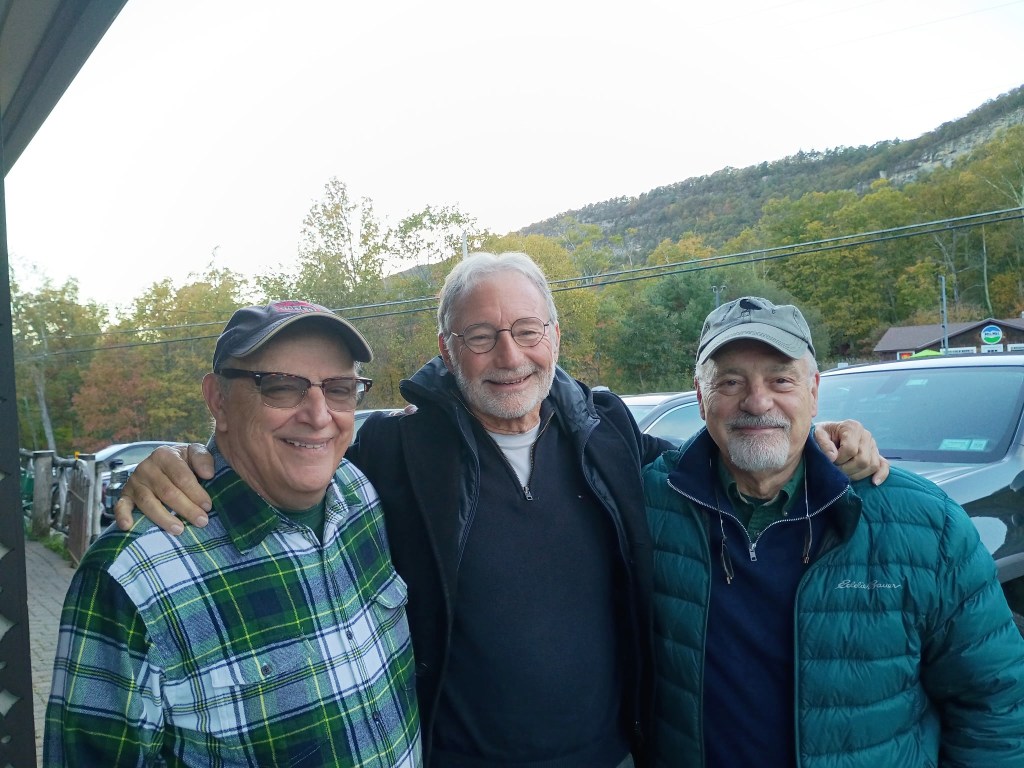


 Three Old Guys Walked Into A Bar