The Art of Perception

The Art of Perception

”Where you sit determines what you see”. I was reminded of this nostrum during dinner with friends in mid-December of last year. I had presented Marc and Deleah with a Christmas ornament that I made – a hollowed and dyed maple ball with a wooden final.

Marc said ‘What is this?’

“A Christmas ornament”, I replied – “or just an ornament if you don’t celebrate Christmas”.

“No, it isn’t,” he said.

Now Marc was not playing word games. He is a man with serious chops as an artist, professor, and businessman in the world of artistic enterprise… so, I listened. I believed that he was making the point that my labeling of the object presented limitations, both on the work – and maybe in life as well. He viewed the object as a mini-sculpture.
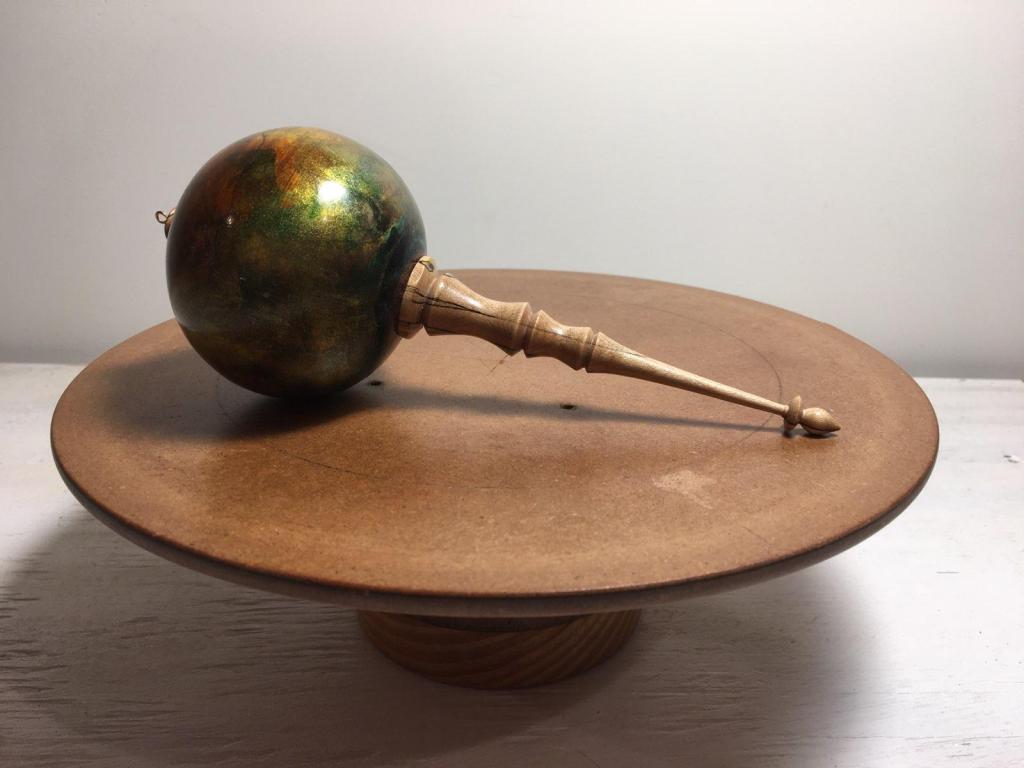
Photo by Marc B.

As a follow-up to our conversation, Marc sent me two items: a) a picture showing the ‘ornament/sculpture’ in a different presentation and b) a discussion of one of Rene Magritte’s paintings. The painting was “The Treachery of Images”, which presented an object (a pipe) with the painted words “Ceci n’est pas une pipe” – “This is not a pipe”. In this work, Magritte was declaring that the image of the ‘pipe’ was not an actual pipe, nor the drawing of the words themselves, actual words. He is challenging the audience to make a distinction between representational art and the object itself. His piece is a philosophical argument.

The philosopher Ludwig Wittgenstein followed a similar line of thought: he believed that the object that a word stands for does not convey the meaning of the word (or, I assume, its image). He is famous for the line “If a lion could talk, we would not understand it.” Bottomline, our language and communication of ideas is very much dependent on context and use, not simply pointing to an object while saying its label. Therefore, Magritte says his painting is not a pipe. (I think Freud would agree, even though he felt that ‘sometimes a cigar is just a cigar’).

There are lots of ways that context and/or use can be altered. It occurred to me that another method of underlining the difference between an object and its representation, is by varying the angle of view – or its scale. After all, art is essentially juxtaposition – allowing the viewer to see something in a different way. To that point, two sculptures highlight the same utilitarian object – a clothespin – in a vastly different context.
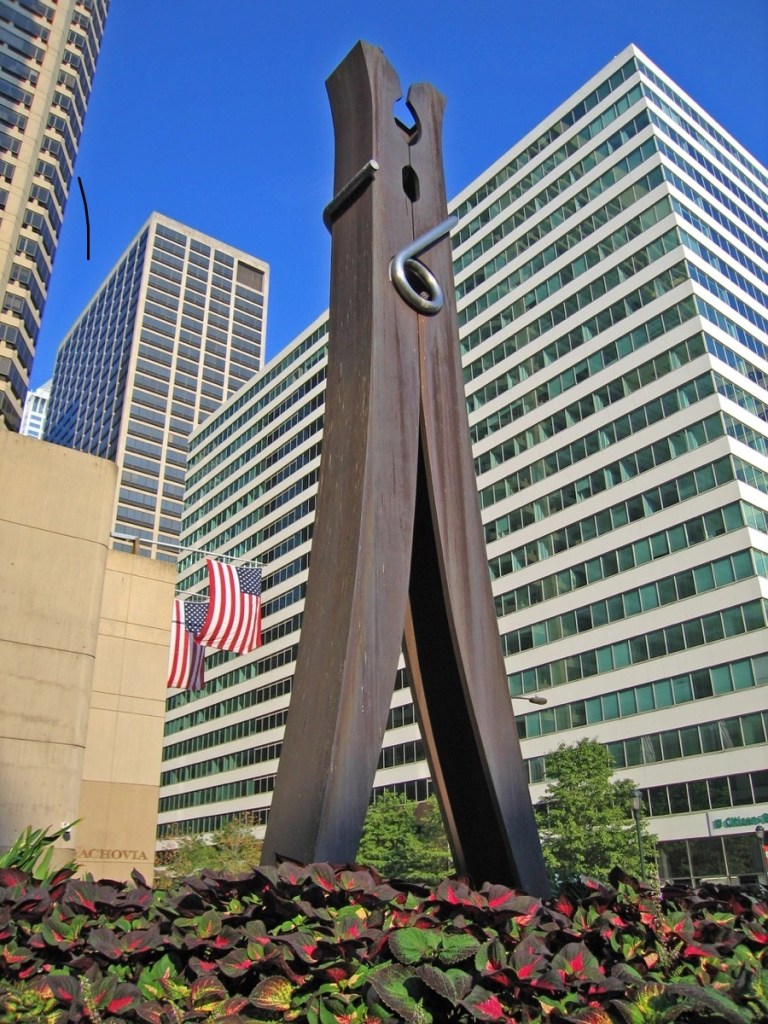
Claes Oldenberg’s Sculpture

Claes Oldenberg created his work in huge scale in urban Philadelphia – and it is certainly representational! It’s easy to see that this piece distinguishes itself in context from a run of the mill clothespin. Yet another take on the clothespin theme was completed by Mehmet Ali Uysal for a park in Belgium. Now this is also an installation of grand scale, yet I think we’d all agree it is more ‘clothespinny’, because it speculates a use in line with a conventional pincer. 

Mehmet Ali Uysal’s sculpture

So now we come full circle. Where you sit determines what you see. The labels we use are rooted in the context of our experience. Sometimes a simple challenge will cause you to change where you normally sit and realize a different field of view.

Note from an Impressionist
Perhaps because it was December when Wally presented his friend with his beautiful handmade gift, he assumed it would be perceived as a Christmas ornament.  In spite of Christmas carols playing on the radio, Wally’s intention to make it an ornament to decorate a tree was not enough to prevent his friend’s perception to wander.  Perhaps his friend was planning his summer vacation or planting his garden, Christmas just wasn’t on his mind. Because of the situation, location, time of year, what he had for breakfast, when he opened the gift his first impression was not that of a Christmas ornament.  I’m not sure of the shades of difference between impressions and perceptions, but first impressions are strong persuaders of how we react.  Impressions and perceptions can change over time.  Fortunately, time allows us to adjust first impressions based on additional information, change of mood, time of day and degree of hunger!

Having owned an antique store for a short time and having been an avid antique hunter for most of my life, I always looked for alternative purposes to the items I purchased.   What I perceived as an end table, with a little creative thought could be repurposed as a plant stand, an aquarium stand, a book shelf and whatever one’s creative mind perceived it as regardless of its original intended purpose.

Perception is a critical process we experience daily.  It is essential to life.  It deceives us, comforts us, endangers us, supports us, and the list goes on… We all perceive constantly.  When Wally approached the topic. my first impression was not about objects and how they are perceived but rather about people.  I am an impressionist!  First impressions are my life blood.  More often than not, that protects me from behavior I might regret while giving me time to adjust my impressions ’til I feel comfortable with my perception of the person.  I think most of us do that.  When I go to a new doctor that first impression dictates what I will share.  That reaction more than likely changes with subsequent visits.  What about that crazy driver in front of you who is driving at a snail’s pace?  I have two friends (who shall remain nameless) who perceive that person to be someone on the spectrum somewhere between common criminal and mass murderer (slight exaggeration here).  But perhaps over a beer or glass of wine could be fine company.

I guess my point is perception is everywhere- all the time- an essential life skill.  I wish I could quote some world-renowned expert in the field, but I mostly read fiction.  I trust my first impressions and adjust my perceptions as time passes and I get to know more about those people who impressed me!

The Power of Embracing Perspective

After reading Wal’s story about perception I was struck by his ability and willingness to be open to listening to his friend’s interpretation of the gift that was given.  Despite the fact (reality) that he intentionally crafted this wood-turned Christmas ornament, he was still able to accept that his friend perceived it differently.

I have often heard, and used the phrase, “perception is reality.”  However, as I spent more time thinking and reading about perception, I realized that perception is not reality.  In an article in Psychology Today, Jim Taylor, Ph.D. suggests that, by definition, perception (“The way of regarding, understanding, or interpreting something; a mental impression.”) and reality (“The world or the state of things as they actually exist… existence that is absolute, self-sufficient, or objective, and not subject to human decisions or conventions.”) are not the same.  However, because our perceptions come from a myriad of personal experiences and influences and since these are often strong enough to create a sense of certainty within us, it is may be more accurate to say, perception can (and often does) become an individual person’s reality.  My “reality” isn’t reality.  It’s just a construct of what I believe, based on everything I’ve assimilated over these many years as fact and right and good.

Therefore, when one’s beliefs are challenged, ignored, or replaced with another’s opposing thought, it is understandable for the common response to dig in, defend, and spend time creating a convincing argument to help the other see the “error of their ways” and counter with the value of one’s initial viewpoint.  It is my belief that we are seeing this kind of behavior more than ever before.  And, more than ever before, there appears to be less trust, less compromise, and fewer examples of collaboration and community.

But there are a few exceptions! Case in point, Wal who reminds us that despite the inarguable fact that he intentionally made an ornament, he was willing to listen to another’s immediate challenge to his label (his reality) and substitute it with a term/realty of his own.  And, in doing so and by asking questions, Wal was able to understand his friend’s point of view.  Furthermore, he seized the opportunity to think more about art, perspective, and philosophy.  I would venture to say that he likely enhanced his relationship with this friend, as I know few greater needs than the need for people to feel heard.

Wal closes his piece with words worth repeating:

“So now we come full circle. Where you sit determines what you see. The labels we use are rooted in the context of our experience. Sometimes a simple challenge will cause you to change where you normally sit and realize a different field of view.” If we could learn to practice what these simple, but powerful words suggest we might be open enough to realize a different field of view, which in turn might allow us to better understand each other.  If we understand each other better and feel heard, then perhaps…  (I’ll let you finish this piece with your own perspective.)

State of the Union

I have had to rewrite this several times because my purpose was not to push my political leanings but they somehow leaked out anyway.  In an effort to be more balanced I have attempted to compose my heightened feelings without my personal perceptions clogging or distracting from my ideas.  These last two years have been very difficult.  The isolation and the threat of disease has overshadowed our lives.  And, just as things seem to be easing up, a war starts. Hard to find a half full glass around now. I have been in a constant state of unhappiness if not depression for over 2 years, exacerbated by the loneliness and isolation demanded by a virus that spreads through social contact.-  the one thing that affords me enjoyment and purpose.  But there are signs of change and hope. A new administration that seemed to know how to handle not only the pandemic but also how to raise the civility and respect in a country suffering horribly from rudeness and lack of proper social behavior.  Yes, even I was feeling the weight lifting a little as restrictions eased and infection slowed.  I noticed a few more drops of water were added to that glass unexpectedly.  Things were looking up and hope was rising as the voracity of the disease was slowly ebbing.

And just as that ray of hope was entering our homes, the threat of war became more real as attacks on the Ukraine slowly began to tear apart the new found hope.  It was difficult to watch the destruction being committed on the civilians of Russia’s neighbors and see my glass being filled anymore. Yet, I held onto glimmers and was waiting to see what our next moves would be.  Our president was preparing for the State of the Union Address and I was anticipating it with less than exhilaration and more with same old same old blah blah blah platitudes and promises that usually don’t come to pass. The country is so divided that nothing is getting accomplished other than one side blaming the other.  The President is being accused of being senile due to his stuttering which occasionally makes his words a little difficult to understand.  I have known stutterers in my personal life and in my career and know that techniques they use to pronounce words sometimes elongates sounds or clips off words in an attempt to avoid the repetition associated with stuttering.  Stuttering itself in no way suggests feebleness or academic deficiency.  With all this running through my head, I sat down with a glass of wine and prepared to be less than awestruck.  I was sort of half listening and sipping my wine when I sensed the need to listen more closely, impressed by the manner in which he presented his intended information.  You could sense his integrity, and his empathy for a nation in pain. He was encouraging our nation to come together and addressed some of the issues that have separated us for the past 5 years.  His language was encouraging, comforting and yes, even hopeful.  He laid out what he wants to do for us average folk in America, things that everyone would benefit from.  Democrats and even Republicans were standing and applauding.  I hadn’t seen that recently, and for a few moments we were united in the common good for the United States.  My eyes teared up and suddenly I saw my glass filling up a little more with my tear drops, slowly perhaps but surely!  I was feeling good, I believed him, I trusted him, and I was reveling in the fact that the Republicans were not cat calling or booing but instead seemed to be in agreement with much of what he was proposing.  I heard shouted ridiculing of President Biden as he talked about his son’s cancer, but that didn’t bother me much because of the source.  That is sad and highly inappropriate.  I realized about 40 minutes into his address that not one discouraging word of ridicule or self promotion was articulated and that in itself was so refreshing because President Biden realizes his job is to promote what is good for us and it is not about him.  I smiled when he honored the little boy who was invited to attend the presentation and a few more drops were added to the glass.  

For a fifty or so minute presentation I felt good about us!  I felt we can work together and was thankful that he was the man in charge of dealing with the epidemic, a possible war and perhaps even pestilence as that seems to be the one thing missing in our experience so far.  I felt good……I felt positive……..I was energized and hopeful and am attempting to hold on to that positivity for as long as I can.

And then my glass tipped over a little and some spillage occurred as the days passed and the war intensified.  The images were horrifying. I watched bodies being thrown into unmarked graves just because the bodies had to be buried and families were separated all over the area.  I am in awe of the Ukrainian people and their commitment to protecting their land.  I am comforted by our reaction as well.  The world will be suffering consequences but the consequences of higher costs can’t compare to the terror these families have faced and continue to face.  Humanity has to return as a natural value of decent people.  More and more I think the world is rising to the challenge and is refusing to be bullied by a rogue nation that just wants MORE of everything for itself. That alone adds drops to my glass!  The faucet isn’t open yet but the degree of tragedy might just be enough to wake people up the dangers of dictatorships and bully authoritarians who want everything for themselves and their cronies and the rest of the people just don’t matter.  Mr Putin, WE DO!

*Ya Ye Ukrayinskyy

Fifty-nine years ago – almost two generations past — John F. Kennedy gave a monumental speech. It was during the depths of the cold war, at a time when the Soviet Union controlled the German Democratic Republic and built a wall to around East Berlin to prevent an exodus to West Berlin. In essence, West Berlin was a free island in the midst of a communist ocean. Addressing this situation, Kennedy proclaimed to an audience of 120,000 West Berliners:

“Two thousand years ago, the proudest boast was civis romanus sum [“I am a Roman citizen”]. Today, in the world of freedom, the proudest boast is “Ich bin ein Berliner!”… All free men, wherever they may live, are citizens of Berlin, and therefore, as a free man, I take pride in the words “Ich bin ein Berliner!”

The wall stood for 28 years – almost a generation.  It represented the prison mentality of a regime that detained its citizens, rather than winning their hearts and minds. In fact, the concrete and barbed wire barrier was officially named the “Anti-Fascist Protection Rampart” by the GDR: a wall to keep out the fascists. 

In 28 years, it is estimated that only 5,000 people managed to escape East Berlin past the ‘death strip’ and over the concrete wall patrolled by the GDR. One of the folks who managed to escape East Germany is a close family friend. It took him two attempts. On the second try, he made his way to South America; then Canada; and finally to the US. A man of irrepressible humor, he’s had an interesting life – including the accomplishment of recreating the Columbus voyage to the Americas in his 38 ft. sailboat. He was recruited by the New York Cosmos soccer team, but decided to ply his craft building circular wooden staircases.  You would be hard pressed to find a person who was more proud to be an American citizen. He is a ‘Berliner’ in the sense of the Kennedy speech.

It is of note that Vladimir Putin was in East Germany during the fall of the Berlin Wall – fluent in German and assigned as a KGB agent. As things came apart in the GDR, Putin was credited as saving the files of the Soviet Cultural Center in Dresden, which included KGB files. It has also been suggested, but not proved, that he liaised with the terrorist group, The Red Army Faction, during his assignment. 

One wonders how this early experience has affected his outlook and decision making. It certainly appears that the soviet siege paranoia hasn’t changed much in sixty years. The current Russian president seems willing to create a wall of rubble in Ukraine to act as another ‘Anti-Fascist Protection Rampart’. 

Ukraine is one of the poorest nations in Europe, yet it has battled mightily to maintain its sovereignty in the face of overwhelming blunt force. Their bravery and steadfast loyalty is rightly celebrated. Perhaps we have not yet missed an opportunity to update the sentiment of ‘Ich bin ein Berliner’ with ‘Ya Ye Ukrayinskyy’ – I Am a Ukrainian. 

*With apologies for the phonic spelling!

On Hope

I appreciate George’s offer of hope in his most recent post.  His words convey the struggle he faces as he parses through the highs and lows of pandemic, war, extreme weather, disconnection and more.  And yet, despite how overwhelming the daily bombardment of discouraging news is, finding hope in and between the stories, keeps us going.

Oxford Languages defines hope as, “a feeling of expectation and desire for a certain thing to happen.”  George goes beyond the wishing stage and helps us see, through his eyes, where we can see evidence of hope.  He provides a path for us to steer through these tumultuous times by modeling a way through to address feelings of helplessness, sadness, and hopelessness.  

Hope speaks to the future, to what is optimistically, yet to be.  It doesn’t look back or flounder in the past.  Yes, it draws on our earlier experiences and what we learned from them.  But it then allows us to take that knowledge and wisdom and see what is in front of us from a broader perspective.  It allows us to see how people and countries have recovered after horrific events and came back better and even stronger as a result of their struggles.  I suspect we must look past the short term and hope the longer view will see the pendulum swing back toward more peace and calm and health and unity.  In the interim, how we face the present will determine how prepared we’ll be to recognize the telltale signs of change for the better.

Today I donated to the children of Ukraine.  Earlier this week I spoke with friends and family about various ways we could help and how we could maintain an awareness of the plight of those suffering the effects of war beyond the time spent watching and listening to the news.  And while it doesn’t help those in need that I remind myself to be thankful for all that I have and often take for granted, it does prompt me to feel gratitude and give greater value to how I spend my time each day.  I’m hopeful that more and more, people all over the world will make time to do what they can to make life more harmonic despite the challenges thrust upon us.

Sending warm hugs to all! 

Slowing Down

When I wore a younger man’s clothes I noticed that older people slowed down.  As I reflect on that presumption it appears I was correct, but more often, for the wrong reason. 

Gray-haired folk drove more slowly, walked more slowly, spoke more slowly, did fewer things, and made decisions more slowly.  At the time, I believed it was for obvious reasons.  Essentially, they couldn’t move or act more quickly because well, they were old!  Their bodies and brains were no longer capable of executing physical actions and mental calculations at the rate of a younger person and they were lazy and lacked the energy to chase each and every adventure and challenge set before them.   I further reckoned that those who were the exceptions put in more effort to offset these limitations.  Of course, I promised, I would be one of the few who would “keep up the pace” despite my years.

However, today I doth protest the notion that slowing down is primarily a function of physical and cognitive decline.  I surmise that it is more often a purposeful result of recognizing the benefits of measured steps and reasoned choices and the oft-ignored limitations of filling every moment and doing so with speed!  Now, at the ripe young age of 75 you might be suspicious that I’m simply conjuring up some defensive rationalization that justifies my shift from rabbit speed to turtle pace…and perhaps there may be a part of me that began this thinking process to keep others from judging me now as I once judged those like me, years ago.  But I do believe that my story holds merit and thus, I’m sticking to it.

In an article entitled, “The Art of Slowing Down” by Karen Horneffer-Ginter, a psychologist and co-founder for the Center for Psychotherapy and Wellness, the author talks about her realization of the price of the everyday hurried life when she was granted a sabbatical and felt a dramatic shift in her pace and how it impacted her.  She mentioned the reaction of patients who, coming to see her for reasons of feeling overwhelmed by the fast pace of life, felt a huge sense of calm and release when they sit down on her sofa simply because they were given the chance to slow down and be present.  

The author’s commentary triggered two of my own experiences that were eye opening for me.  The first was when I was in the middle of my career as a school principal and trying to be as perfect as possible as I attempted to balance work and family.  And while I loved the energy I got from my work and relationships, I was shocked when I found myself in the dentist’s chair for some extensive work feeling an overwhelming sense of mental and emotional calm.  In the dentist chair!  With painful work going on in my mouth!  Afterwards, I realized that I was unable to deliberately allow myself any “time off” from thinking about work, etc. unless someone else (the dentist) forced me into a much-needed distraction.  (Interestingly, this also happened to one of my hard-working friends who shared a very similar dentist story.)

The second experience was at the end of my career.  Shortly after retirement, I came in contact with a group of my former staff members.  One of them asked what I found most different in my life now that I was not working full-time.  (I was then working as a consultant only when and with whom I wanted.)  What came to mind was that the previous day, a light bulb had gone out in one of the rooms of my house and I stopped what I was doing and changed it.  I told her that I now made time to change a light bulb when it went out, and didn’t need to plan it (or similar daily happenings) for some future time when I could squeeze it in to my impossibly hurried schedule.   I had just started learning about letting go of getting everything done that appeared before me and I could chose what and when I wanted to do it.  Yes, it is easier when working part time.  But I wonder if I had begun to deliberately slow down in the middle years, how it would have impacted my life.

As I continue to “slow down” I realize that doing so gives me more time to enjoy my active but less complicated life more fully and with less stress.  After all, I am one of the three “Old Guys” who made the time to write this post and who looks forward to Zooming time with my two seasoned colleagues as we nurture ideas of what has been and what may yet be.

Time Stamp

What is nice about sharing a blog with two other friends is that we have an opportunity to discuss different points of view – or the same point of view in different ways.  I usually look to Hen for an aspirational and analytic viewpoint and to George for connecting on a heart-to-heart basis. In this case, I subscribe to the thoughtfulness of both my friends regarding the need to slow down and sort through what is important and to ‘level’ our reactions to life’s issues by applying some mellow consideration.

My head supports this; my spirit is objecting. Perhaps you’ve seen the TV commercial where Ewan McGregor asks the question, that at the end of our lives, will we regret the things we didn’t buy, or rather the places we didn’t visit? While the commercial is sponsored by the travel industry, it is just as meaningful by substituting the “experiences we did not have”. In other words, when should we slow down our explorations?

Lately, I feel the urgency of the moment. So little time, so much to do. A good deal of the problem centers with the catch-up needed to settle affairs that have lain fallow for too long: such as house renovations and estate planning. A second set of tasks revolves around pledges of assistance given to family, friends, and organizations that need to be upheld. A third area of attention is personal physical and mental maintenance: sustaining the ability to function effectively. I view all of these as necessary responsibilities – time-consuming responsibilities all of us share… and responsibilities that should not be reneged.

But there is also a fourth imperative: exploring new ideas and experiences. No matter how old one becomes, no matter our increasing physical limitations, our spirits are built to grow. Whether you call it self-actualizing or being in the flow, there is no better feeling than following a calling. In my case, it is a strong need to be creative and to collaborate with my partner in that enterprise. The realization that each of us has an expiration date adds to the urgency.

Perhaps folks will disagree with my opinion: which is that responsibilities take precedence over exploration. The piper must be paid. But responsibilities get in the way of exploration. So, my spirit rebels – there simply is no time to slow down! 

Speed Dreaming

“Slow down you’re moving’ too fast” the song lyrics go! If you have to make the morning last the best way is to seal it away in your memory cause slowing down won’t do any good. I used to rush through everything I did. When I was young, you know early 60’s, if I was out walking in the winter and came upon a patch of black ice, I would accelerate my pace and slide across the ice!  That’s just how it was.  Stupid?  Sure but I never thought of that until finally in my 70’s I began getting daily notifications that perhaps things like that weren’t in my best interest.   Ice is slippery, your bones are more brittle,  you do the math!  After a couple of defiant experiences where I lost, it dawned on me… yeah-  slow down, you’re moving too fast!

That festered, and I constantly tried to dismiss the concept but the reminders were becoming too frequent and too medically damaging!  Several visits to ER’s for accidents, falls and stupid mishaps occurred.  Ok, I’m intelligent- what are these experiences trying to tell me?  Slowdown!  I kept rejecting that til I synonymized the concept and referred to my need as mellowing. Yeah, that’s it, I needed to mellow .  

Hmmm, how are they connected. My body didn’t know how to slow down.  Sure, body parts hurt when I moved the way I used to, but it is what it is!  Slowly, over time I began to realize that movement can pause until thoughtful arguments are resolved within my mind.  Hence… mellowing.  Example-  Oh look, black ice-  let me slide over it!  Mind- You jerk, fall on that now, break a hip, or a foot, or an arm. OR, carefully navigate your path across that ice and get to your destination without any distress!  Mellow…. Use your thought process to help you survive old age! 

Mellowing not only works for physicality! It also helps with judgment calls and decision making.  I used to make decisions by running at them and sliding over the ice to a decision.  Now with conscious mellowization, decisions and judgments occur, yes it is true, more slowly but less dangerously and with more support documentation behind them.  If I meet a person who kind of annoys me, I run it through my brain.  Why does this guy annoy me?  Yeah, he says crazy stuff that opposes everything I stand for… he can’t string words together into a sentence but I can understand what he is trying to say, which I really don’t agree with, but he just gave that homeless guy on the street $10 so obviously he has some humanity.  Maybe we share other things in common.  Definitely mellowing!

I still speed dream however, and that is ok cause I wake up with no broken bones and not in jail!